Unit 8: Fluids第 8 单元:流体
Density and pressure, how pressure grows with depth, Pascal's principle and hydraulic lifts, buoyancy and Archimedes' principle, and moving fluids: the continuity equation, Bernoulli's equation and Torricelli's result.密度与压强、压强随深度的变化、帕斯卡原理与液压机、浮力与阿基米德原理,以及流动的流体:连续性方程(continuity equation)、伯努利方程(Bernoulli's equation)与托里拆利(Torricelli)结论。
Density and Pressure密度与压强
- Calculate the density of an object or fluid from $\rho = m/V$, and convert between g/cm³ and kg/m³.
- Calculate the pressure exerted by a force spread over an area from $P = F_\perp/A$, in pascals.
- Explain why pressure is a scalar and why the force it produces always acts perpendicular to a surface.
- Distinguish absolute pressure from gauge pressure and convert between them using $P_\text{gauge} = P - P_\text{atm}$.
- Compare the pressures produced by the same force on different contact areas.
- 由 $\rho = m/V$ 计算(
calculate)物体或流体的密度,并在 g/cm³ 与 kg/m³ 之间换算。 - 由 $P = F_\perp/A$ 计算(
calculate)力分布在一定面积上产生的压强,单位为帕斯卡(pascal)。 - 解释(
explain)为什么压强是标量,以及为什么它产生的力总是垂直于表面。 - 区分(
distinguish)绝对压强与表压(gauge pressure),并用 $P_\text{gauge} = P - P_\text{atm}$ 互相换算。 - 比较(
compare)同一个力作用在不同接触面积上产生的压强。
Solids, Liquids and Gases: The Particle Picture固体、液体与气体:粒子图像
Every substance is made of atoms or molecules that attract and repel one another. The three common phases differ in how close the particles sit and how strongly they interact. In a solid the particles are packed closely and held in fixed positions by strong interactions, so a solid is rigid: it keeps its shape and does not flow.
任何物质都由相互吸引、排斥的原子或分子构成。三种常见物态的区别在于粒子靠得多近、相互作用多强。固体(solid)中粒子排列紧密,被很强的相互作用固定在各自位置上,所以固体有刚性:保持形状、不能流动。
In a liquid the particles are still almost touching, so a liquid is hard to compress, but they can slide past one another, so a liquid flows and takes the shape of its container.
液体(liquid)中粒子仍几乎相互接触,所以液体很难压缩,但粒子可以相互滑过,所以液体能流动并呈容器的形状。
In a gas the particles are far apart compared with their size and interact only weakly except in brief collisions, so a gas flows, fills its whole container and is easily compressed. Liquids and gases are the fluids.
气体(gas)中粒子间距远大于粒子本身的尺寸,除了短暂的碰撞外相互作用很弱,所以气体能流动、充满整个容器,而且容易压缩。液体和气体统称流体。
Real fluids are complicated, so we usually work with the ideal fluid model, a simplification that treats the fluid as incompressible (constant density) and ignores the internal friction between its layers. Liquids come close to this model; gases do so only when their density changes little, as in slow air flow.
真实流体很复杂,所以我们通常使用理想流体(ideal fluid)模型:这是一种简化,把流体看作不可压缩(密度不变),并忽略各层之间的内摩擦。液体很接近这个模型;气体只有在密度变化很小时才接近,例如缓慢的空气流动。
Density密度
A fluid is any substance that flows: liquids and gases. Because a fluid has no fixed shape, we describe it by quantities per unit volume rather than by its total mass. The first of these is density, the mass per unit volume. Its SI unit is kg/m³.
流体(fluid)是任何能流动的物质:液体和气体。流体没有固定形状,所以我们用"单位体积的量"而不是总质量来描述它。第一个这样的量是密度(density),即单位体积的质量,国际单位为 kg/m³。
Fresh water has a density of about $1000\;\text{kg/m}^3$ (that is, $1.00\;\text{g/cm}^3$), seawater about $1025\;\text{kg/m}^3$, and air at sea level only about $1.2\;\text{kg/m}^3$.
淡水的密度约为 $1000\;\text{kg/m}^3$(即 $1.00\;\text{g/cm}^3$),海水约为 $1025\;\text{kg/m}^3$,而海平面附近的空气只有约 $1.2\;\text{kg/m}^3$。
Density is a property of the material, not of the sample: cutting a block of aluminum in half halves both $m$ and $V$, so $\rho$ is unchanged. To convert, use $1\;\text{g/cm}^3 = 1000\;\text{kg/m}^3$, because $1\;\text{g} = 10^{-3}\;\text{kg}$ and $1\;\text{cm}^3 = 10^{-6}\;\text{m}^3$.
密度是材料的性质,而不是某一块样品的性质:把一块铝切成两半,$m$ 和 $V$ 都减半,$\rho$ 不变。换算时用 $1\;\text{g/cm}^3 = 1000\;\text{kg/m}^3$,因为 $1\;\text{g} = 10^{-3}\;\text{kg}$,$1\;\text{cm}^3 = 10^{-6}\;\text{m}^3$。
Pressure压强
Pressure is the magnitude of the perpendicular force per unit area. Its SI unit is the pascal: $1\;\text{Pa} = 1\;\text{N/m}^2$. The same force produces a large pressure on a small area and a small pressure on a large area, which is why a knife edge cuts and snowshoes do not sink.
压强(pressure)是单位面积上垂直作用力的大小,国际单位为帕斯卡:$1\;\text{Pa} = 1\;\text{N/m}^2$。同一个力作用在小面积上压强大、作用在大面积上压强小,这就是刀刃能切东西而雪鞋不会陷下去的原因。
Inside a fluid at rest, pressure at a point is the same in every direction, so pressure is a scalar: it has no direction of its own.
在静止流体内部,某一点的压强在各个方向上都相同,所以压强是标量(scalar):它本身没有方向。
The force that a fluid exerts on any surface it touches, however, is a vector, and it always points perpendicular to that surface, pushing on it. That is why water pushes sideways on the wall of a pool and upward on the bottom of a boat.
但流体对它接触的任何表面施加的力是矢量,而且总是垂直于该表面、推向该表面。这就是水会侧向推泳池的池壁、向上推船底的原因。
Where Pressure Comes From: Particle Collisions压强从何而来:粒子碰撞
Pressure is the large-scale result of countless tiny collisions. When a fluid particle of mass $m$ strikes a wall and bounces back, the wall must change the particle's momentum, so by Newton's third law the particle pushes on the wall. For a head-on elastic bounce at perpendicular speed $v$, the particle's momentum changes by $2mv$.
压强是无数微小碰撞在宏观上的结果。质量为 $m$ 的流体粒子撞到器壁并弹回时,器壁必须改变粒子的动量,所以根据牛顿第三定律,粒子对器壁施加推力。垂直速率为 $v$ 的粒子正面弹性反弹时,动量变化为 $2mv$。
One collision is far too small to notice, but a fluid has an enormous number of particles, so the wall receives a huge number of collisions every second. Their average effect is a steady force $F$ = (collisions per second) $\times$ (momentum change per collision), and that force divided by the area struck is the pressure.
单次碰撞小到无法察觉,但流体中粒子数量极多,所以器壁每秒受到巨量碰撞。它们的平均效果是一个稳定的力 $F$ =(每秒碰撞次数)$\times$(每次碰撞的动量变化),这个力除以受撞面积就是压强。
Pressure rises when the collisions are more frequent (a denser or more crowded fluid) or more forceful (faster particles).
碰撞更频繁(流体更稠密或更拥挤)或更有力(粒子速率更大)时,压强更大。
Absolute and Gauge Pressure绝对压强与表压
The air above us presses on everything with atmospheric pressure, $P_\text{atm} \approx 1.01 \times 10^5\;\text{Pa}$ at sea level. The absolute pressure $P$ is the total pressure measured from a perfect vacuum. Most gauges (a tire gauge, a blood-pressure cuff) read only the amount above atmospheric pressure, called the gauge pressure.
我们头顶的空气以大气压强压在一切物体上,海平面处 $P_\text{atm} \approx 1.01 \times 10^5\;\text{Pa}$。绝对压强(absolute pressure)$P$ 是从理想真空算起的总压强。大多数压力表(轮胎气压表、血压计)只读出高于大气压的部分,称为表压(gauge pressure)。
absolute)或"表压"(gauge)字样,并在一次计算中始终使用同一种压强。
Worked Example: Density of a Metal Block例题:金属块的密度
A rectangular metal block measures $10.0\;\text{cm} \times 5.0\;\text{cm} \times 2.0\;\text{cm}$ and has a mass of $0.270\;\text{kg}$. Find its density in kg/m³ and decide whether it sinks in water.
一块长方体金属块的尺寸为 $10.0\;\text{cm} \times 5.0\;\text{cm} \times 2.0\;\text{cm}$,质量为 $0.270\;\text{kg}$。求它的密度(单位 kg/m³),并判断它在水中是否下沉。
Worked Example: Flat Shoes versus a Stiletto Heel例题:平底鞋与细高跟
A $60\;\text{kg}$ person stands on two flat shoes with a total contact area of $0.030\;\text{m}^2$. Later the same person balances all of their weight on one stiletto heel of area $1.0\;\text{cm}^2$. Find the pressure on the floor in each case. Use $g = 9.8\;\text{m/s}^2$.
一个 $60\;\text{kg}$ 的人穿平底鞋站立,两只鞋与地面的总接触面积为 $0.030\;\text{m}^2$。之后这个人把全部体重压在一只面积为 $1.0\;\text{cm}^2$ 的细高跟上。分别求两种情况下对地面的压强。取 $g = 9.8\;\text{m/s}^2$。
Convert to SI before substituting: $1\;\text{cm}^2 = 10^{-4}\;\text{m}^2$, $1\;\text{cm}^3 = 10^{-6}\;\text{m}^3$ and $1\;\text{g/cm}^3 = 1000\;\text{kg/m}^3$. In $P = F_\perp/A$ the force is the component perpendicular to the surface, and for an object resting on a level floor it is the weight $mg$, not the mass. When a question gives or asks for a pressure, check whether it means absolute or gauge pressure before you add or drop $P_\text{atm}$.
代入数值前先换算成国际单位:$1\;\text{cm}^2 = 10^{-4}\;\text{m}^2$,$1\;\text{cm}^3 = 10^{-6}\;\text{m}^3$,$1\;\text{g/cm}^3 = 1000\;\text{kg/m}^3$。$P = F_\perp/A$ 中的力是垂直于表面的分量;对静置在水平地面上的物体,它是重力 $mg$,而不是质量。题目给出或要求压强时,先确认是绝对压强还是表压,再决定是否加上或去掉 $P_\text{atm}$。
A $50.0\;\text{cm}^3$ sample of a liquid has a mass of $40.0\;\text{g}$. Find its density in g/cm³ and in kg/m³.一份 $50.0\;\text{cm}^3$ 的液体样品质量为 $40.0\;\text{g}$。分别以 g/cm³ 和 kg/m³ 为单位求它的密度。
$\rho = 40.0/50.0 = 0.800\;\text{g/cm}^3$. Multiplying by 1000 gives $800\;\text{kg/m}^3$. The liquid is less dense than water, so it would float on water if the two do not mix.
$\rho = 40.0/50.0 = 0.800\;\text{g/cm}^3$。乘以 1000 得 $800\;\text{kg/m}^3$。这种液体密度小于水,如果两者不混溶,它会浮在水面上。
A tire gauge reads $2.0 \times 10^5\;\text{Pa}$. What is the absolute pressure of the air in the tire? Take $P_\text{atm} = 1.01 \times 10^5\;\text{Pa}$.轮胎气压表读数为 $2.0 \times 10^5\;\text{Pa}$。胎内空气的绝对压强是多少?取 $P_\text{atm} = 1.01 \times 10^5\;\text{Pa}$。
The gauge reads pressure above atmospheric, so $P = P_\text{gauge} + P_\text{atm} = 2.0 \times 10^5 + 1.01 \times 10^5 = 3.01 \times 10^5 \approx 3.0 \times 10^5\;\text{Pa}$.
压力表读出的是高于大气压的部分,所以 $P = P_\text{gauge} + P_\text{atm} = 2.0 \times 10^5 + 1.01 \times 10^5 = 3.01 \times 10^5 \approx 3.0 \times 10^5\;\text{Pa}$。
You push a thumbtack into a board with a force of $20\;\text{N}$. The head has an area of $1.0\;\text{cm}^2$ and the point an area of $1.0 \times 10^{-8}\;\text{m}^2$. Find the pressure on your thumb and on the wood, and explain why the tack goes in.你用 $20\;\text{N}$ 的力把图钉按进木板。钉帽面积为 $1.0\;\text{cm}^2$,钉尖面积为 $1.0 \times 10^{-8}\;\text{m}^2$。求拇指和木板受到的压强,并解释图钉为什么能按进去。
On the thumb: $P = 20/(1.0 \times 10^{-4}) = 2.0 \times 10^5\;\text{Pa}$. On the wood: $P = 20/(1.0 \times 10^{-8}) = 2.0 \times 10^9\;\text{Pa}$. The tack is light and at rest, so the force at both ends is the same $20\;\text{N}$, but the tiny point area makes the pressure on the wood ten thousand times larger, enough to push the wood fibres apart.
拇指受到:$P = 20/(1.0 \times 10^{-4}) = 2.0 \times 10^5\;\text{Pa}$。木板受到:$P = 20/(1.0 \times 10^{-8}) = 2.0 \times 10^9\;\text{Pa}$。图钉很轻且处于静止,两端的力都是 $20\;\text{N}$,但钉尖面积极小,使木板受到的压强大了一万倍,足以挤开木纤维。
Classify each as a solid, liquid or gas, using particle spacing and interactions: (a) keeps its shape and volume and does not flow; (b) flows and is almost incompressible; (c) flows and is easily compressed.根据粒子间距和相互作用,判断下列各项对应固体、液体还是气体:(a) 保持形状和体积、不能流动;(b) 能流动、几乎不可压缩;(c) 能流动、容易压缩。
(a) Solid: particles are close and held in fixed positions by strong interactions, so it is rigid. (b) Liquid: particles are close, so it resists compression, but they slide past each other, so it flows. (c) Gas: particles are far apart and interact weakly, so it flows and can be compressed a lot.
(a) 固体:粒子靠得近,被很强的相互作用固定在各自位置,所以有刚性。(b) 液体:粒子靠得近,所以抗压缩,但粒子能相互滑过,所以能流动。(c) 气体:粒子相距远、相互作用弱,所以能流动,而且可以被大幅压缩。
Gas particles of mass $5.0 \times 10^{-26}\;\text{kg}$ hit a wall head-on and rebound elastically at a perpendicular speed of $400\;\text{m/s}$. How many collisions per second give a force of $0.20\;\text{N}$ on a patch of area $2.0 \times 10^{-4}\;\text{m}^2$, and what is the pressure?质量为 $5.0 \times 10^{-26}\;\text{kg}$ 的气体粒子以 $400\;\text{m/s}$ 的垂直速率正面撞向器壁并弹性反弹。面积为 $2.0 \times 10^{-4}\;\text{m}^2$ 的一小块器壁受到 $0.20\;\text{N}$ 的力,每秒需要多少次碰撞?压强是多少?
Momentum change per collision: $2mv = 2(5.0 \times 10^{-26})(400) = 4.0 \times 10^{-23}\;\text{kg m/s}$. Collisions per second: $0.20/(4.0 \times 10^{-23}) = 5.0 \times 10^{21}$. Pressure: $P = F/A = 0.20/(2.0 \times 10^{-4}) = 1.0 \times 10^3\;\text{Pa}$. Many tiny impulses add up to a steady force.
每次碰撞的动量变化:$2mv = 2(5.0 \times 10^{-26})(400) = 4.0 \times 10^{-23}\;\text{kg m/s}$。每秒碰撞次数:$0.20/(4.0 \times 10^{-23}) = 5.0 \times 10^{21}$。压强:$P = F/A = 0.20/(2.0 \times 10^{-4}) = 1.0 \times 10^3\;\text{Pa}$。许多微小的冲量叠加成一个稳定的力。
Hydrostatic Pressure and Pascal's Principle静水压强与帕斯卡原理
- Derive $P = P_0 + \rho g h$ from the forces on a column of fluid in equilibrium.
- Calculate the absolute and gauge pressure at a given depth in a liquid.
- Explain why pressure at a given depth does not depend on the shape of the container.
- Sketch and interpret a graph of pressure against depth, identifying the slope as $\rho g$ and the intercept as $P_0$.
- State Pascal's principle and apply it to a hydraulic lift, calculating the force on each piston and the distance each moves.
- 由一段处于平衡的流体柱的受力推导(
derive)$P = P_0 + \rho g h$。 - 计算(
calculate)液体中某一深度处的绝对压强与表压。 - 解释(
explain)为什么某一深度处的压强与容器形状无关。 - 画出(
sketch)并解读压强随深度变化的图像,指出斜率为 $\rho g$、截距为 $P_0$。 - 陈述(
state)帕斯卡原理并应用于液压机,计算每个活塞上的力和移动的距离。
Pressure Increases with Depth压强随深度增加
Picture a vertical column of liquid of cross-sectional area $A$ and height $h$, with its top at the surface, where the pressure is $P_0$. The column is at rest, so the forces on it balance.
设想一段截面积为 $A$、高为 $h$ 的竖直液柱,它的顶面在液面处,那里的压强为 $P_0$。液柱静止,所以受力平衡。
Downward: the push $P_0 A$ on its top and its weight $mg = \rho (Ah) g$. Upward: the push $PA$ from the liquid below its bottom. Setting $PA = P_0 A + \rho A h g$ and dividing by $A$ gives the hydrostatic pressure equation.
向下:顶面受到的推力 $P_0 A$ 和液柱的重力 $mg = \rho (Ah) g$。向上:下方液体对底面的推力 $PA$。令 $PA = P_0 A + \rho A h g$,两边除以 $A$,就得到静水压强(hydrostatic pressure)公式。
Here $\rho$ is the density of the liquid, $h$ is the vertical depth below the surface, and $P_0$ is the pressure at the surface (for an open container, $P_0 = P_\text{atm}$).
其中 $\rho$ 是液体的密度,$h$ 是液面以下的竖直深度,$P_0$ 是液面处的压强(敞口容器中 $P_0 = P_\text{atm}$)。
The term $\rho g h$ on its own is the gauge pressure at depth $h$. Because the liquid is treated as incompressible, $\rho$ is the same at every depth and $P$ rises linearly with $h$: a straight line of slope $\rho g$, as Figure 8.1 shows.
单独一项 $\rho g h$ 就是深度 $h$ 处的表压。由于液体被视为不可压缩,各深度处 $\rho$ 相同,$P$ 随 $h$ 线性增大:一条斜率为 $\rho g$ 的直线,如图 8.1 所示。
Worked Example: Pressure on a Diver例题:潜水员受到的压强
A diver swims $15\;\text{m}$ below the surface of the sea ($\rho = 1025\;\text{kg/m}^3$). Find the gauge pressure and the absolute pressure on the diver. Take $P_\text{atm} = 1.01 \times 10^5\;\text{Pa}$ and $g = 9.8\;\text{m/s}^2$.
一名潜水员在海面以下 $15\;\text{m}$ 处游动(海水 $\rho = 1025\;\text{kg/m}^3$)。求潜水员受到的表压和绝对压强。取 $P_\text{atm} = 1.01 \times 10^5\;\text{Pa}$,$g = 9.8\;\text{m/s}^2$。
First Principles: Why Pressure Grows Linearly with Depth第一性原理:压强为何随深度线性增大
Principle. Newton's first law for a thin horizontal slab of fluid at rest: the forces on it add to zero. Take a slab of area $A$ and thickness $\Delta h$, with its top at depth $h$.
原理。对一薄层静止的水平流体应用牛顿第一定律:它受到的合力为零。取面积为 $A$、厚度为 $\Delta h$ 的薄层,其顶面位于深度 $h$ 处。
- Vertical forces: $P(h+\Delta h)\,A$ up on the bottom, $P(h)\,A$ down on the top, and the weight $\rho A\,\Delta h\,g$ down.
- Balance and divide by $A$: $P(h+\Delta h) - P(h) = \rho g\,\Delta h$. Each extra metre of depth adds the same $\rho g$.
- With $\rho$ constant (incompressible), stack the slabs from the surface down to depth $h$: $P = P_0 + \rho g h$.
- 竖直方向的力:底面受向上的 $P(h+\Delta h)\,A$,顶面受向下的 $P(h)\,A$,以及向下的重力 $\rho A\,\Delta h\,g$。
- 令其平衡并除以 $A$:$P(h+\Delta h) - P(h) = \rho g\,\Delta h$。每多一米深度,压强增加同样的 $\rho g$。
- $\rho$ 为常数(不可压缩)时,把从液面到深度 $h$ 的薄层逐层叠加:$P = P_0 + \rho g h$。
Limiting-case check. At $h = 0$ the formula returns $P_0$. For air, $\rho g \approx 12\;\text{Pa}$ per metre against $9800\;\text{Pa}$ per metre for water, so the pressure in a gas tank is uniform to about $0.1\%$ over $10\;\text{m}$. Units: $\mathrm{kg/m^3\cdot m/s^2\cdot m} = \mathrm{N/m^2} = \mathrm{Pa}$.
极限检验。$h = 0$ 时公式给出 $P_0$。空气的 $\rho g \approx 12\;\text{Pa}$ 每米,而水为 $9800\;\text{Pa}$ 每米,所以在 $10\;\text{m}$ 范围内储气罐中的压强均匀到约 $0.1\%$。单位:$\mathrm{kg/m^3\cdot m/s^2\cdot m} = \mathrm{N/m^2} = \mathrm{Pa}$。
Blaise Pascal is said to have fitted a tall, thin tube into the lid of a sealed barrel full of water, then filled the tube from a balcony. A small amount of water in the tube burst the barrel.
据说布莱兹·帕斯卡在一个装满水的密封木桶盖上插入一根又高又细的管子,然后从阳台往管里灌水。管中少量的水就把木桶撑裂了。
Pressure depends on depth, not on how much water sits above. A $10\;\text{m}$ column of $1.0\;\text{cm}$ tube holds only about $0.79\;\text{kg}$ of water, yet it adds $\rho g h = 9.8\times10^4\;\text{Pa}$, a push of about $2.0\times10^4\;\text{N}$ on a $0.20\;\text{m}^2$ lid.
压强取决于深度,而不取决于上方有多少水。一根内径 $1.0\;\text{cm}$、高 $10\;\text{m}$ 的水柱只有约 $0.79\;\text{kg}$ 的水,却使压强增加 $\rho g h = 9.8\times10^4\;\text{Pa}$,对 $0.20\;\text{m}^2$ 的桶盖产生约 $2.0\times10^4\;\text{N}$ 的推力。
Wikipedia: Pascal's barrel (the hydrostatic paradox)维基百科:帕斯卡裂桶实验(静水压强佯谬)
Pascal's Principle and the Hydraulic Lift帕斯卡原理与液压机
Pascal's principle: a change in pressure applied to an enclosed, incompressible fluid is transmitted undiminished to every part of the fluid and to the walls of its container. This follows from $P = P_0 + \rho g h$: if $P_0$ rises by $\Delta P$, the pressure at every depth rises by the same $\Delta P$.
帕斯卡原理(Pascal's principle):施加在封闭的不可压缩流体上的压强变化,会大小不变地传递到流体的每一部分以及容器壁上。这可以由 $P = P_0 + \rho g h$ 得出:如果 $P_0$ 增加 $\Delta P$,每个深度处的压强都增加同样的 $\Delta P$。
A hydraulic lift uses this. A small force $F_1$ on a small piston of area $A_1$ raises the pressure by $F_1/A_1$; the same pressure acts on a large piston of area $A_2$ at the same level, which pushes up with $F_2 = (F_1/A_1)A_2$.
液压机(hydraulic lift)就利用了这一原理。在面积为 $A_1$ 的小活塞上施加一个小力 $F_1$,压强增加 $F_1/A_1$;同样的压强作用在同一高度、面积为 $A_2$ 的大活塞上,产生向上的力 $F_2 = (F_1/A_1)A_2$。
The force is multiplied by $A_2/A_1$. Energy is not: the liquid volume pushed out of the small cylinder, $A_1 d_1$, equals the volume pushed into the large one, $A_2 d_2$, so the small piston must move much farther, and $F_1 d_1 = F_2 d_2$.
力被放大了 $A_2/A_1$ 倍。但能量没有被放大:从小缸压出的液体体积 $A_1 d_1$ 等于压入大缸的体积 $A_2 d_2$,所以小活塞要移动远得多的距离,且 $F_1 d_1 = F_2 d_2$。
Worked Example: Lifting a Car例题:举起一辆汽车
A hydraulic lift has a small piston of area $0.0050\;\text{m}^2$ and a large piston of area $0.25\;\text{m}^2$, at the same level. (a) What force on the small piston holds up a $1200\;\text{kg}$ car on the large piston? (b) How far must the small piston move to raise the car by $0.10\;\text{m}$? Ignore the masses of the pistons.
一台液压机的小活塞面积为 $0.0050\;\text{m}^2$,大活塞面积为 $0.25\;\text{m}^2$,两者在同一高度。(a) 在小活塞上施加多大的力,才能托住大活塞上一辆 $1200\;\text{kg}$ 的汽车?(b) 要把汽车升高 $0.10\;\text{m}$,小活塞要移动多远?忽略活塞质量。
In $P = P_0 + \rho g h$, $h$ is the vertical depth below the free surface, not a distance along a slanted tube, and $\rho$ is the density of the fluid, not of any object in it. When a question shows containers of different shapes, compare depths only.
在 $P = P_0 + \rho g h$ 中,$h$ 是自由液面以下的竖直深度,不是沿倾斜管的长度;$\rho$ 是流体的密度,不是流体中任何物体的密度。题目给出形状不同的容器时,只比较深度。
For a hydraulic lift, write the equal-pressure equation $F_1/A_1 = F_2/A_2$; if the pistons are given by diameter, the force ratio is the square of the diameter ratio.
液压机问题先写出压强相等的方程 $F_1/A_1 = F_2/A_2$;若活塞给的是直径,力之比等于直径之比的平方。
When you explain a result in words, name the principle (Pascal's principle, or pressure depends only on depth) and the quantity that is the same at both points.
用文字解释结果时,要说出所依据的原理(帕斯卡原理,或压强只与深度有关)以及两点之间相同的那个量。
Three open containers (a narrow tube, a wide tank and a cone that widens upward) are filled with water to the same height. Rank the pressures at their bottoms.三个敞口容器(细管、宽水箱、向上变宽的圆锥形容器)都装水至同一高度。比较它们底部压强的大小。
All three are equal. The pressure at the bottom is $P_\text{atm} + \rho g h$, which depends only on the depth $h$ and the liquid, not on the shape or the total amount of water.
三者相等。底部压强为 $P_\text{atm} + \rho g h$,只取决于深度 $h$ 和液体种类,与容器形状和水的总量无关。
At what depth in fresh water is the absolute pressure twice atmospheric pressure ($P_\text{atm} = 1.01 \times 10^5\;\text{Pa}$)?在淡水中多深处,绝对压强等于大气压的两倍($P_\text{atm} = 1.01 \times 10^5\;\text{Pa}$)?
We need $\rho g h = P_\text{atm}$, so $h = \dfrac{1.01 \times 10^5}{(1000)(9.8)} = 10.3\;\text{m}$. Every 10.3 m of water adds about one atmosphere.
需要 $\rho g h = P_\text{atm}$,所以 $h = \dfrac{1.01 \times 10^5}{(1000)(9.8)} = 10.3\;\text{m}$。每 10.3 m 的水约增加一个大气压。
A hydraulic jack has pistons of diameter $2.0\;\text{cm}$ and $20\;\text{cm}$ at the same level. A force of $150\;\text{N}$ is applied to the small piston. What is the largest mass the large piston can hold up?一个液压千斤顶的两个活塞直径分别为 $2.0\;\text{cm}$ 和 $20\;\text{cm}$,处于同一高度。在小活塞上施加 $150\;\text{N}$ 的力。大活塞最多能托住多大质量?
Area scales with diameter squared, so $A_2/A_1 = (20/2.0)^2 = 100$. Then $F_2 = 100 \times 150 = 1.5 \times 10^4\;\text{N}$ and $m = F_2/g = 15{,}000/9.8 \approx 1.5 \times 10^3\;\text{kg}$.
面积与直径的平方成正比,所以 $A_2/A_1 = (20/2.0)^2 = 100$。于是 $F_2 = 100 \times 150 = 1.5 \times 10^4\;\text{N}$,$m = F_2/g = 15{,}000/9.8 \approx 1.5 \times 10^3\;\text{kg}$。
Buoyancy and Archimedes' Principle浮力与阿基米德原理
- Explain the buoyant force as the result of greater fluid pressure on the bottom of an object than on its top.
- State Archimedes' principle and calculate the buoyant force from $F_B = \rho_\text{fluid}\,g\,V_\text{disp}$.
- Deduce the fraction of a floating object that is submerged from $\rho_\text{obj}/\rho_\text{fluid}$.
- Draw a free-body diagram for a floating, submerged or supported object, with arrows of correct relative length.
- Calculate the apparent weight of a submerged object and use it to find the object's density.
- 把浮力解释(
explain)为物体底面受到的流体压强大于顶面所产生的结果。 - 陈述(
state)阿基米德原理,并由 $F_B = \rho_\text{fluid}\,g\,V_\text{disp}$ 计算(calculate)浮力。 - 由 $\rho_\text{obj}/\rho_\text{fluid}$ 推断(
deduce)漂浮物体浸没部分所占的比例。 - 为漂浮、浸没或受支撑的物体画出(
draw)受力图,箭头的相对长度要正确。 - 计算(
calculate)浸没物体的视重,并用它求出物体的密度。
Where the Buoyant Force Comes From浮力从何而来
Hold a block of height $H$ and face area $A$ fully under water. The water pushes down on its top face at depth $h$ with force $(P_0 + \rho g h)A$ and up on its bottom face at depth $h + H$ with force $(P_0 + \rho g (h+H))A$. The sideways pushes on the vertical faces cancel.
把一块高为 $H$、底面积为 $A$ 的物块完全浸没在水中。水在深度 $h$ 处以 $(P_0 + \rho g h)A$ 的力向下压它的顶面,在深度 $h + H$ 处以 $(P_0 + \rho g (h+H))A$ 的力向上推它的底面。竖直侧面受到的水平推力相互抵消。
The net upward push is the difference, $\rho g H A = \rho g V$: the weight of a volume $V$ of the fluid. This upward net force from the fluid is the buoyant force.
向上的合力就是两者之差 $\rho g H A = \rho g V$:等于体积为 $V$ 的流体的重力。流体施加的这个向上的合力就是浮力(buoyant force)。
Notice that $h$ cancels: once an object is fully submerged in a liquid, the buoyant force does not change with depth.
注意 $h$ 被约掉了:物体一旦完全浸没在液体中,浮力就不随深度改变。
Archimedes' principle: the buoyant force on an object equals the weight of the fluid it displaces. $V_\text{disp}$ is the volume of the object that is below the fluid surface: the whole volume for a submerged object, only the part under the waterline for a floating one. The density in the formula is the density of the fluid.
阿基米德原理(Archimedes' principle):物体受到的浮力等于它排开的流体的重力。$V_\text{disp}$ 是物体位于流体表面以下部分的体积:浸没物体取整个体积,漂浮物体只取水线以下的部分。公式中的密度是流体的密度。
First Principles: Archimedes' Principle for Any Shape第一性原理:任意形状物体的阿基米德原理
Principle. The pressure at each point of a surface depends only on its depth in the surrounding fluid, not on what is inside the surface. The block result above generalizes to any shape.
原理。表面上每一点的压强只取决于该点在周围流体中的深度,而与表面内部是什么无关。上面的方块结论可以推广到任意形状。
- Replace the object by a "fluid twin": fluid of the same shape. It stays at rest, so the surrounding fluid pushes it up with a force equal to its weight, $\rho_\text{fluid} V g$.
- Put the object back. The surrounding fluid and every surface pressure are unchanged, so the net push is the same: $F_B = \rho_\text{fluid}\,g\,V_\text{disp}$.
- For a fully submerged object, the net force is $F_B - mg = (\rho_\text{fluid} - \rho_\text{obj})\,V g$, upward when the fluid is denser.
- 把物体换成"流体替身":形状相同的一团流体。它保持静止,所以周围流体对它向上的推力等于它的重力 $\rho_\text{fluid} V g$。
- 把物体放回原处。周围流体和表面各点的压强都没有变,所以净推力相同:$F_B = \rho_\text{fluid}\,g\,V_\text{disp}$。
- 对完全浸没的物体,合力为 $F_B - mg = (\rho_\text{fluid} - \rho_\text{obj})\,V g$,当流体密度更大时向上。
Limiting-case check. If $\rho_\text{obj} = \rho_\text{fluid}$ the net force is zero: the object hovers, like the fluid twin. In a vacuum ($\rho_\text{fluid} = 0$) there is no buoyant force. For the block, $V = HA$ returns $\rho g H A$ from the pressure-difference argument.
极限检验。若 $\rho_\text{obj} = \rho_\text{fluid}$,合力为零:物体悬浮,就像流体替身一样。在真空中($\rho_\text{fluid} = 0$)没有浮力。对方块,$V = HA$ 回到压强差推导得到的 $\rho g H A$。
The Buoyant Force as a Collective Particle Effect浮力作为粒子的集体效应
The pressure-difference account has a particle explanation underneath. A fluid has no single "buoyancy" force pushing on an object. The buoyant force is the net of the ordinary forces from the collisions of the fluid's particles with every part of the object's surface.
压强差的解释背后还有粒子层面的解释。流体并没有一个单独的"浮力"在推物体。浮力是流体粒子与物体表面各处碰撞所产生的普通力的合力。
Deeper in the fluid the particles are squeezed together by the weight of the fluid above, so they strike a surface more often and harder.
在流体更深处,粒子被上方流体的重力挤压得更紧,所以撞击表面更频繁、更有力。
The bottom of a submerged object is deeper than its top, so it takes more frequent and more forceful collisions, a larger pressure and a larger upward force than the downward force on the top.
浸没物体的底面比顶面更深,所以受到更频繁、更有力的碰撞,压强更大,向上的力大于顶面受到的向下的力。
The sideways collisions on opposite faces cancel. What remains, the net upward force from the particle collisions, is the buoyant force $F_B$. This is why the same fluid behaves as a continuous medium with a pressure that grows with depth, and why $F_B$ equals the weight of the displaced fluid.
相对两侧面的水平碰撞相互抵消。剩下的这个由粒子碰撞产生的向上合力就是浮力 $F_B$。这也说明了为什么同一种流体可以看作压强随深度增大的连续介质,以及为什么 $F_B$ 等于排开流体的重力。
Floating漂浮
A floating object is in equilibrium, so the buoyant force equals its weight: $\rho_\text{fluid} V_\text{sub} g = \rho_\text{obj} V g$. Cancelling $g$ gives the fraction of the object below the surface. An object denser than the fluid cannot displace enough fluid to balance its weight, so it sinks; a less dense object floats with part of it above the surface.
漂浮的物体处于平衡状态,所以浮力等于它的重力:$\rho_\text{fluid} V_\text{sub} g = \rho_\text{obj} V g$。约去 $g$ 就得到物体位于液面以下部分所占的比例。密度大于流体的物体无法排开足够的流体来平衡自身重力,所以下沉;密度较小的物体漂浮,有一部分露出液面。
Sink, Float or Hover: Comparing Densities下沉、漂浮还是悬浮:比较密度
For a solid object released from rest in a fluid, the density comparison alone predicts the outcome.
实心物体在流体中由静止释放时,只需比较密度就能预测结果。
| Density comparison密度比较 | When fully submerged完全浸没时 | Final state最终状态 | Fraction below the surface液面以下的比例 |
|---|---|---|---|
| $\rho_\text{obj} < \rho_\text{fluid}$ | $F_B > mg$: rises$F_B > mg$:上浮 | floats, $F_B = mg$漂浮,$F_B = mg$ | $\rho_\text{obj}/\rho_\text{fluid}$ |
| $\rho_\text{obj} = \rho_\text{fluid}$ | $F_B = mg$: no net force$F_B = mg$:合力为零 | hovers at any depth在任意深度悬浮 | all of it全部 |
| $\rho_\text{obj} > \rho_\text{fluid}$ | $F_B < mg$: sinks$F_B < mg$:下沉 | rests on the bottom, $F_N = mg - F_B$沉在底部,$F_N = mg - F_B$ | all of it全部 |
Archimedes of Syracuse stated the buoyancy principle in his treatise On Floating Bodies (3rd century BC). The famous "Eureka" story, told by the Roman writer Vitruvius two centuries later, has him testing whether King Hiero II's gold crown contained silver.
叙拉古的阿基米德在《论浮体》(On Floating Bodies,公元前 3 世纪)中提出了浮力原理。著名的"尤里卡"故事由两个世纪后的罗马作家维特鲁威记载:阿基米德要检验希伦二世国王的金王冠里是否掺了银。
The physics works: $1.00\;\text{kg}$ of gold occupies $51.8\;\text{cm}^3$, but $1.00\;\text{kg}$ of silver occupies $95.2\;\text{cm}^3$, so a mixed crown displaces more water. Galileo later argued that a balance weighed in water (the apparent-weight method of this section) was the more likely method.
其中的物理是成立的:$1.00\;\text{kg}$ 黄金的体积为 $51.8\;\text{cm}^3$,而 $1.00\;\text{kg}$ 白银的体积为 $95.2\;\text{cm}^3$,所以掺银的王冠排开更多的水。伽利略后来认为,更可能的方法是在水中称量的天平(即本节的视重法)。
Wikipedia: Archimedes' principle (history and statement)维基百科:阿基米德原理(历史与表述)
Worked Example: A Floating Wooden Cube例题:漂浮的木块
The wooden cube in Figure 8.2 has sides of $0.10\;\text{m}$ and density $600\;\text{kg/m}^3$. Find the depth of the cube below the waterline in fresh water and the buoyant force on it.
图 8.2 中的木块边长 $0.10\;\text{m}$,密度 $600\;\text{kg/m}^3$。求它在淡水中位于水线以下的深度以及它受到的浮力。
Worked Example: How Much of an Iceberg Is Hidden?例题:冰山有多少藏在水下?
Ice has a density of $917\;\text{kg/m}^3$ and seawater $1025\;\text{kg/m}^3$. What percentage of a floating iceberg's volume is below the surface?
冰的密度为 $917\;\text{kg/m}^3$,海水为 $1025\;\text{kg/m}^3$。漂浮的冰山有百分之多少的体积在水面以下?
Apparent Weight视重
An object denser than the fluid sinks, but the fluid still pushes up on it. If it hangs from a spring scale while fully submerged, the scale reads its apparent weight: from $T + F_B = mg$, the reading is $T = mg - F_B$. Comparing the weight in air with the apparent weight in water gives $F_B$, and from it the object's volume and density.
密度大于流体的物体会下沉,但流体仍然向上推它。如果把它挂在弹簧秤下完全浸没,弹簧秤读出的是它的视重(apparent weight):由 $T + F_B = mg$,读数为 $T = mg - F_B$。比较物体在空气中的重力和在水中的视重,可以得到 $F_B$,进而求出物体的体积和密度。
Worked Example: Weighing a Block Under Water例题:在水下称一块金属
A $0.54\;\text{kg}$ aluminum block ($\rho = 2700\;\text{kg/m}^3$) hangs from a spring scale and is lowered until it is fully under water. What does the scale read?
一块 $0.54\;\text{kg}$ 的铝块($\rho = 2700\;\text{kg/m}^3$)挂在弹簧秤下,并下放到完全浸没在水中。弹簧秤的读数是多少?
Start every buoyancy problem with a free-body diagram of the object, then write Newton's second law: floating gives $F_B = mg$; hanging from a string gives $T + F_B = mg$; resting on the bottom gives $F_N + F_B = mg$. Draw $F_B$ and $mg$ with equal lengths only when nothing else acts. In $F_B = \rho g V$, $\rho$ is the fluid and $V$ is the submerged volume.
每道浮力题都先画物体的受力图,再写牛顿第二定律:漂浮时 $F_B = mg$;用绳悬挂时 $T + F_B = mg$;沉在底部时 $F_N + F_B = mg$。只有在没有其他力作用时,才把 $F_B$ 和 $mg$ 画成等长。$F_B = \rho g V$ 中,$\rho$ 是流体的密度,$V$ 是浸没部分的体积。
When a question asks why a floating object rides higher or lower, argue from $F_B = mg$: the weight is fixed, so a denser fluid needs a smaller displaced volume.
题目问漂浮物体为什么浮得更高或更低时,要从 $F_B = mg$ 出发论证:重力不变,流体密度越大,所需排开的体积越小。
An object weighs $10.0\;\text{N}$ in air and $8.0\;\text{N}$ when fully submerged in water. Find its volume and its density.一个物体在空气中重 $10.0\;\text{N}$,完全浸没在水中时视重为 $8.0\;\text{N}$。求它的体积和密度。
$F_B = 10.0 - 8.0 = 2.0\;\text{N}$, so $V = F_B/(\rho_w g) = 2.0/(1000 \times 9.8) = 2.04 \times 10^{-4}\;\text{m}^3$. The mass is $10.0/9.8 = 1.02\;\text{kg}$, so $\rho = 1.02/(2.04 \times 10^{-4}) = 5.0 \times 10^3\;\text{kg/m}^3$. Shortcut: $\rho/\rho_w = W/F_B = 10.0/2.0 = 5.0$.
$F_B = 10.0 - 8.0 = 2.0\;\text{N}$,所以 $V = F_B/(\rho_w g) = 2.0/(1000 \times 9.8) = 2.04 \times 10^{-4}\;\text{m}^3$。质量为 $10.0/9.8 = 1.02\;\text{kg}$,所以 $\rho = 1.02/(2.04 \times 10^{-4}) = 5.0 \times 10^3\;\text{kg/m}^3$。捷径:$\rho/\rho_w = W/F_B = 10.0/2.0 = 5.0$。
A ship sails from a freshwater river into the sea. Does it ride higher or lower in the water? Explain.一艘船从淡水河驶入大海。它在水中浮得更高还是更低?解释原因。
Higher. The ship floats in both, so $F_B = mg$ is the same. Since $F_B = \rho_\text{fluid} g V_\text{disp}$ and seawater is denser, a smaller displaced volume gives the same buoyant force, so less of the hull is under water.
更高。船在两种水中都漂浮,所以 $F_B = mg$ 相同。由于 $F_B = \rho_\text{fluid} g V_\text{disp}$ 而海水密度更大,较小的排水体积就能提供同样的浮力,所以船体浸在水下的部分更少。
A $0.50\;\text{kg}$ rock of volume $2.0 \times 10^{-4}\;\text{m}^3$ rests on the bottom of a lake. Find the normal force from the lake bed on the rock.一块质量 $0.50\;\text{kg}$、体积 $2.0 \times 10^{-4}\;\text{m}^3$ 的石头静置在湖底。求湖底对石头的支持力。
$mg = (0.50)(9.8) = 4.9\;\text{N}$ and $F_B = (1000)(9.8)(2.0 \times 10^{-4}) = 1.96\;\text{N}$. From $F_N + F_B = mg$: $F_N = 4.9 - 1.96 = 2.94 \approx 2.9\;\text{N}$.
$mg = (0.50)(9.8) = 4.9\;\text{N}$,$F_B = (1000)(9.8)(2.0 \times 10^{-4}) = 1.96\;\text{N}$。由 $F_N + F_B = mg$:$F_N = 4.9 - 1.96 = 2.94 \approx 2.9\;\text{N}$。
Using fluid particles, explain why a fully submerged block feels a net upward force from the fluid.用流体粒子解释:为什么完全浸没的物块受到流体向上的合力。
The fluid's particles collide with every face of the block. At greater depth the fluid is more compressed, so collisions are more frequent and more forceful and the pressure is larger.
流体粒子与物块的每个面都发生碰撞。深度越大,流体被压得越紧,碰撞越频繁、越有力,压强越大。
The bottom face is deeper than the top face, so the upward force from collisions on the bottom exceeds the downward force on the top. The sideways collisions cancel, so the net force is upward: the buoyant force.
底面比顶面更深,所以底面碰撞产生的向上的力大于顶面受到的向下的力。侧面的水平碰撞相互抵消,所以合力向上,这就是浮力。
Fluid Flow: Continuity and Bernoulli流体流动:连续性方程与伯努利方程
- State the assumptions of the ideal-fluid model: incompressible, non-viscous, steady flow, applied along a streamline.
- Calculate the volume flow rate $Q = Av$ and use the continuity equation $A_1 v_1 = A_2 v_2$ to find a speed in a pipe of changing width.
- Explain the continuity equation as conservation of mass and Bernoulli's equation as conservation of energy per unit volume.
- Apply Bernoulli's equation to find a pressure, speed or height at one point of a flow from values at another point.
- Derive Torricelli's result $v = \sqrt{2gh}$ for fluid leaving a small hole in a large open tank, and use it with projectile motion.
- 陈述(
state)理想流体模型的假设:不可压缩、无黏性、定常流动、沿同一条流线应用。 - 计算(
calculate)体积流量 $Q = Av$,并用连续性方程 $A_1 v_1 = A_2 v_2$ 求截面变化的管道中的流速。 - 把连续性方程解释(
explain)为质量守恒,把伯努利方程解释为单位体积的能量守恒。 - 应用(
apply)伯努利方程,由流动中一点的数值求另一点的压强、流速或高度。 - 推导(
derive)液体从大型敞口容器的小孔流出时的托里拆利结论 $v = \sqrt{2gh}$,并结合抛体运动使用它。
The Ideal-Fluid Model理想流体模型
Real fluids are complicated, so for moving fluids we use a model with four assumptions. Each equation below is only as good as these assumptions.
真实流体很复杂,所以研究流动的流体时我们使用带有四条假设的模型。下面每个方程的适用程度都取决于这些假设。
- Incompressible: the density $\rho$ is the same everywhere in the fluid (a good model for liquids).
- Non-viscous: no internal friction, so no mechanical energy is turned into thermal energy.
- Steady flow: the velocity at each point in the pipe does not change with time.
- Along a streamline: Bernoulli's equation compares two points on the same path that a bit of fluid follows.
- 不可压缩(
incompressible):流体各处密度 $\rho$ 相同(对液体是很好的模型)。 - 无黏性(
non-viscous):没有内摩擦,所以没有机械能转化为内能。 - 定常流动(
steady flow):管道中每一点的流速不随时间变化。 - 沿流线(
streamline):伯努利方程比较的是同一小团流体所经过路径上的两点。
The Continuity Equation连续性方程
The volume flow rate $Q$ is the volume of fluid passing a cross-section per second. In a time $\Delta t$ the fluid moves a distance $v\,\Delta t$, sweeping out a volume $Av\,\Delta t$, so $Q = Av$ (unit m³/s).
体积流量(volume flow rate)$Q$ 是每秒通过某一截面的流体体积。在时间 $\Delta t$ 内流体移动距离 $v\,\Delta t$,扫过体积 $Av\,\Delta t$,所以 $Q = Av$(单位 m³/s)。
Fluid cannot pile up or vanish inside a full pipe, and an incompressible fluid cannot be squeezed, so the same volume must pass every cross-section each second. Where the pipe narrows, the fluid speeds up.
流体在充满的管道中不会堆积也不会消失,不可压缩流体也不能被压缩,所以每秒通过每个截面的体积必须相同。管道变窄的地方,流体流速变大。
First Principles: Continuity from Conservation of Mass第一性原理:由质量守恒得到连续性方程
Principle. Mass is conserved. In steady flow, no mass builds up in the stretch of pipe between two cross-sections.
原理。质量守恒。在定常流动中,两个截面之间的管段内不会积累质量。
- In a time $\Delta t$, the mass entering at section 1 is $\rho_1 A_1 v_1\,\Delta t$; the mass leaving at section 2 is $\rho_2 A_2 v_2\,\Delta t$.
- Nothing accumulates, so the two are equal: $\rho_1 A_1 v_1 = \rho_2 A_2 v_2$.
- An incompressible fluid has $\rho_1 = \rho_2$, which cancels: $A_1 v_1 = A_2 v_2 = Q$.
- 在时间 $\Delta t$ 内,从截面 1 流入的质量为 $\rho_1 A_1 v_1\,\Delta t$;从截面 2 流出的质量为 $\rho_2 A_2 v_2\,\Delta t$。
- 没有质量积累,所以二者相等:$\rho_1 A_1 v_1 = \rho_2 A_2 v_2$。
- 不可压缩流体 $\rho_1 = \rho_2$,可以约去:$A_1 v_1 = A_2 v_2 = Q$。
Limiting-case check. A pipe of constant area ($A_1 = A_2$) gives $v_1 = v_2$. As $A_2$ shrinks, $v_2$ grows as $1/A_2$. Units: $\mathrm{m^2\cdot m/s} = \mathrm{m^3/s}$, a volume per second.
极限检验。截面积不变的管道($A_1 = A_2$)给出 $v_1 = v_2$。$A_2$ 变小时,$v_2$ 按 $1/A_2$ 增大。单位:$\mathrm{m^2\cdot m/s} = \mathrm{m^3/s}$,即每秒的体积。
Worked Example: A Garden Hose Nozzle例题:花园水管的喷嘴
Water flows at $1.5\;\text{m/s}$ through a hose of inner diameter $2.0\;\text{cm}$. It leaves through a nozzle of diameter $0.50\;\text{cm}$. Find the volume flow rate and the speed at the nozzle.
水以 $1.5\;\text{m/s}$ 的速度流过内径 $2.0\;\text{cm}$ 的水管,从直径 $0.50\;\text{cm}$ 的喷嘴流出。求体积流量和喷嘴处的流速。
Bernoulli's Equation伯努利方程
Follow a small parcel of fluid of volume $V$ along a streamline. The fluid behind it pushes it forward and the fluid ahead pushes back; if the pressure behind is larger, the net work done on the parcel by the surrounding fluid is $(P_1 - P_2)V$.
沿一条流线跟踪一小团体积为 $V$ 的流体。后面的流体推它向前,前面的流体推它向后;若后方压强较大,周围流体对它做的净功为 $(P_1 - P_2)V$。
With no friction, that net work becomes the parcel's change in kinetic energy, $\tfrac{1}{2}\rho V(v_2^2 - v_1^2)$, plus its change in gravitational potential energy, $\rho V g(y_2 - y_1)$. Dividing by $V$ and collecting each point's terms gives Bernoulli's equation: the work-energy theorem written per unit volume.
没有摩擦时,这部分净功转化为这团流体的动能变化 $\tfrac{1}{2}\rho V(v_2^2 - v_1^2)$ 与重力势能变化 $\rho V g(y_2 - y_1)$ 之和。除以 $V$ 并把同一点的项归在一起,就得到伯努利方程:按单位体积写出的动能定理。
Two special cases are worth knowing. If the fluid is at rest ($v_1 = v_2 = 0$), Bernoulli's equation reduces to $P = P_0 + \rho g h$ from Topic 8.2. If the flow is horizontal ($y_1 = y_2$), then where the speed is higher, the pressure is lower: combined with continuity, the narrow part of a horizontal pipe has the fastest flow and the lowest pressure.
有两个特殊情形值得掌握。如果流体静止($v_1 = v_2 = 0$),伯努利方程就退化为专题 8.2 的 $P = P_0 + \rho g h$。如果流动是水平的($y_1 = y_2$),那么流速越大的地方压强越小:结合连续性方程,水平管道最窄处流速最快、压强最低。
Three Pressure Terms in Bernoulli's Equation伯努利方程中的三个压强项
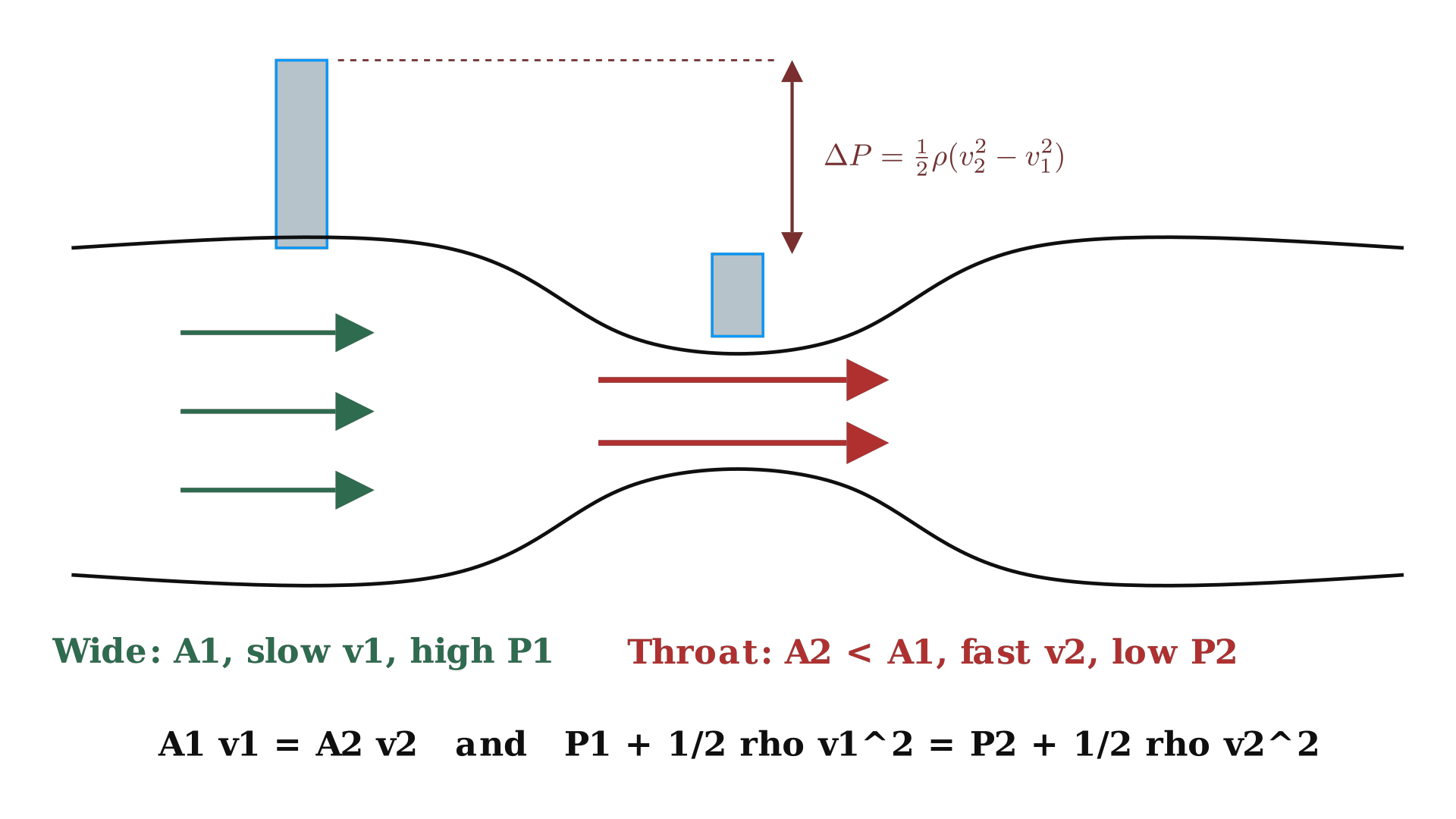
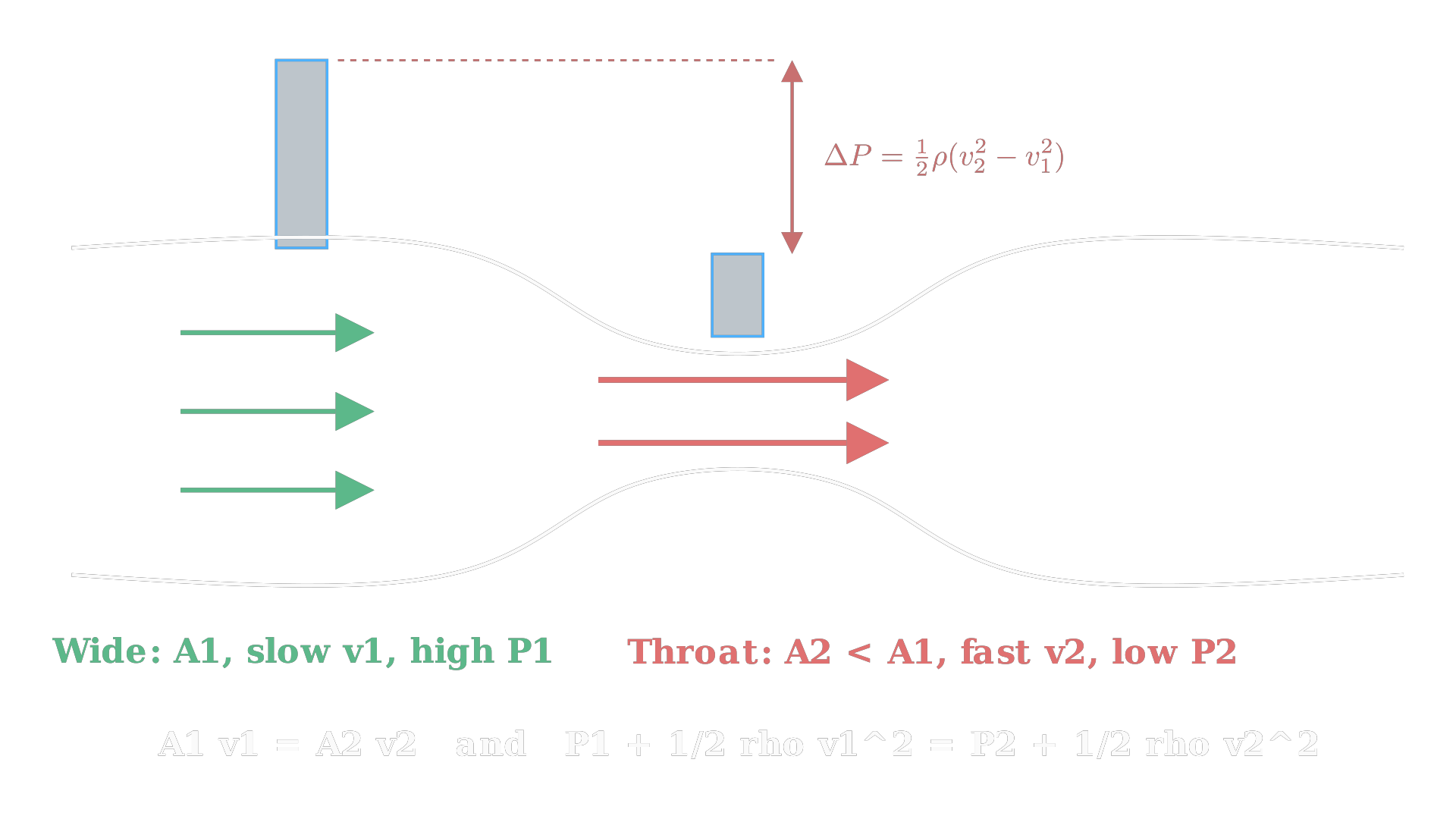
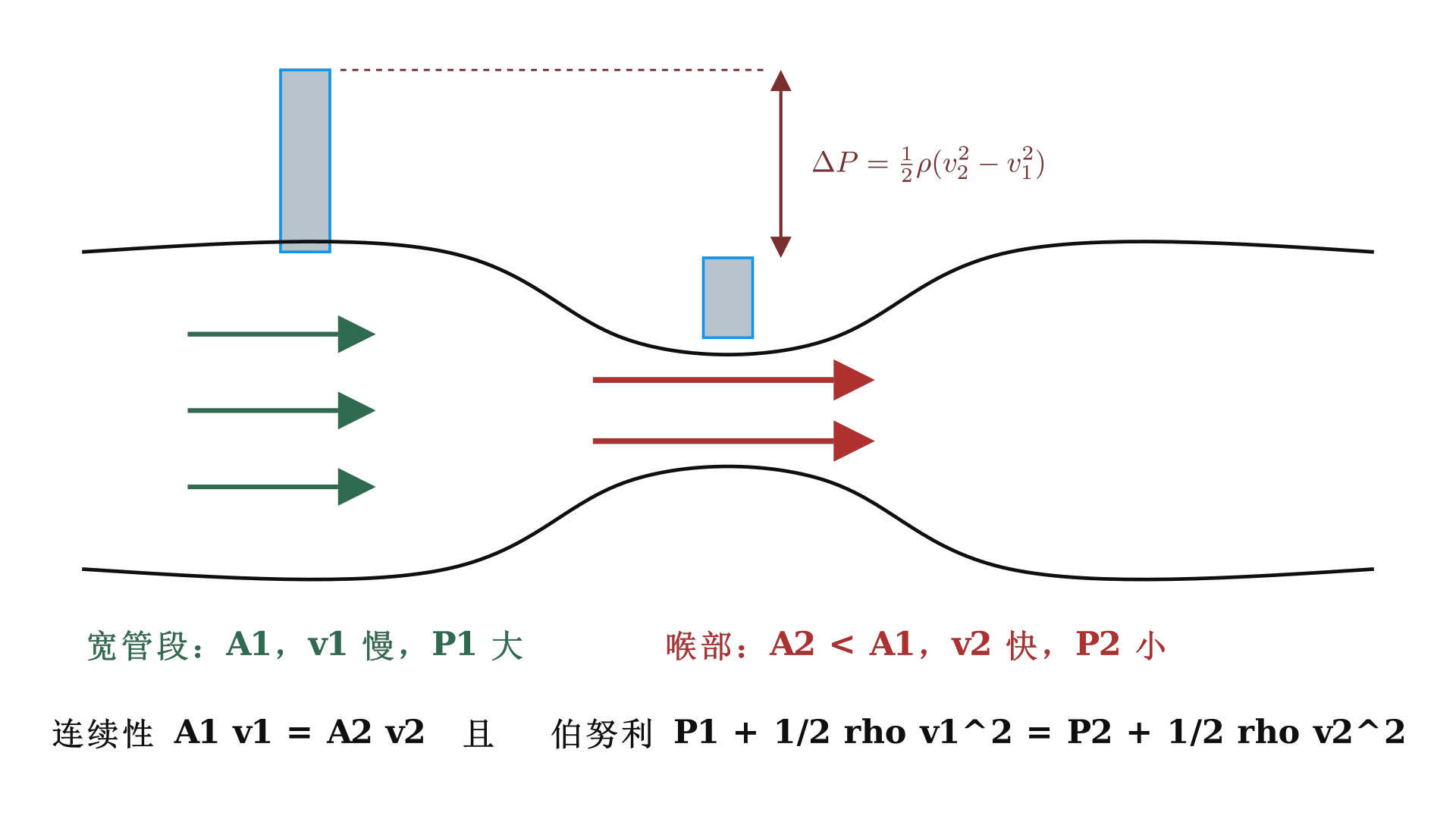
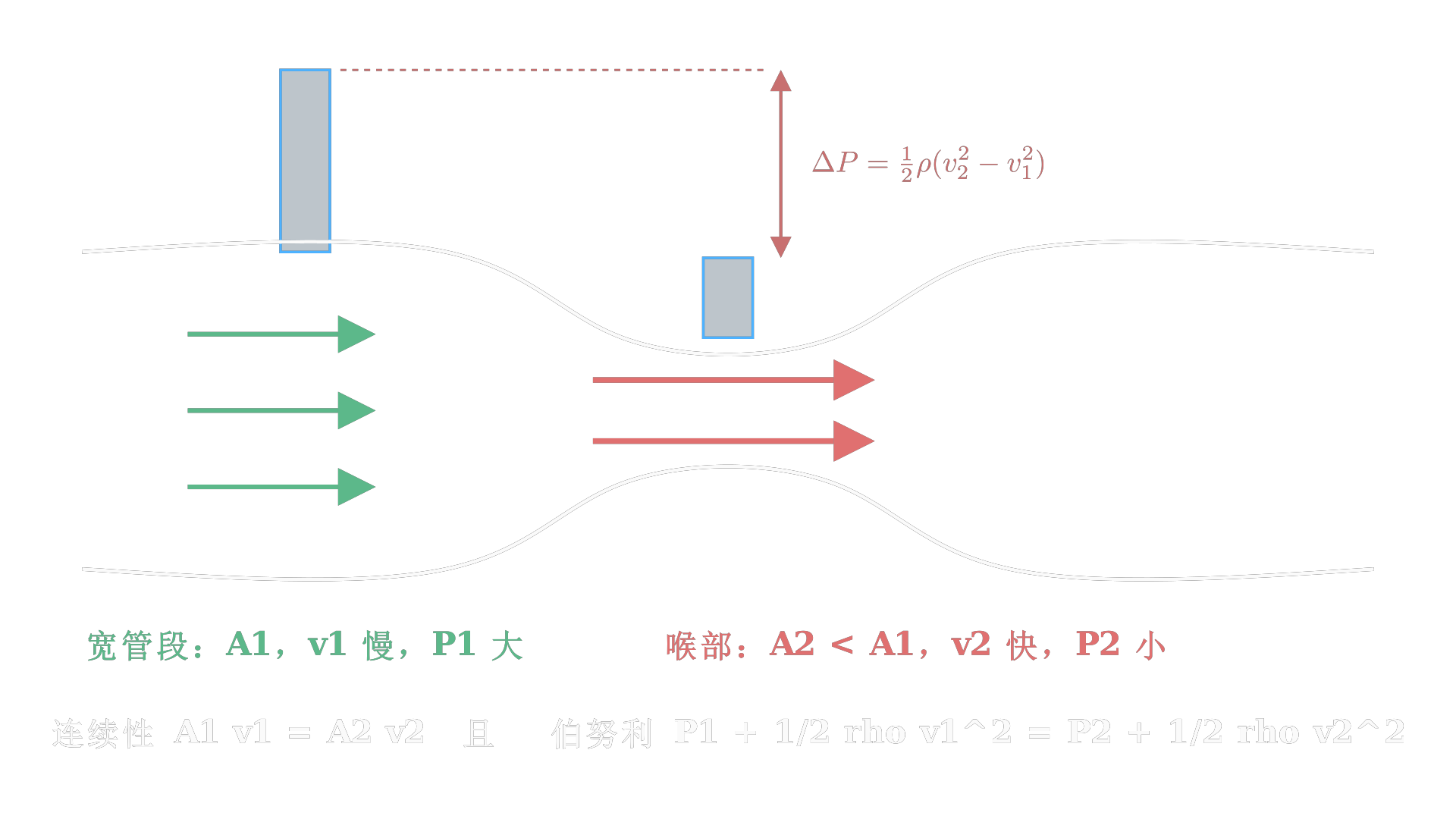
Venturi tube)。连续性方程使狭窄喉部的流速更快($A_2 < A_1$,所以 $v_2 > v_1$);在 $y_1 = y_2$ 时,伯努利方程使那里的压强低 $\Delta P = \tfrac{1}{2}\rho(v_2^2 - v_1^2)$。喉部上方开口液柱的高度比宽段上方的低,对应这一压强差。在下面的例题中,流速从 2.0 m/s 加倍到 4.0 m/s,压强下降 6.0 kPa。Each term in Bernoulli's equation is an energy per unit volume, measured in pascals. The table compares the hydrostatic terms, which a fluid at rest already has, with the hydrodynamic term, which needs motion.
伯努利方程中的每一项都是单位体积的能量,单位为帕斯卡。下表比较静止流体本来就具有的静水项(hydrostatic)与需要运动才出现的动压项(hydrodynamic)。
| Term项 | Physical meaning物理意义 | Typical size in water水中的典型大小 | Zero or constant when何时为零或不变 |
|---|---|---|---|
| $P$ | static pressure: work done per unit volume by the surrounding fluid静压:周围流体对单位体积所做的功 | $1.01\times10^5\;\text{Pa}$ at an open surface敞开液面处为 $1.01\times10^5\;\text{Pa}$ | equal to $P_\text{atm}$ at every point open to the air凡与空气相通的点都等于 $P_\text{atm}$ |
| $\rho g y$ | hydrostatic term: gravitational potential energy per unit volume静水项:单位体积的重力势能 | $9.8\times10^3\;\text{Pa}$ per metre of height每米高度 $9.8\times10^3\;\text{Pa}$ | cancels when $y_1 = y_2$ (horizontal flow)$y_1 = y_2$(水平流动)时相消 |
| $\tfrac{1}{2}\rho v^2$ | dynamic pressure: kinetic energy per unit volume动压:单位体积的动能 | $2.0\times10^3\;\text{Pa}$ at $2.0\;\text{m/s}$$2.0\;\text{m/s}$ 时为 $2.0\times10^3\;\text{Pa}$ | zero for a fluid at rest; $\approx 0$ at the surface of a wide tank静止流体为零;宽大水箱液面处约为零 |
Daniel Bernoulli published Hydrodynamica in 1738. Using energy conservation, he concluded that the pressure in a flowing fluid falls where its speed rises.
丹尼尔·伯努利于 1738 年出版了《流体动力学》(Hydrodynamica)。他利用能量守恒得出:流动流体的速度增大处,压强降低。
The equation in the form used today was derived by Leonhard Euler in 1752, from Newton's second law applied to a fluid parcel.
今天所用形式的方程是莱昂哈德·欧拉于 1752 年把牛顿第二定律用于流体微团推导出来的。
Wikipedia: Bernoulli's principle (history and derivations)维基百科:伯努利原理(历史与推导)
Worked Example: Pressure in a Narrowing Pipe例题:变窄管道中的压强
Water flows at $2.0\;\text{m/s}$ through a horizontal pipe where the absolute pressure is $2.00 \times 10^5\;\text{Pa}$. The pipe then narrows to half its cross-sectional area. Find the speed and the pressure in the narrow section.
水以 $2.0\;\text{m/s}$ 的速度流过一段水平管道,该处绝对压强为 $2.00 \times 10^5\;\text{Pa}$。管道随后变窄到截面积的一半。求窄段的流速和压强。
Torricelli's Result托里拆利结论
Water leaks from a small hole a depth $h$ below the surface of a large open tank. Compare point 1 on the surface with point 2 just outside the hole. Both are open to the air, so $P_1 = P_2 = P_\text{atm}$. Because the tank is much wider than the hole, continuity makes the surface fall very slowly, so $v_1 \approx 0$. With $y_1 - y_2 = h$, Bernoulli's equation leaves $\rho g h = \tfrac{1}{2}\rho v_2^2$.
水从大型敞口水箱液面以下深度 $h$ 处的小孔漏出。比较液面上的点 1 和小孔外侧的点 2。两点都与空气相通,所以 $P_1 = P_2 = P_\text{atm}$。由于水箱比小孔宽得多,由连续性方程可知液面下降极慢,所以 $v_1 \approx 0$。由 $y_1 - y_2 = h$,伯努利方程化为 $\rho g h = \tfrac{1}{2}\rho v_2^2$。
This is the same speed an object reaches falling freely through height $h$ from rest, which makes sense: each bit of water that leaves effectively replaces a bit at the surface that dropped by $h$.
这与物体从静止开始自由下落高度 $h$ 时获得的速度相同,这是合理的:每流出一小团水,相当于液面处有一小团水下降了 $h$。
Worked Example: How Far Does the Jet Land?例题:水柱落在多远处?
A large open tank has a small hole in its side, $1.8\;\text{m}$ below the water surface and $0.80\;\text{m}$ above the level ground. The water leaves horizontally. Find the speed of the jet and how far from the tank it hits the ground.
一个大型敞口水箱侧壁上有一个小孔,位于水面以下 $1.8\;\text{m}$、水平地面以上 $0.80\;\text{m}$。水沿水平方向射出。求水柱的速度以及它落地处距水箱多远。
Before using Bernoulli's equation, choose two points on the same streamline and list $P$, $v$ and $y$ at each; usually one unknown remains. Use continuity first to link the two speeds.
使用伯努利方程前,在同一条流线上选两点,列出每点的 $P$、$v$、$y$;通常只剩一个未知量。先用连续性方程把两点的流速联系起来。
Points open to the air both have $P = P_\text{atm}$, so it cancels, and the surface of a large tank has $v \approx 0$. Use absolute or gauge pressure consistently on both sides.
两点都与空气相通时,$P = P_\text{atm}$ 相互抵消;大型水箱的液面 $v \approx 0$。等式两边统一使用绝对压强或统一使用表压。
When a question asks you to justify an assumption or to explain why a prediction differs from a measurement, name the ideal-fluid assumption involved, such as viscosity for a thick liquid or a tank that is not much wider than its hole.
题目要求说明某个假设是否合理,或解释预测值为什么与测量值不同时,要指出相关的理想流体假设,例如黏稠液体的黏性,或水箱并不比小孔宽很多。
Water moves at $3.0\;\text{m/s}$ through a pipe of cross-sectional area $6.0\;\text{cm}^2$ and then enters a section of area $2.0\;\text{cm}^2$. Find the new speed and the volume flow rate.水以 $3.0\;\text{m/s}$ 流过截面积 $6.0\;\text{cm}^2$ 的管道,随后进入截面积 $2.0\;\text{cm}^2$ 的一段。求新的流速和体积流量。
$v_2 = v_1 A_1/A_2 = (3.0)(6.0/2.0) = 9.0\;\text{m/s}$. $Q = A_1 v_1 = (6.0 \times 10^{-4})(3.0) = 1.8 \times 10^{-3}\;\text{m}^3/\text{s}$, the same in both sections.
$v_2 = v_1 A_1/A_2 = (3.0)(6.0/2.0) = 9.0\;\text{m/s}$。$Q = A_1 v_1 = (6.0 \times 10^{-4})(3.0) = 1.8 \times 10^{-3}\;\text{m}^3/\text{s}$,两段相同。
Water flows at $2.0\;\text{m/s}$ in a pipe at ground level where the absolute pressure is $3.00 \times 10^5\;\text{Pa}$. The pipe, with the same cross-section, rises $5.0\;\text{m}$ to the next floor. Find the pressure there.水以 $2.0\;\text{m/s}$ 在地面高度的管道中流动,该处绝对压强为 $3.00 \times 10^5\;\text{Pa}$。管道截面不变,升高 $5.0\;\text{m}$ 到上一层楼。求那里的压强。
Same area, so by continuity the speed is still $2.0\;\text{m/s}$ and the kinetic terms cancel. Bernoulli gives $P_2 = P_1 - \rho g (y_2 - y_1) = 3.00 \times 10^5 - (1000)(9.8)(5.0) = 3.00 \times 10^5 - 4.9 \times 10^4 = 2.51 \times 10^5\;\text{Pa}$.
截面积相同,由连续性方程流速仍为 $2.0\;\text{m/s}$,动能项相互抵消。由伯努利方程 $P_2 = P_1 - \rho g (y_2 - y_1) = 3.00 \times 10^5 - (1000)(9.8)(5.0) = 3.00 \times 10^5 - 4.9 \times 10^4 = 2.51 \times 10^5\;\text{Pa}$。
Honey flows slowly down a narrow tube. Which assumption of the ideal-fluid model fails most clearly, and how does it affect a Bernoulli prediction of the speed?蜂蜜沿一根细管缓慢流下。理想流体模型的哪条假设最明显不成立?它如何影响用伯努利方程预测的流速?
Non-viscous. Honey is very viscous, so internal friction turns mechanical energy into thermal energy along the tube. Bernoulli's equation ignores that loss, so it overestimates the speed.
无黏性假设。蜂蜜黏性很大,内摩擦沿管道把机械能转化为内能。伯努利方程忽略了这部分损失,所以会高估流速。
Water leaves a small hole $5.0\;\text{m}$ below the surface of a large open tank. Find its speed.水从大型敞口水箱液面以下 $5.0\;\text{m}$ 处的小孔流出。求流速。
$v = \sqrt{2gh} = \sqrt{2(9.8)(5.0)} = \sqrt{98} = 9.9\;\text{m/s}$.
$v = \sqrt{2gh} = \sqrt{2(9.8)(5.0)} = \sqrt{98} = 9.9\;\text{m/s}$。
How to Prepare Unit 8 for the AP Exam如何为 AP 考试准备第 8 单元
The College Board course page lists Unit 8, Fluids, at 10-15% of the multiple-choice section of AP Physics 1. Fluids is part of AP Physics 1 only; AP Physics C: Mechanics has no fluids unit.
College Board 课程页面列出第 8 单元"流体"占 AP Physics 1 选择题部分的 10-15%。流体只出现在 AP Physics 1 中;AP Physics C: Mechanics 没有流体单元。
For exams from May 2027, the exam page describes Section I as 42 multiple-choice questions in 85 minutes and Section II as 4 free-response questions in 95 minutes, each section 50% of the score. A calculator is permitted and reference materials are provided.
对于 2027 年 5 月起的考试,考试页面写明:第一部分为 42 道选择题,85 分钟;第二部分为 4 道自由作答题,95 分钟;两部分各占总分的 50%。允许使用计算器,并提供参考资料(reference materials)。
The exam page names four free-response types: mathematical routines, translation between representations, experimental design and analysis, and qualitative/quantitative translation. A fluids setup can be practised in each format:
考试页面列出四种自由作答题型:数学过程(mathematical routines)、表征之间的转换(translation between representations)、实验设计与分析(experimental design and analysis)、定性与定量的转换(qualitative/quantitative translation)。同一个流体情境可以按每种题型来练习:
- Mathematical routines: chain continuity into Bernoulli, or a free-body diagram into Archimedes' principle, showing each substitution with units.
- Translation between representations: go from a free-body diagram to an equation, or from a pressure-depth graph to $\rho$ (slope $\div\, g$) and $P_0$ (intercept), as in Figure 8.1.
- Experimental design and analysis: for example, find a liquid's density by measuring the apparent weight of a block at several immersion depths while it is only partly submerged, and say which graph would be linear.
- Qualitative/quantitative translation: predict in words what happens (a ship rides higher in seawater; pressure is lowest in the narrow part of a horizontal pipe), then confirm it with the equation.
- 数学过程:把连续性方程接到伯努利方程,或把受力图接到阿基米德原理,每次代入都写出单位。
- 表征之间的转换:由受力图写出方程,或像图 8.1 那样由压强-深度图读出 $\rho$(斜率 $\div\, g$)和 $P_0$(截距)。
- 实验设计与分析:例如,在物块只部分浸没时,测量它在不同浸入深度下的视重来求液体密度,并说明哪个图像应是直线。
- 定性与定量的转换:先用文字预测会发生什么(船在海水中浮得更高;水平管道最窄处压强最低),再用方程验证。
- Using the object's density in $F_B = \rho g V$: it is always the fluid's density.
- Mixing absolute and gauge pressure within one calculation.
- Measuring $h$ along a slanted tube or from the bottom of the container: it is the vertical depth below the surface.
- Using the diameter ratio in continuity: speeds scale with the area ratio, which is the diameter ratio squared.
- Claiming a hydraulic lift multiplies energy: it multiplies force, and the small piston moves farther by the same factor.
- Applying Bernoulli's equation without checking its assumptions (incompressible, non-viscous, steady, same streamline).
- 在 $F_B = \rho g V$ 中代入物体的密度:这里永远是流体的密度。
- 在一次计算中混用绝对压强与表压。
- 沿倾斜管道或从容器底部量 $h$:它是液面以下的竖直深度。
- 在连续性方程中用直径之比:流速与面积之比有关,即直径之比的平方。
- 声称液压机放大了能量:它放大的是力,小活塞移动的距离按同样倍数增大。
- 不检查假设(不可压缩、无黏性、定常、同一流线)就使用伯努利方程。
Flashcards: Click to Flip闪卡:点击翻面
Unit 8: Practice Quiz第 8 单元:练习测验
鼎睿学苑 · Dingrui Scholars
AP Physics 1 · Unit 8: Fluids · 2026 EditionAP Physics 1 · 第 8 单元:流体 · 2026 版