10–15% Exam Weight考试占分 10–15%~13–19 Class Periods约 13–19 课时6 Topics6 个专题
Topic 6.1专题 6.1
Rotational Kinetic Energy转动动能
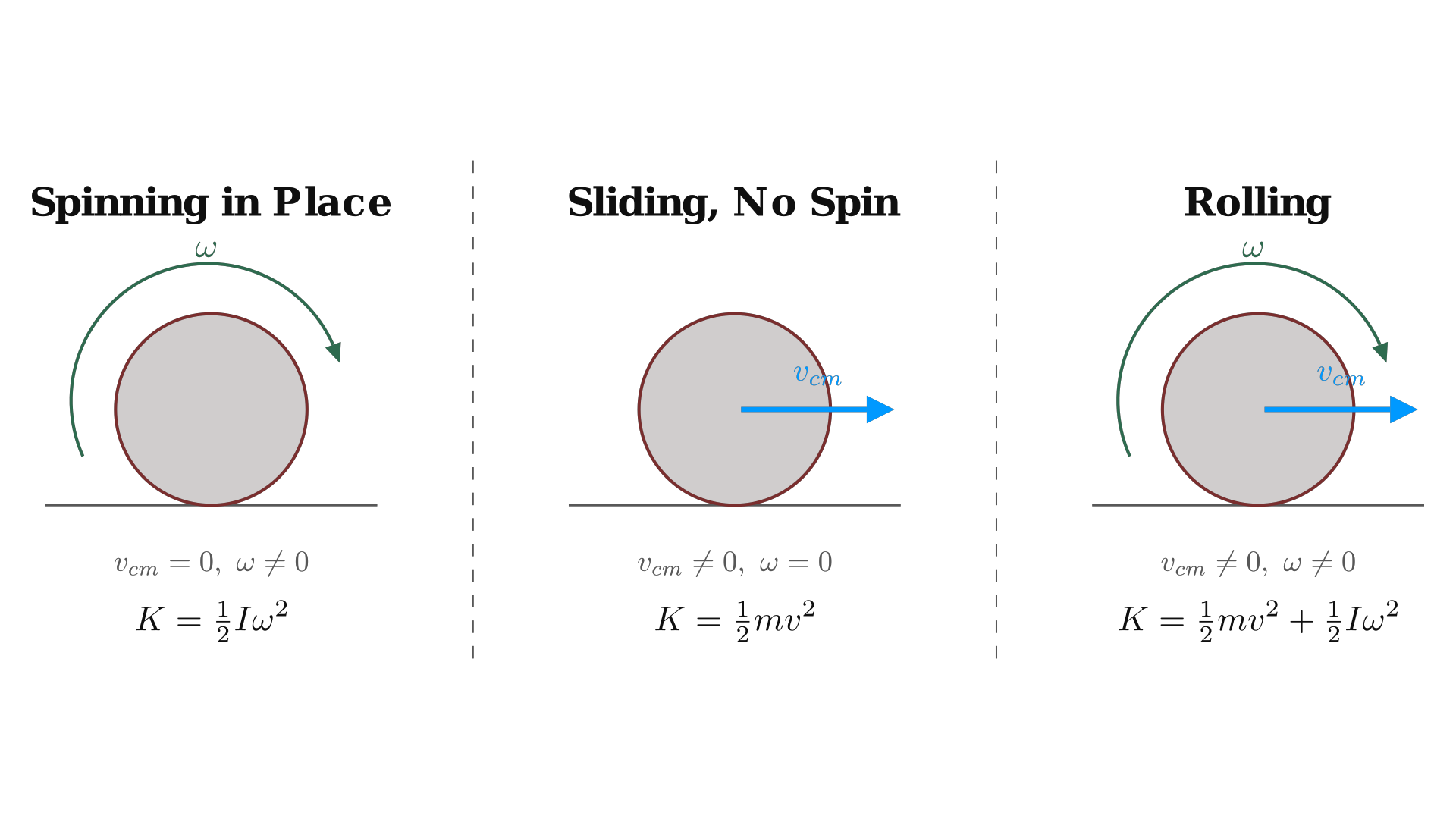
In Unit 3 you learned that an object in translational motion carries kinetic energy $K = \frac{1}{2}mv^2$. A spinning object carries energy too, even if its center of mass is stationary — think of a merry-go-round bolted to the ground. The rotational kinetic energy depends on the rotational inertia $I$ and the angular velocity $\omega$, in a formula that perfectly mirrors the translational version.
Why does this work? Every tiny mass element $dm$ on a rigid body at distance $r$ from the axis has tangential speed $v = r\omega$, so its kinetic energy is $\frac{1}{2}(dm)(r\omega)^2$. Summing (integrating) over the entire body gives $\frac{1}{2}\omega^2 \int r^2\,dm = \frac{1}{2}I\omega^2$. This derivation shows that rotational KE is really just the translational KE of all the constituent particles viewed collectively.
Three physical states of motion: a spinning top has only rotational kinetic energy, a sliding puck has only translational, a rolling ball has both.三种运动状态:旋转陀螺只有转动动能,滑动冰球只有平动动能,滚动的球两者兼具。
When a rigid body both translates and rotates — like a bowling ball rolling down a lane — its total kinetic energy is the sum of two independent contributions:
Key Insight
A rigid body can possess rotational kinetic energy even when its center of mass is at rest. A spinning top balanced on its point has $v_{\text{cm}} = 0$ but $\omega \neq 0$, so $K_{\text{rot}} > 0$. The converse is also true — a sliding (non-rotating) puck has translational KE but no rotational KE.
Big Idea
Rotational kinetic energy is a scalar, just like translational kinetic energy. It is always non-negative and does not have a direction.
核心观念
转动动能和平动动能一样是标量,永远非负、没有方向。
Worked Example — Flywheel Energy例题 —— 飞轮的储能
A solid disk flywheel has $M = 20\;\text{kg}$, $R = 0.30\;\text{m}$, and spins at $\omega = 150\;\text{rad/s}$. How much rotational kinetic energy does it store?
Two flywheels have the same angular velocity $\omega$. Flywheel A has rotational inertia $I$ and Flywheel B has rotational inertia $3I$. What is the ratio $K_B / K_A$?两个飞轮角速度 $\omega$ 相同。飞轮 A 的转动惯量为 $I$,飞轮 B 的为 $3I$。比值 $K_B / K_A$ 是多少?
$1/3$
$3$
$9$
$\sqrt{3}$
Correct! Since $K = \frac{1}{2}I\omega^2$ and $\omega$ is the same, the ratio is simply $3I / I = 3$.正确!由 $K = \frac{1}{2}I\omega^2$ 且 $\omega$ 相同,比值就是 $3I / I = 3$。
$K = \frac{1}{2}I\omega^2$. With the same $\omega$, $K_B/K_A = 3I/I = 3$. The kinetic energy scales linearly with $I$.$K = \frac{1}{2}I\omega^2$。$\omega$ 相同时 $K_B/K_A = 3I/I = 3$。动能随 $I$ 线性变化。
Worked Example — Total KE of a Rolling Ball例题 —— 滚动球的总动能
A solid sphere ($M = 4.0\;\text{kg}$, $R = 0.10\;\text{m}$, $I = \tfrac{2}{5}MR^2$) rolls without slipping at $v_{\text{cm}} = 6.0\;\text{m/s}$. Find its total kinetic energy, and what fraction of it is rotational.
About $2/7$ of the total kinetic energy is rotational — this fraction is always $\tfrac{2}{7}$ for any solid sphere rolling without slipping, regardless of its mass, radius, or speed, since $I=\tfrac25MR^2$ makes the mass and radius cancel out of the ratio.约 $2/7$ 的总动能是转动动能——对任何无滑动滚动的实心球,这一比例恒为 $\tfrac{2}{7}$,与质量、半径、速率无关,因为 $I=\tfrac25MR^2$ 使质量与半径在比值中相互抵消。
Topic 6.2专题 6.2
Torque and Work力矩与功
In translational mechanics, work is done when a force displaces an object: $W = \int F\,dx$. The rotational analog replaces force with torque and linear displacement with angular displacement. A torque that rotates a body through some angle transfers energy into or out of the system.
This is the work-energy theorem in rotational form: the net work done by all torques on a rigid body equals the change in its rotational kinetic energy. Graphically, the work equals the area under a $\tau$-vs-$\theta$ curve, just as translational work equals the area under an $F$-vs-$x$ curve.
Key Insight
A torque must be exerted over an angular displacement to do work. A torque applied to a stationary object that does not rotate does zero work — analogous to pushing against a wall.
This work equals the change in rotational KE since the wheel started from rest.由于轮从静止释放,这一功恰好等于转动动能的变化。
Torque–Work Explorer力矩做功探究器
Adjust the constant torque and angular displacement. Work equals the area of the rectangle under the τ-vs-θ graph.调整恒定力矩和角位移。功等于 τ–θ 图下方矩形的面积。
Work W功 W
80.0
J
Revolutions圈数
1.59
rev
If I=1 kg·m², ω_f若 I=1 kg·m²,ω_f
12.6
rad/s (from rest)rad/s(从静止开始)
A torque varies linearly from $0$ to $20$ N·m as a disk rotates through $\pi$ rad. What is the work done?圆盘转过 $\pi$ rad 的过程中力矩由 0 线性增至 20 N·m。所做的功是多少?
$20\pi$ J
$20$ J
$10\pi$ J
$40\pi$ J
Correct! The area under a linearly increasing $\tau$-vs-$\theta$ graph is a triangle: $W = \frac{1}{2}(20)(\pi) = 10\pi$ J.正确!线性增大的 $\tau$–$\theta$ 曲线下方为三角形:$W = \frac{1}{2}(20)(\pi) = 10\pi$ J。
Since $\tau$ increases linearly from $0$ to $20$ over $\pi$ rad, the area is a triangle: $W = \frac{1}{2}(\pi)(20) = 10\pi$ J.由于 $\tau$ 在 $\pi$ rad 内从 0 线性升至 20,面积为三角形:$W = \frac{1}{2}(\pi)(20) = 10\pi$ J。
Topic 6.3专题 6.3
Angular Momentum & Angular Impulse角动量与角冲量
Angular momentum is the rotational counterpart of linear momentum. Just as linear momentum $p = mv$ quantifies how hard it is to stop a translating object, angular momentum $L$ quantifies how hard it is to stop a spinning one.
Angular Momentum (Rigid Body About Fixed Axis)角动量(绕固定轴的刚体)
$$L = I\omega$$
Angular Momentum of a Particle质点的角动量
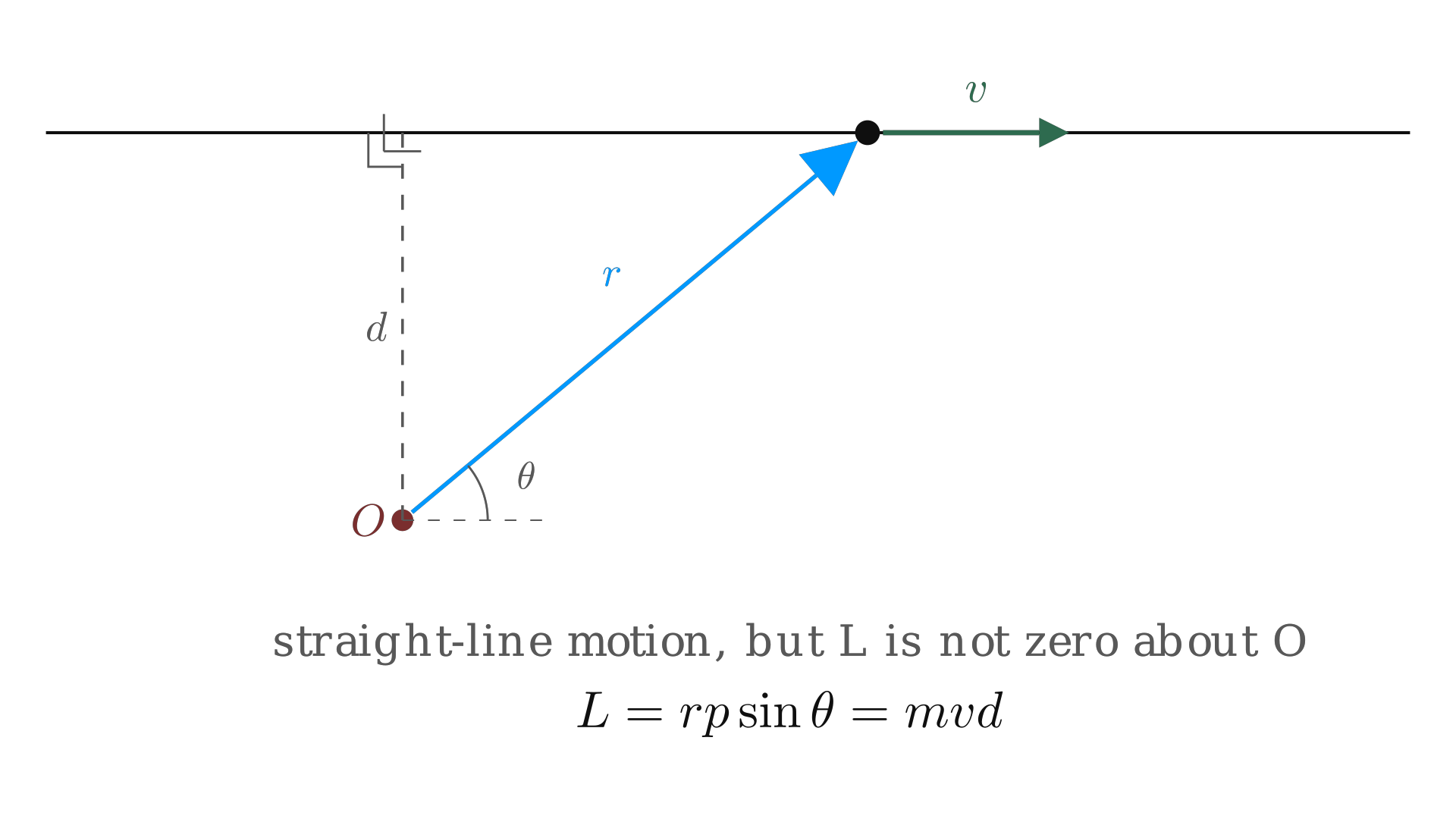
A particle moving in a straight line still has nonzero angular momentum about an off-axis point O, equal to its momentum times the perpendicular distance from O to the line of motion.沿直线运动的质点,相对偏离直线的参考点 O 仍具有非零角动量,其大小等于动量乘以 O 到运动直线的垂直距离。
For a single particle (or an object treated as one), the angular momentum about a chosen reference point is defined through the cross product of its position and momentum vectors:
对于单个质点(或将物体视为质点的情形),相对所选参考点的角动量由位置矢量与动量矢量的矢量积定义:
Angular Momentum of a Particle质点的角动量
$$\vec{L} = \vec{r} \times \vec{p}$$
Magnitude: $L = rp\sin\theta = rmv\sin\theta$
大小:$L = rp\sin\theta = rmv\sin\theta$
Axis Dependence
Angular momentum depends on your choice of reference point. A particle moving in a straight line does have angular momentum about any point not on its line of motion — the value depends on the perpendicular distance between the point and the velocity vector.
Angular impulse is the rotational analog of linear impulse. A torque applied over a time interval delivers angular impulse, which equals the change in angular momentum — the rotational impulse-momentum theorem.
When rotational inertia $I$ is constant, this reduces to a familiar chain: $\tau_{\text{net}} = \frac{dL}{dt} = I\frac{d\omega}{dt} = I\alpha$. The net torque is the slope of the $L$-vs-$t$ graph, and the angular impulse is the area under the $\tau$-vs-$t$ graph.
Even though the ball moves in a straight line, it has angular momentum about this off-axis point — $L$ always depends on your chosen reference.即使球沿直线运动,它相对该偏离的参考点仍具有角动量——$L$ 始终依赖于参考点的选择。
Worked Example — Time-Dependent Torque: τ = dL/dt (FRQ-style)例题 —— 随时间变化的力矩:τ = dL/dt(FRQ 风格)
A flywheel with rotational inertia $I = 4.0\;\text{kg}\cdot\text{m}^2$ is at rest. A net torque $\tau(t) = 6t$ N·m is applied for $t = 0$ to $t = 5.0$ s. (a) Find the angular impulse delivered. (b) Find the flywheel's angular velocity at $t = 5.0$ s. (c) At what time does the instantaneous angular acceleration equal $\alpha = 3.0\;\text{rad/s}^2$?
$$1.5\,t = 3.0 \;\Rightarrow\; t = 2.0\;\text{s}$$
Takeaway: $\tau = dL/dt$ is the rotational analog of $F = dp/dt$. For constant $I$ you can use $\tau = I\alpha$, but for time-varying torque you must integrate — never assume $\tau = I\,\alpha_\text{avg}$.
A constant torque of $5.0$ N·m is applied to a wheel for $3.0$ s. What is the angular impulse delivered?对轮施加恒定力矩 $5.0$ N·m 持续 $3.0$ s。传递的角冲量是多少?
$15$ N·m·s
$5.0$ N·m·s
$1.67$ N·m·s
$8.0$ N·m·s
Correct! For constant torque, the angular impulse is $\tau \Delta t = (5.0)(3.0) = 15$ N·m·s, which equals $\Delta L$.正确!恒力矩下角冲量为 $\tau \Delta t = (5.0)(3.0) = 15$ N·m·s,亦即 $\Delta L$。
Conservation of angular momentum is one of the most profound and widely applied principles in physics. It governs everything from figure skating spins to the collapse of interstellar gas clouds into stars.
角动量守恒(conservation of angular momentum)是物理学最深刻且应用最广泛的原理之一。它支配着从花样滑冰的旋转,到星际气体云塌缩成恒星等一切现象。
The total angular momentum of a system is the sum of the angular momenta of all its parts. If no external torque acts on the system, this total remains constant. Internal torques redistribute angular momentum among the parts but cannot change the total — a direct consequence of Newton's third law applied to angular impulse.
系统总角动量等于各部分角动量之和。若系统不受任何外力矩作用,该总量便保持不变。内力矩只能在各部分之间重新分配角动量,无法改变总量——这是 Newton 第三定律推广到角冲量上的直接结果。
Key Insight — The Spinning Skater
When a figure skater pulls their arms inward, their rotational inertia $I$ decreases. Since no external torque acts (neglecting ice friction), $L = I\omega$ is conserved, so $\omega$ must increase. The skater spins faster. Note that kinetic energy is not conserved here — it increases because the skater does internal work by pulling their arms in.
Exam Tip
On the AP exam, simply writing "conservation of angular momentum" is not enough for full credit. You must explain why it is conserved (identify that the net external torque on the system is zero) and then show the algebra: $I_i\omega_i = I_f\omega_f$.
应试提醒
AP 考试中仅写"角动量守恒"并不够拿满分。必须说明为什么守恒(指出系统的合外力矩为零),再列出代数:$I_i\omega_i = I_f\omega_f$。
Angular Momentum Conservation Explorer角动量守恒探究器
Adjust $I_i$, $\omega_i$, and $I_f$ to see how $\omega_f$ must change to keep $L$ constant. Watch the KE change too.调整 $I_i$、$\omega_i$ 与 $I_f$,观察为了保持 $L$ 不变,$\omega_f$ 如何变化;同时留意动能的变化。
L (conserved)L(守恒量)
8.00
kg·m²/s
ω_f
5.00
rad/s
KE initial初动能
8.00
J
KE final末动能
20.00
J
Worked Example — Two Disks Collide例题 —— 两圆盘碰撞合并
A spinning disk with $I_1 = 0.40\;\text{kg}\cdot\text{m}^2$ and $\omega_1 = 10\;\text{rad/s}$ is dropped onto a stationary disk with $I_2 = 0.60\;\text{kg}\cdot\text{m}^2$.
No — kinetic energy decreased. This is an不守恒——动能减少了。这是一次
inelastic rotational "collision."非弹性的转动"碰撞"。
Worked Example — Spinning Platform Catch (FRQ Style)例题 —— 转盘上接球(FRQ 风格)
A person ($I_{\text{person}} = 3.0\;\text{kg}\cdot\text{m}^2$) stands at the center of a frictionless turntable, initially not spinning. A ball ($m = 0.50\;\text{kg}$) is thrown tangentially at $v = 8.0\;\text{m/s}$ and caught at arm's length $r = 0.80\;\text{m}$. Find (a) the final angular velocity, and (b) whether kinetic energy is conserved.
$K_f \ll K_i$. Kinetic energy is not conserved — this is an inelastic collision. The "missing" energy goes into deforming the person's arms.$K_f \ll K_i$。动能不守恒——这是一次非弹性碰撞,"消失"的能量被人手臂的形变吸收。
If the ball were caught at $r = 0$ (at the axis), $I_f \approx I_{\text{person}}$ and $L_i = 0$ (ball passes through axis). Makes sense. ✓如果在 $r = 0$(轴心)处接球,$I_f \approx I_{\text{person}}$,且 $L_i = 0$(球穿过轴)。结果自洽。✓
A turntable with $I = 0.50$ kg·m² rotates at $6.0$ rad/s. A piece of clay ($m = 0.20$ kg) is dropped onto it at $r = 0.40$ m from the center. What is the new angular velocity?转盘 $I = 0.50$ kg·m²,以 $6.0$ rad/s 旋转。一团 $m = 0.20$ kg 的橡皮泥落到距轴 $r = 0.40$ m 处。新的角速度是多少?
Rolling combines translation and rotation into a single motion. A wheel rolling down the road translates forward while simultaneously spinning about its center. The energy, momentum, and dynamics of rolling objects are among the most exam-tested topics in AP Physics C.
滚动把平动和转动合二为一。车轮沿路面滚动时既向前平动、又绕中心旋转。滚动物体的能量、动量与动力学是 AP Physics C 中考查最频繁的主题之一。
Rolling Without Slipping无滑滚动
When an object rolls without slipping, there is a strict geometric constraint tying the translational motion of the center of mass to the rotational motion about the center:
当物体做无滑滚动(rolling without slipping,又称纯滚动)时,质心的平动与绕质心的转动之间存在严格的几何约束:
The physical meaning: the contact point between the rolling object and the surface is instantaneously at rest. Because there is no relative sliding at the contact point, static friction acts but does not dissipate energy. The total kinetic energy is:
Key Insight — The Rolling Race
When objects of different shapes roll down the same incline from the same height, the one with the smallest $I/(mr^2)$ ratio reaches the bottom first with the greatest $v_{\text{cm}}$. A sliding block ($I = 0$) wins, then a solid sphere ($2/5$), then a solid cylinder ($1/2$), then a hoop ($1$). Mass and radius cancel — only the shape matters!
Choose the shape factor $\beta = I/(mr^2)$ and drop height. Watch how energy splits between translational and rotational KE.选择形状因子 $\beta = I/(mr^2)$ 与下落高度,观察能量在平动动能与转动动能之间的分配。
Bottom Speed底端速率
4.58
m/s
KE Trans %平动动能占比
71.4
%
KE Rot %转动动能占比
28.6
%
Shape Cue形状提示
Sphere
Rolling While Slipping边滚边滑
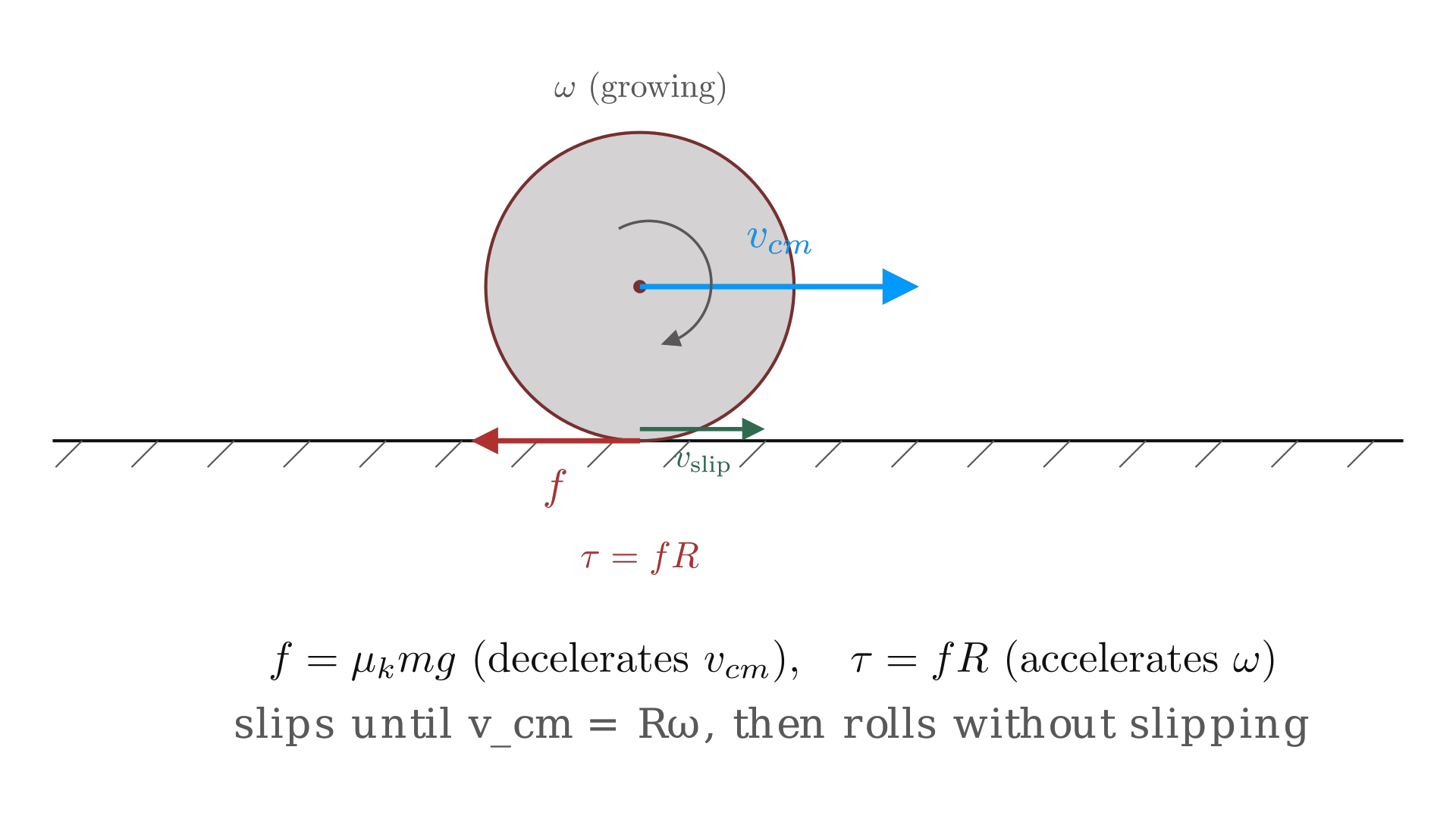
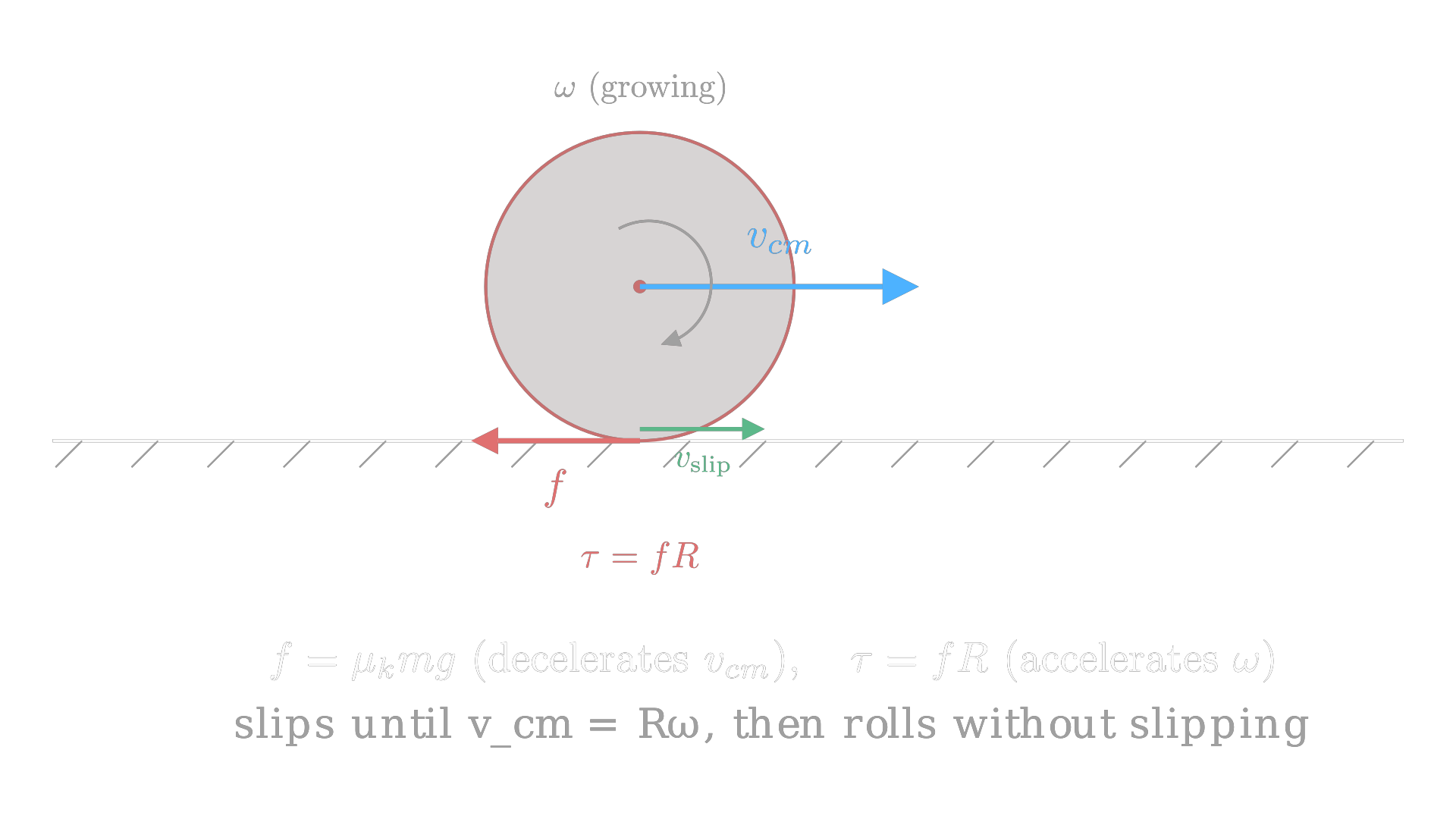
While slipping, the contact point still moves relative to the ground; kinetic friction decelerates the center of mass while its torque accelerates the spin, until v_cm = R*omega is reached.打滑期间接触点相对地面仍在运动;动摩擦力使质心减速,同时其力矩使自转加速,直到 v_cm = Rω 重新成立。
When an object slips, the contact point has nonzero velocity relative to the surface. The rolling constraint ($v_{\text{cm}} = r\omega$) no longer holds, and kinetic friction acts at the contact point, dissipating energy. The translational and rotational equations of motion must be solved independently until slipping ceases and $v_{\text{cm}} = r\omega$ is re-established.
The sphere is slower because some PE goes into rotation.球较慢,因为部分势能进入了转动。
Worked Example — Bowling Ball Starts Sliding例题 —— 保龄球起初打滑
A bowling ball with $I = \tfrac{2}{5}mR^2$ is launched with speed $v_0$ and no spin on a surface with kinetic friction $\mu_k$. How long until it rolls without slipping?
Exam Note
Rolling friction (resistance due to deformation of surfaces) is beyond the scope of AP Physics C. Problems will only involve static friction (for rolling without slipping) or kinetic friction (for rolling while slipping).
应试提醒
滚动摩擦(接触面形变引起的阻力,rolling friction)超出 AP Physics C 范围。题目只涉及静摩擦(无滑滚动)或动摩擦(边滚边滑)。
A solid disk and a hoop, both with mass $m$ and radius $r$, roll without slipping down the same incline from the same height $h$. Which reaches the bottom with greater translational speed?质量 $m$、半径 $r$ 的实心圆盘与圆环从同一高度 $h$ 沿同一斜面无滑滚下。谁先到底且平动速率更大?
The hoop — it has greater $I$圆环 —— 它的 $I$ 更大
They arrive with the same speed两者末速率相同
It depends on the angle of the incline取决于斜面倾角
The disk — less energy goes into rotation圆盘 —— 较少能量进入转动
Correct! The disk has $I/(mr^2) = 1/2$ while the hoop has $I/(mr^2) = 1$. A smaller ratio means more of the gravitational PE converts into translational KE, so the disk is faster: $v_{\text{disk}} = \sqrt{4gh/3}$ vs $v_{\text{hoop}} = \sqrt{gh}$.正确!圆盘 $I/(mr^2) = 1/2$,圆环 $I/(mr^2) = 1$。比值越小,重力势能转化为平动动能的比例越大,所以圆盘更快:$v_{\text{disk}} = \sqrt{4gh/3}$ vs $v_{\text{hoop}} = \sqrt{gh}$。
Using energy conservation: $v = \sqrt{2gh/(1 + I/(mr^2))}$. The disk's smaller ratio ($1/2$ vs $1$) gives it a greater $v_{\text{cm}}$ at the bottom.由能量守恒:$v = \sqrt{2gh/(1 + I/(mr^2))}$。圆盘的比值更小($1/2$ vs $1$),底端 $v_{\text{cm}}$ 更大。
Topic 6.6专题 6.6
Motion of Orbiting Satellites轨道卫星的运动
Orbital mechanics is where conservation of energy and angular momentum come together beautifully. A satellite orbiting a massive body follows paths dictated by Newton's law of gravitation, and the conservation laws govern what is constant and what changes throughout its orbit.
轨道力学(orbital mechanics)让能量守恒与角动量守恒"美美与共"。绕大质量天体运动的卫星遵循 Newton 万有引力定律给出的轨迹,沿途哪些量守恒、哪些量变化全由守恒律决定。
Gravitational Potential Energy引力势能
For two masses separated by distance $r$, with the convention that $U = 0$ at $r \to \infty$:
对距离 $r$ 的两质量,约定 $r \to \infty$ 时 $U = 0$:
Gravitational Potential Energy引力势能
$$U_g = -\frac{Gm_1 m_2}{r}$$
Always negative — bound systems have $E_{\text{total}} < 0$
恒为负——引力束缚系统(束缚轨道)满足 $E_{\text{total}} < 0$。
Circular Orbits圆轨道
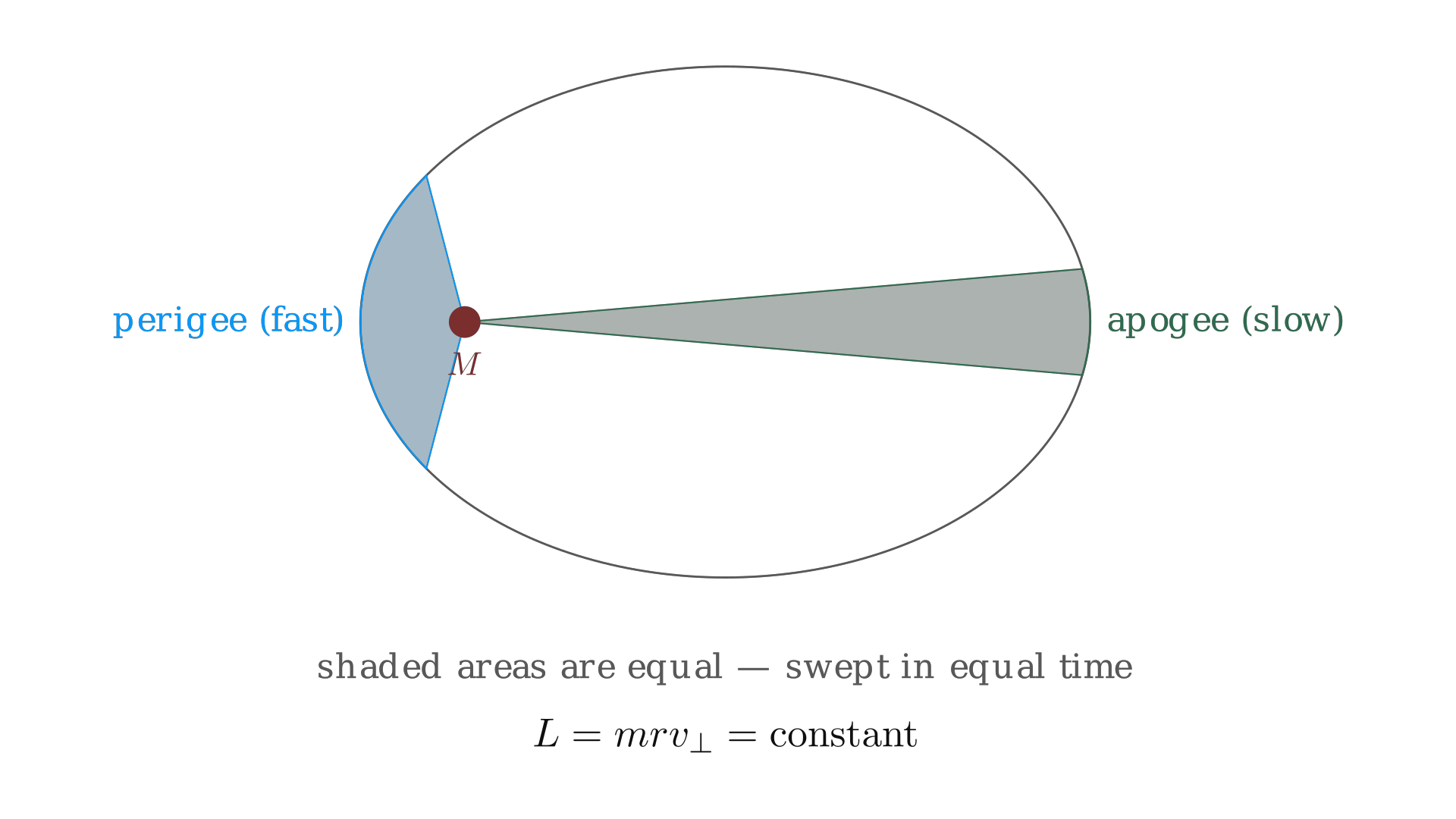
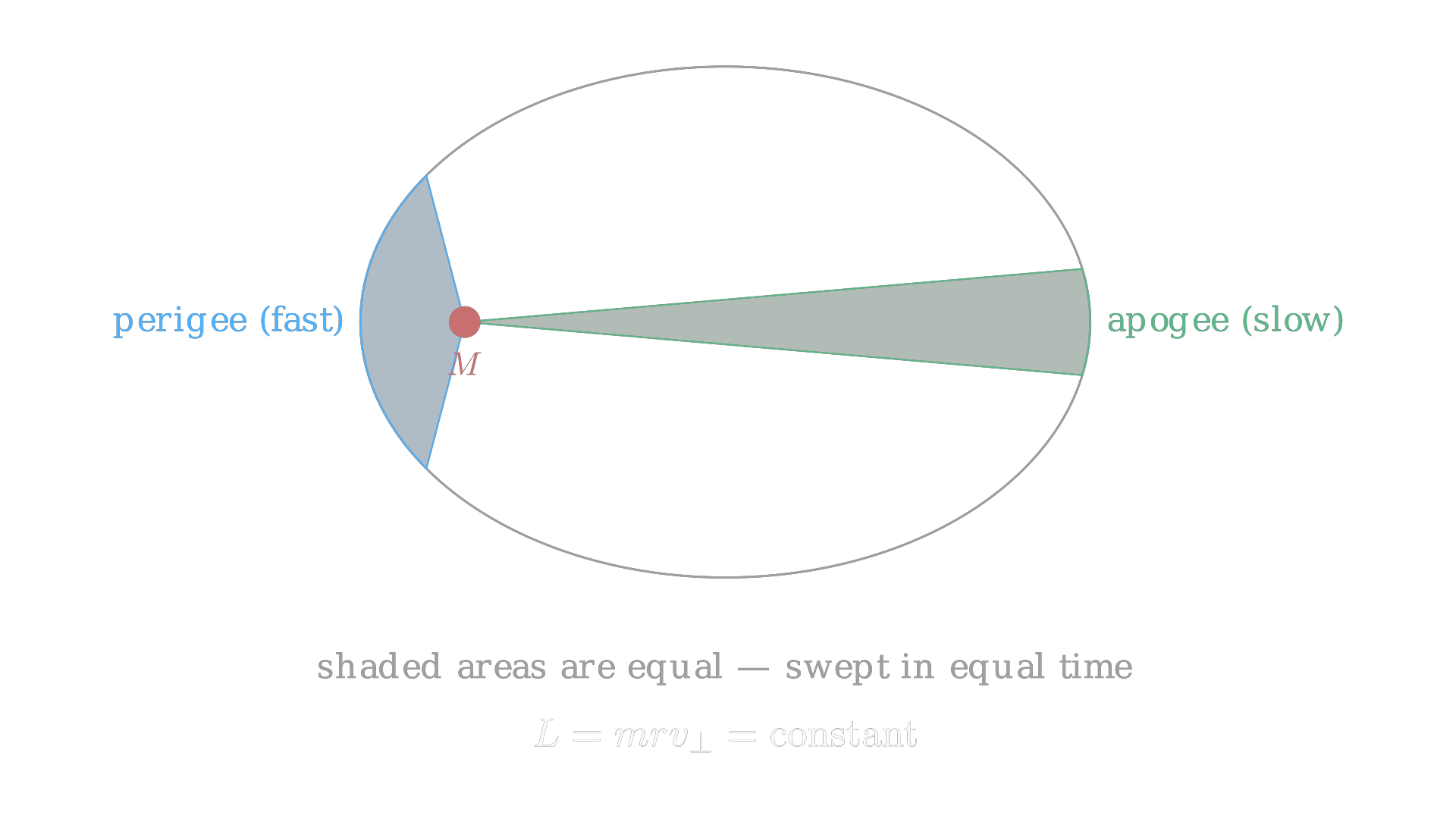
Equal areas swept in equal times: a satellite moves faster near perigee (small r) and slower near apogee (large r), keeping angular momentum L = mrv_perp constant.相等时间内扫过相等面积:卫星在近地点(r 小)运动更快、远地点(r 大)更慢,以保持角动量 L = mrv_⊥ 不变。
In a circular orbit, gravity provides exactly the centripetal force needed. Setting $F_g = F_c$:
圆轨道下,引力恰好提供所需的向心力。令 $F_g = F_c$:
Orbital Speed (Circular Orbit)轨道速度(圆轨道)
$$v_{\text{orb}} = \sqrt{\frac{GM}{r}}$$
Larger orbits move slower. Independent of the satellite's mass $m$.
轨道半径越大,绕行越慢。与卫星质量 $m$ 无关。
Derivation — Two Lines from Newton's Laws
Gravity supplies exactly the centripetal force required for a circular orbit:
$$\frac{GMm}{r^2} = \frac{mv^2}{r}$$
Cancel $m$, multiply both sides by $r$, and take the square root:
$$v_{\text{orb}} = \sqrt{\frac{GM}{r}}$$
From here, $K = \tfrac{1}{2}mv^2 = \tfrac{GMm}{2r}$, and combining with $U = -\tfrac{GMm}{r}$ gives the energy relations below.
Kepler's Third Law (Bonus)
Plugging $v = 2\pi r / T$ into $v = \sqrt{GM/r}$ and solving gives $T^2 = \frac{4\pi^2}{GM}\,r^3$ — period squared is proportional to radius cubed. Show this derivation if a Kepler FRQ prompt asks you to "justify" the relationship.
Key Insight — Kepler's Second Law
The conservation of angular momentum explains why planets sweep equal areas in equal times: when $r$ decreases, $v$ increases to keep $L = mrv_\perp$ constant.
The escape velocity is the minimum launch speed needed for a satellite to reach infinity with zero final speed. Setting $E_{\text{total}} = K + U = 0$:
逃逸速度(escape velocity,从地表逃逸时也称第二宇宙速度)是卫星到达无穷远处时末速度为零所需的最小发射速率。令 $E_{\text{total}} = K + U = 0$:
Escape Velocity逃逸速度
$$v_{\text{esc}} = \sqrt{\frac{2GM}{r}}$$
Comparison
The orbital speed for a circular orbit at radius $r$ is $v_{\text{orb}} = \sqrt{GM/r}$. The escape velocity is exactly $\sqrt{2}$ times the orbital speed at the same radius. An orbiting satellite needs only a 41% speed boost to escape.
Adjust the orbital radius and see how kinetic energy, potential energy, total energy, orbital speed, and escape speed all depend on $r$.调整轨道半径,观察动能、势能、总能量、轨道速度与逃逸速率如何随 $r$ 变化。
v_orb
5.59
km/s
v_esc
7.91
km/s
E_total
−15.6
MJ/kg
K/|U|
0.50
(always ½)(恒为 ½)
Worked Example — Deriving Escape Velocity例题 —— 推导逃逸速度
Derive the escape velocity from a planet of mass $M$, radius $R$.
Escape velocity is independent of the satellite's mass $m$, and $v_\text{esc} = \sqrt{2}\,v_\text{orb}$ at the same radius.逃逸速度与卫星质量 $m$ 无关;在同一半径处 $v_\text{esc} = \sqrt{2}\,v_\text{orb}$。
Worked Example — Total Energy of a Circular Orbit例题 —— 圆轨道总能量
A satellite of mass m orbits a planet of mass M at radius r. Show that E_total = −GMm/(2r).
质量 m 的卫星以半径 r 绕质量 M 的行星做圆运动。 证明 $E_\text{total} = -GMm/(2r)$。
For circular orbit, set gravity = centripetal force:圆轨道:引力 = 向心力:
$$GMm/r^2 = mv^2/r$$
$$v^2 = GM/r$$
Kinetic energy动能
$$K = \frac{1}{2}mv^2 = GMm/(2r)$$
Potential energy势能
$$U = -\frac{GMm}{r}$$
Total总能量
$$E = K + U = \frac{GMm}{2r} - \frac{GMm}{r}$$
$$E = \frac{GMm}{2r} - \frac{2GMm}{2r}$$
$$E = -\frac{GMm}{2r}$$
$E < 0$ confirms the satellite is bound.$E < 0$ 表明卫星被束缚。
Worked Example — Hohmann Transfer Orbit (FRQ Style)例题 —— 霍曼转移轨道(Hohmann transfer orbit,FRQ 风格)
A satellite in circular orbit at radius $r_1 = R_E + 300\;\text{km}$ needs to transfer to a higher orbit at $r_2 = R_E + 35{,}786\;\text{km}$ (geostationary). Find the velocity boost $\Delta v_1$ needed at the first burn. Use $GM_E = 3.986 \times 10^{14}\;\text{m}^3/\text{s}^2$ and $R_E = 6.371 \times 10^6\;\text{m}$.
Principles: Circular orbit velocity $v_c = \sqrt{GM/r}$; conservation of energy for the elliptical transfer orbit $E = -GMm/(2a)$ where $a = (r_1 + r_2)/2$.
$\Delta v > 0$: the satellite must speed up to enter a higher orbit. ✓$\Delta v > 0$:要进入更高轨道,卫星必须加速。✓
$v_t > v_{c1}$: at periapsis of the transfer ellipse, the satellite moves faster than in the circular orbit. ✓$v_t > v_{c1}$:在转移椭圆的近地点处,卫星比原圆轨道更快。✓
This is a real mission profile — the GTO injection burn for geostationary satellites is ~2.4 km/s. ✓这是真实任务剖面——进入地球同步转移轨道(GTO)所需的近地点点火约 2.4 km/s。✓
A satellite orbits Earth in a circular orbit at radius $r$. If it is moved to a circular orbit at radius $2r$, what happens to its total mechanical energy?卫星以半径 $r$ 在圆轨道上绕地球运行。若被移到半径 $2r$ 的圆轨道,其总机械能如何变化?
It is halved (becomes more negative)变为一半(更负)
It is halved in magnitude (becomes less negative)大小减半(更不负)
It doubles (becomes more negative)变为两倍(更负)
It remains the same保持不变
Correct! $E = -GMm/(2r)$. Doubling $r$ gives $E' = -GMm/(4r)$, which is half the magnitude — less negative, meaning the satellite is less tightly bound.正确!$E = -GMm/(2r)$。$r$ 加倍后 $E' = -GMm/(4r)$,大小减半——更接近零,卫星束缚更弱。
$E = -GMm/(2r)$. At $2r$: $E' = -GMm/(4r)$. The magnitude is halved and the energy becomes less negative (closer to zero), meaning the satellite is less bound.$E = -GMm/(2r)$。$r = 2r$ 时 $E' = -GMm/(4r)$。大小减半,能量更接近零——束缚更弱。
Exam Strategy考试策略
How Unit 6 Appears on the AP Exam第 6 单元在 AP 考试中的形式
MC
Multiple Choice — Common StylesMultiple Choice —— 常考题型
Comparing scenarios: Two objects (different shapes, same mass/radius) roll down identical inclines. Use $v = \sqrt{2gh/(1 + I/(mr^2))}$ — the shape with the smaller $I/(mr^2)$ ratio wins.
Free Response — Common StylesFree Response —— 常考题型
Justifying conservation: On the FRQ, simply naming a conservation law earns zero credit. Identify the system, explain why the quantity is conserved (e.g., "no net external torque"), and write the before/after equation.
Combined translation-rotation energy: Rolling objects on inclines or Atwood machines with massive pulleys. Always include $K_{\text{rot}}$ in energy conservation.
Energy bar charts: Draw $K_{\text{trans}}$, $K_{\text{rot}}$, $U_g$, and $W_{\text{friction}}$ bars before and after. This prevents forgetting the rotational KE term.
Top Mistakes That Lose Points1. Forgetting rotational KE — when an object rolls, $K = \frac{1}{2}mv^2 + \frac{1}{2}I\omega^2$. Using only $\frac{1}{2}mv^2$ gives the wrong answer every time.2. Assuming KE is conserved in angular momentum conservation problems — when $I$ changes, $L$ is conserved but $K$ usually is not.3. Confusing $L = I\omega$ with $L = rmv\sin\theta$ — use the first for rigid bodies about a fixed axis, the second for particles.4. Wrong sign on gravitational PE — $U_g = -GMm/r$ is always negative. Making $U$ positive leads to nonsensical escape velocities.5. Applying $v = r\omega$ when the object is slipping — this only holds for rolling without slipping.6. Not justifying conservation claims on the FRQ — state what forces/torques are present and why they do or don't affect the conserved quantity.
Exactly $\sqrt{2}$ times the orbital speed at the same radius.恰好是同半径圆轨道速度的 $\sqrt{2}$ 倍。
Assessment测评
Unit 6 — Practice Quiz第 6 单元 —— 练习测验
1. A solid cylinder rolls without slipping down an incline of height $h$. What fraction of its total kinetic energy at the bottom is rotational?实心圆柱沿高 $h$ 的斜面做无滑滚下。底端总动能中,转动占的比例是多少?
$1/2$
$2/5$
$1/3$
$1/4$
Correct! With $I = \frac{1}{2}mr^2$ and $v = r\omega$: $K_{\text{rot}} = \frac{1}{4}mv^2$ and $K_{\text{tot}} = \frac{3}{4}mv^2$. Ratio = $\frac{1/4}{3/4} = 1/3$.正确!由 $I = \frac{1}{2}mr^2$、$v = r\omega$:$K_{\text{rot}} = \frac{1}{4}mv^2$,$K_{\text{tot}} = \frac{3}{4}mv^2$,比值 $\frac{1/4}{3/4} = 1/3$。
2. A skater with $I_i = 4.0$ kg·m² spins at $2.0$ rad/s, then pulls in her arms so $I_f = 1.6$ kg·m². What is her final angular velocity?花滑运动员 $I_i = 4.0$ kg·m²、以 $2.0$ rad/s 旋转,收拢双臂后 $I_f = 1.6$ kg·m²。末角速度是多少?
3. A satellite in a circular orbit at radius $r$ has speed $v$. What speed would it need to escape from this orbital radius?半径 $r$ 的圆轨道上卫星速率 $v$。要从该轨道半径逃逸,需要多快?
$v_{\text{esc}} = \sqrt{2GM/r}$ and $v_{\text{orb}} = \sqrt{GM/r}$, so $v_{\text{esc}} = \sqrt{2}\,v_{\text{orb}}$.$v_{\text{esc}} = \sqrt{2GM/r}$,$v_{\text{orb}} = \sqrt{GM/r}$,故 $v_{\text{esc}} = \sqrt{2}\,v_{\text{orb}}$。
4. A constant torque of $\tau = 6.0$ N·m spins a disk through $4\pi$ rad. The disk has $I = 0.50$ kg·m² and starts from rest. What is its final angular velocity?恒力矩 $\tau = 6.0$ N·m 使圆盘转过 $4\pi$ rad。圆盘 $I = 0.50$ kg·m² 且从静止释放。末角速度是多少?
5. A planet in an elliptical orbit has speed $v_1$ at periapsis (distance $r_1$). At apoapsis (distance $r_2 = 3r_1$), what is the speed?行星在椭圆轨道上,近日点(距离 $r_1$)速率 $v_1$。在远日点(距离 $r_2 = 3r_1$)速率为多少?
$3v_1$
$v_1/9$
$v_1/3$
$v_1\sqrt{3}$
Correct! At periapsis and apoapsis, $\vec{v}$ is perpendicular to $\vec{r}$, so $L = mrv$. Conservation: $r_1 v_1 = r_2 v_2 \Rightarrow v_2 = v_1/3$.正确!在近日点和远日点 $\vec{v} \perp \vec{r}$,故 $L = mrv$。守恒:$r_1 v_1 = r_2 v_2 \Rightarrow v_2 = v_1/3$。