Conservation as a foundational principle of physics, with work as the primary agent of change for energy. Master scalar quantities, integral formulations, and graphical techniques the AP exam demands.
守恒(conservation)是物理学最根本的原则之一,而功(work)是改变能量的主要途径。掌握标量、积分表达式与 AP 考试要求的图像分析技巧。
15–25% Exam Weight考试占分 15–25%~12–17 Class Periods约 12–17 课时5 Topics5 个专题
Topic 3.1专题 3.1
Translational Kinetic Energy平动动能
Kinetic energy is the energy an object possesses because it is moving. In AP Physics C: Mechanics, we focus on translational kinetic energy — the energy associated with an object's center-of-mass motion through space (rotational kinetic energy appears in Unit 6).
动能(kinetic energy)是物体由于运动而具有的能量。在 AP Physics C: Mechanics 中,我们重点研究平动动能(translational kinetic energy)——与物体质心(center of mass)在空间中的整体运动相关联的那部分能量(转动动能将在 Unit 6 出现)。
The quantity depends on two things: mass and speed. Because velocity is squared, even modest increases in speed produce large increases in kinetic energy. Doubling the speed quadruples the kinetic energy.
where m is mass (kg) and v is speed (m/s). Units: Joules (J = kg·m²/s²)其中 m 是质量(kg),v 是速率(m/s)。单位:焦耳(Joule,J = kg·m²/s²)。
Key Insight
Kinetic energy is a scalar — it has no direction. It is always non-negative because both mass and the square of velocity are non-negative. Two objects moving in opposite directions at the same speed have the same kinetic energy.
Frame Dependence
Different observers may disagree on the kinetic energy of the same object. A passenger sitting still on a train has zero kinetic energy in the train's frame, but may have enormous kinetic energy in the ground frame. Kinetic energy is frame-dependent, even though the laws of physics are the same in all inertial frames.
The car has about $67\times$ more KE than the bullet despite being far slower — its much greater mass dominates.尽管汽车慢得多,它的动能仍约为子弹的 $67$ 倍——巨大的质量起了主导作用。
Object A has twice the mass and half the speed of Object B. What is the ratio $K_A / K_B$?物体 A 的质量是物体 B 的两倍,速率是 B 的一半。比值 $K_A / K_B$ 等于多少?
(A) 2
(B) 1
(C) 1/2
(D) 1/4
Correct! Let B have mass $m$ and speed $v$: $K_B = \tfrac{1}{2}mv^2$. Then A has mass $2m$ and speed $v/2$: $K_A = \tfrac{1}{2}(2m)(v/2)^2 = \tfrac{1}{4}mv^2$. So $K_A/K_B = 1/2$. The squared dependence on speed wins over the linear dependence on mass.正确!设 B 的质量为 $m$、速率为 $v$:$K_B = \tfrac{1}{2}mv^2$。则 A 的质量为 $2m$、速率为 $v/2$:$K_A = \tfrac{1}{2}(2m)(v/2)^2 = \tfrac{1}{4}mv^2$。故 $K_A/K_B = 1/2$。速度的平方依赖盖过了质量的线性依赖。
Doubling mass multiplies $K$ by 2, but halving speed multiplies by $(1/2)^2 = 1/4$. Net factor: $2 \times 1/4 = 1/2$. The answer is (C).质量加倍使 $K$ 乘以 2,但速率减半使 $K$ 乘以 $(1/2)^2 = 1/4$。综合因子为 $2 \times 1/4 = 1/2$,故选 (C)。
Topic 3.2专题 3.2
Work功
Work is the mechanism by which energy is transferred into or out of a system by a force acting over a displacement. Forces cause accelerations (Unit 2), but they also cause energy changes — and work is the bridge between force and energy.
功(work)是力沿位移作用时,能量进入或离开系统的机制。力会引起加速度(见 Unit 2),但同时也引起能量变化——而功正是连接力与能量的桥梁。
Work is a scalar quantity. It can be positive (energy flows into the system), negative (energy flows out), or zero (no energy transfer). The sign depends on the angle between the force and displacement.
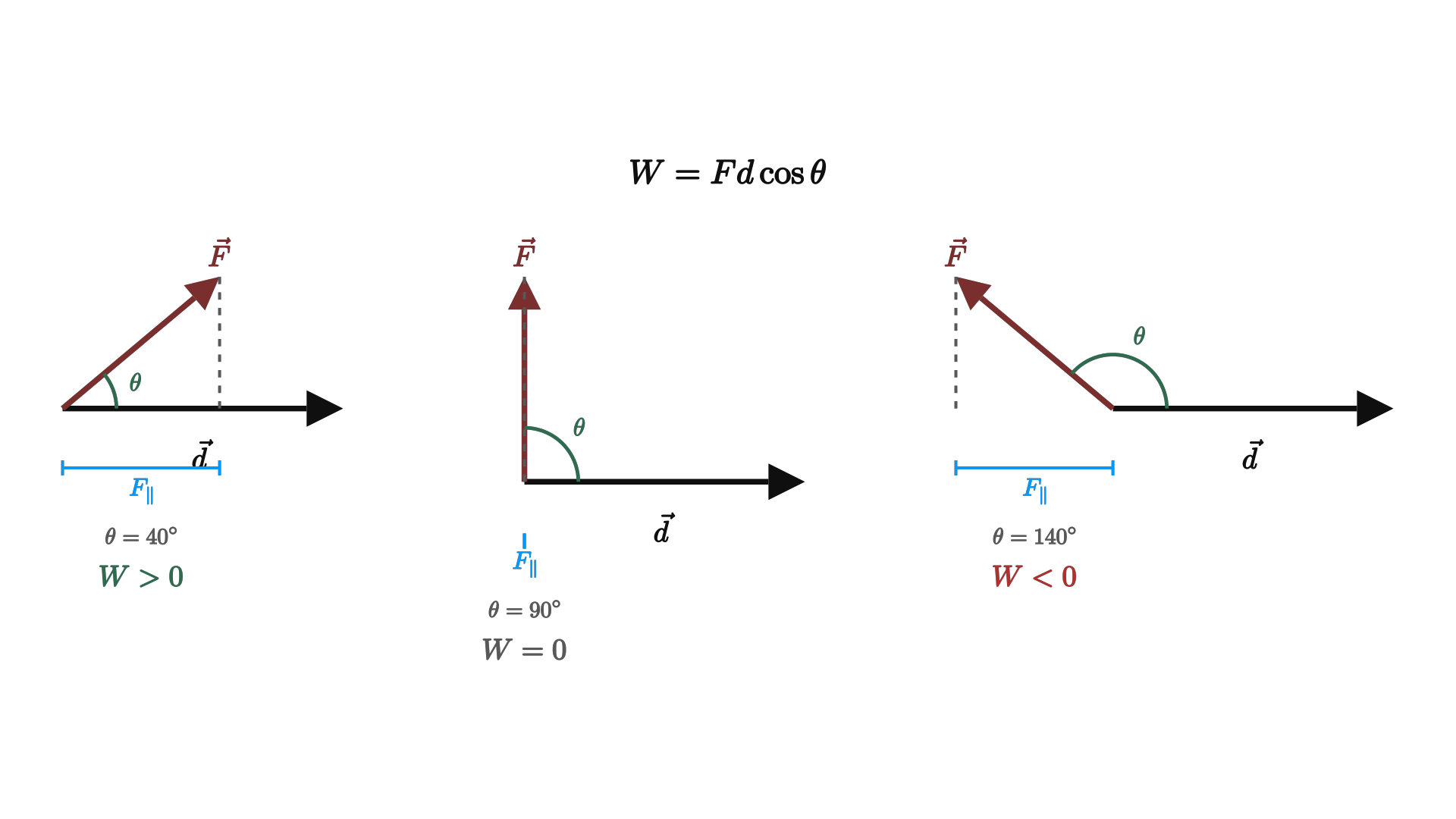
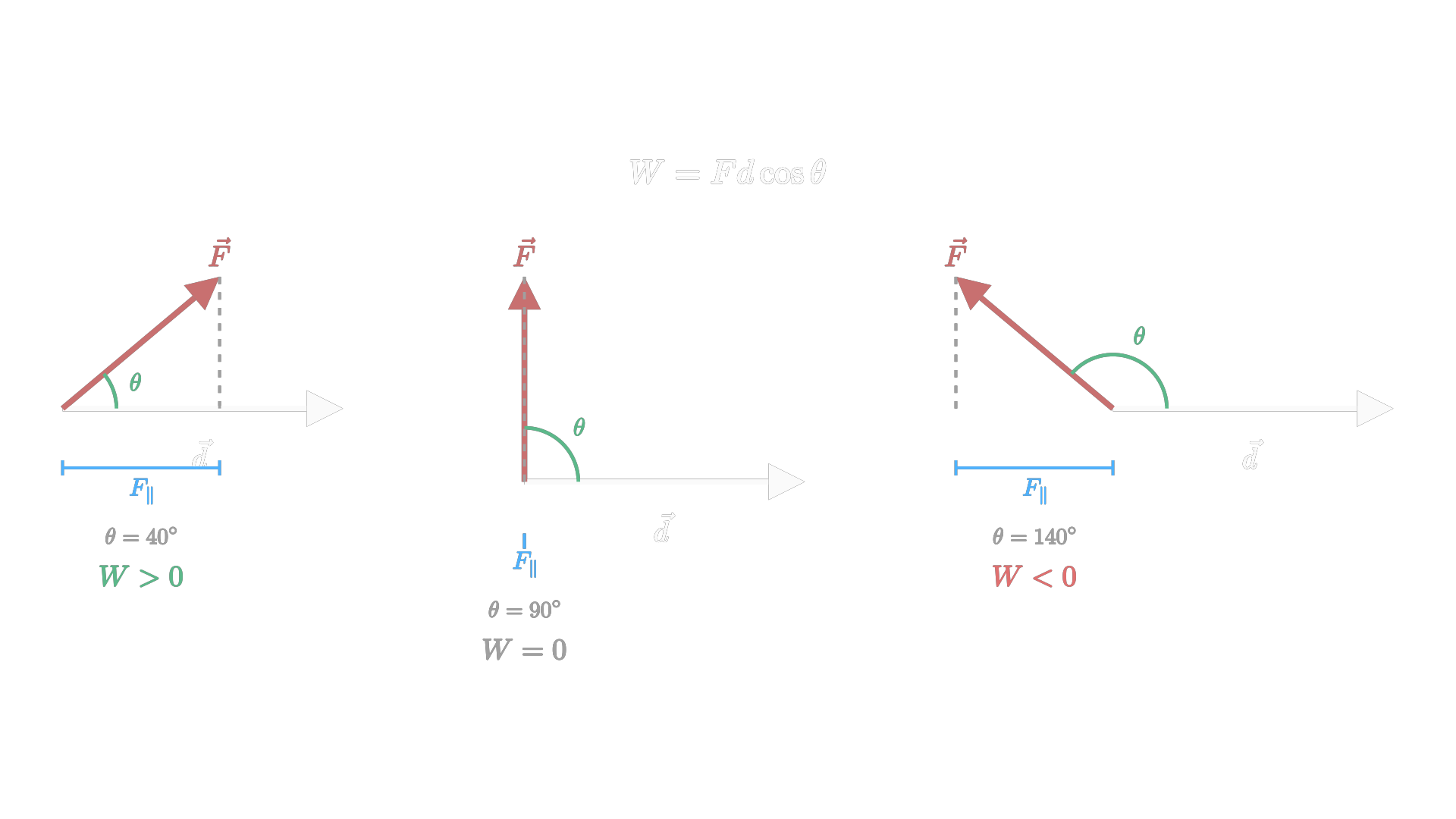
A force at an angle to displacement, decomposed into the parallel component that does work and the perpendicular component that doesn't力与位移成一定夹角时的分解:沿位移做功的平行分量与不做功的垂直分量
When a constant force $\vec{F}$ acts on an object undergoing displacement $\vec{d}$, the work done is the dot product of the two vectors. Only the component of force parallel to the displacement transfers energy. The perpendicular component changes direction without changing speed — think of centripetal force in circular motion.
where $\theta$ is the angle between $\vec{F}$ and $\vec{d}$其中 $\theta$ 为 $\vec{F}$ 与 $\vec{d}$ 之间的夹角
Sign Convention
When $\theta < 90°$: force has a component along displacement → $W > 0$ (positive work). When $\theta = 90°$: force is perpendicular → $W = 0$. When $\theta > 90°$: force opposes displacement → $W < 0$ (negative work). This is exactly what cosine does.
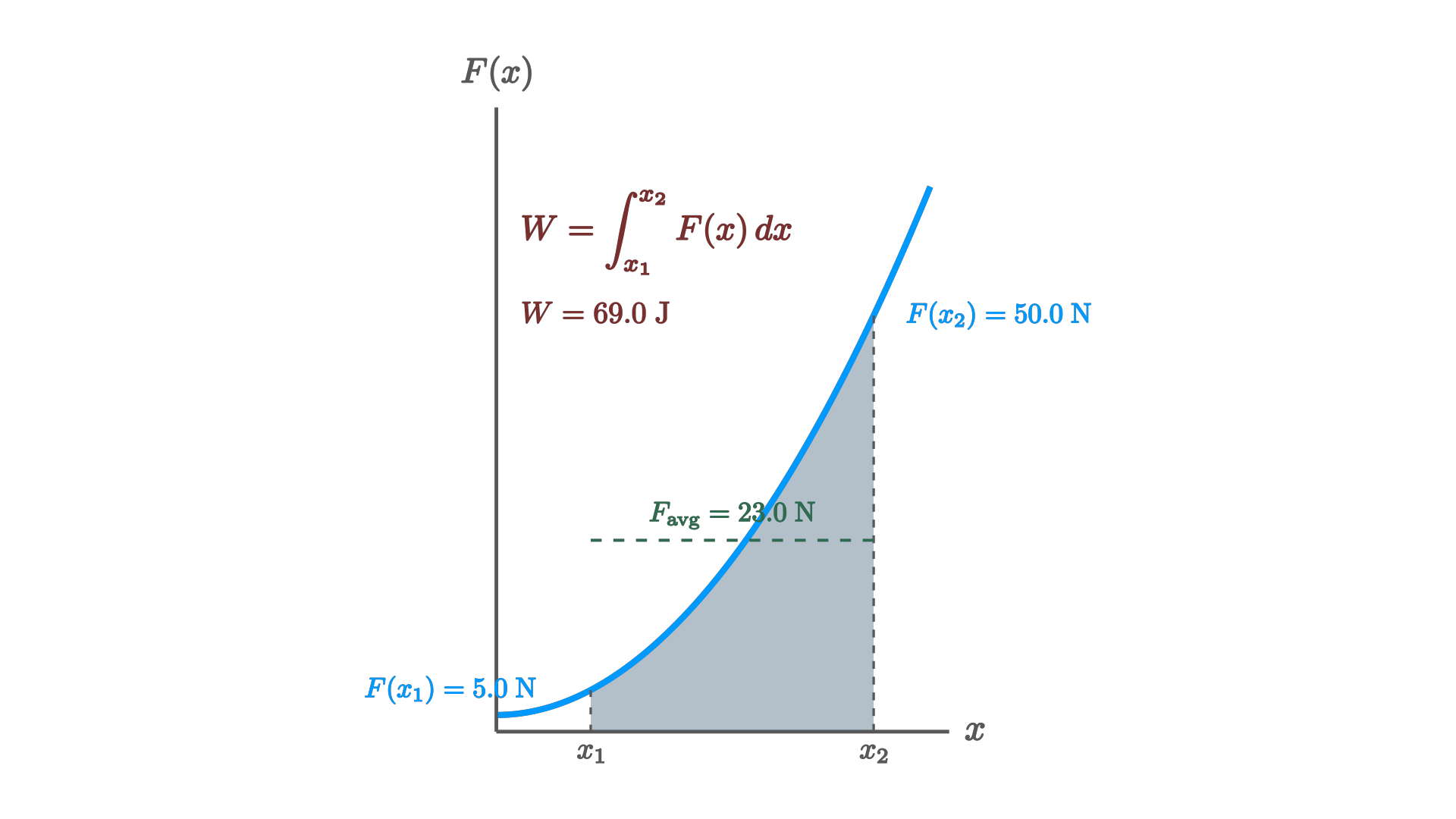
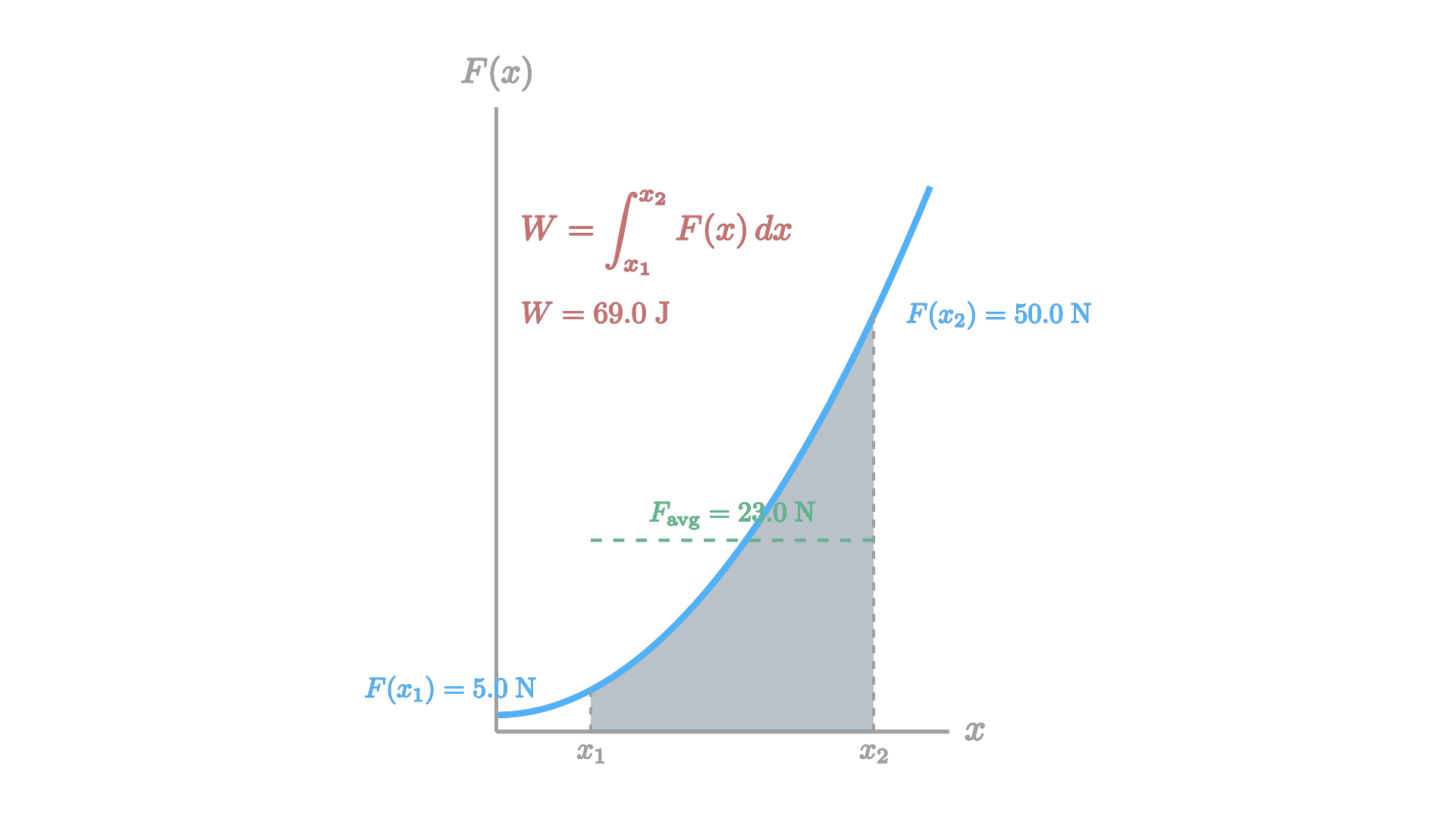
Work as the area under a force-vs-displacement graph, for a force that varies with position力随位置变化时,功即为力—位移图中曲线下方的面积
In AP Physics C, forces are often not constant — springs, gravity at large distances, and many applied forces vary with position. When force depends on position, we must integrate along the path. This is one of the signature calculus applications in the course.
在 AP Physics C 中,力往往不是恒定的——弹簧力、远距离的引力以及许多外加力都会随位置变化。当力依赖于位置时,必须沿路径做积分(integral)。这是本课程最具标志性的微积分应用之一。
Work by a Variable Force变力做功
$$W = \int_a^b \vec{F}(\vec{r}) \cdot d\vec{r}$$
In 1D: $W = \int_{x_a}^{x_b} F(x)\,dx$. Graphically, work = area under $F_\parallel$ vs. displacement curve.在一维情形下:$W = \int_{x_a}^{x_b} F(x)\,dx$。从图像看,功 = $F_\parallel$ 对位移曲线下的面积。
Interactive — Work by a Variable Force互动 —— 变力做功
Adjust the force function $F(x) = ax^n$ and see the work as the shaded area under the curve调整力的函数 $F(x) = ax^n$,观察曲线下的阴影面积即为所做的功
Work Done所做的功
—
J
F(x₁)
—
N
F(x₂)
—
N
Avg Force平均力
—
N
Worked Example — Work Done by a Position-Dependent Force例题 —— 位置相关的变力做功
A force $F(x) = 3x^2 + 2$ (N) is applied as an object moves from $x = 1$ m to $x = 4$ m. Find the work done.
物体在 $x = 1$ m 到 $x = 4$ m 之间运动时受到力 $F(x) = 3x^2 + 2$(N)。求所做的功。
Worked Example — Block on a Rough Incline (Energy Method)例题 —— 粗糙斜面上的滑块(能量方法)
A 3.0 kg block slides 4.0 m down a 30° incline starting from rest. The kinetic friction coefficient is $\mu_k = 0.20$. Find the speed at the bottom using the work–energy theorem.
一个 3.0 kg 的滑块从静止开始沿 30° 斜面下滑 4.0 m,动摩擦系数(coefficient of kinetic friction)$\mu_k = 0.20$。用动能定理(work–energy theorem)求其抵达底端时的速率。
Solving with $\vec{F}=m\vec{a}$ and kinematics gives the same answer, but energy methods skip finding the acceleration explicitly.用 $\vec{F}=m\vec{a}$ 加运动学也能得到同样答案,但能量方法不必显式求出加速度。
The Work–Energy Theorem动能定理
The net work done on an object — by all forces combined — equals the change in that object's kinetic energy. This exact theorem is derivable from Newton's second law via calculus and gives you a powerful alternative to $\vec{F} = m\vec{a}$ for solving problems.
作用在物体上的所有力共同所做的净功等于该物体动能的变化。这条精确定理(work–energy theorem)可由 Newton 第二定律通过微积分推出,是 $\vec{F} = m\vec{a}$ 之外的一种强有力解题工具。
Work–Energy Theorem动能定理
$$\Delta K = \sum W_i = \sum F_{\parallel,i}\, d_i$$
The net work equals $K_f - K_i$.净功等于 $K_f - K_i$。
Calculus Derivation — Memorize the Four Lines
This derivation comes up on the FRQ section often enough to be worth memorizing. Start from Newton's second law and integrate along the path.
Step 1 — Newton's second law for the net force along the motion:
$$F_\text{net} = m\,\frac{dv}{dt}$$
Step 2 — Multiply both sides by the displacement and integrate along the path:
Step 4 — Identify the right-hand side as the change in kinetic energy:
$$W_\text{net} = \Delta K$$
The key trick in step 3 is treating $\frac{dv}{dt}\,dx$ as $v\,dv$. If the FRQ asks you to derive the theorem, reproducing these four lines is worth full credit.
Why It Matters
When you care about speeds rather than accelerations, or when force varies with position, energy methods are often far easier than $\vec{F} = m\vec{a}$. The AP exam tests your ability to choose the best approach.
When friction is present, the energy dissipated equals the friction force times the total path length (not displacement). This energy leaves the mechanical system as thermal energy and sound.
where $d$ is the path length and $F_f$ is the friction force magnitude其中 $d$ 为路程,$F_f$ 为摩擦力大小
Conservative vs. Nonconservative Forces保守力与非保守力
Conservative forces do work that depends only on starting and ending positions — not on the path taken. A round trip gives zero net work. Gravity, spring forces, and electrostatic forces are conservative. Because their work is path-independent, we can define a potential energy for each.
Nonconservative forces do path-dependent work. The most common are friction and air resistance. A box sliding back and forth loses energy on every pass — friction's work is always negative and accumulates. You cannot define a potential energy for friction.
Exam Insight
The AP exam often asks whether a force is conservative or nonconservative, and what this implies about path independence and potential energy. Remember: potential energies can only be defined for conservative forces.
应试要点
AP 经常考某个力是保守还是非保守,以及由此能否说做功与路径无关、能否定义势能。记住:势能只能对保守力定义。
A block is pulled 5 m across a rough floor by a rope at $30°$ above horizontal with tension 40 N. Kinetic friction is 12 N. What is the net work done on the block?一根绳沿水平方向以上 $30°$ 拉一个木块在粗糙地面上前进 5 m,张力 40 N,动摩擦力 12 N。对木块所做的净功是多少?
(A) 200 J
(B) 113 J
(C) 173 J
(D) 60 J
Correct. $W_T = 40 \times 5 \times \cos 30° \approx 173$ J. $W_f = -12 \times 5 = -60$ J. Normal and gravity are perpendicular → zero work. Net = $173 - 60 = 113$ J.正确。$W_T = 40 \times 5 \times \cos 30° \approx 173$ J;$W_f = -12 \times 5 = -60$ J。法向力与重力均垂直于位移 → 不做功。净功 $= 173 - 60 = 113$ J。
Tension work: $W_T = Fd\cos\theta = 40(5)\cos 30° \approx 173$ J. Friction: $W_f = -60$ J. Net = $113$ J. Answer: (B).张力做功:$W_T = Fd\cos\theta = 40(5)\cos 30° \approx 173$ J;摩擦力做功:$W_f = -60$ J。净功 $= 113$ J,选 (B)。
Topic 3.3专题 3.3
Potential Energy势能
Potential energy is the energy stored in a system by virtue of the positions or configurations of the objects within it. Unlike kinetic energy, potential energy is a property of a system of interacting objects. A ball held above the ground has gravitational PE, but that energy belongs to the ball–Earth system, not the ball alone.
Potential energy is scalar. Its value depends on position, and the observer gets to choose where PE is zero. Only changes in PE matter physically — pick the reference that makes the math simplest.
System Thinking
A common misconception: "the ball has potential energy." Strictly, a single isolated object cannot have PE. Potential energy arises from the interaction between objects (ball and Earth, block and spring). The AP exam may test this distinction.
The deep connection between conservative forces and potential energy runs in both directions. If you know the force, integrate to find PE; if you know PE, differentiate to find force. This reciprocal relationship is one of the most powerful tools in physics.
$$\Delta U = -\int_a^b \vec{F}_{cf}(\vec{r}) \cdot d\vec{r}$$
The negative sign means a conservative force in the direction of displacement decreases PE.负号意味着:与位移方向一致的保守力会减少势能。
Force from Potential Energy (1D)由势能求力(一维)
$$F_x = -\frac{dU(x)}{dx}$$
Force equals the negative slope of the $U(x)$ curve — always points toward decreasing $U$.力等于 $U(x)$ 曲线斜率的相反数——始终指向 $U$ 减小的方向。
Watch the Negative Sign
Students frequently lose the negative sign in $F = -dU/dx$. This sign is essential: it tells you forces point "downhill" on the PE landscape. If $U$ increases to the right, the force points left.
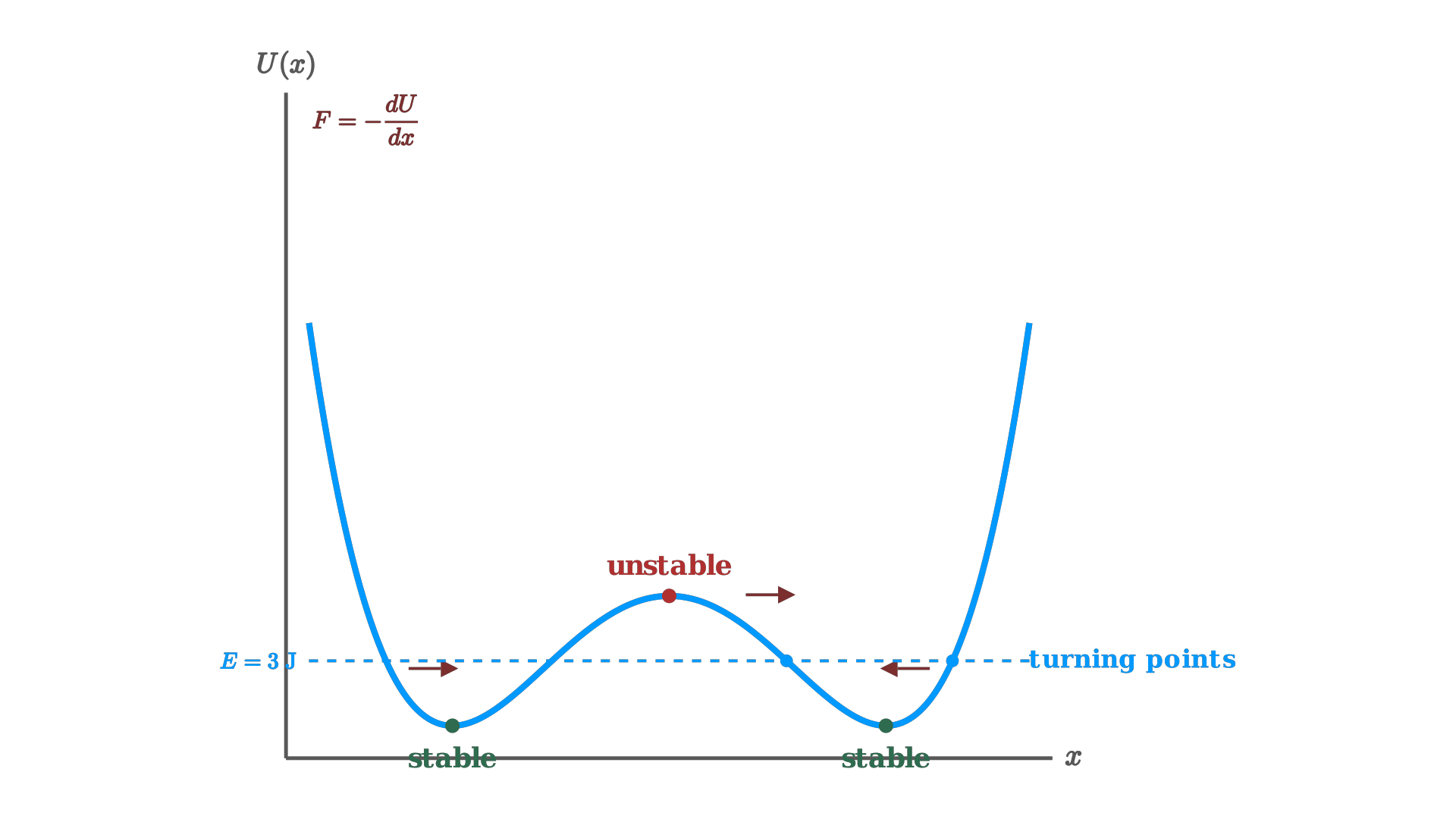
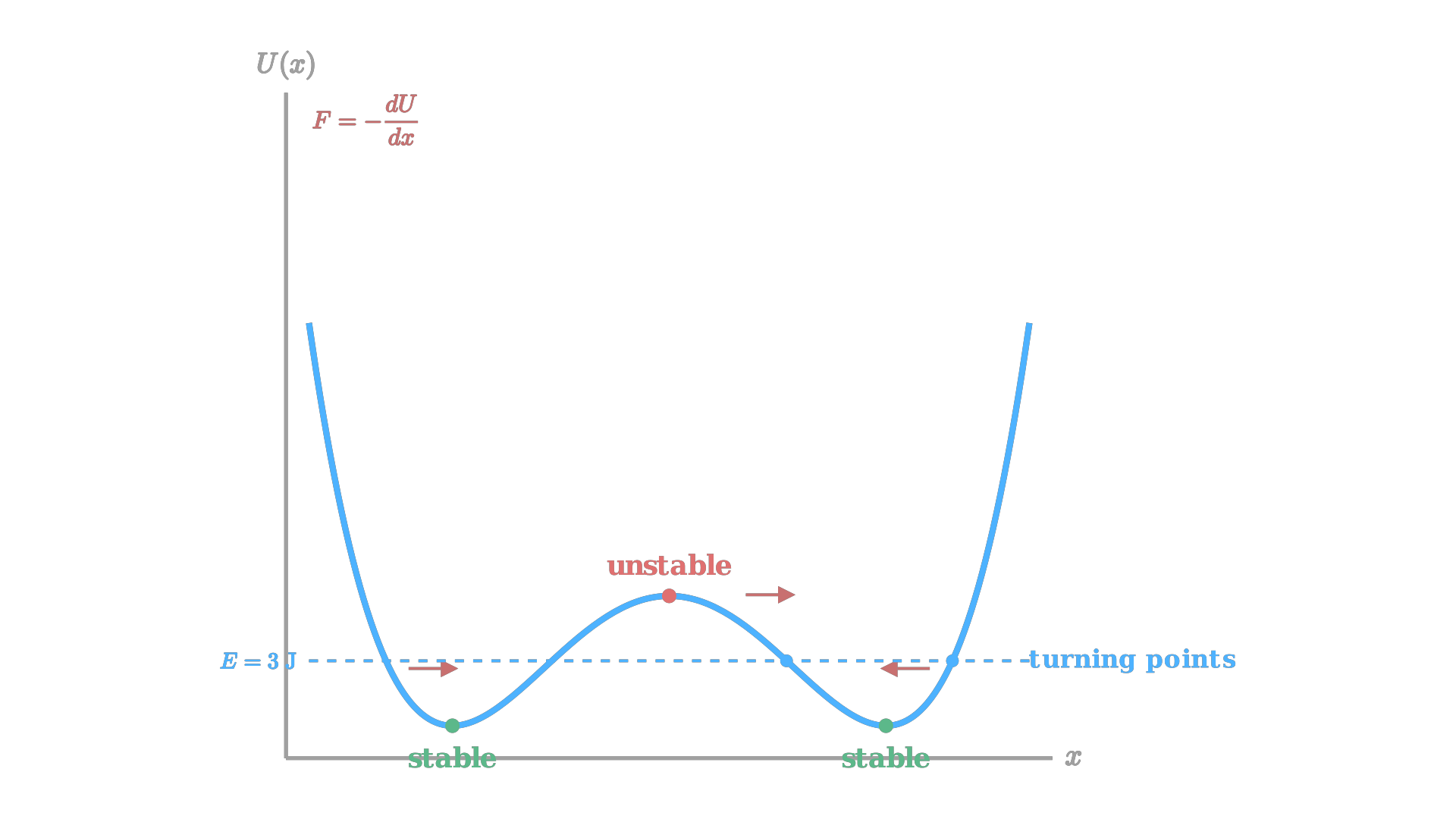
A potential energy landscape: stable equilibrium at a valley, unstable equilibrium at a peak势能曲线:稳定平衡位于谷底,不稳定平衡位于峰顶
At any position where $dU/dx = 0$, the force is zero and the system is in equilibrium. Stable equilibrium occurs at a local minimum (valleys) — displaced objects get pushed back. Unstable equilibrium occurs at a local maximum (peaks) — displaced objects get pushed away.
AP Exam Trap
On a $U(x)$ graph, the force is the negative slope, not the value of $U$. High $U$ with zero slope means zero force. Low $U$ with steep slope means large force. Don't confuse "high potential energy" with "large force."
AP 考试陷阱
在 $U(x)$ 图上,力是斜率的相反数,不是 $U$ 的数值本身。$U$ 很大但斜率为零,力依然为零;$U$ 很小但斜率很陡,力却很大。别把"势能高"误当成"力大"。
Interactive — Potential Energy Landscape互动 —— 势能曲线
Explore $U(x) = ax^4 - bx^2 + c$ — find equilibrium positions and turning points for a given total energy $E$.探究 $U(x) = ax^4 - bx^2 + c$——给定总能量 $E$,找出平衡位置与转折点(turning points)。
Equilibrium平衡位置
—
Turning points转折点
—
m
Animates the particle bouncing between turning points (energy conserved).演示质点在两个转折点之间来回运动(能量守恒)。
Common Potential Energies常见势能形式
Gravitational PE (Near Surface)重力势能(近地表)
$$\Delta U_g = mg\Delta y$$
Valid when $g$ is approximately constant (near Earth's surface)$g$ 近似为常量(近地表)时成立
Gravitational PE (General)引力势能(一般形式)
$$U_g = -\frac{Gm_1 m_2}{r}$$
Two masses separated by $r$. Note the negative sign — zero is at $r = \infty$.两个相距 $r$ 的质量之间。注意负号——零势能取在 $r = \infty$ 处。
Elastic (Spring) PE弹性(弹簧)势能
$$U_s = \frac{1}{2}k(\Delta x)^2$$
where $\Delta x$ is the displacement from the spring's natural length其中 $\Delta x$ 是相对弹簧自然长度的位移
Multi-Object Systems
When a system contains more than two objects, the total PE is the sum of every pair's PE. For three masses: $U_{12} + U_{13} + U_{23}$.
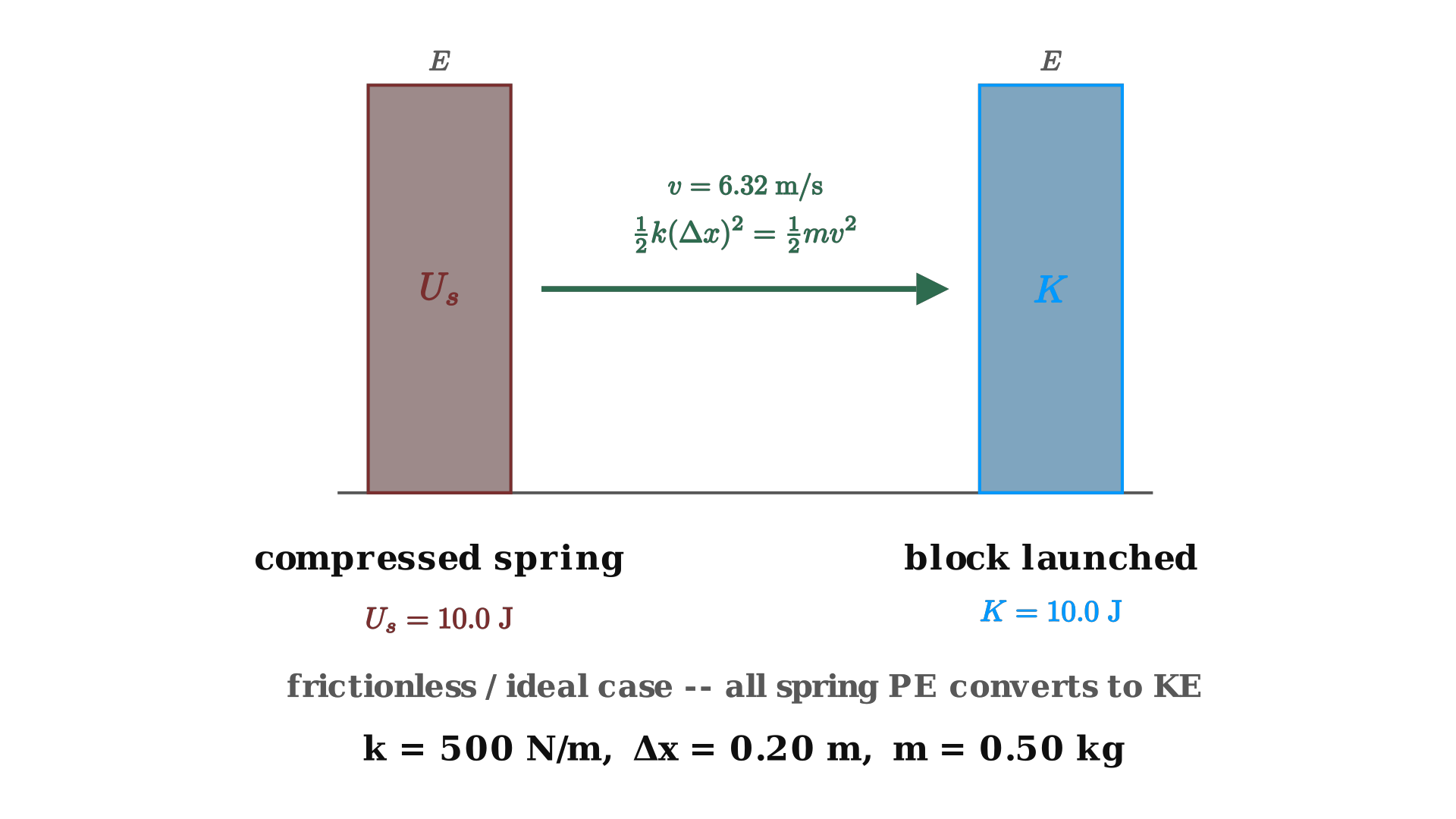
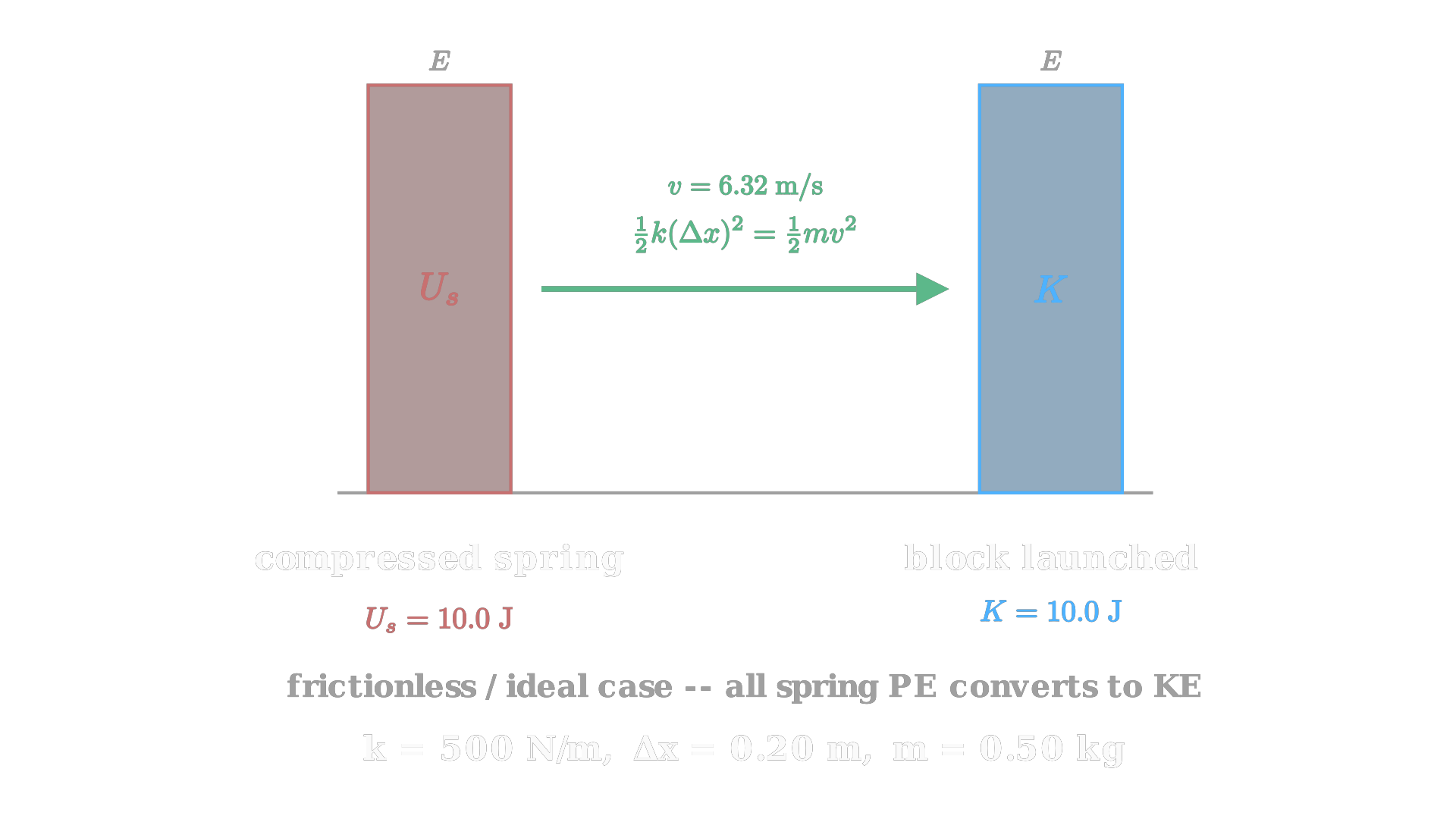
Energy conservation as a spring launches a block: all potential energy converts to kinetic energy弹簧发射木块过程中的能量守恒:势能全部转化为动能
Energy conservation is one of the most profound principles in all of science. The total energy of an isolated system never changes — energy can be transformed and transferred, but never created or destroyed.
能量守恒(conservation of energy)是整个科学中最深刻的原理之一:孤立系统的总能量永远不变——能量只能转化或传递,不能被创生或毁灭。
In AP Physics C: Mechanics, we focus on mechanical energy — the sum of kinetic and potential energies. The conservation law takes different forms depending on your system choice:
在 AP Physics C: Mechanics 中,我们重点研究机械能(mechanical energy)——动能与势能之和。守恒律的表达形式取决于系统的选取:
System Choice Matters
A single-object system can have KE but not PE (PE requires interacting objects). By choosing a larger system, you can treat internal forces as conservative and use PE rather than computing work. The AP exam often rewards smart system choices.
Worked Example — Loop-the-Loop Minimum Release Height例题 —— 竖直圆环轨道的最小释放高度
A small block is released from rest at height $h$ on a frictionless track that leads into a vertical loop of radius $R$. Find the minimum $h$ (in terms of $R$) for the block to maintain contact with the track at the top of the loop.
Step 2 — Energy conservation, release point to top of loop第 2 步 —— 从释放点到圆环顶端的能量守恒
Release from rest at height $h$; top of loop is at height $2R$:从高度 $h$ 处静止释放;圆环顶端高度为 $2R$:
$$mgh = \tfrac{1}{2}m v_\text{top}^2 + mg(2R)$$
$$gh = \tfrac{1}{2}(gR) + 2gR = \tfrac{5}{2}gR$$
$$\boxed{\,h_\text{min} = \tfrac{5}{2}R\,}$$
Common slip: forgetting to add the $2R$ height of the top of the loop to the energy equation.常见错误:忘记把圆环顶端的 $2R$ 高度加进能量方程。
Worked Example — Bungee Jumper Maximum Stretch例题 —— 蹦极的最大伸长
A 70 kg jumper steps off a platform attached to an ideal bungee cord of natural length $L_0 = 15$ m and spring constant $k = 200$ N/m. Use $g = 9.8$ m/s². Find the maximum stretch $\Delta x$ of the cord (the jumper momentarily at rest at the lowest point).
Sanity check: the jumper falls $L_0 + \Delta x \approx 29$ m total.验算:蹦极者总下落 $L_0 + \Delta x \approx 29$ m,合理。
A pendulum swings from height $h$ above its lowest point. At the lowest point, which statement is correct about the system (bob + Earth)?一个单摆从相对最低点高度为 $h$ 处释放。在最低点处,关于系统(摆球 + 地球)下列哪种说法正确?
(A) KE = $mgh$ and且 PE = $mgh$
(B) KE = 0 and且 PE = $mgh$
(C) KE = $mgh$ and PE = 0 (choosing lowest point as reference)、PE = 0(以最低点为参考)
(D) Total mechanical energy = 0总机械能 = 0
Correct. Setting $U = 0$ at the bottom, all initial gravitational PE ($mgh$) converts to KE there. So $K = mgh$ and $U = 0$.正确。取最低点处 $U = 0$,初始重力势能 $mgh$ 在此处全部转化为动能。故 $K = mgh$,$U = 0$。
At the top: all energy is PE = $mgh$. At the bottom ($U = 0$ there): all PE → KE. So $K = mgh$. Answer: (C).最高点时:全部为势能 $mgh$。最低点(取 $U = 0$):势能全转为动能,$K = mgh$。选 (C)。
Topic 3.5专题 3.5
Power功率
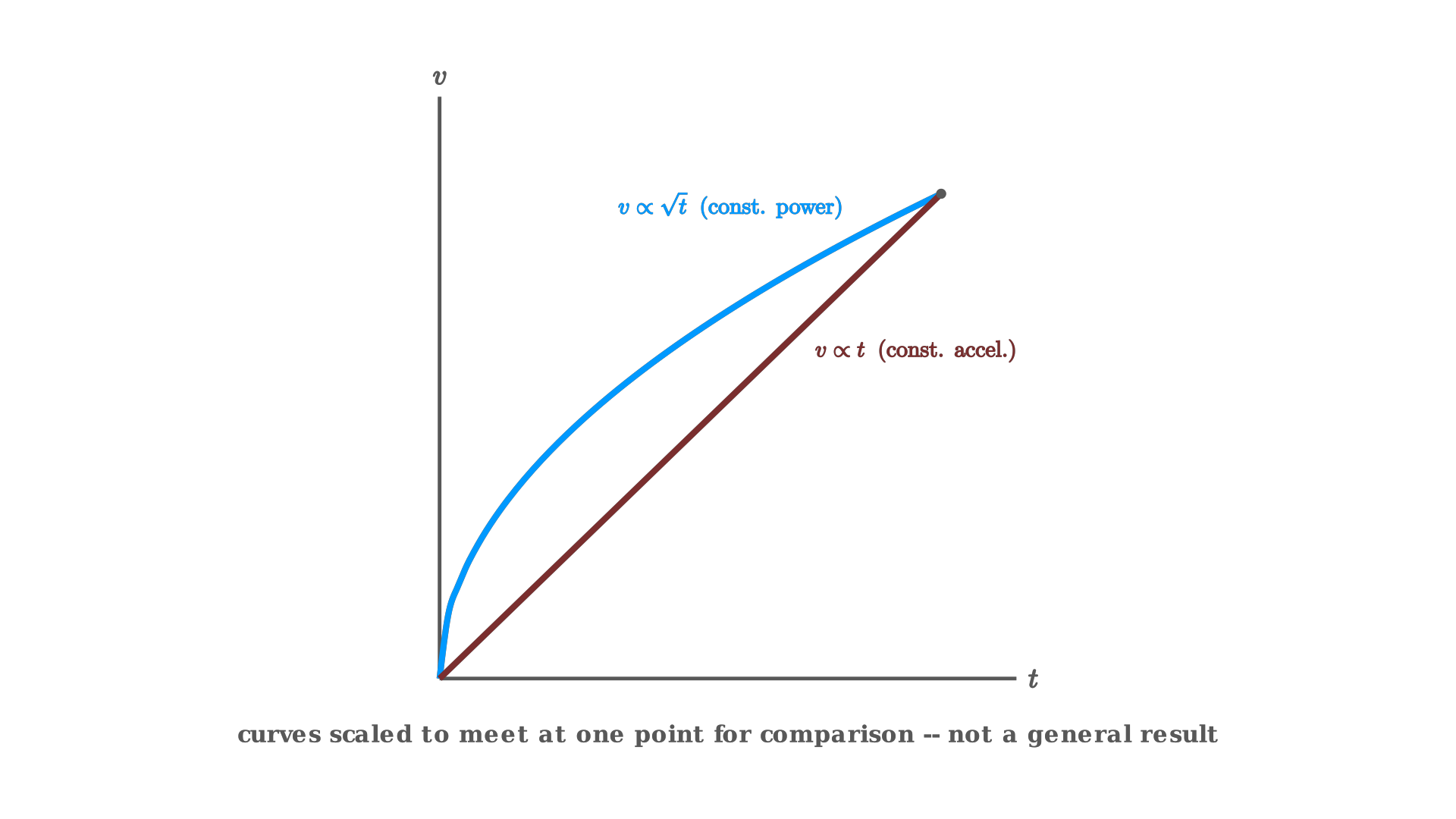
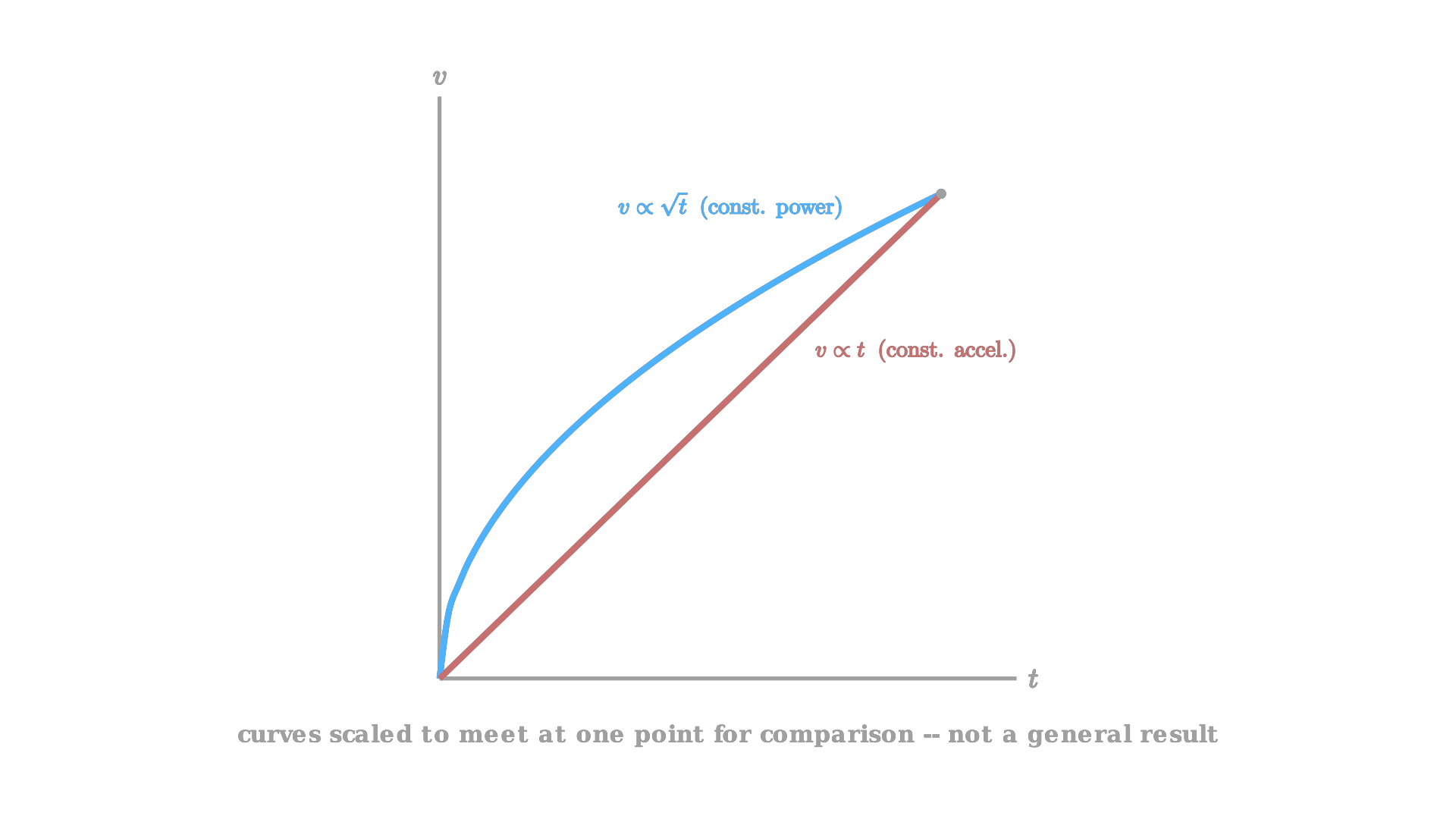
Velocity growing as the square root of time under constant power, contrasted with the linear growth of constant acceleration恒功率下速度按时间的平方根增长,与恒加速度下的线性增长形成对比
Power measures how quickly energy is transferred or converted. Two machines might do the same total work, but the faster one delivers more power. The SI unit is the Watt (W = J/s). One horsepower ≈ 746 W.
A particularly useful derived formula connects power directly to force and velocity:
下面这条派生公式特别有用,它把功率直接与力和速度联系起来:
Power from Force and Velocity由力与速度求功率
$$P = \vec{F} \cdot \vec{v} = Fv\cos\theta$$
where $\theta$ is the angle between $\vec{F}$ and $\vec{v}$其中 $\theta$ 为 $\vec{F}$ 与 $\vec{v}$ 之间的夹角
Terminal Velocity Connection
At terminal velocity, net force is zero and KE doesn't change. All power from the driving force is dissipated by resistance. Common AP setup: $P_\text{engine} = F_\text{drag} \cdot v_\text{terminal}$.
Worked Example — Car vs. Quadratic Drag (P = F·v, FRQ-style)例题 —— 汽车与二次阻力(P = F·v,FRQ 风格)
A car of mass $m = 1200$ kg cruises on a level road. Aerodynamic drag is $F_\text{drag} = bv^2$ with $b = 0.80\;\text{N}\cdot\text{s}^2/\text{m}^2$. The engine delivers force $F_\text{eng}$ at the drive wheels. (a) Find the engine force and power needed to cruise at a constant $v = 30$ m/s. (b) If the engine can deliver at most $P_\text{max} = 60$ kW, find the car's top speed. (c) At top speed, what is the instantaneous acceleration if the engine force is suddenly doubled (drag unchanged)?
At top speed the car is still at constant $v$, so drag balances the engine force. The power absorbed by drag at any speed is:达到最高速时车仍以恒定 $v$ 行驶,阻力等于发动机力。任意速度下阻力吸收的功率为:
$$P_\text{drag} = F_\text{drag}\,v = bv^3$$
Setting this equal to the engine's maximum power:令其等于发动机最大功率:
Takeaway: $P = \vec{F}\cdot\vec{v}$ connects engine output, the drag law, and top speed — each part of this FRQ is one line once you identify which quantity is constant.
Power increases linearly with time because $v$ increases linearly while $F$ is constant.由于 $F$ 恒定而 $v$ 线性增加,功率随时间线性增长。
Worked Example — Constant-Power Acceleration (Calculus)例题 —— 恒功率加速(微积分)
An engine delivers a constant 60 kW of power to a 1500 kg car starting from rest on a level frictionless road. Find (a) the speed at $t = 8.0$ s and (b) the distance covered in that time.
发动机以恒定 60 kW 功率驱动 1500 kg 的汽车,从静止在平直无摩擦的路面上加速。求 (a) $t = 8.0$ s 时的速率;(b) 这段时间内行驶的距离。
(a) Speed at $t = 8.0$ s(a) $t = 8.0$ s 时的速率
Constant $P$ means $W = Pt$. Apply the work–energy theorem:$P$ 恒定意味着 $W = Pt$。代入动能定理:
At $t \to 0$ the force $F = P/v$ diverges, which is an idealization. Real engines limit force at low speed via torque-vs-rpm curves.$t \to 0$ 时,力 $F = P/v$ 发散,这是理想化的结果。真实发动机会通过扭矩—转速曲线在低速时限制最大力。
An engine delivers constant power $P$ to a car of mass $m$ starting from rest on a frictionless surface. After time $t$, the speed is proportional to:发动机以恒定功率 $P$ 驱动质量为 $m$ 的汽车,在无摩擦地面上从静止开始运动。经过时间 $t$ 后,速率与下列哪一项成正比?
$P$ constant → $W = Pt$. Then $Pt = \frac{1}{2}mv^2 \Rightarrow v \propto \sqrt{t}$. Answer: (D).$P$ 恒定 → $W = Pt$。再代入 $Pt = \frac{1}{2}mv^2 \Rightarrow v \propto \sqrt{t}$。选 (D)。
Exam Preparation考试备考
Exam Strategy考试策略
MC
Multiple-Choice Questions多选题(Multiple Choice)
MCQs test your ability to compare kinetic energies using $v^2$ dependence, determine the sign of work from force–displacement angles, read $U(x)$ graphs to identify equilibrium and turning points, and apply conservation to two-state problems. Many are "conceptual calculus" — asking what happens when you integrate or differentiate. Practice quickly identifying whether a problem is best solved with energy methods or Newton's laws.
Multiple Choice 部分考查:利用 $v^2$ 关系比较动能;由力与位移之间的夹角判断做功正负;从 $U(x)$ 图识别平衡位置与转折点;以及对"两态"问题应用守恒律。许多题目属于"概念性微积分"——问你积分或求导后会得到什么。练就一眼判断"该用能量方法还是 Newton 定律"的本能。
The Mathematical Routines (MR) question often draws from this unit. You'll derive symbolic expressions (e.g., speed at the bottom of a ramp), justify whether a force is conservative, sketch $K$, $U$, $E$ vs. position graphs, and write coherent paragraph-length analyses. Show every step of your calculus — the AP exam awards points for correct integration setup even if algebra has errors.
Instantaneous rate of energy transfer by a force.力传递能量的瞬时速率。
Stable vs. Unstable Equilibrium稳定与不稳定平衡
$$\frac{dU}{dx} = 0$$
Stable: local minimum of $U(x)$. Unstable: local maximum.稳定:$U(x)$ 的局部极小;不稳定:局部极大。
Assessment测评
Unit Quiz单元测验
Score:得分:0 / 8
Q1.A spring ($k = 200$ N/m) is compressed 0.3 m and launches a 0.5 kg block on a frictionless surface. What is the block's speed?弹簧($k = 200$ N/m)被压缩 0.3 m,在无摩擦表面上将 0.5 kg 木块弹出。木块的速率是多少?
Q3.A 2 kg ball drops from rest at 5 m. Using $g = 10$ m/s², what is its KE just before hitting the ground?2 kg 的小球从 5 m 高处自由下落。取 $g = 10$ m/s²,触地前瞬间的动能是多少?
(A) 100 J
(B) 50 J
(C) 200 J
(D) 10 J
All PE converts to KE: $K = mgh = 2(10)(5) = 100$ J.势能全部转化为动能:$K = mgh = 2(10)(5) = 100$ J。
Q6.A $4.0\;\text{kg}$ block slides $5.0\;\text{m}$ across a horizontal surface with $\mu_k = 0.30$. The work done by friction on the block is:$4.0\;\text{kg}$ 的木块在水平面上滑行 $5.0\;\text{m}$,动摩擦系数 $\mu_k = 0.30$。摩擦力对木块所做的功是:
(A) $+58.8\;\text{J}$
(B) $+11.8\;\text{J}$
(C) $-58.8\;\text{J}$
(D) $0\;\text{J}$ (friction is perpendicular to motion)$0\;\text{J}$(摩擦力垂直于运动方向)
Kinetic friction always opposes motion ($\theta = 180^{\circ}$), so $W_f = -f_k d < 0$. Magnitude: $\mu_k mg \times d = 0.30 \times 4.0 \times 9.8 \times 5.0 = 58.8\;\text{J}$. Sign is negative.动摩擦力始终与运动反向($\theta = 180^{\circ}$),故 $W_f = -f_k d < 0$。大小为 $\mu_k mg \times d = 0.30 \times 4.0 \times 9.8 \times 5.0 = 58.8\;\text{J}$,取负号。
Q7.A car of mass $m = 1200\;\text{kg}$ travels at constant velocity $v = 25\;\text{m/s}$ up a $5^{\circ}$ incline. Ignore drag. The instantaneous power delivered by the engine is closest to:质量 $m = 1200\;\text{kg}$ 的汽车以恒定速度 $v = 25\;\text{m/s}$ 沿 $5^{\circ}$ 斜坡上行,忽略空气阻力。发动机输出的瞬时功率最接近:
At constant velocity the engine's force balances gravity along the slope: $F = mg\sin\theta = (1200)(9.8)\sin 5^{\circ} \approx 1024\;\text{N}$. Power: $P = F v = 1024 \times 25 \approx 25.6\;\text{kW}$. Answer (B). Note that "constant velocity" means $\Delta K = 0$, but the engine still does positive work against gravity.匀速时发动机推力沿斜面与重力分量平衡:$F = mg\sin\theta = (1200)(9.8)\sin 5^{\circ} \approx 1024\;\text{N}$;$P = F v = 1024 \times 25 \approx 25.6\;\text{kW}$。选 (B)。注意"匀速"意味着 $\Delta K = 0$,但发动机仍要对抗重力做正功。
Use $P = \vec F \cdot \vec v$. At constant velocity along the slope, $F = mg\sin\theta$. $P = mg\sin\theta \cdot v = 1200 \times 9.8 \times \sin 5^{\circ} \times 25 \approx 25.6\;\text{kW}$.用 $P = \vec F \cdot \vec v$。沿斜面匀速时 $F = mg\sin\theta$,故 $P = mg\sin\theta \cdot v = 1200 \times 9.8 \times \sin 5^{\circ} \times 25 \approx 25.6\;\text{kW}$。
Q8.A particle moves under a one-dimensional potential $U(x) = \tfrac{1}{2}kx^2$ with $k = 8\;\text{N/m}$. If its total mechanical energy is $E = 4\;\text{J}$, the turning points are at:一质点在一维势能 $U(x) = \tfrac{1}{2}kx^2$($k = 8\;\text{N/m}$)中运动。若总机械能 $E = 4\;\text{J}$,转折点位置为:
(A) $x = \pm 1.0\;\text{m}$
(B) $x = \pm 0.5\;\text{m}$
(C) $x = \pm 2.0\;\text{m}$
(D) $x = 0$ only仅在 $x = 0$
Turning points are where $K = 0$, i.e. $U(x) = E$. Solve $\tfrac{1}{2}(8)x^2 = 4 \Rightarrow x^2 = 1 \Rightarrow x = \pm 1.0\;\text{m}$. Answer (A).转折点处 $K = 0$,即 $U(x) = E$。解 $\tfrac{1}{2}(8)x^2 = 4 \Rightarrow x^2 = 1 \Rightarrow x = \pm 1.0\;\text{m}$。选 (A)。
Worked Example — Variable Force, $U(x)$ and Turning Points (FRQ Style)例题 —— 变力、$U(x)$ 与转折点(FRQ 风格)
A particle of mass $m = 0.50\;\text{kg}$ moves along the $x$-axis under a conservative force whose potential energy is $U(x) = x^4 - 8x^2 + 5\;\text{J}$ (with $x$ in metres). The particle is released from rest at $x = 3.0\;\text{m}$. (a) Find the force $F(x)$. (b) Locate every equilibrium of $U(x)$ and classify each as stable or unstable. (c) Find the speed of the particle as it passes through $x = 0$. (d) Determine the turning points of the subsequent motion.
Principle: for a conservative 1-D system, $F(x) = -dU/dx$, equilibria are roots of $dU/dx = 0$ classified by the sign of $d^2U/dx^2$, and energy conservation $E = K + U$ gives speed at any $x$ and turning points at $U(x) = E$.
Compute the total energy $E$ once at the release point — it is conserved, so the same value gives speed at any $x$ and the locations of the turning points.
Let $u = x^2$. Then $u^2 - 8u - 9 = (u - 9)(u + 1) = 0$, so $u = 9$ (the $u = -1$ root is unphysical). Therefore $x = \pm 3.0\;\text{m}$.令 $u = x^2$,则 $u^2 - 8u - 9 = (u - 9)(u + 1) = 0$,得 $u = 9$($u = -1$ 不合理)。故 $x = \pm 3.0\;\text{m}$。
$$\boxed{\,x_\text{turn} = \pm 3.0\;\text{m}\,}$$
Evaluate校验
$x = +3.0\;\text{m}$ recovers the release point — the other turning point is at $x = -3.0\;\text{m}$, which is correct because the potential is symmetric about $x = 0$. ✓$x = +3.0\;\text{m}$ 即释放点;另一转折点在 $x = -3.0\;\text{m}$,正确——势能关于 $x = 0$ 对称。✓
The particle has enough energy ($E = 14 > U(0) = 5$) to cross the central barrier at $x = 0$, so it oscillates over the full range $[-3, +3]$ rather than being trapped in a single well. If $E < 5$, it would be confined to one well only. ✓$E = 14 > U(0) = 5$,质点有足够能量翻越中央势垒,故在 $[-3, +3]$ 整个范围内来回振荡,而非被困在单个势阱中。若 $E < 5$,则只能在某一侧势阱内运动。✓
Speed peaks at the bottoms of the wells, $x = \pm 2$, where $U = 16 - 32 + 5 = -11\;\text{J}$ is minimum — speed there is $\sqrt{2(14 + 11)/0.5} = \sqrt{100} = 10\;\text{m/s}$, the global maximum. The $6.0\;\text{m/s}$ at $x = 0$ is correctly less. ✓速率在势阱底部 $x = \pm 2$ 处达到最大,此处 $U = 16 - 32 + 5 = -11\;\text{J}$ 最低——$v = \sqrt{2(14 + 11)/0.5} = \sqrt{100} = 10\;\text{m/s}$。$x = 0$ 处为 $6.0\;\text{m/s}$,确实较小。✓
Worked Example — Spring → Ramp → Friction (Energy Bookkeeping, FRQ Style)例题 —— 弹簧 → 斜面 → 摩擦(能量记账,FRQ 风格)
A spring with $k = 800\;\text{N/m}$ is compressed by $\Delta x = 0.20\;\text{m}$ at the bottom of a frictionless ramp. When released, it launches a $m = 2.0\;\text{kg}$ block up the ramp. Above the spring's release point, the ramp is inclined at $\theta = 30^{\circ}$ and has kinetic-friction coefficient $\mu_k = 0.25$. (a) Find the launch speed. (b) Find the maximum distance $L$ the block slides up the inclined section before momentarily stopping. (c) Determine whether the block slides back down on its own. Use $g = 9.8\;\text{m/s}^2$.
Principle: energy conservation with non-conservative work — spring PE converts entirely to KE on the frictionless launch zone, then KE converts to gravitational PE plus heat as friction acts up the ramp. Resting condition compares the gravity component along the slope to the maximum static friction.
At rest, the block slides only if the gravity component along the slope exceeds the maximum static friction. Treating $\mu_s \approx \mu_k = 0.25$ as the bound (typical AP simplification):瞬时静止后,只有当沿斜面的重力分量大于最大静摩擦力时才会下滑。沿用 AP 常用近似 $\mu_s \approx \mu_k = 0.25$: