Unit 1: Kinematics第 1 单元:运动学
Describe and predict the motion of objects using vectors, calculus-based definitions of velocity and acceleration, kinematic equations, and the independence of perpendicular motion components.用矢量(vector)、基于微积分的速度(velocity)与加速度(acceleration)定义、运动学方程(kinematic equations),以及垂直方向上运动分量相互独立的原理,描述并预测物体的运动。
Scalars and Vectors标量与矢量Scalars and Vectors in One Dimension一维中的标量与矢量
- State whether a quantity is a scalar or a vector, and give examples of each.
- Write a vector in unit-vector notation using $\hat{i}$, $\hat{j}$ and $\hat{k}$.
- Describe a vector along one axis by its magnitude and a sign (positive or negative direction).
- Calculate the $x$- and $y$-components of a vector from its magnitude and direction.
- Calculate the resultant of two vectors by adding components.
- Calculate the magnitude and direction of a vector from its components, correcting the angle for the quadrant.
- 判断(
state)一个物理量是标量(scalar)还是矢量(vector),并各举例。 - 用 $\hat{i}$、$\hat{j}$、$\hat{k}$ 以单位矢量记号(
unit vector notation)写出矢量。 - 用大小和一个正负号(正方向或负方向)描述沿一条坐标轴的矢量。
- 由矢量的大小与方向计算(
calculate)其 $x$、$y$ 分量。 - 用分量相加的方法计算两个矢量的合矢量(
resultant)。 - 由分量计算矢量的大小与方向,并按象限(
quadrant)校正角度。
Physics begins with measurement, and the first distinction to make is between quantities that have direction and those that don't. A scalar is described by magnitude alone: distance, speed, mass, and energy are all scalars. A vector requires both magnitude and direction: position, displacement, velocity, acceleration, and force are vectors.
物理学始于测量,第一个要区分的概念是:哪些物理量需要方向,哪些不需要。标量(scalar)只用大小描述:距离(distance)、速率(speed)、质量(mass)和能量(energy)都是标量。矢量(vector)则需要大小与方向:位置(position)、位移(displacement)、速度(velocity)、加速度(acceleration)和力(force)都是矢量。
Vectors can be expressed in two equivalent ways. As a magnitude and angle ($|\vec{A}|$ at $\theta$), or in unit vector notation using $\hat{i}$, $\hat{j}$, $\hat{k}$ for the $x$-, $y$-, $z$-directions respectively. The position vector of a point is $\vec{r}$, and the unit vector in its direction is $\hat{r}$.
矢量可以用两种等价的方式表示:大小加方向($|\vec{A}|$ 与角度 $\theta$),或者用单位矢量记号(unit vector notation):$\hat{i}$、$\hat{j}$、$\hat{k}$ 分别表示 $x$、$y$、$z$ 方向。点的位置矢量记作 $\vec{r}$,该方向上的单位矢量记作 $\hat{r}$。
Along a single axis, a vector needs only a magnitude and a sign: choose which direction is positive, and give a vector pointing the opposite way a negative sign. For a vector at an angle (Topic 1.5), give its magnitude and direction angle, or its components $A_x$ and $A_y$. AP Physics 1 does not require unit-vector notation.
沿单一坐标轴时,矢量只需要大小和一个正负号:先选定哪个方向为正,指向相反方向的矢量取负号。对于斜向的矢量(专题 1.5),给出它的大小和方向角,或者给出它的分量 $A_x$ 与 $A_y$。AP Physics 1 不要求使用单位矢量记号。
Along one axis, add the signed values directly.
沿一条坐标轴时,直接把带符号的数值相加。
Always check the quadrant: $\arctan$ alone gives angles only in Q1 and Q4.
务必判断象限(quadrant):仅靠 $\arctan$ 只能给出第一、四象限的角度。
Components from Magnitude and Angle由大小与角度求分量
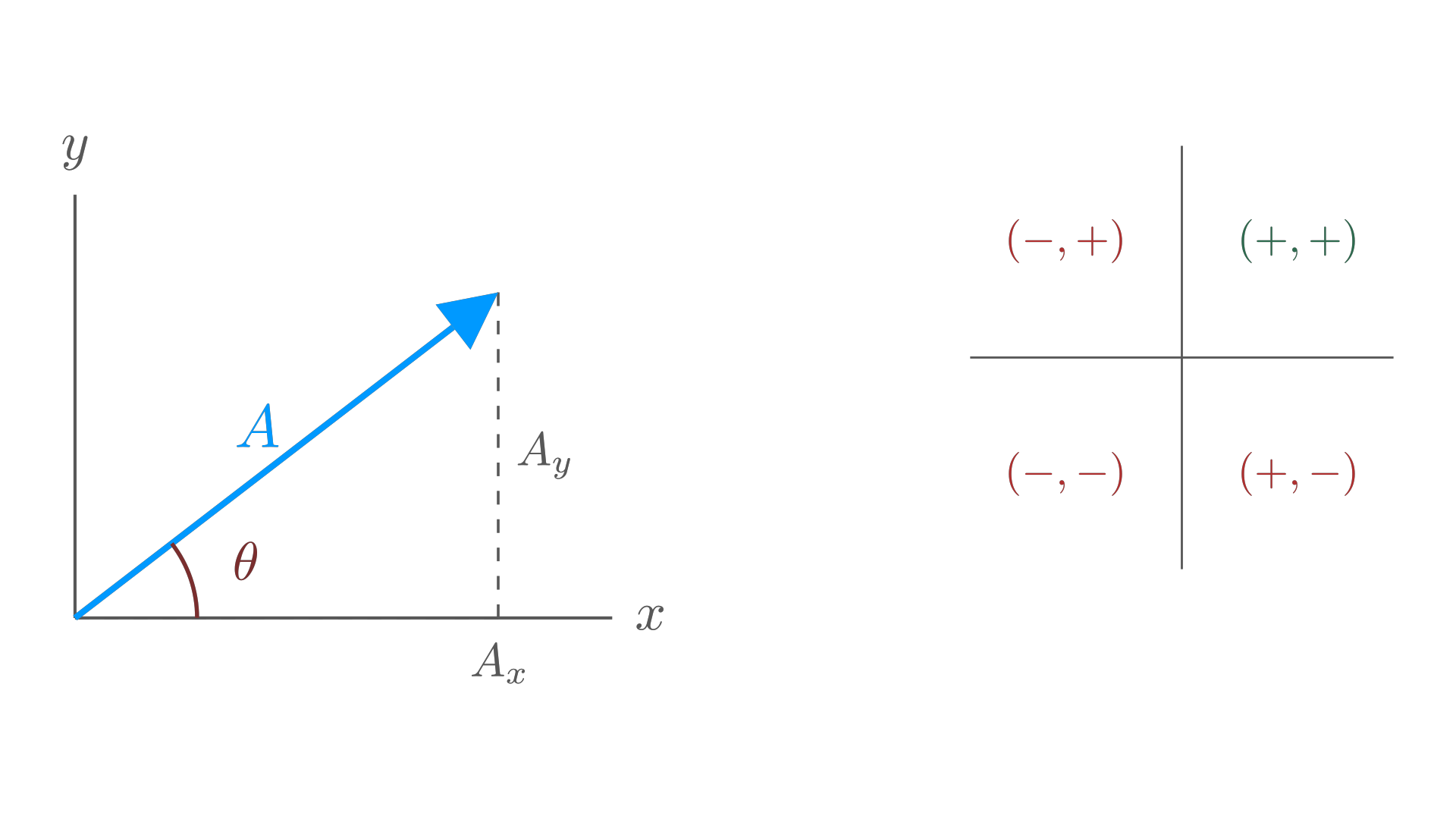
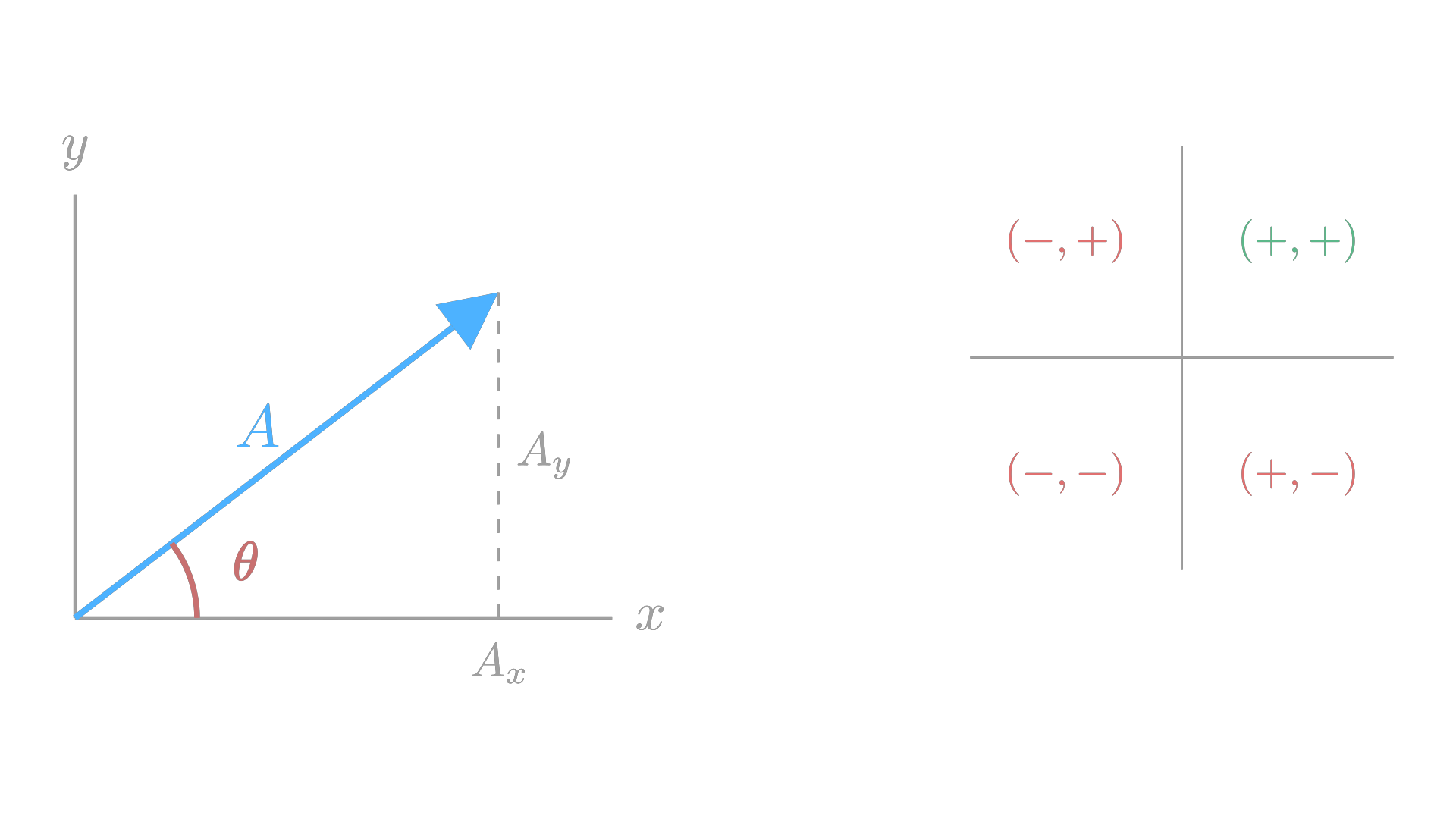
To decompose a vector of magnitude $A$ at angle $\theta$ from the positive $x$-axis:
把大小为 $A$、与正 $x$ 轴夹角为 $\theta$ 的矢量分解为分量(components):
Worked Example: Adding Two Displacements in One Dimension例题:一维中两个位移相加
A hiker walks 30 m east, then 45 m west along the same straight trail. Take east as positive. Find the net displacement and the distance traveled.
一名徒步者沿同一条直路先向东走 30 m,再向西走 45 m。取向东为正。求总位移和走过的路程。
Worked Example: Adding Two Vectors例题:两个矢量相加
Find the resultant of A⃗ = 3î + 4ĵ and B⃗ = −1î + 2ĵ.
Give magnitude and direction.
求 A⃗ = 3î + 4ĵ 与 B⃗ = −1î + 2ĵ 的合矢量(resultant)。
给出其大小与方向。
Worked Example: Resolving a Force into Components例题:把力分解为分量
A 50 N force acts at 37° above horizontal. Find its components.
一个 50 N 的力与水平方向成 37° 向上作用,求其分量。
Always decompose vectors into components before calculating; never add the magnitudes of vectors that point in different directions (a tip-to-tail drawing is a good sketch, but calculate with components). On the AP exam, remember that $\arctan$ gives you an angle relative to the $x$-axis, and you must manually adjust for quadrants II and III.
计算之前永远先把矢量分解为分量,方向不同的矢量绝不能直接把大小相加("首尾相接 tip-to-tail"作图适合画草图,计算仍要用分量)。AP 考试中要记住:$\arctan$ 给出的是相对 $x$ 轴的角度,第二、三象限(quadrant)必须手动校正。
Worked Example: Adjusting for Quadrant III例题:校正第三象限
A vector has components $A_x = -4$, $A_y = -3$. Find its magnitude and direction.
某矢量的分量为 $A_x = -4$、$A_y = -3$。求其大小与方向。
Sort these into scalars and vectors: speed, velocity, distance, displacement, acceleration, mass.把下列物理量分为标量与矢量:速率、速度、距离、位移、加速度、质量。
Scalars (magnitude only): speed, distance, mass. Vectors (magnitude and direction): velocity, displacement, acceleration. Speed is the magnitude of velocity, so the pair differs only in whether direction is included.
标量(只有大小):速率、距离、质量。矢量(大小与方向):速度、位移、加速度。速率是速度的大小,两者的区别只在于是否包含方向。
A velocity of $20$ m/s points at $150°$ from the $+x$-axis. Find its components.某速度大小为 $20$ m/s,方向与 $+x$ 轴成 $150°$。求其分量。
$v_x = 20\cos 150° = 20(-0.866) \approx -17.3$ m/s and $v_y = 20\sin 150° = 20(0.5) = 10.0$ m/s. The negative $v_x$ and positive $v_y$ confirm the vector lies in quadrant II.
$v_x = 20\cos 150° = 20(-0.866) \approx -17.3$ m/s,$v_y = 20\sin 150° = 20(0.5) = 10.0$ m/s。$v_x$ 为负、$v_y$ 为正,说明矢量在第二象限。
Find the magnitude and direction of $\vec{A} + \vec{B}$ for $A_x = 3$, $A_y = 1$ and $B_x = -8$, $B_y = 11$.已知 $A_x = 3$、$A_y = 1$、$B_x = -8$、$B_y = 11$,求 $\vec{A} + \vec{B}$ 的大小与方向。
Add components: $C_x = -5$ and $C_y = 12$. Magnitude: $|\vec{C}| = \sqrt{25 + 144} = 13$. Reference angle: $\arctan(12/5) \approx 67.4°$. With $C_x < 0$ and $C_y > 0$ the vector is in quadrant II, so $\theta = 180° - 67.4° \approx 112.6°$ from the $+x$-axis.
逐分量相加:$C_x = -5$,$C_y = 12$。大小:$|\vec{C}| = \sqrt{25 + 144} = 13$。参考角:$\arctan(12/5) \approx 67.4°$。由于 $C_x < 0$、$C_y > 0$,矢量在第二象限,所以 $\theta = 180° - 67.4° \approx 112.6°$(从 $+x$ 轴量起)。
Displacement, Velocity, and Acceleration位移、速度与加速度
- Distinguish distance (scalar) from displacement (vector) and calculate each for a trip that reverses direction.
- Calculate average velocity, average speed and average acceleration over a time interval.
- Explain instantaneous velocity as the slope of the tangent line to a position-time graph.
- Explain why a negative acceleration does not always mean the object is slowing down.
- Calculate $v(t)$ and $a(t)$ by differentiating $x(t)$, and $x(t)$ by integrating $v(t)$ with an initial condition.
- 区分距离(
distance,标量)与位移(displacement,矢量),并对往返运动分别计算。 - 计算一段时间内的平均速度(
average velocity)、平均速率(average speed)与平均加速度。 - 解释(
explain)瞬时速度是位置-时间图上切线(tangent line)的斜率。 - 解释为什么加速度为负并不总意味着物体在减速。
- 对 $x(t)$ 求导得到 $v(t)$ 与 $a(t)$,并利用初始条件对 $v(t)$ 积分得到 $x(t)$。
When we model a physical object, we often use the object (particle) model: ignoring its size, shape, and internal structure and treating it as a single point. This simplification lets us focus entirely on the object's position as a function of time.
建模物理对象时,常用质点模型(particle model):忽略物体的大小、形状和内部结构,把它当作一个点。这样我们就只关注物体的位置(position)随时间的变化。
distance,标量):经过的总路程,永远为正。
位移(displacement,矢量):位置的变化,有方向,可正可负。
往返一周后位移为零,但距离非零。
Average vs. Instantaneous平均量与瞬时量
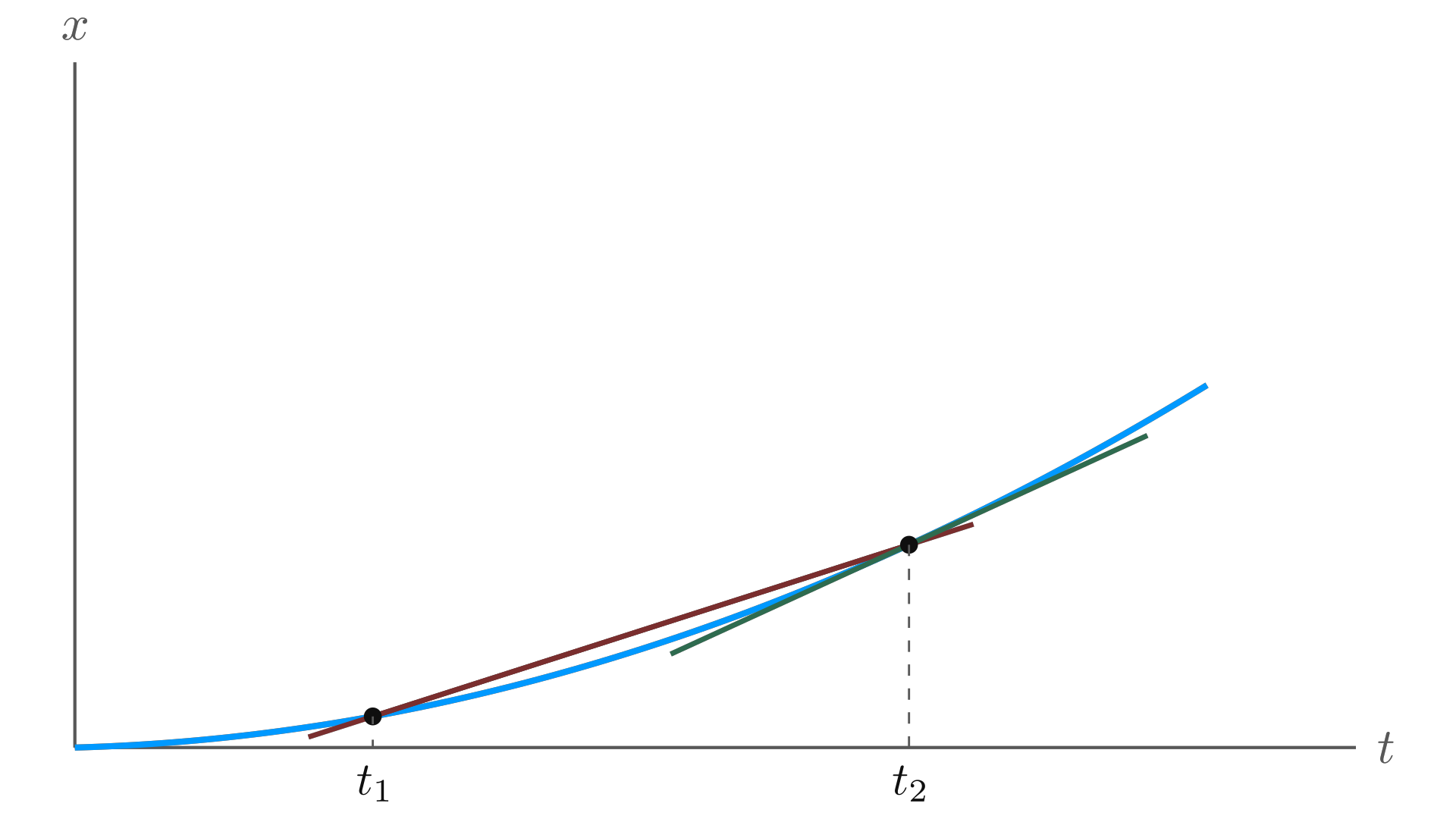
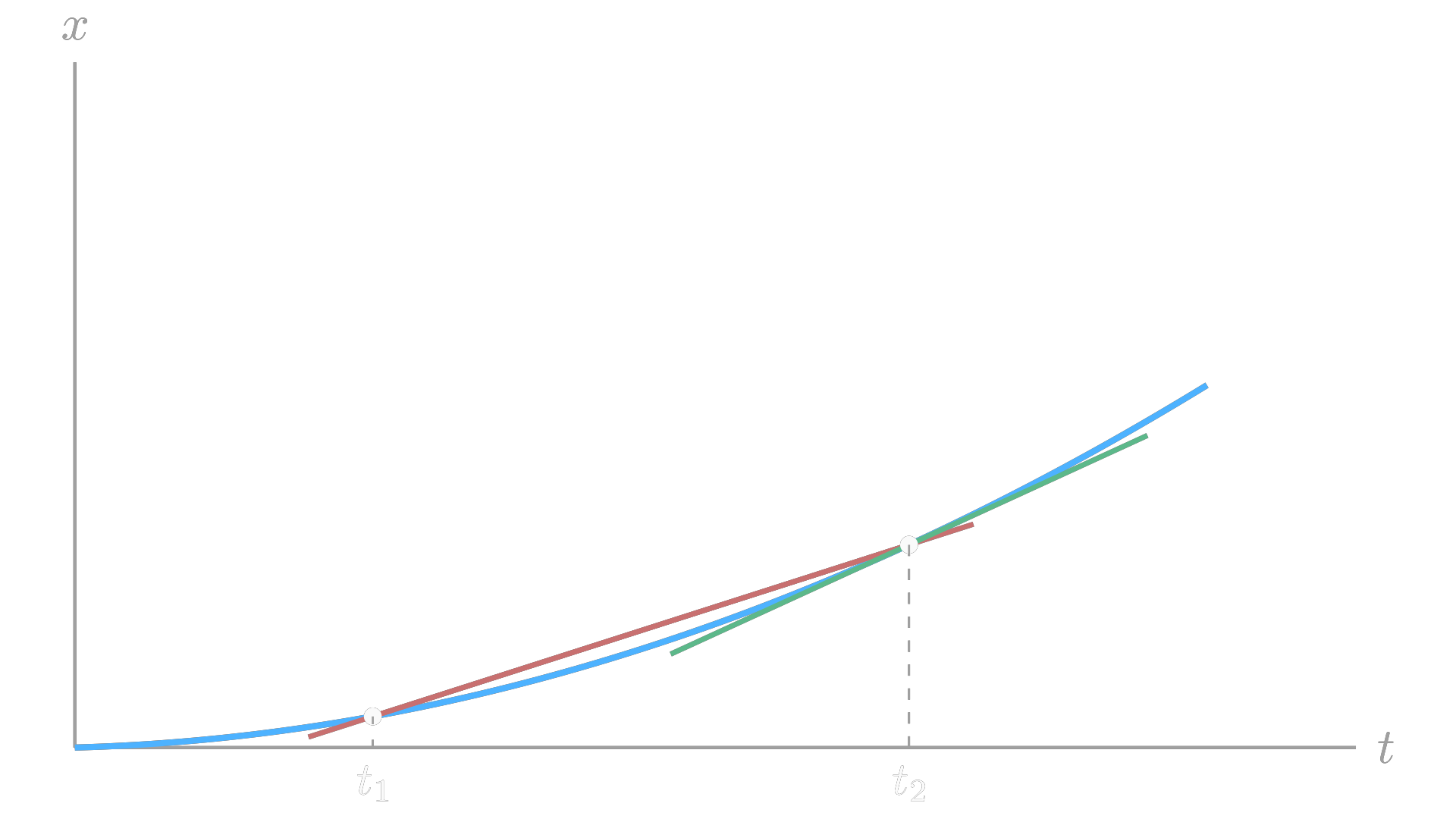
Average quantities are computed over a finite time interval using initial and final states. As the time interval shrinks toward zero, the average approaches the instantaneous value, and this limit is exactly the derivative.
平均量(average)在某段有限时间间隔内由始末状态算出。当时间间隔趋于零时,平均量就趋近于瞬时量(instantaneous),这个极限正是导数(derivative)。
Average quantities are computed over a finite time interval using initial and final states. As the time interval shrinks toward zero, the average approaches the instantaneous value: on a position-time graph, the secant line turns into the tangent line at that instant.
平均量(average)在某段有限时间间隔内由始末状态算出。当时间间隔趋于零时,平均量就趋近于瞬时量(instantaneous):在位置-时间图上,割线变成该时刻的切线(tangent line)。
Velocity is the time derivative of position.
速度是位置对时间的导数。
Acceleration is the time derivative of velocity (second derivative of position).
加速度是速度对时间的导数(也就是位置对时间的二阶导数)。
Instantaneous velocity at time $t$ is the slope of the tangent line to the $x$-$t$ graph at $t$. Instantaneous acceleration is the slope of the tangent line to the $v$-$t$ graph. When acceleration is constant, the $v$-$t$ graph is a straight line and its slope is $a = \Delta v / \Delta t$ at every instant.
时刻 $t$ 的瞬时速度等于 $x$-$t$ 图在 $t$ 处切线的斜率;瞬时加速度等于 $v$-$t$ 图切线的斜率。加速度恒定时,$v$-$t$ 图是一条直线,任意时刻的斜率都是 $a = \Delta v / \Delta t$。
accelerating)。不要把"加速度为负"等同于"减速"。加速度为负只是说加速度矢量指向负方向。物体真正减速(slowing down)发生在 $v$ 与 $a$ 异号时。
Worked Example: Instantaneous Velocity from a Position Function例题:由位置函数求瞬时速度 Physics C
A particle's position is x(t) = 4t³ − 6t² + 2t.
Find the velocity at t = 2 s.
一个质点的位置为 x(t) = 4t³ − 6t² + 2t。
求 t = 2 秒时的速度。
Worked Example: Position from Velocity by Integration例题:由速度积分得到位置 Physics C
initial condition) x(0) = 3Worked Example: Distance, Displacement and Average Velocity例题:距离、位移与平均速度
A runner jogs $120$ m east in $40$ s, then turns and jogs $60$ m west in $20$ s. Find the distance, the displacement, the average speed and the average velocity for the whole trip.
一名跑步者用 $40$ s 向东跑 $120$ m,然后掉头用 $20$ s 向西跑 $60$ m。求全程的距离、位移、平均速率与平均速度。
Worked Example: Average Acceleration and Slowing Down例题:平均加速度与减速
A cart moving at $+6.0$ m/s has velocity $-2.0$ m/s $4.0$ s later, with constant acceleration. Find the acceleration, the time at which the cart is momentarily at rest, and when it is slowing down.
一辆小车以 $+6.0$ m/s 运动,加速度恒定,$4.0$ s 后速度为 $-2.0$ m/s。求加速度、小车瞬时静止的时刻,以及它在何时减速。
This is AP Physics C. Always use derivatives for instantaneous quantities and integrals for accumulation. On free response, write $v = dx/dt$ (or $x = \int v\,dt$) before you differentiate or integrate, so the method is visible and not just the result. Always include the constant of integration and use the initial condition to determine it.
这是 AP Physics C(含微积分版)。瞬时量永远用导数,累积量永远用积分。在自由作答题(FRQ)中,先写出 $v = dx/dt$(或 $x = \int v\,dt$)再求导或积分,让方法本身可见,而不只是结果。务必带上积分常数,并用初始条件(initial condition)确定它。
AP Physics 1 is algebra-based. When a question gives a graph, find instantaneous velocity as the slope of the tangent to the $x$-$t$ graph and acceleration as the slope of the $v$-$t$ graph; say which slope you are reading.
AP Physics 1 以代数为基础。题目给出图像时,瞬时速度取 $x$-$t$ 图切线的斜率,加速度取 $v$-$t$ 图的斜率,并说明你读的是哪条图线的斜率。
Write the sign convention first (for example, "east is positive"), then keep the sign on every displacement and velocity, and give units ($\text{m/s}$, $\text{m/s}^2$) on each answer.
先写出符号约定(例如"向东为正"),每个位移和速度都保留符号,每个答案都带单位($\text{m/s}$、$\text{m/s}^2$)。
A runner completes one $400$ m lap of a track in $80$ s and stops at the start line. Find the displacement, average velocity and average speed.一名跑步者用 $80$ s 跑完一圈 $400$ m 的跑道并停在起点。求位移、平均速度与平均速率。
The runner ends where they started, so $\Delta x = 0$ and $v_{\text{avg}} = 0$. The distance is $400$ m, so the average speed is $400/80 = 5.0$ m/s.
终点与起点重合,所以 $\Delta x = 0$,$v_{\text{avg}} = 0$。路程为 $400$ m,所以平均速率为 $400/80 = 5.0$ m/s。
An object has $v = -3$ m/s and $a = -2$ m/s². Is it speeding up or slowing down? Explain.某物体 $v = -3$ m/s,$a = -2$ m/s²。它在加速还是减速?说明理由。
Speeding up. Velocity and acceleration have the same sign, so the acceleration points along the motion and the speed grows, even though both values are negative.
在加速。速度与加速度同号,加速度沿运动方向,速率增大,尽管两个数值都是负的。
A car speeds up uniformly from $4.0$ m/s to $10.0$ m/s in $3.0$ s. Find its acceleration, its average velocity and its displacement.一辆车在 $3.0$ s 内从 $4.0$ m/s 匀加速到 $10.0$ m/s。求加速度、平均速度与位移。
$a = (10.0 - 4.0)/3.0 = 2.0$ m/s². With constant acceleration the average velocity is the mean of the end values: $(4.0 + 10.0)/2 = 7.0$ m/s. Displacement: $\Delta x = (7.0)(3.0) = 21$ m.
$a = (10.0 - 4.0)/3.0 = 2.0$ m/s²。加速度恒定时,平均速度等于始末速度的平均值:$(4.0 + 10.0)/2 = 7.0$ m/s。位移:$\Delta x = (7.0)(3.0) = 21$ m。
Representing Motion运动的表示
- Translate between a motion description and its $x$-$t$, $v$-$t$ and $a$-$t$ graphs.
- Calculate velocity and acceleration from graph slopes, and displacement and change in velocity from graph areas.
- Select and apply the three constant-acceleration kinematic equations, and state when they are valid.
- Solve free-fall problems with a stated sign convention and $g \approx 10\;\text{m/s}^2$.
- Calculate $\Delta x$ and $\Delta v$ by integrating $v(t)$ and $a(t)$ when the acceleration is not constant.
- 在文字描述与 $x$-$t$、$v$-$t$、$a$-$t$ 图像之间相互转换(
translate)。 - 由图像斜率(
slope)计算速度与加速度,由图像面积(area)计算位移与速度变化。 - 选择并运用三条匀加速运动学方程,并说明(
state)其适用条件。 - 在写明符号约定、取 $g \approx 10\;\text{m/s}^2$ 的前提下求解自由落体问题。
- 加速度不恒定时,通过对 $v(t)$、$a(t)$ 积分计算 $\Delta x$ 与 $\Delta v$。
Motion can be represented through motion diagrams, figures, graphs, equations, and narrative descriptions. The most important skill in kinematics is translating fluently between these representations: this is the core of the Translation Between Representations (TBR) free-response question.
运动可以通过运动示意图、图形、图像(graph)、方程和文字描述来表示。运动学最关键的能力是在这些表示之间自如切换:这正是 AP 考试中"表示之间的转换"(Translation Between Representations / TBR)自由作答题的核心。
Kinematic Equations (Constant Acceleration Only)运动学方程(仅适用于匀加速)
When acceleration is constant, three fundamental kinematic equations describe motion in one dimension. These are derived from calculus: they are the results of integrating constant $a$.
当加速度恒定时,一维运动可以由三条基本的运动学方程(kinematic equations)描述。这些方程是由微积分推导出来的:它们就是对常数 $a$ 积分的结果。
When acceleration is constant, three fundamental kinematic equations describe motion in one dimension. Each one restates a graph fact: the $v$-$t$ graph is a straight line of slope $a$, and the displacement is the area under it.
当加速度恒定时,一维运动可以由三条基本的运动学方程(kinematic equations)描述。每条方程都对应一个图像事实:$v$-$t$ 图是斜率为 $a$ 的直线,位移就是其下方的面积。
First Principles: Equations 1 and 2 from Constant Acceleration第一性原理:由匀加速得到方程 1 与方程 2
Principle. Acceleration is the rate of change of velocity, and velocity is the rate of change of position. Take $a_x$ constant and start the clock at $t=0$.
原理。加速度是速度的变化率,速度是位置的变化率。取 $a_x$ 为常数,并从 $t=0$ 开始计时。
- Integrate the acceleration: $v_x(t)=v_{x0}+\displaystyle\int_0^t a_x\,dt'=v_{x0}+a_x t$ (Equation 1).
- Integrate the velocity: $x(t)=x_0+\displaystyle\int_0^t (v_{x0}+a_x t')\,dt'$.
- The integral of $a_x t'$ is $\tfrac{1}{2}a_x t^2$, so $x=x_0+v_{x0}t+\tfrac{1}{2}a_x t^2$ (Equation 2).
- 对加速度积分:$v_x(t)=v_{x0}+\displaystyle\int_0^t a_x\,dt'=v_{x0}+a_x t$(方程 1)。
- 对速度积分:$x(t)=x_0+\displaystyle\int_0^t (v_{x0}+a_x t')\,dt'$。
- $a_x t'$ 的积分是 $\tfrac{1}{2}a_x t^2$,所以 $x=x_0+v_{x0}t+\tfrac{1}{2}a_x t^2$(方程 2)。
- Constant $a_x$ makes the $v$-$t$ graph a straight line of slope $a_x$: $a_x=\dfrac{v_x-v_{x0}}{t}$, so $v_x=v_{x0}+a_x t$ (Equation 1).
- Displacement is the area under that line: a rectangle of height $v_{x0}$ plus a triangle of height $a_x t$, both of width $t$.
- Add the areas: $\Delta x=v_{x0}t+\tfrac{1}{2}(a_x t)(t)=v_{x0}t+\tfrac{1}{2}a_x t^2$ (Equation 2). The $\tfrac{1}{2}$ is the triangle's.
- $a_x$ 恒定时,$v$-$t$ 图是斜率为 $a_x$ 的直线:$a_x=\dfrac{v_x-v_{x0}}{t}$,所以 $v_x=v_{x0}+a_x t$(方程 1)。
- 位移等于这条直线下方的面积:高为 $v_{x0}$ 的矩形,加上高为 $a_x t$ 的三角形,两者宽度都是 $t$。
- 面积相加:$\Delta x=v_{x0}t+\tfrac{1}{2}(a_x t)(t)=v_{x0}t+\tfrac{1}{2}a_x t^2$(方程 2)。$\tfrac{1}{2}$ 来自三角形。
Limiting-case check. Set $a_x=0$: Equation 2 becomes $x=x_0+v_{x0}t$, uniform motion. Units: $(\mathrm{m/s^2})(\mathrm{s^2})=\mathrm{m}$, so every term is a length.
极限检验。令 $a_x=0$:方程 2 变为 $x=x_0+v_{x0}t$,即匀速运动。单位:$(\mathrm{m/s^2})(\mathrm{s^2})=\mathrm{m}$,每一项都是长度。
First Principles: Equation 3 Without Time第一性原理:不含时间的方程 3
Principle. With constant $a_x$, velocity changes linearly in time, so the average velocity over an interval is the mean of its end values: $\bar{v}_x=\tfrac{1}{2}(v_{x0}+v_x)$.
原理。$a_x$ 恒定时,速度随时间线性变化,所以一段时间内的平均速度等于始末速度的平均值:$\bar{v}_x=\tfrac{1}{2}(v_{x0}+v_x)$。
- Chain rule: $a_x=\dfrac{dv_x}{dt}=\dfrac{dv_x}{dx}\dfrac{dx}{dt}=v_x\dfrac{dv_x}{dx}$.
- Separate and integrate: $\displaystyle\int_{v_{x0}}^{v_x}v'\,dv'=a_x\int_{x_0}^{x}dx'$.
- So $\tfrac{1}{2}(v_x^2-v_{x0}^2)=a_x(x-x_0)$, which is $v_x^2=v_{x0}^2+2a_x(x-x_0)$.
- 链式法则(
chain rule):$a_x=\dfrac{dv_x}{dt}=\dfrac{dv_x}{dx}\dfrac{dx}{dt}=v_x\dfrac{dv_x}{dx}$。 - 分离变量并积分:$\displaystyle\int_{v_{x0}}^{v_x}v'\,dv'=a_x\int_{x_0}^{x}dx'$。
- 于是 $\tfrac{1}{2}(v_x^2-v_{x0}^2)=a_x(x-x_0)$,即 $v_x^2=v_{x0}^2+2a_x(x-x_0)$。
- Displacement is average velocity times time: $\Delta x=\tfrac{1}{2}(v_{x0}+v_x)\,t$.
- Equation 1 gives the time: $t=\dfrac{v_x-v_{x0}}{a_x}$.
- Substitute: $\Delta x=\dfrac{(v_x+v_{x0})(v_x-v_{x0})}{2a_x}=\dfrac{v_x^2-v_{x0}^2}{2a_x}$, so $v_x^2=v_{x0}^2+2a_x\Delta x$.
- 位移等于平均速度乘时间:$\Delta x=\tfrac{1}{2}(v_{x0}+v_x)\,t$。
- 由方程 1 得时间:$t=\dfrac{v_x-v_{x0}}{a_x}$。
- 代入:$\Delta x=\dfrac{(v_x+v_{x0})(v_x-v_{x0})}{2a_x}=\dfrac{v_x^2-v_{x0}^2}{2a_x}$,所以 $v_x^2=v_{x0}^2+2a_x\Delta x$。
Limiting-case check. At $\Delta x=0$ the speed is unchanged. To stop ($v_x=0$) needs $\Delta x=\dfrac{v_{x0}^2}{2|a_x|}$: doubling the initial speed quadruples the stopping distance.
极限检验。$\Delta x=0$ 时速率不变。要停下来($v_x=0$)需要 $\Delta x=\dfrac{v_{x0}^2}{2|a_x|}$:初速度加倍,制动距离变为四倍。
Graph Relationships图像之间的关系
The connections between position, velocity, and acceleration graphs are the backbone of kinematics analysis. Slopes give derivatives; areas give integrals.
位置、速度、加速度三种图像(graph)之间的联系是运动学分析的脊梁。斜率(slope)就是导数;曲线下面积(area under the curve)就是积分。
The connections between position, velocity, and acceleration graphs are the backbone of kinematics analysis. The slope of one graph gives the next quantity down; the area under a graph gives the change in the quantity above.
位置、速度、加速度三种图像(graph)之间的联系是运动学分析的脊梁。一幅图的斜率(slope)给出下一个物理量;曲线下面积(area under the curve)给出上一个物理量的变化。
| From | To | Operation | On the Graph |
|---|---|---|---|
| $x(t)$ | $v(t)$ | $v = dx/dt$ | Slope of $x$-$t$ graph |
| $v(t)$ | $a(t)$ | $a = dv/dt$ | Slope of $v$-$t$ graph |
| $v(t)$ | $\Delta x$ | $\Delta x = \int v\,dt$ | Area under $v$-$t$ curve |
| $a(t)$ | $\Delta v$ | $\Delta v = \int a\,dt$ | Area under $a$-$t$ curve |
| 从 | 到 | 运算 | 在图像上 |
|---|---|---|---|
| $x(t)$ | $v(t)$ | $v = dx/dt$ | $x$-$t$ 图的斜率 |
| $v(t)$ | $a(t)$ | $a = dv/dt$ | $v$-$t$ 图的斜率 |
| $v(t)$ | $\Delta x$ | $\Delta x = \int v\,dt$ | $v$-$t$ 曲线下面积 |
| $a(t)$ | $\Delta v$ | $\Delta v = \int a\,dt$ | $a$-$t$ 曲线下面积 |
| Graph | Slope gives | Area under the curve gives |
|---|---|---|
| $x$-$t$ | velocity $v$ | (not used) |
| $v$-$t$ | acceleration $a$ | displacement $\Delta x$ |
| $a$-$t$ | (not used) | change in velocity $\Delta v$ |
| 图像 | 斜率给出 | 曲线下面积给出 |
|---|---|---|
| $x$-$t$ | 速度 $v$ | (不使用) |
| $v$-$t$ | 加速度 $a$ | 位移 $\Delta x$ |
| $a$-$t$ | (不使用) | 速度变化 $\Delta v$ |
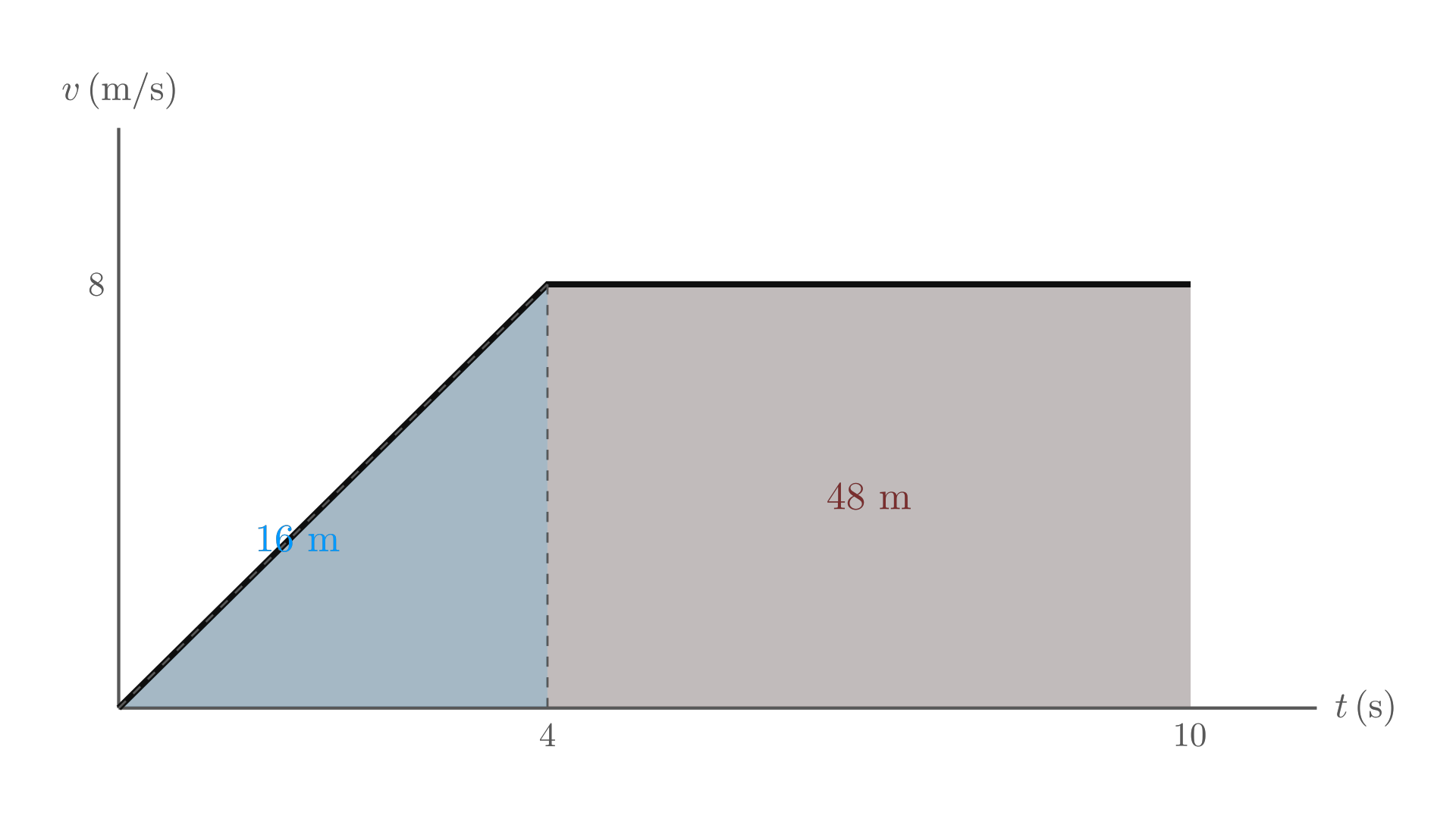
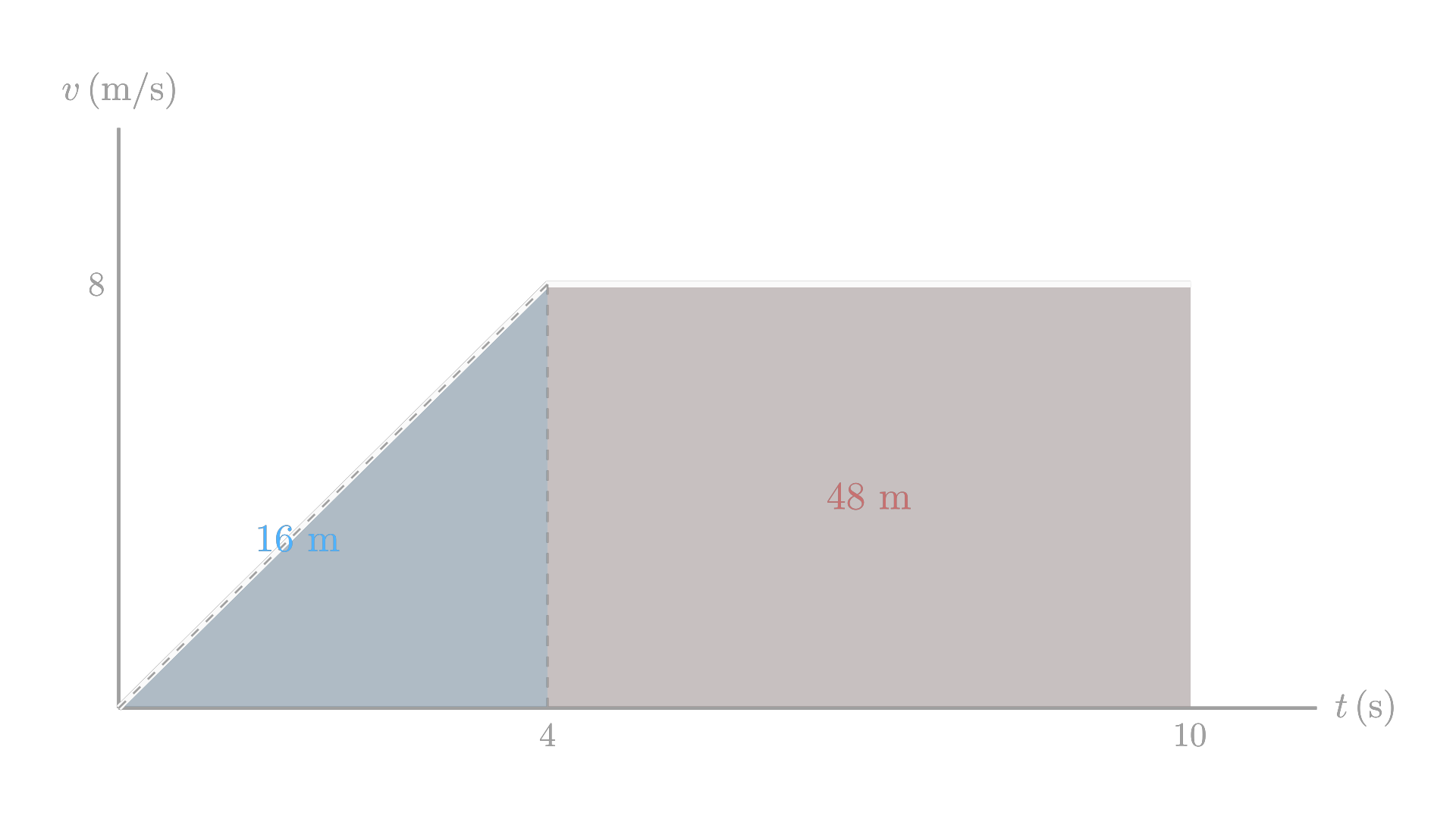
Worked Example: Reading Displacement Straight Off a v-t Graph例题:直接从 v-t 图像读出位移
A v-t graph shows a bicycle's velocity rising in a straight line from $0$ to $8$ m/s over the first $4$ s, then holding constant at $8$ m/s for the next $6$ s. Find the total displacement over the $10$ s using only the graph, no kinematic equations.
某自行车的 v-t 图像显示:前 $4$ s 内速度从 $0$ 沿直线上升到 $8$ m/s,随后 $6$ s 内保持 $8$ m/s 不变。仅用图像(不用运动学方程),求 $10$ s 内的总位移。
Free Fall自由落体
A falling ball moves too fast to time by hand, so Galileo rolled bronze balls down a long grooved ramp, which "dilutes" gravity. He timed each run by weighing the water that flowed from a vessel while the ball rolled.
落体运动太快,无法用手计时,于是伽利略让铜球沿一条刻有凹槽的长斜面滚下,相当于把重力"冲淡"。他称量球滚动期间从容器中流出的水的重量来计时。
He found distance proportional to time squared: the distances covered in successive equal intervals go as 1 : 3 : 5 : 7. That is Equation 2 with $v_{x0}=0$. He published it in Two New Sciences (1638).
他发现距离与时间的平方成正比:在相继相等的时间间隔内走过的距离之比为 1 : 3 : 5 : 7。这正是 $v_{x0}=0$ 时的方程 2。他在 1638 年出版的《关于两门新科学的对话》(Two New Sciences)中发表了这一结果。
g)方向竖直向下、大小近似恒定,$g \approx 10\;\text{m/s}^2$。除非题目给出其他数值,本指南一律取 $g \approx 10$ m/s²。
Worked Example: Free-Fall Problem例题:自由落体
A ball is thrown straight up at 20 m/s from ground level.
How high does it go? How long until it returns? (g = 10 m/s²)
从地面竖直向上以 20 m/s 抛出一个球。
它能上升多高?多久后落回?(g = 10 m/s²)
Worked Example: Braking Distance例题:刹车距离
A car at 30 m/s brakes at −5 m/s². How far to stop?
一辆 30 m/s 的车以 −5 m/s² 的加速度刹车,需要多远停下?
The dots in the left strip show where the ball physically is at $t = 0, 0.5, 1.0, \ldots$ s; they sit on a single vertical line because the motion is purely 1D.
Purple dots are on the way up, green is the apex, red is on the way down. The same data plotted as a graph (right) gives the parabola $y(t) = h_0 + v_0 t - \tfrac{1}{2}g t^2$; that curve is a function plot, not a flight path.
sign convention)一致,并在自由作答题中明确写出。
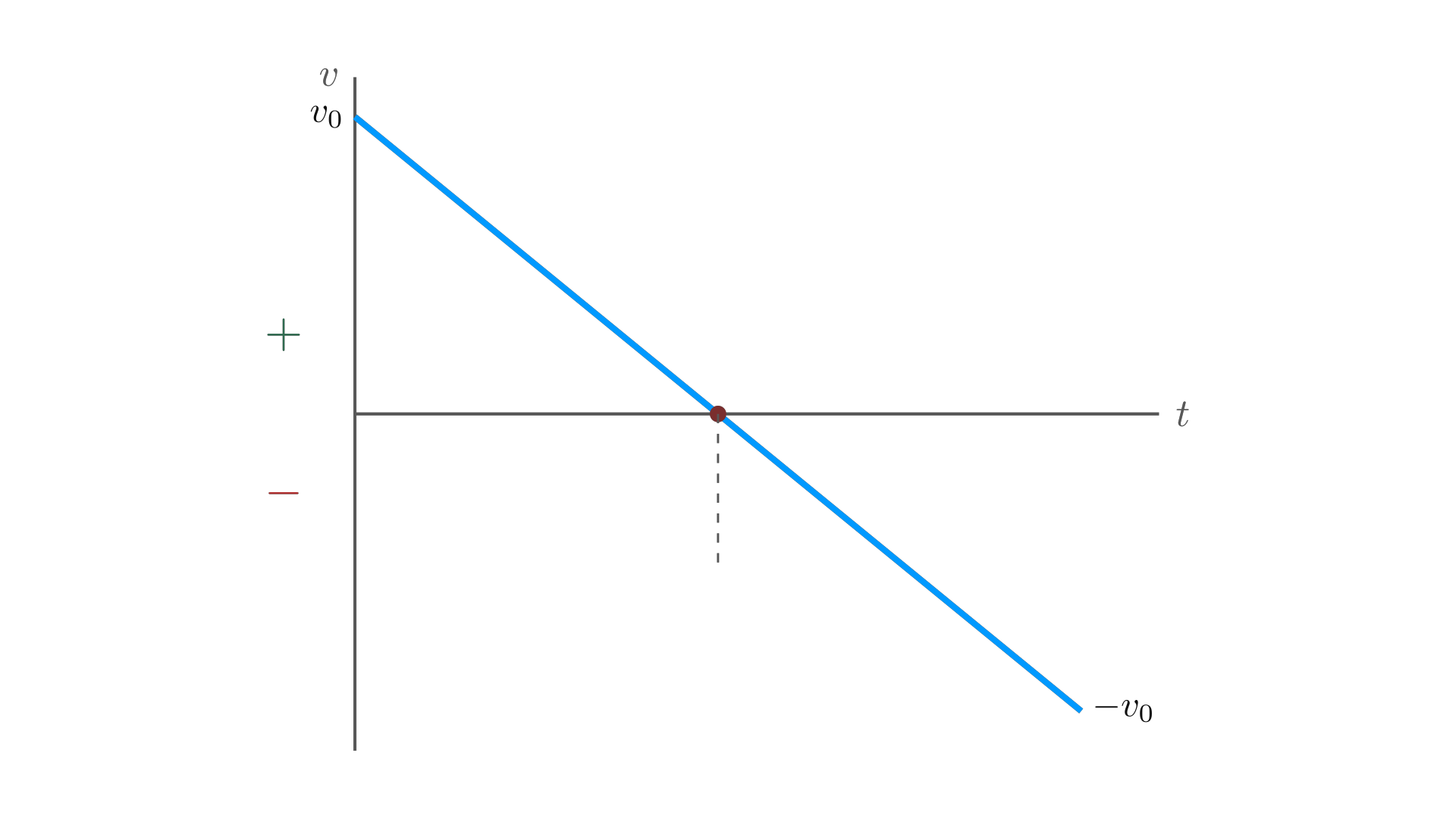
On a $v$-$t$ graph, displacement is the signed area: area below the time axis is negative displacement, and distance adds the areas as positive numbers.
在 $v$-$t$ 图上,位移是带符号的面积:时间轴下方的面积是负位移,而路程把各块面积都按正数相加。
Use the three kinematic equations only over an interval where the acceleration is constant; if the graph has a corner, split the motion at the corner and solve each piece. When you sketch the matching $x$-$t$ graph, make its slope zero wherever $v = 0$.
三条运动学方程只能用于加速度恒定的时间段;图像有拐点时,在拐点处把运动分段逐段求解。画对应的 $x$-$t$ 图时,凡是 $v = 0$ 的时刻斜率都要为零。
A car starts from rest and reaches $20$ m/s over $50$ m with constant acceleration. Which kinematic equation fits, and what is the acceleration?一辆车由静止出发,以恒定加速度行驶 $50$ m 后速度达到 $20$ m/s。应选用哪条运动学方程?加速度是多少?
Time is neither given nor asked for, so use $v^2 = v_0^2 + 2a\Delta x$: $400 = 0 + 2a(50)$, giving $a = 4.0$ m/s².
题目既未给出也不要求时间,所以用 $v^2 = v_0^2 + 2a\Delta x$:$400 = 0 + 2a(50)$,得 $a = 4.0$ m/s²。
A $v$-$t$ graph is flat at $6$ m/s from $0$ to $2$ s, then falls in a straight line to $0$ at $5$ s. Find the acceleration from $2$ to $5$ s and the total displacement.某 $v$-$t$ 图在 $0$ 到 $2$ s 内水平于 $6$ m/s,随后沿直线在 $5$ s 时降到 $0$。求 $2$ 到 $5$ s 的加速度及总位移。
Slope from $2$ to $5$ s: $a = (0 - 6)/3 = -2.0$ m/s². Area: rectangle $(6)(2) = 12$ m plus triangle $\tfrac{1}{2}(3)(6) = 9$ m, so $\Delta x = 21$ m.
$2$ 到 $5$ s 的斜率:$a = (0 - 6)/3 = -2.0$ m/s²。面积:矩形 $(6)(2) = 12$ m 加三角形 $\tfrac{1}{2}(3)(6) = 9$ m,所以 $\Delta x = 21$ m。
A ball is thrown straight up at $15$ m/s from the edge of a roof $20$ m above the ground and falls past the roof to the ground. How long is it in the air, and how fast does it hit the ground? ($g = 10$ m/s²)从离地 $20$ m 的屋顶边缘以 $15$ m/s 竖直向上抛出一个球,球越过屋顶边缘落到地面。它在空中运动多长时间?落地速率是多少?($g = 10$ m/s²)
Take up as positive, so $a = -10$ m/s² and the ground is at $\Delta y = -20$ m. Then $-20 = 15t - 5t^2$, so $t^2 - 3t - 4 = 0$ and $(t - 4)(t + 1) = 0$, giving $t = 4.0$ s. Velocity: $v = 15 - 10(4.0) = -25$ m/s, so it lands at $25$ m/s downward. Check: $v^2 = 15^2 + 2(-10)(-20) = 625$.
取向上为正,则 $a = -10$ m/s²,地面位于 $\Delta y = -20$ m。由 $-20 = 15t - 5t^2$ 得 $t^2 - 3t - 4 = 0$,即 $(t - 4)(t + 1) = 0$,所以 $t = 4.0$ s。速度:$v = 15 - 10(4.0) = -25$ m/s,即以 $25$ m/s 向下落地。验算:$v^2 = 15^2 + 2(-10)(-20) = 625$。
A cart starts at $+1.0$ m/s. Its $a$-$t$ graph is a constant $+4.0$ m/s² from $0$ to $3.0$ s, then a constant $-2.0$ m/s² from $3.0$ s to $5.0$ s. Use the areas under the $a$-$t$ graph to find its velocity at $3.0$ s and at $5.0$ s.一辆小车的初速度为 $+1.0$ m/s。其 $a$-$t$ 图在 $0$ 到 $3.0$ s 内恒为 $+4.0$ m/s²,在 $3.0$ s 到 $5.0$ s 内恒为 $-2.0$ m/s²。利用 $a$-$t$ 图下方的面积,求小车在 $3.0$ s 和 $5.0$ s 时的速度。
The area under an $a$-$t$ graph is the change in velocity. From $0$ to $3.0$ s: $\Delta v = (4.0)(3.0) = +12$ m/s, so $v = 1.0 + 12 = 13$ m/s. From $3.0$ s to $5.0$ s: $\Delta v = (-2.0)(2.0) = -4.0$ m/s, so $v = 13 - 4.0 = 9.0$ m/s.
$a$-$t$ 图下方的面积等于速度的变化。$0$ 到 $3.0$ s:$\Delta v = (4.0)(3.0) = +12$ m/s,所以 $v = 1.0 + 12 = 13$ m/s。$3.0$ s 到 $5.0$ s:$\Delta v = (-2.0)(2.0) = -4.0$ m/s,所以 $v = 13 - 4.0 = 9.0$ m/s。
(Physics C) A particle has $a(t) = 6t$ m/s² (with $t$ in s), $v(0) = 2.0$ m/s and $x(0) = 0$. Find $v(t)$, $x(t)$ and the values of $v$ and $x$ at $t = 2.0$ s.(Physics C)某质点的加速度 $a(t) = 6t$ m/s²($t$ 以 s 为单位),$v(0) = 2.0$ m/s,$x(0) = 0$。求 $v(t)$、$x(t)$,以及 $t = 2.0$ s 时的 $v$ 与 $x$。
Integrate: $v(t) = v(0) + \int_0^t 6t'\,dt' = 2.0 + 3t^2$. Integrate again: $x(t) = \int_0^t (2.0 + 3t'^2)\,dt' = 2.0t + t^3$. At $t = 2.0$ s: $v = 2.0 + 3(4.0) = 14$ m/s and $x = 2.0(2.0) + 8.0 = 12$ m. The kinematic equations do not apply because $a$ is not constant.
积分:$v(t) = v(0) + \int_0^t 6t'\,dt' = 2.0 + 3t^2$。再积分:$x(t) = \int_0^t (2.0 + 3t'^2)\,dt' = 2.0t + t^3$。$t = 2.0$ s 时:$v = 2.0 + 3(4.0) = 14$ m/s,$x = 2.0(2.0) + 8.0 = 12$ m。因为 $a$ 不恒定,运动学方程在这里不适用。
Reference Frames and Relative Motion参考系与相对运动
- Define a reference frame and explain why two observers can measure different velocities for the same object.
- Calculate relative velocities in one dimension with $\vec{v}_{A/C} = \vec{v}_{A/B} + \vec{v}_{B/C}$.
- Calculate a resultant velocity in two dimensions, such as a boat in a current or a plane in a crosswind.
- Use signs along one axis to find the relative velocity of two objects moving in the same or opposite directions, and reverse it by swapping subscripts: $v_{B/A} = -v_{A/B}$.
- Explain why all inertial reference frames measure the same acceleration.
- 定义(
define)参考系(reference frame),并解释为什么两个观察者对同一物体可能测得不同的速度。 - 用 $\vec{v}_{A/C} = \vec{v}_{A/B} + \vec{v}_{B/C}$ 计算一维相对速度(
relative velocity)。 - 计算二维情形中的合速度,例如船在水流中、飞机在侧风中。
- 沿一条坐标轴用正负号求同向或相向运动的两个物体的相对速度,并通过交换下标得到反向的相对速度:$v_{B/A} = -v_{A/B}$。
- 解释为什么所有惯性参考系(
inertial reference frame)测得的加速度相同。
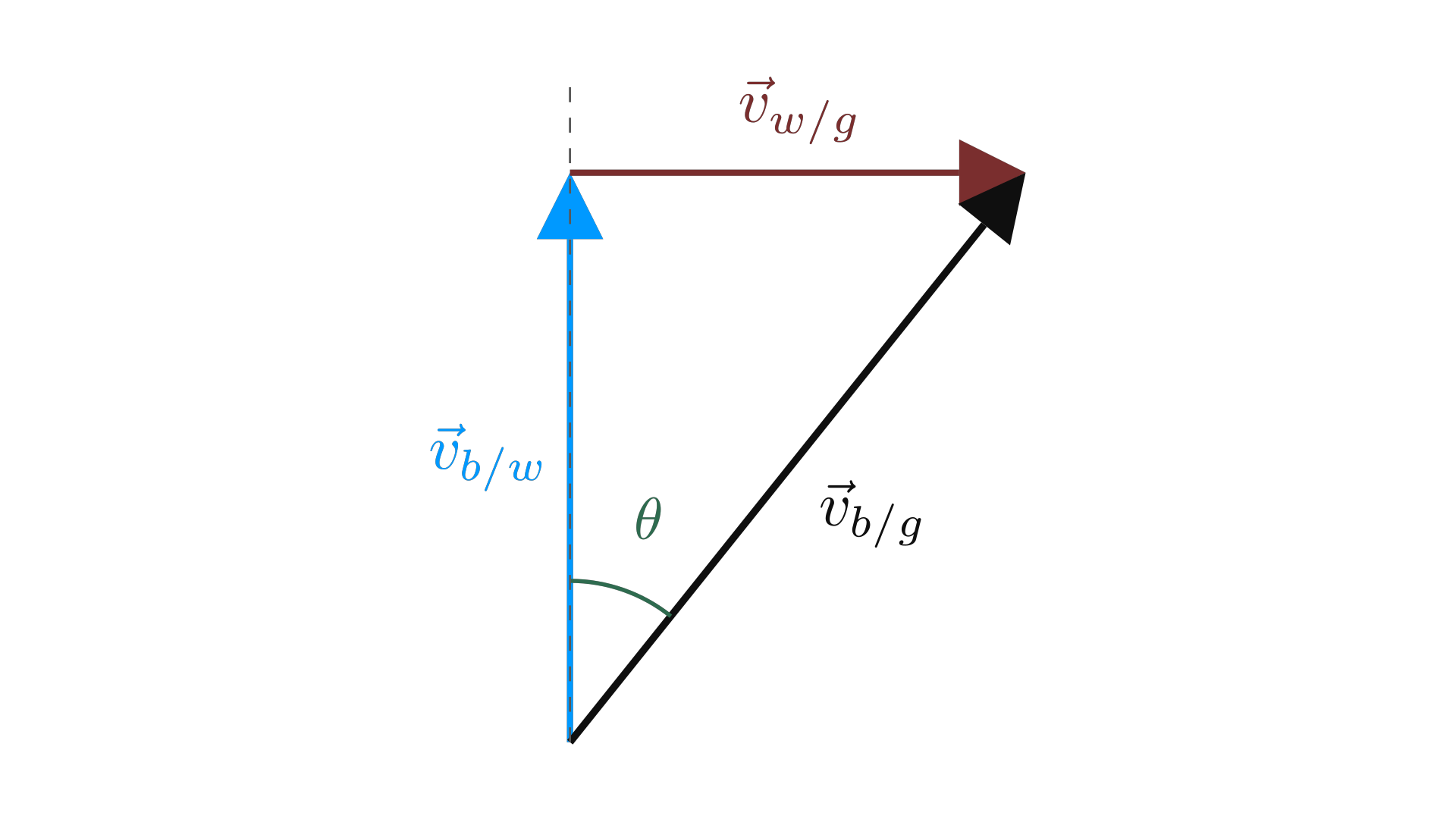
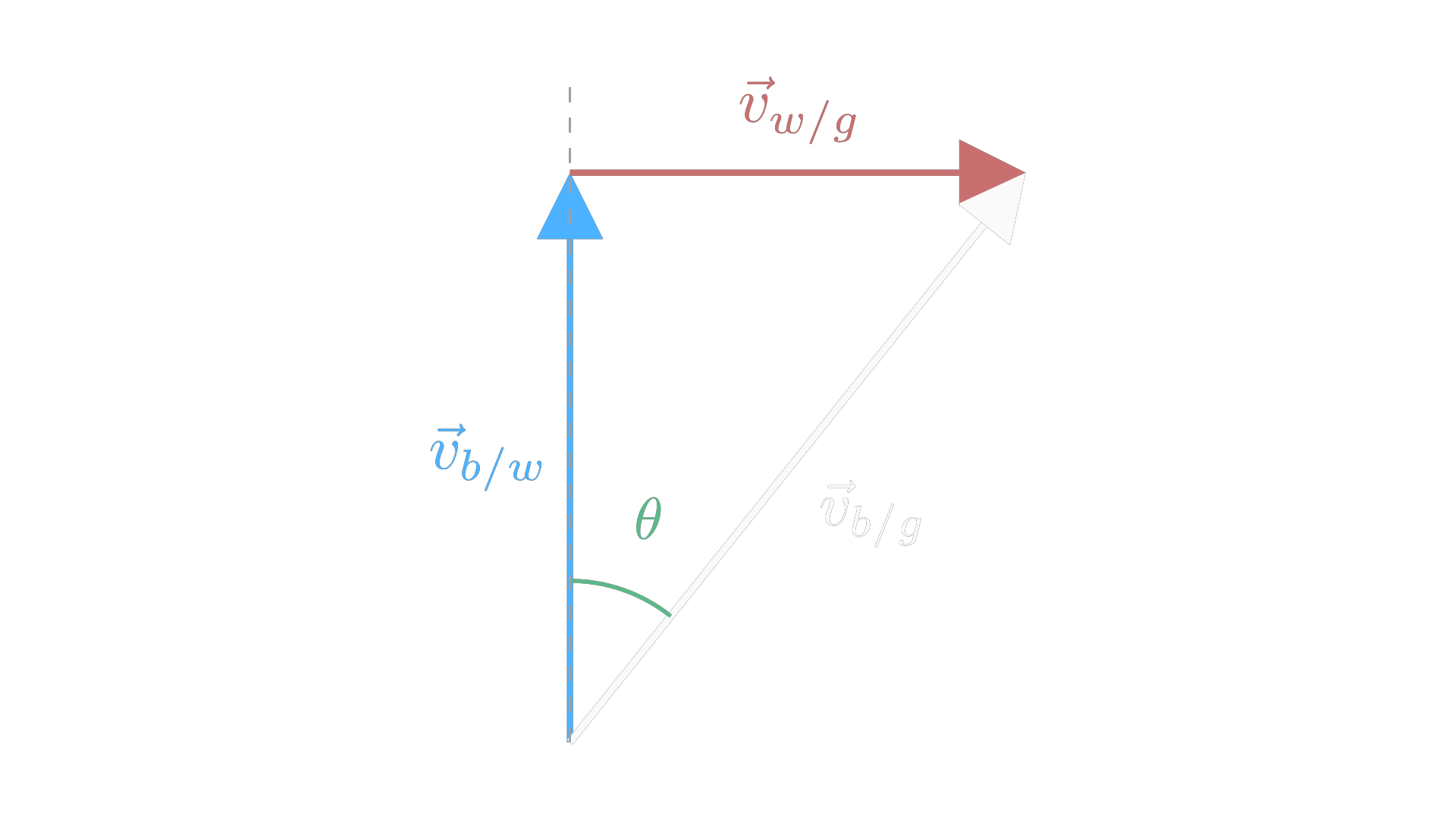
A reference frame defines the origin and coordinate system from which an observer makes measurements. Two observers in different reference frames may measure different velocities for the same object. The key tool for connecting their measurements is the relative velocity equation.
参考系(reference frame)规定了观察者测量时所用的原点和坐标系。处在不同参考系的两个观察者对同一物体测得的速度可能不同。把它们联系起来的关键工具就是相对速度方程(relative velocity)。
Read: "velocity of A relative to C = velocity of A relative to B + velocity of B relative to C." Inner subscripts cancel.
读作:"A 相对 C 的速度 = A 相对 B 的速度 + B 相对 C 的速度"。中间的下标相互抵消。
Galilean Invariance)
在所有惯性参考系(inertial reference frame)中测得的加速度都相同。这意味着牛顿第二定律在每个非加速参考系下都同样成立。AP 考试中若无说明,默认参考系是惯性系。
Worked Example: Airplane in a Headwind例题:逆风飞行的飞机
An airplane flies east with an airspeed of 240 m/s (its velocity relative to the air).
A 30 m/s wind blows west relative to the ground. Find the plane's velocity relative to the ground, and the velocity of the air relative to the plane.
一架飞机向东飞行,空速为 240 m/s(相对空气的速度)。
风相对地面以 30 m/s 向西吹。求飞机相对地面的速度,以及空气相对飞机的速度。
Worked Example: River Crossing例题:渡河问题
A boat moves north at 5 m/s relative to water.
Current flows east at 3 m/s. Ground velocity?
一条船相对水以 5 m/s 向北行驶。
水流相对地面以 3 m/s 向东。船相对地面的速度?
Worked Example: 1D Relative Velocity例题:一维相对速度
Car A: 25 m/s east. Car B: 15 m/s east. Both relative to ground.
Velocity of A relative to B?
甲车 25 m/s 向东,乙车 15 m/s 向东(均相对地面)。
甲相对乙的速度是多少?
The key trick is that inner subscripts cancel: $\vec{v}_{A/C} = \vec{v}_{A/B} + \vec{v}_{B/C}$. Draw a vector diagram for 2D problems and label each arrow with its subscripts; reversing the direction of the current or wind is a common error, and the diagram makes it visible before you calculate.
关键技巧:内部下标相互抵消:$\vec{v}_{A/C} = \vec{v}_{A/B} + \vec{v}_{B/C}$。二维问题务必画矢量图,并在每个箭头旁标出下标;把水流或风的方向弄反是常见错误,画图能在计算前暴露它。
The key trick is that inner subscripts cancel: $\vec{v}_{A/C} = \vec{v}_{A/B} + \vec{v}_{B/C}$. Draw a number line, choose a positive direction, and give every velocity a sign before you subtract; reversing the direction of the current or wind is a common error, and the signs make it visible before you calculate.
关键技巧:内部下标相互抵消:$\vec{v}_{A/C} = \vec{v}_{A/B} + \vec{v}_{B/C}$。把速度画在数轴上,选定正方向,并在相减之前给每个速度标上正负号;把水流或风的方向弄反是常见错误,正负号能在计算前暴露它。
A train moves east at $30$ m/s. A passenger walks toward the back of the train (west) at $2$ m/s relative to the train. What is the passenger's velocity relative to the ground?火车以 $30$ m/s 向东行驶。一名乘客相对火车以 $2$ m/s 向车尾(向西)走。乘客相对地面的速度是多少?
With east positive, $v_{P/G} = v_{P/T} + v_{T/G} = -2 + 30 = +28$ m/s, so $28$ m/s east.
取向东为正,$v_{P/G} = v_{P/T} + v_{T/G} = -2 + 30 = +28$ m/s,即向东 $28$ m/s。
Two observers move at constant velocity relative to each other and watch the same falling ball. Do they agree on its velocity? On its acceleration?两个观察者彼此以恒定速度相对运动,观察同一个下落的球。他们测得的速度相同吗?加速度呢?
They disagree on velocity, because each measures it relative to their own frame. They agree on acceleration: the relative velocity of the frames is constant, so it adds nothing to the change in velocity.
速度不同,因为各自相对自己的参考系测量。加速度相同:两个参考系的相对速度恒定,不会给速度的变化带来任何额外贡献。
On a straight highway, car A moves east at $28$ m/s and truck B moves west at $22$ m/s, both relative to the ground. What is the velocity of A relative to B, and the velocity of B relative to A?在一条笔直的公路上,汽车 A 相对地面以 $28$ m/s 向东行驶,卡车 B 相对地面以 $22$ m/s 向西行驶。A 相对 B 的速度是多少?B 相对 A 的速度又是多少?
With east positive, $v_{A/G} = +28$ m/s and $v_{B/G} = -22$ m/s. Then $v_{A/B} = v_{A/G} + v_{G/B} = v_{A/G} - v_{B/G} = 28 - (-22) = +50$ m/s, so $50$ m/s east. Reversing the subscripts flips the sign: $v_{B/A} = -v_{A/B} = -50$ m/s, so $50$ m/s west. Vehicles moving toward each other have a relative speed equal to the sum of their speeds.
取向东为正,$v_{A/G} = +28$ m/s,$v_{B/G} = -22$ m/s。于是 $v_{A/B} = v_{A/G} + v_{G/B} = v_{A/G} - v_{B/G} = 28 - (-22) = +50$ m/s,即向东 $50$ m/s。交换下标,符号相反:$v_{B/A} = -v_{A/B} = -50$ m/s,即向西 $50$ m/s。相向行驶的两车,相对速率等于两者速率之和。
A boat points straight across an $80$ m wide river at $4.0$ m/s relative to the water. The current flows at $3.0$ m/s. Find the crossing time, the downstream drift and the boat's speed relative to the ground.一条船以相对水 $4.0$ m/s 的速度船头垂直对岸,横渡 $80$ m 宽的河,水流速度为 $3.0$ m/s。求渡河时间、顺流漂移距离以及船相对地面的速率。
Only the across-river component moves the boat across: $t = 80/4.0 = 20$ s. In that time the current carries it $3.0 \times 20 = 60$ m downstream. Ground speed: $\sqrt{4.0^2 + 3.0^2} = 5.0$ m/s.
只有垂直河岸的分量使船过河:$t = 80/4.0 = 20$ s。这段时间里水流把船带向下游 $3.0 \times 20 = 60$ m。对地速率:$\sqrt{4.0^2 + 3.0^2} = 5.0$ m/s。
Motion in Two or Three Dimensions二维与三维运动Vectors and Motion in Two Dimensions矢量与二维运动
- Explain the independence of perpendicular components of motion, with time as the link between them.
- Resolve a launch velocity into horizontal and vertical components.
- Calculate the time of flight, maximum height and range of a projectile.
- Derive the trajectory equation $y(x)$ by eliminating time.
- Decide when the level-ground range formula applies, and solve cliff problems from the full equations.
- 解释(
explain)垂直方向运动分量的独立性,以及时间是连接各分量的纽带。 - 把发射速度分解为水平与竖直分量。
- 计算抛体的飞行时间、最大高度与射程(
range)。 - 通过消去时间推导(
derive)轨迹方程 $y(x)$。 - 判断同高度射程公式何时适用,并用完整方程求解悬崖类问题。
The central insight of multidimensional kinematics is the independence of perpendicular components. Motion in one dimension can be changed without causing a change in a perpendicular dimension. This means 2D or 3D motion is analyzed by separating it into independent 1D kinematic problems, one for each axis.
多维运动学的核心思想是各垂直方向相互独立(independence of perpendicular components)。一个方向上的运动改变并不会引起另一垂直方向上的变化。因此处理二维、三维运动时,把它沿坐标轴拆成几组互不相关的一维运动学问题来分析。
Projectile Motion)
抛体运动是二维运动中的特殊情况:$a_x = 0$(水平方向速度恒定),$a_y = -g$(竖直方向恒为向下的重力加速度)。忽略空气阻力。时间是连接水平与竖直两个方向的唯一变量。
where $v_{y0} = v_0\sin\theta$
其中 $v_{y0} = v_0\sin\theta$。
Derived Formulas (Level Ground)推导公式(同高度发射与落地)
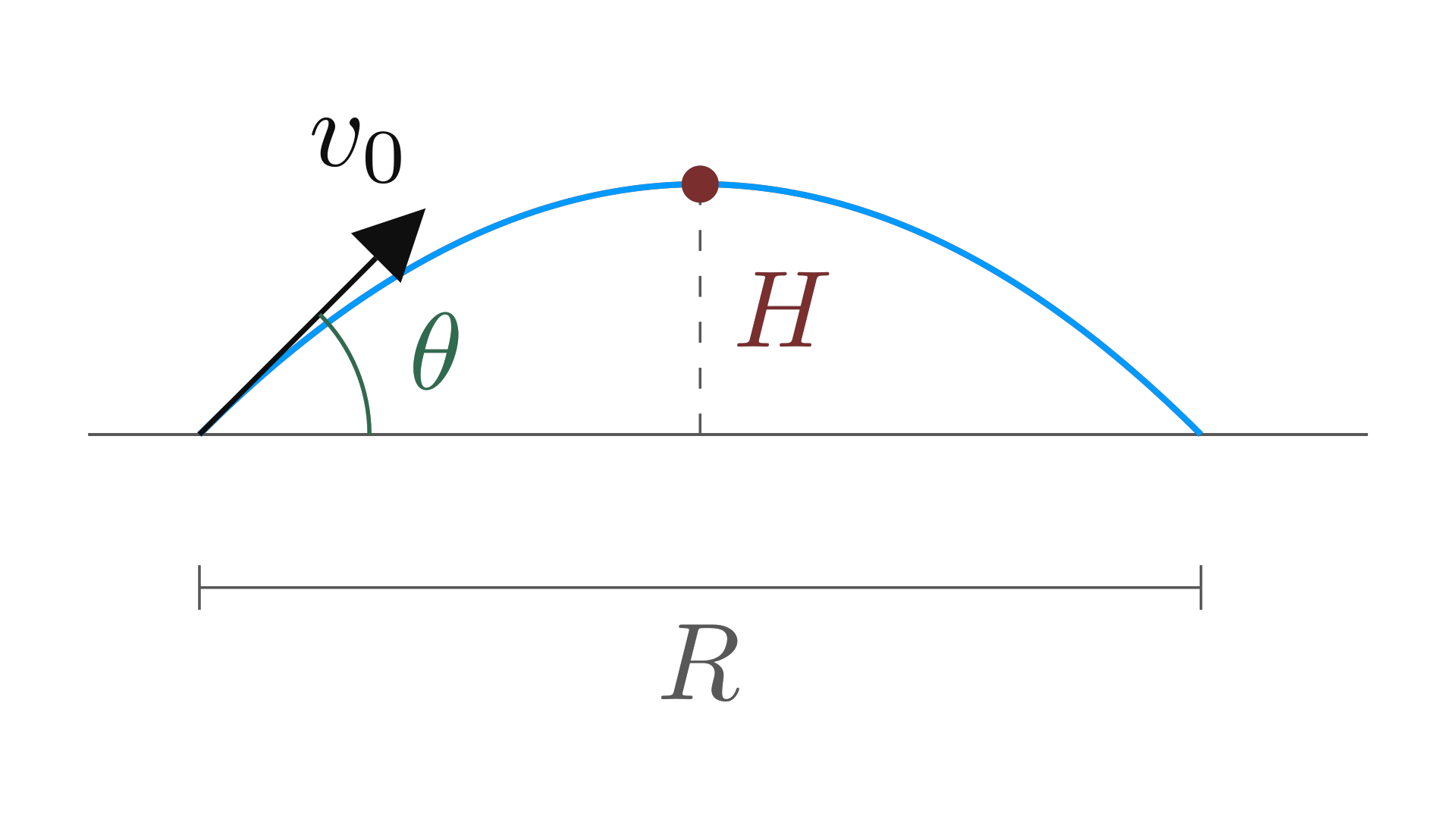
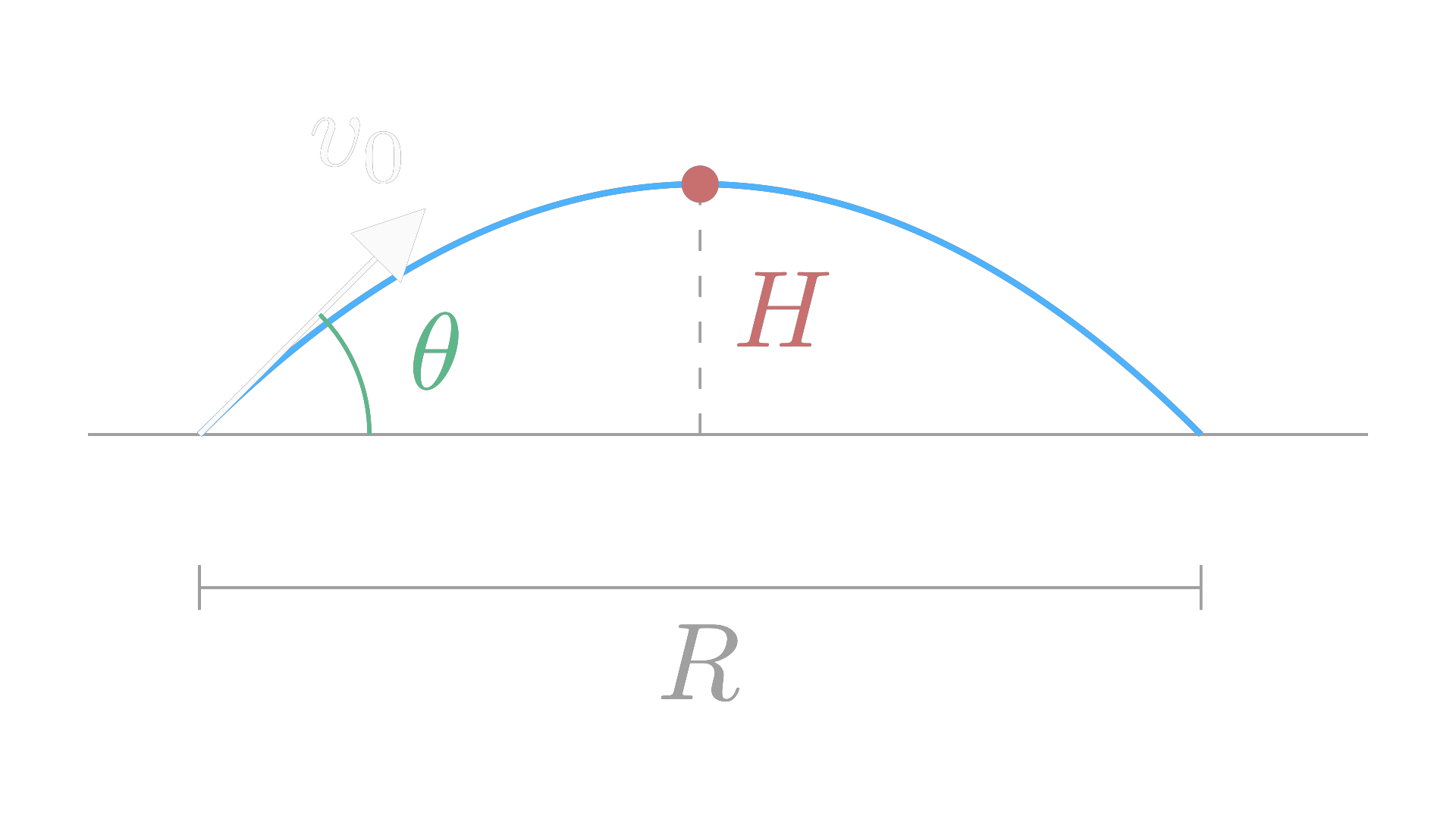
Maximum range at $\theta = 45°$. Only valid for level ground.
$\theta = 45°$ 时射程最大。仅当发射点与落地点同高时成立。
First Principles: Where the Range Formula Comes From第一性原理:射程公式从何而来
Principle. Gravity acts only vertically, so $a_x=0$ and $a_y=-g$ act independently. The two motions share only the clock $t$. Take level ground and launch from the origin.
原理。重力只沿竖直方向作用,所以 $a_x=0$ 与 $a_y=-g$ 互不影响。两个方向的运动只共用时间 $t$。取同高度落地,从原点发射。
- Vertical: $y=(v_0\sin\theta)\,t-\tfrac{1}{2}g t^2=0$ at landing, so $T=\dfrac{2v_0\sin\theta}{g}$.
- Horizontal: constant velocity, so $R=(v_0\cos\theta)\,T=\dfrac{2v_0^2\sin\theta\cos\theta}{g}$.
- Use $2\sin\theta\cos\theta=\sin 2\theta$: $R=\dfrac{v_0^2\sin 2\theta}{g}$.
- 竖直方向:落地时 $y=(v_0\sin\theta)\,t-\tfrac{1}{2}g t^2=0$,所以 $T=\dfrac{2v_0\sin\theta}{g}$。
- 水平方向:匀速,所以 $R=(v_0\cos\theta)\,T=\dfrac{2v_0^2\sin\theta\cos\theta}{g}$。
- 利用 $2\sin\theta\cos\theta=\sin 2\theta$:$R=\dfrac{v_0^2\sin 2\theta}{g}$。
Limiting-case check. At $\theta=0$ the flight time is zero; at $\theta=90^\circ$ the ball goes straight up and down. Both give $R=0$. $\sin 2\theta$ peaks at $\theta=45^\circ$. Units: $(\mathrm{m^2/s^2})/(\mathrm{m/s^2})=\mathrm{m}$.
极限检验。$\theta=0$ 时飞行时间为零;$\theta=90^\circ$ 时球竖直上下。两者都给出 $R=0$。$\sin 2\theta$ 在 $\theta=45^\circ$ 时最大。单位:$(\mathrm{m^2/s^2})/(\mathrm{m/s^2})=\mathrm{m}$。
The path of a projectile is a parabola. Coefficient of $x$ sets the initial slope; coefficient of $x^2$ sets the curvature (opens downward).
抛体的轨迹是一条抛物线(parabola)。$x$ 的系数对应初始斜率;$x^2$ 的系数决定弯曲程度(开口向下)。
Whenever an FRQ asks "does it clear the wall?" or "what angle must it be launched at to hit target $(x_T, y_T)$?", start from $x(t)$ and $y(t)$, solve $x(t)$ for $t$, and substitute into $y(t)$.
Setting $y = 0$ (landing on level ground) and solving for $x$ recovers the range formula, a quick FRQ sanity check.
凡是 FRQ 出现"能否越过墙?"或者"以什么角度发射才能击中目标 $(x_T, y_T)$?",都从 $x(t)$ 与 $y(t)$ 出发,把 $x(t)$ 解出 $t$ 再代回 $y(t)$。
令 $y = 0$(同高度落地)并对 $x$ 求解,即可还原出射程公式,这也是 FRQ 中常用的快速验算技巧。
Worked Example: Angled Launch例题:斜抛运动
Ball launched at 40 m/s at 30° from ground. Find range and max height. (g = 10)
小球以 40 m/s、相对地面 30° 角发射。求射程和最大高度。(取 $g = 10$)
Worked Example: Horizontal Launch from a Cliff例题:从悬崖水平抛出
Ball rolls off a 45 m cliff at 10 m/s horizontally. How far from the base does it land? (Take $g = 10\;\text{m/s}^2$.)
小球以 10 m/s 水平速度从 45 m 高的悬崖滚下。它落地点距崖底多远?(取 $g = 10\;\text{m/s}^2$)
Worked Example: Projectile + Relative Motion FRQ (Plane Drop)例题:抛体 + 相对运动 FRQ(飞机投物)
A plane flies horizontally at $v_p = 80$ m/s at an altitude of $h = 500$ m and releases a supply package. (a) How long until the package lands? (b) What horizontal distance does the package travel relative to the ground?
飞机在海拔 $h = 500$ m 处以 $v_p = 80$ m/s 水平飞行,并释放一个补给包。(a) 多久后落地?(b) 相对地面水平移动多远?
(c) In the plane's reference frame, what does the package's path look like? (d) A target on the ground is moving in the same direction as the plane at $v_t = 20$ m/s. How far behind the target must the package be released so it lands on the target? (Take $g = 10\;\text{m/s}^2$.)
(c) 在飞机的参考系(plane's reference frame)中包的运动轨迹是什么样?(d) 地面目标与飞机同向、以 $v_t = 20$ m/s 移动。包应在目标后方多远处释放才能正中目标?(取 $g = 10\;\text{m/s}^2$)
free fall),是一条紧贴飞机正下方的竖直线。飞机上的观察者看到的是纯粹的自由落体,地面上的观察者看到的是抛物线轨迹。两者描述的是同一运动,都正确。Exploring Projectile Motion探究抛体运动
Set up two columns, $x$ and $y$, and list $v_{x0}$, $v_{y0}$, $a_x = 0$ and $a_y = -g$ with signs before substituting anything.
分成 $x$、$y$ 两列,代入数值前先写出带符号的 $v_{x0}$、$v_{y0}$、$a_x = 0$ 与 $a_y = -g$。
Use $R = v_0^2\sin 2\theta / g$ only when launch and landing heights are equal; for a cliff or a raised target, solve the vertical equation for $t$ first and then use $x = v_{x0}t$. In a "how does the path change" question, name the component that changes and the one that does not.
只有发射点与落地点同高时才能用 $R = v_0^2\sin 2\theta / g$;悬崖或目标高于地面时,先由竖直方程解出 $t$,再用 $x = v_{x0}t$。遇到"轨迹如何变化"类问题,要指明哪个分量改变、哪个分量不变。
At the highest point of a projectile's path (no air resistance), what are $v_x$, $v_y$ and the acceleration?在抛体轨迹的最高点(忽略空气阻力),$v_x$、$v_y$ 与加速度分别是多少?
$v_y = 0$, $v_x$ keeps its launch value $v_0\cos\theta$ (no horizontal force), and the acceleration is still $g$ downward. The speed at the top is $v_x$, not zero.
$v_y = 0$;$v_x$ 保持发射时的 $v_0\cos\theta$(水平方向不受力);加速度仍为竖直向下的 $g$。最高点的速率等于 $v_x$,而不是零。
A ball is thrown horizontally at $12$ m/s from a height of $80$ m. Find the time to land, the horizontal distance and the impact speed. ($g = 10$ m/s²)从 $80$ m 高处以 $12$ m/s 水平抛出一个球。求落地时间、水平距离与落地速率。($g = 10$ m/s²)
Vertical: $80 = \tfrac{1}{2}(10)t^2$, so $t = 4.0$ s. Horizontal: $x = (12)(4.0) = 48$ m. At impact $v_y = (10)(4.0) = 40$ m/s downward, so $|v| = \sqrt{12^2 + 40^2} = \sqrt{1744} \approx 41.8$ m/s.
竖直方向:$80 = \tfrac{1}{2}(10)t^2$,得 $t = 4.0$ s。水平方向:$x = (12)(4.0) = 48$ m。落地时 $v_y = (10)(4.0) = 40$ m/s(向下),所以 $|v| = \sqrt{12^2 + 40^2} = \sqrt{1744} \approx 41.8$ m/s。
Two balls are launched on level ground at $20$ m/s, one at $30°$ and one at $60°$. Compare their ranges, maximum heights and flight times. ($g = 10$ m/s²)在水平地面上以 $20$ m/s 分别按 $30°$ 和 $60°$ 发射两个球。比较它们的射程、最大高度与飞行时间。($g = 10$ m/s²)
Ranges are equal because $\sin 60° = \sin 120°$: $R = (400)(0.866)/10 \approx 34.6$ m for both. Heights: $H = (v_0\sin\theta)^2/(2g)$ gives $5.0$ m at $30°$ and $15$ m at $60°$. Flight times: $T = 2v_0\sin\theta/g$ gives $2.0$ s at $30°$ and about $3.5$ s at $60°$. The steeper launch trades horizontal speed for a longer flight.
因为 $\sin 60° = \sin 120°$,两者射程相同:$R = (400)(0.866)/10 \approx 34.6$ m。高度:由 $H = (v_0\sin\theta)^2/(2g)$,$30°$ 时为 $5.0$ m,$60°$ 时为 $15$ m。飞行时间:由 $T = 2v_0\sin\theta/g$,$30°$ 时为 $2.0$ s,$60°$ 时约为 $3.5$ s。发射角更陡时,以较小的水平速度换取更长的飞行时间。
How Unit 1 Appears on the AP Exam第 1 单元在 AP 考试中的形式
Unit 1 has a 10-15% weighting in the multiple-choice section. From the May 2027 exam, Section I has 42 multiple-choice questions in 85 minutes (50% of the score) and Section II has 4 free-response questions in 95 minutes (50%): one each of mathematical routines, translation between representations, experimental design and analysis, and qualitative/quantitative translation.
A calculator is permitted and reference materials are provided. The course is calculus-based, so in this unit show the derivative or integral that links $x$, $v$ and $a$.
第 1 单元在选择题部分的占比为 10-15%。自 2027 年 5 月的考试起,第一部分为 42 道选择题,85 分钟(占总分 50%);第二部分为 4 道自由作答题,95 分钟(占 50%),题型各一道:数学推演(mathematical routines)、表示形式转换(translation between representations)、实验设计与分析(experimental design and analysis)、定性/定量转换(qualitative/quantitative translation)。
允许使用计算器,并提供参考资料(reference materials)。本课程以微积分为基础,所以本单元要写出联系 $x$、$v$、$a$ 的导数或积分。
Unit 1 has a 10-15% weighting in the multiple-choice section. From the May 2027 exam, Section I has 42 multiple-choice questions in 85 minutes (50% of the score) and Section II has 4 free-response questions in 95 minutes (50%): one each of mathematical routines, translation between representations, experimental design and analysis, and qualitative/quantitative translation.
A calculator is permitted and reference materials are provided. The course is algebra-based, so in this unit read instantaneous velocity and acceleration from graph slopes and displacement from graph areas.
第 1 单元在选择题部分的占比为 10-15%。自 2027 年 5 月的考试起,第一部分为 42 道选择题,85 分钟(占总分 50%);第二部分为 4 道自由作答题,95 分钟(占 50%),题型各一道:数学推演(mathematical routines)、表示形式转换(translation between representations)、实验设计与分析(experimental design and analysis)、定性/定量转换(qualitative/quantitative translation)。
允许使用计算器,并提供参考资料(reference materials)。本课程以代数为基础,所以本单元从图像斜率读瞬时速度与加速度,从图像面积读位移。
Question Styles on the Exam考试中的题型
Calculate an unknown kinematic quantity from given information using the three kinematic equations or graph slopes and areas.
Interpret graphs: read slopes and areas from $x$-$t$, $v$-$t$, and $a$-$t$ plots.
Compare scenarios: determine which object arrives first, goes higher, or travels farther.
Relative motion: find velocity of one object as seen from another reference frame.
Multiple Choice):常见题型计算类:由已知量用三大运动学方程或图像的斜率与面积求未知量。
图像解读:从 $x$-$t$、$v$-$t$、$a$-$t$ 图中读取斜率与面积。
情景比较:判断哪个物体先到、跳得更高或走得更远。
相对运动:在另一参考系中观察某物体的速度。
Translation Between Representations (TBR): Given one representation (e.g., a v-t graph), produce another (e.g., the x-t graph or a motion description).
Experimental design: Describe a procedure to determine kinematic quantities from real data.
Multi-step projectile problems: Derive expressions, calculate unknowns, and explain physical reasoning.
Free Response):常见题型表示形式之间的转换(Translation Between Representations, TBR):给一种表示(如 v-t 图),转换为另一种(如 x-t 图或文字描述)。
实验设计:设计一套测量某些运动学量的实际实验方案。
多步抛体题:推导表达式、计算未知量并解释物理意义。
distance)与位移(displacement):往返一次 $\Delta x = 0$,但 $d > 0$。
6. 最终结果未带单位(units)。
- Using the kinematic equations when $a(t)$ is given as a function of time; integrate it instead.
- Forgetting the constant of integration $C$ when integrating $v(t)$ or $a(t)$.
- 题目把 $a(t)$ 作为时间的函数给出时仍套用运动学方程;应改为积分。
- 在对 $v(t)$ 或 $a(t)$ 积分时漏写积分常数 $C$。
Flashcards: Click to Flip闪卡:点击翻面
(constant $a$)三大运动学方程
($a$ 恒定)
$x = x_0 + v_0 t + \frac{1}{2}at^2$
$v^2 = v_0^2 + 2a\Delta x$
(level ground)射程公式
(同高度)
Unit 1: Practice Quiz第 1 单元:练习测验
quadratic formula):$t = \frac{3 \pm \sqrt{3}}{6}$。inertial reference frame),下列哪句正确?Galilean invariance):在所有非加速的惯性参考系中加速度都相同。速度和位置都与参考系有关。Worked Example: Projectile Range and the 45° Result (FRQ Style)例题:抛体射程与 45° 最优角(FRQ 风格) Physics C
A projectile is launched from ground level with initial speed $v_0$ at angle $\theta$ above the horizontal. Air resistance is negligible. (a) Derive the horizontal range $R(\theta)$ and the time of flight. (b) Show that $R$ is maximized at $\theta = 45^{\circ}$. (c) Compute $R$ for $v_0 = 20\;\text{m/s}$, $\theta = 30^{\circ}$, $g = 9.8\;\text{m/s}^2$.
抛体从地面以初速度 $v_0$、与水平方向成 $\theta$ 角发射,空气阻力不计。(a) 推导水平射程 $R(\theta)$ 与飞行时间。(b) 证明 $R$ 在 $\theta = 45^{\circ}$ 时取最大值。(c) 计算 $v_0 = 20\;\text{m/s}$、$\theta = 30^{\circ}$、$g = 9.8\;\text{m/s}^2$ 时的 $R$。
Identify)Principle: 2-D projectile motion as independent constant-acceleration kinematics in $x$ (no force) and $y$ (gravity only); calculus optimization on the closed-form range.
原理:二维抛体运动 = $x$ 方向匀速(无力)与 $y$ 方向匀变速(仅重力)的两个互不相关的一维运动;再对射程的闭式表达式做微积分优化。
Set Up)Place the origin at the launch point with $+x$ horizontal and $+y$ upward. Resolve $\vec v_0$ into components and write the kinematic equations:
将原点置于发射点,$+x$ 取水平方向、$+y$ 取竖直向上。将 $\vec v_0$ 分解后写出运动学方程:
Execute)Evaluate)Worked Example: Non-Constant Acceleration: Integrating $a(t)$ (FRQ Style)例题:非恒定加速度:对 $a(t)$ 积分(FRQ 风格) Physics C
A particle moves along the $x$-axis with acceleration $a(t) = 6t - 12\;\text{m/s}^2$. At $t = 0$ the particle is at $x_0 = 5\;\text{m}$ with $v_0 = 0$. (a) Derive $v(t)$ and $x(t)$. (b) Find every time on $0 \le t \le 5\;\text{s}$ at which the particle is momentarily at rest. (c) Compute the total distance (not displacement) traveled on $0 \le t \le 5\;\text{s}$.
一质点沿 $x$ 轴运动,加速度 $a(t) = 6t - 12\;\text{m/s}^2$。$t = 0$ 时 $x_0 = 5\;\text{m}$,$v_0 = 0$。(a) 推导 $v(t)$ 与 $x(t)$;(b) 找出 $0 \le t \le 5\;\text{s}$ 内所有质点瞬时静止的时刻;(c) 计算 $0 \le t \le 5\;\text{s}$ 内总路程(total distance,注意不是位移)。
Identify)Principle: velocity and position from non-constant acceleration via direct integration; total distance requires partitioning the interval at sign changes of $v(t)$.
原理:对非恒定加速度直接积分得速度与位置;求总路程必须在 $v(t)$ 变号处对时间区间进行划分。
Set Up)Use the calculus definitions directly:
直接用微积分定义:
Execute)Evaluate)鼎睿学苑 · Dingrui Scholars
AP Physics C: Mechanics · Unit 1 Kinematics · 2026 EditionAP 物理 C:力学 · 第 1 单元 运动学 · 2026 版