Unit 4: Linear Momentum第 4 单元:线动量
Impulse, collisions, and the conservation law that governs every interaction: master the vector nature of momentum, handle time-varying forces and variable mass with calculus, and learn when energy methods fail but momentum methods succeed.冲量(impulse)、碰撞(collision),以及支配一切相互作用的守恒律:掌握动量的矢量本性,用微积分处理随时间变化的力与变质量问题,并弄清在哪些情形下能量方法失效、而动量方法依然奏效。
Impulse, collisions, and the conservation law that governs every interaction: master the vector nature of momentum with algebra, force-time graphs and diagrams, and learn when energy methods fail but momentum methods succeed.冲量(impulse)、碰撞(collision),以及支配一切相互作用的守恒律:用代数、力-时间图像和示意图掌握动量的矢量本性,并弄清在哪些情形下能量方法失效、而动量方法依然奏效。
Linear Momentum线动量
- Calculate the momentum of an object from $\vec{p} = m\vec{v}$, giving its direction with a sign or with components.
- Explain why momentum is a vector while kinetic energy is a scalar, and compare the two for objects moving in opposite directions.
- Calculate the total momentum of a system of objects in one and two dimensions.
- Describe a collision and an explosion as interactions in which the internal forces are much larger than the external forces.
- Apply conservation of momentum to calculate a recoil velocity.
- 由 $\vec{p} = m\vec{v}$ 计算(
calculate)物体的动量,并用正负号或分量表示其方向。 - 解释(
explain)为什么动量是矢量而动能是标量,并比较反向运动物体的这两个量。 - 计算(
calculate)一维和二维情形下物体系统的总动量。 - 把碰撞和爆炸描述(
describe)为内力远大于外力的相互作用。 - 应用(
apply)动量守恒计算反冲速度。
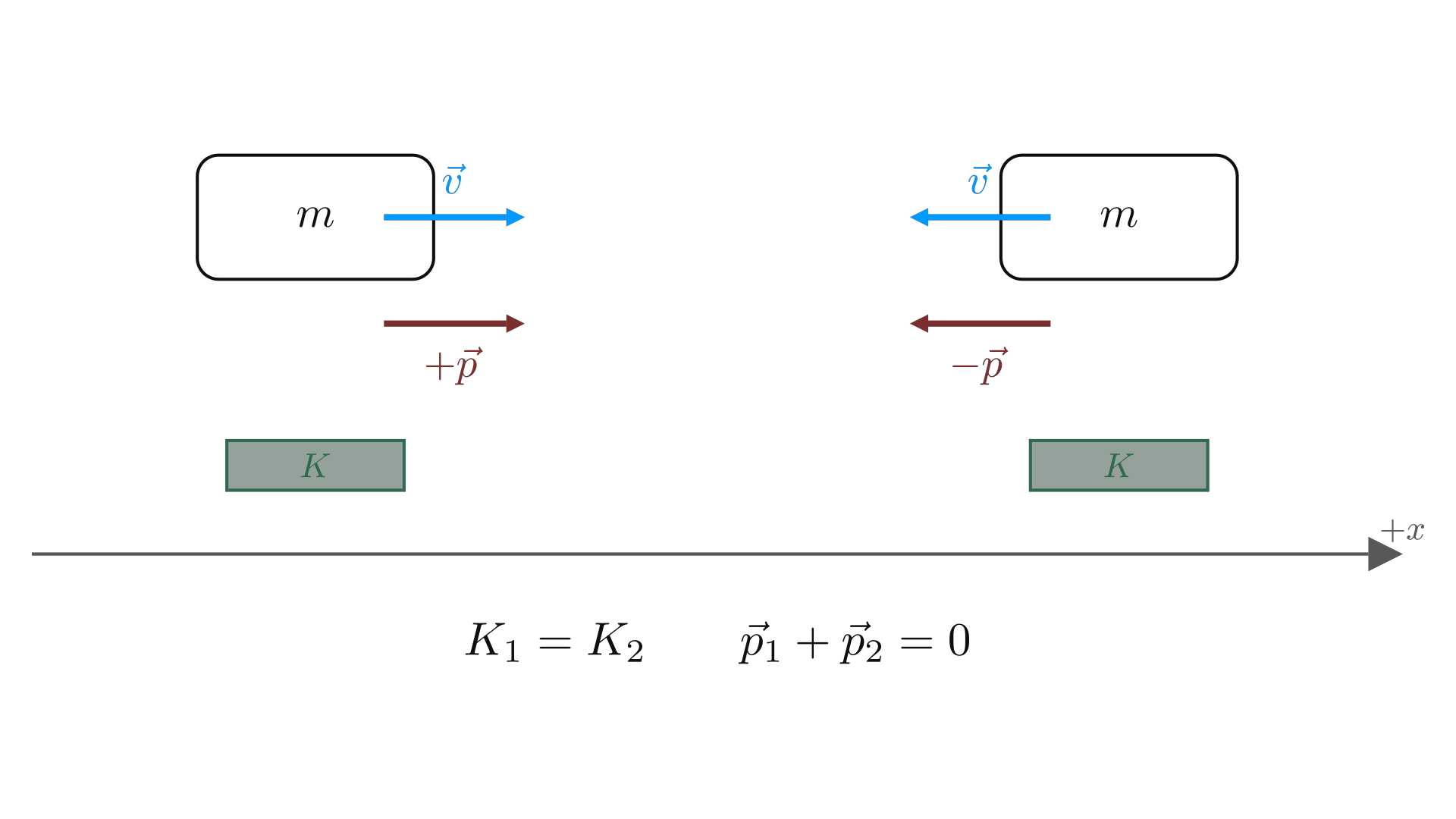
Momentum is the quantity that captures how much "motion" an object has, and in what direction. Unlike kinetic energy, momentum is a vector. Two identical cars traveling at the same speed in opposite directions have the same kinetic energy but opposite momenta.
动量(momentum)刻画了物体"运动得有多多",以及朝哪个方向。与动能不同,动量是一个矢量。两辆完全相同、以同样速率反向行驶的汽车,动能相同但动量相反。
This distinction is essential for collision analysis: it's why momentum, not energy, captures the full picture of a system's state of motion.
这一区分对碰撞分析至关重要:正因如此,要完整描述系统的运动状态,靠的是动量而不是能量。
Units: kg·m/s. Direction: same as $\vec{v}$.
单位:kg·m/s。方向与 $\vec{v}$ 一致。
Collisions and Explosions碰撞与爆炸
Momentum provides the natural language for describing two important classes of interactions. A collision is a model for an interaction in which the forces between the colliding objects are much larger than any external forces during the brief interaction time. Because of this, external forces can be neglected and momentum is approximately conserved.
动量是描述两类重要相互作用的天然语言。碰撞(collision)的模型是:两物体间的内力在极短作用时间内远大于任何外力,因此外力可忽略,动量近似守恒。
An explosion is the reverse: internal forces push objects within a system apart. The same conservation principle applies.
爆炸(explosion)则相反:系统内部的力把物体推开。但守恒原理同样适用。
In 1644 René Descartes claimed that the total "quantity of motion" (size times speed) never changes. He ignored direction, so most of his seven rules for colliding bodies were wrong.
1644 年,René Descartes 提出世界上的"运动量"(quantity of motion,大小乘以速率)总量不变。他忽略了方向,所以他给出的七条碰撞规则大多是错的。
In 1668 the Royal Society asked for papers on collisions. John Wallis, Christopher Wren and Christiaan Huygens replied. Huygens showed that the conserved quantity must carry a sign for direction, which is today's vector momentum.
1668 年,英国皇家学会(Royal Society)征集关于碰撞的论文,John Wallis、Christopher Wren 和 Christiaan Huygens 作出了回应。Huygens 证明守恒的量必须带有表示方向的正负号,这就是今天的矢量动量。
Worked Example: Explosion from Rest例题:静止状态下的"爆炸"
A 3 kg cannon sits on a frictionless surface and fires
a 0.5 kg ball at 20 m/s to the right. Find the cannon's recoil velocity.
一门 3 kg 的炮置于无摩擦地面上,向右发射一颗 0.5 kg 的炮弹(速率 20 m/s)。求炮身的反冲速度(recoil velocity)。
Worked Example: Momentum in Two Dimensions例题:二维动量
A 2 kg ball moves at 10 m/s, directed 30° above the horizontal. Find the $x$- and $y$-components of its momentum.
一个 2 kg 的球以 10 m/s 运动,方向与水平方向成 30° 角。求其动量的 $x$、$y$ 分量。
Write your sign convention in words ("right is positive") before the first momentum equation, and give every momentum with a magnitude, a unit (kg·m/s, which is the same as N·s) and a direction. A bare negative number is ambiguous unless the convention is stated.
写第一个动量方程之前,先用文字写出正方向约定(例如"向右为正"),每个动量都要给出大小、单位(kg·m/s,与 N·s 相同)和方向。没有说明约定时,单独一个负数是含糊的。
When a question compares two objects, remember that momentum and kinetic energy can rank them differently: for the same momentum, $K = \dfrac{p^2}{2m}$, so the lighter object has more kinetic energy.
题目比较两个物体时要记住:动量和动能给出的排序可能不同。动量相同时 $K = \dfrac{p^2}{2m}$,所以质量小的物体动能更大。
A 0.145 kg baseball moves at 40 m/s toward home plate. What is the magnitude of its momentum?一个 0.145 kg 的棒球以 40 m/s 飞向本垒。它的动量大小是多少?
$p = mv = (0.145)(40) = 5.8$ kg·m/s, directed toward home plate.
$p = mv = (0.145)(40) = 5.8$ kg·m/s,方向指向本垒。
Two objects have momenta of the same magnitude. Object A has four times the mass of object B. Which has more kinetic energy, and by what factor?两个物体的动量大小相同,物体 A 的质量是物体 B 的 4 倍。哪个动能更大?大几倍?
$K = \dfrac{p^2}{2m}$ with the same $p$, so $K$ is inversely proportional to $m$. Object B, the lighter one, has 4 times the kinetic energy of A. (B also moves 4 times as fast, because $v = p/m$.)
在 $p$ 相同时 $K = \dfrac{p^2}{2m}$,所以 $K$ 与 $m$ 成反比。质量较小的物体 B 动能是 A 的 4 倍。(由 $v = p/m$,B 的速率也是 A 的 4 倍。)
A 70 kg skater at rest on frictionless ice throws a 5.0 kg ball horizontally forward at 8.0 m/s. Find the skater's velocity just after the throw.一名 70 kg 的滑冰者静止在无摩擦冰面上,把一个 5.0 kg 的球以 8.0 m/s 水平向前扔出。求扔出后瞬间滑冰者的速度。
System: skater + ball, no horizontal external force, total momentum 0 before. Forward positive: $0 = (5.0)(8.0) + (70)\,v_s$, so $v_s = -\dfrac{40}{70} \approx -0.57$ m/s. The skater moves backward at about 0.57 m/s.
系统:滑冰者 + 球,水平方向无外力,扔之前总动量为 0。取向前为正:$0 = (5.0)(8.0) + (70)\,v_s$,得 $v_s = -\dfrac{40}{70} \approx -0.57$ m/s。滑冰者以约 0.57 m/s 向后运动。
A 2.0 kg cart moves at 3.0 m/s in the $+x$ direction and a 1.0 kg cart moves at 4.0 m/s in the $+y$ direction. Find the total momentum of the two-cart system.一辆 2.0 kg 的小车以 3.0 m/s 沿 $+x$ 方向运动,另一辆 1.0 kg 的小车以 4.0 m/s 沿 $+y$ 方向运动。求这两辆小车组成的系统的总动量。
Add the momenta by components: $p_x = (2.0)(3.0) = 6.0$ kg·m/s and $p_y = (1.0)(4.0) = 4.0$ kg·m/s. The magnitude is $\sqrt{6.0^2 + 4.0^2} \approx 7.2$ kg·m/s, directed at $\tan^{-1}(4.0/6.0) \approx 34°$ above the $+x$ axis.
按分量相加:$p_x = (2.0)(3.0) = 6.0$ kg·m/s,$p_y = (1.0)(4.0) = 4.0$ kg·m/s。大小为 $\sqrt{6.0^2 + 4.0^2} \approx 7.2$ kg·m/s,方向与 $+x$ 轴成 $\tan^{-1}(4.0/6.0) \approx 34°$ 角,位于该轴上方。
Change in Momentum and Impulse动量变化与冲量
- Calculate impulse as average force times time interval, and as the area under a force-time graph.
- Apply the impulse-momentum theorem to find a change in velocity or an average force.
- Explain why a longer stopping time reduces the average force on an object (airbags, crumple zones).
- Explain why a rebound needs a larger impulse than stopping.
- Determine the net force from the slope of a momentum-time graph.
- Calculate the impulse of a time-varying force $F(t)$ by integration, and use $\vec{F}_\text{net} = d\vec{p}/dt$.
- Apply $\vec{F}_\text{net} = d\vec{p}/dt$ to a system whose mass changes.
- 把冲量计算(
calculate)为平均力乘以时间间隔,以及力-时间图像下方的面积。 - 应用(
apply)动量定理求速度变化或平均力。 - 解释(
explain)为什么延长停止时间会减小物体所受的平均力(安全气囊、溃缩区)。 - 解释(
explain)为什么反弹所需的冲量比停下更大。 - 由动量-时间图像的斜率确定(
determine)净力。 - 用积分计算随时间变化的力 $F(t)$ 的冲量,并使用 $\vec{F}_\text{net} = d\vec{p}/dt$。
- 把 $\vec{F}_\text{net} = d\vec{p}/dt$ 应用于质量变化的系统。
Newton's Second Law: The Momentum FormNewton 第二定律:动量形式 Physics C
Newton's second law is often written as $\vec{F} = m\vec{a}$, but this is actually a special case that assumes constant mass. Newton himself stated the law in terms of momentum: the net external force on a system equals the rate of change of that system's momentum.
Newton 第二定律常被写成 $\vec{F} = m\vec{a}$,但这其实是质量恒定时的特例。Newton 本人是用动量来表述这条定律的:作用于系统的合外力等于系统动量的变化率。
This more general formulation handles situations like rockets (where mass changes) and collisions (where force varies rapidly).
这种更一般的写法能处理质量变化的情形(如火箭)以及力随时间剧烈变化的情形(如碰撞)。
Newton's Second Law in Terms of Momentum用动量表述的 Newton 第二定律
Newton's second law, $\vec{F}_\text{net} = m\vec{a}$, can be rewritten with momentum. For constant mass, $\vec{a} = \Delta\vec{v}/\Delta t$, so $\vec{F}_\text{net} = m\Delta\vec{v}/\Delta t = \Delta\vec{p}/\Delta t$: the net force equals the rate at which the momentum changes. A large net force changes momentum quickly; a small one changes it slowly. On a momentum-time graph this rate is the slope.
Newton 第二定律 $\vec{F}_\text{net} = m\vec{a}$ 可以用动量改写。质量恒定时 $\vec{a} = \Delta\vec{v}/\Delta t$,所以 $\vec{F}_\text{net} = m\Delta\vec{v}/\Delta t = \Delta\vec{p}/\Delta t$:净力等于动量变化的快慢。净力大,动量变化得快;净力小,动量变化得慢。在动量-时间图像上,这个变化率就是斜率。
The Impulse–Momentum Theorem动量定理
Integrating both sides of Newton's second law over a time interval gives the impulse–momentum theorem: the impulse delivered to an object equals its change in momentum. Impulse is defined as the integral of force over time; it is a vector quantity with the same direction as the net force.
将 Newton 第二定律两边对一段时间积分,得到动量定理(impulse–momentum theorem):物体获得的冲量(impulse)等于它动量的变化。冲量定义为力对时间的积分,是一个与净力方向相同的矢量。
Multiply both sides of $\vec{F}_\text{net} = \Delta\vec{p}/\Delta t$ by $\Delta t$ and you get the impulse–momentum theorem: the impulse delivered to an object equals its change in momentum.
把 $\vec{F}_\text{net} = \Delta\vec{p}/\Delta t$ 两边同乘 $\Delta t$,就得到动量定理(impulse–momentum theorem):物体获得的冲量(impulse)等于它动量的变化。
For a constant force, the impulse is the force times the time it acts. For a force that changes, use the average force, or find the area under the force-time graph. Impulse is a vector with the same direction as the net force.
对恒力,冲量等于力乘以作用时间;对变化的力,用平均力,或求力-时间图像下方的面积。冲量是一个与净力方向相同的矢量。
Impulse–momentum drops straight out of Newton's second law. If a question asks you to derive it, these two lines are the whole derivation.
动量定理直接由 Newton 第二定律导出。若题目要求推导(derive),这两行就是完整的推导。
Use $\vec{J} = \int \vec{F}(t)\,dt$ when the problem gives you $F(t)$ as a function (algebraic or graphical): the integral is just the area under the $F$-$t$ curve.
Use $\vec{J} = \bar{\vec{F}}\,\Delta t$ when the problem tells you the collision lasts $\Delta t$ and asks for the average force. Rearrange to $\bar F = \Delta p / \Delta t$.
The two forms are consistent, since $\bar F \equiv \tfrac{1}{\Delta t}\int F\,dt$, but never mix them in the same equation.
当题目给出 $F(t)$(无论是代数式还是图像)时,用 $\vec{J} = \int \vec{F}(t)\,dt$:积分就是 $F$-$t$ 曲线下方的面积。
当题目告知碰撞持续时间 $\Delta t$ 并问平均力时,用 $\vec{J} = \bar{\vec{F}}\,\Delta t$,整理为 $\bar F = \Delta p / \Delta t$。
两种形式是自洽的,因为 $\bar F \equiv \tfrac{1}{\Delta t}\int F\,dt$,但同一个方程里千万别混用。
Use $\vec{J} = \vec{F}_\text{avg}\,\Delta t$ when the problem tells you how long the contact lasts and asks for the average force. Rearrange to $F_\text{avg} = \Delta p / \Delta t$.
Use the area under the $F$-$t$ graph when the problem gives the graph. Split the area into rectangles and triangles; area below the time axis is negative impulse.
Both give the same impulse: the average force is the constant force that would give the same area over the same time.
当题目告知接触持续多久并问平均力时,用 $\vec{J} = \vec{F}_\text{avg}\,\Delta t$,整理为 $F_\text{avg} = \Delta p / \Delta t$。
当题目给出 $F$-$t$ 图像时,求图像下方的面积。把面积分成矩形和三角形;时间轴下方的面积是负冲量。
两种方法给出同一个冲量:平均力就是在同一段时间内产生相同面积的那个恒力。
First Principles: Where Impulse Comes From第一性原理:冲量从何而来
Principle. Newton's second law in its general form: $\vec{F}_\text{net} = d\vec{p}/dt$.
原理。Newton 第二定律的一般形式:$\vec{F}_\text{net} = d\vec{p}/dt$。
- Multiply by $dt$: in each instant the force adds $d\vec{p} = \vec{F}_\text{net}\,dt$.
- Add the instants from $t_1$ to $t_2$: $\Delta\vec{p} = \int_{t_1}^{t_2}\vec{F}_\text{net}\,dt$.
- Call the integral the impulse $\vec{J}$, and define $\vec{F}_\text{avg} = \vec{J}/\Delta t$.
- 两边乘以 $dt$:每一瞬间力使动量增加 $d\vec{p} = \vec{F}_\text{net}\,dt$。
- 把 $t_1$ 到 $t_2$ 的各瞬间相加:$\Delta\vec{p} = \int_{t_1}^{t_2}\vec{F}_\text{net}\,dt$。
- 把这个积分称为冲量 $\vec{J}$,并定义 $\vec{F}_\text{avg} = \vec{J}/\Delta t$。
Principle. Newton's second law for constant mass, $\vec{F}_\text{net} = m\vec{a}$, with $\vec{a} = \Delta\vec{v}/\Delta t$ for a constant force.
原理。质量恒定时的 Newton 第二定律 $\vec{F}_\text{net} = m\vec{a}$;力恒定时 $\vec{a} = \Delta\vec{v}/\Delta t$。
- Substitute and multiply by $\Delta t$: $\vec{F}_\text{net}\,\Delta t = m\,\Delta\vec{v} = \Delta\vec{p}$.
- For a changing force, cut the contact into short slices in which the force is nearly constant. Each slice gives $F_i\,\Delta t_i = \Delta p_i$, a thin rectangle under the $F$-$t$ graph.
- Add the slices: the total area under the graph equals the total $\Delta p$. This area is the impulse $J$.
- 代入后两边乘以 $\Delta t$:$\vec{F}_\text{net}\,\Delta t = m\,\Delta\vec{v} = \Delta\vec{p}$。
- 若力在变化,就把接触过程切成许多短时间片,每片内力几乎不变。每片给出 $F_i\,\Delta t_i = \Delta p_i$,即 $F$-$t$ 图像下的一个窄矩形。
- 把各片相加:图像下的总面积等于总的 $\Delta p$,这个面积就是冲量 $J$。
Limiting checks. If $\vec{F}_\text{net} = 0$, the impulse is zero and $\vec{p}$ stays constant (Newton's first law). For a fixed $\Delta p$, letting $\Delta t \to 0$ sends $F_\text{avg} = \Delta p/\Delta t$ to infinity, which is why a rigid impact hurts. Units: $\text{N}\cdot\text{s} = \text{kg}\cdot\text{m/s}$.
极限检验。若 $\vec{F}_\text{net} = 0$,冲量为零,$\vec{p}$ 保持不变(Newton 第一定律)。$\Delta p$ 一定时,令 $\Delta t \to 0$,$F_\text{avg} = \Delta p/\Delta t$ 趋于无穷大,所以刚性碰撞伤害大。单位:$\text{N}\cdot\text{s} = \text{kg}\cdot\text{m/s}$。
Applying the Theorem定理的应用
airbag)和溃缩区(crumple zone)能保命的原因。在车祸中,动量的变化(也即冲量)是定值,因为车必须停下来。但若延长碰撞时间,平均力就会变小:$\vec{F}_\text{avg} = \Delta\vec{p} / \Delta t$。停止时间越长,乘客受到的平均力就越小,实际上峰值力通常也更小。
Graphical Interpretation图像解读
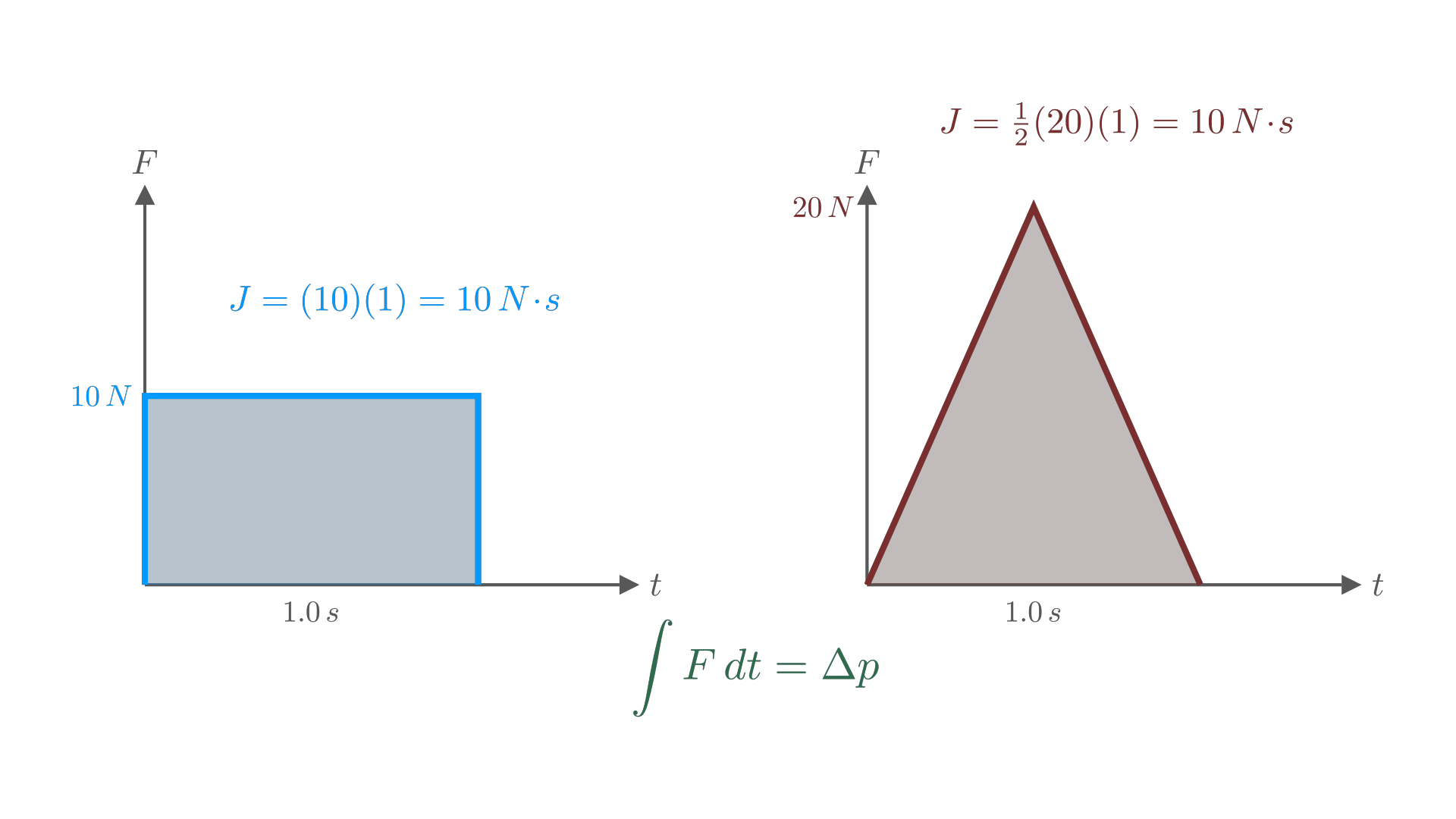
On a force vs. time graph, the impulse delivered to a system is the area under the curve. On a momentum vs. time graph, the net external force at any instant is the slope of the curve. Read both graphs this way: area gives impulse, slope gives force.
在力-时间图上,冲量等于曲线下方的面积。在动量-时间图上,任意瞬时的净外力等于该曲线的斜率。读这两种图都按这个思路:面积给出冲量,斜率给出力。
| From由 | To求 | Operation运算 | On the Graph图像意义 |
|---|---|---|---|
| $F(t)$ | $J$ (impulse)(冲量) | $J = \int F\,dt$ | Area under $F$-$t$ curve$F$-$t$ 曲线下方的面积 |
| $p(t)$ | $F_\text{net}$ | $F = dp/dt$ | Slope of $p$-$t$ graph$p$-$t$ 图的斜率 |
| $J$ | $\Delta p$ | $J = \Delta p$ | Area = change in $p$面积 = 动量变化 |
| Graph图像 | Read off读出 | How方法 |
|---|---|---|
| Force vs. time力-时间 | Impulse $J = \Delta p$冲量 $J = \Delta p$ | Area between the graph and the time axis (rectangles and triangles)图线与时间轴之间的面积(矩形与三角形) |
| Momentum vs. time动量-时间 | Net force $F_\text{net}$净力 $F_\text{net}$ | Slope $\Delta p / \Delta t$斜率 $\Delta p / \Delta t$ |
Variable-Mass Systems变质量系统 Physics C
When an object's mass changes with time (such as a rocket expelling fuel), the impulse–momentum theorem in its general form still applies. If velocity is constant but mass changes:
当物体的质量随时间变化(例如喷射燃料的火箭),动量定理的一般形式依然成立。若速度恒定而质量变化:
Rockets: Momentum Conservation with Exhaust火箭:包含排气的动量守恒
Take a rocket and the exhaust it ejects together as one system. Far from other objects there is no external force, so the total momentum of rocket + exhaust stays constant. The engine pushes exhaust backward, giving the exhaust backward momentum; the rocket gains an equal amount of forward momentum.
把火箭和它喷出的排气一起看作一个系统。远离其他物体时没有外力,所以"火箭 + 排气"的总动量保持不变。发动机把排气向后推,使排气获得向后的动量;火箭则获得同样大小的向前动量。
By Newton's third law, the exhaust pushes forward on the rocket with a force equal in size to the force the rocket exerts backward on the exhaust. The rocket does not need anything to push against.
由 Newton 第三定律,排气对火箭向前的推力与火箭对排气向后的力大小相等。火箭并不需要"推着"任何外部物体。
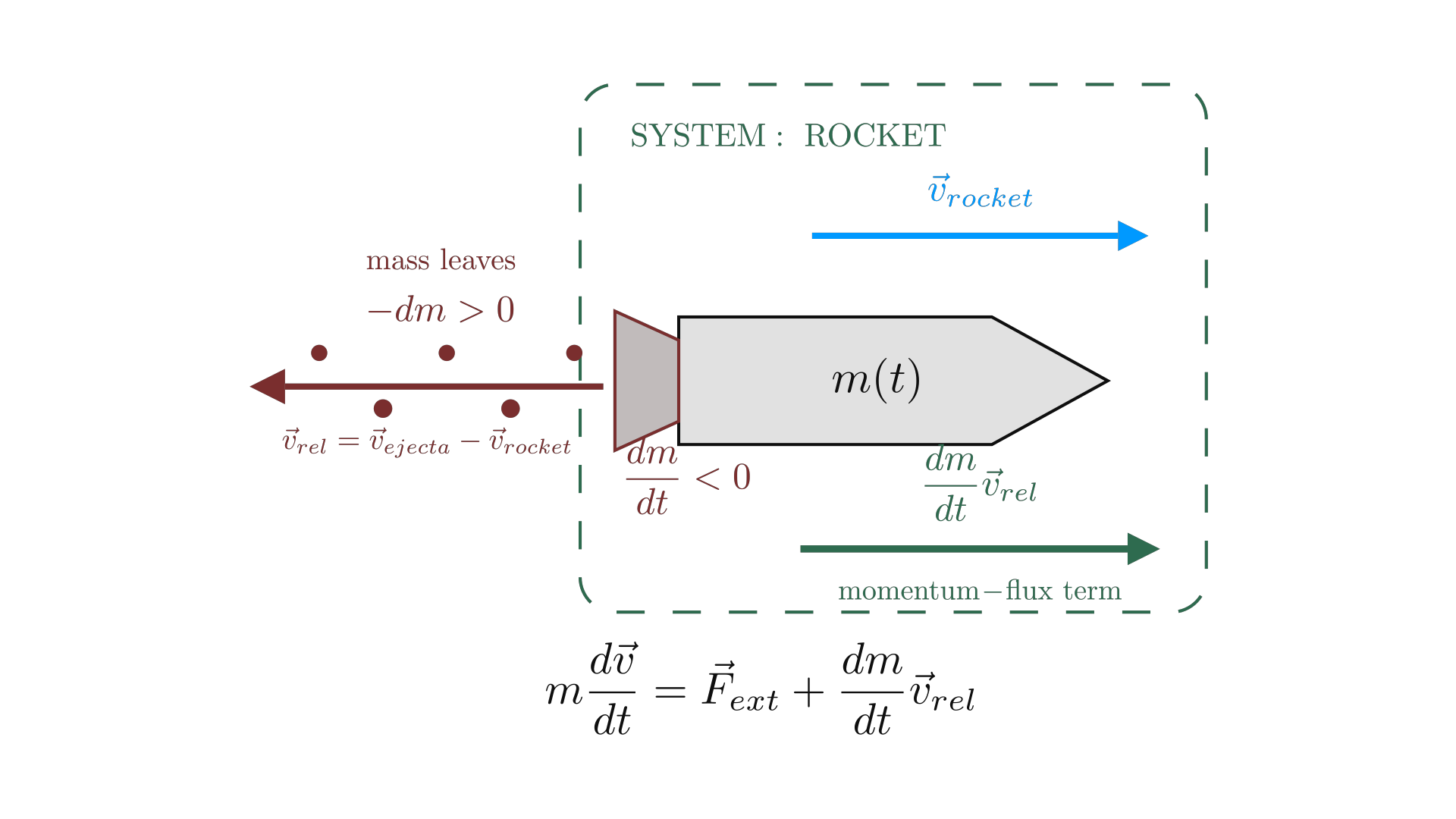
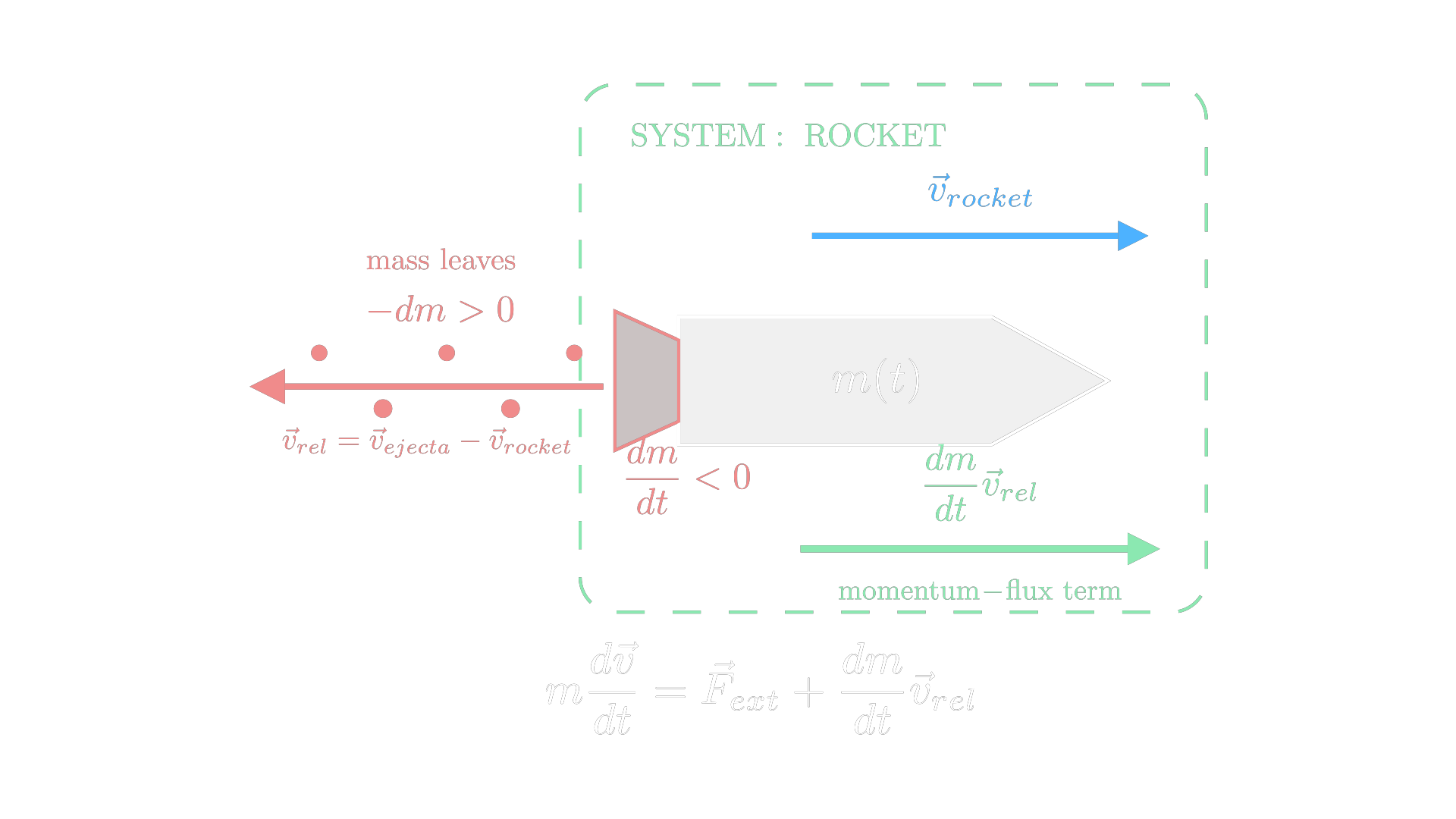
For a rocket, define $\vec{v}_\text{rel} = \vec{v}_\text{ejecta} - \vec{v}_\text{rocket}$ (exhaust velocity relative to the rocket, pointing backward for backward exhaust) and take $\frac{dm}{dt} < 0$ when mass leaves the rocket. The momentum balance is $m\frac{d\vec{v}}{dt} = \vec{F}_\text{ext} + \frac{dm}{dt}\vec{v}_\text{rel}$. When $\vec{F}_\text{ext}=0$ and the exhaust leaves backward, $\frac{dm}{dt}\vec{v}_\text{rel}$ points forward, so the rocket accelerates forward. Know this direction argument even when a question does not ask for the full rocket equation.
对于火箭,定义 $\vec{v}_\text{rel} = \vec{v}_\text{ejecta} - \vec{v}_\text{rocket}$(排气相对火箭的速度,向后喷出时指向后方),质量离开火箭时取 $\frac{dm}{dt} < 0$。动量平衡为 $m\frac{d\vec{v}}{dt} = \vec{F}_\text{ext} + \frac{dm}{dt}\vec{v}_\text{rel}$:当 $\vec{F}_\text{ext}=0$ 且排气向后时,$\frac{dm}{dt}\vec{v}_\text{rel}$ 指向前方,火箭向前加速。即使题目不要求完整的火箭方程,也要会这个方向论证。
Worked Example: Impulse from a Variable Force例题:由变力求冲量 Physics C
A force $F(t) = 6t$ N acts on a 3.0 kg object, initially at rest, from $t = 0$ to $t = 4.0$ s. Find the impulse and the final speed.
力 $F(t) = 6t$ N 作用于一个初始静止、质量 3.0 kg 的物体,从 $t = 0$ 持续到 $t = 4.0$ s。求冲量和末速率。
Worked Example: Impulse from F(t) Graph (Triangle)例题:由 F(t) 图(三角形)求冲量
A triangular F(t) profile: F rises linearly from 0 to 20 N
over 0.5 s, then drops back to 0 over the next 0.5 s.
The object has mass 4 kg and is initially at rest.
三角形 F(t) 图:F 在 0.5 s 内由 0 线性升至 20 N,
再在随后 0.5 s 内降回 0。
物体质量 4 kg,初始静止。
Worked Example: Average Force on a Rebounding Ball例题:反弹小球受到的平均力
A 0.50 kg ball moving at 12 m/s hits a wall head-on and rebounds along the same line at 8.0 m/s. The ball is in contact with the wall for 0.020 s. Find (a) the impulse on the ball and (b) the average force the wall exerts on it.
一个 0.50 kg 的小球以 12 m/s 正面撞墙,沿同一直线以 8.0 m/s 弹回。小球与墙的接触时间为 0.020 s。求 (a) 小球受到的冲量;(b) 墙对小球的平均力。
Impulse and change in momentum are vectors: compute $\Delta p = p_f - p_i$ with signs, never by subtracting speeds. When you use an average force, state the time interval it acts over.
冲量和动量变化都是矢量:带符号计算 $\Delta p = p_f - p_i$,绝不能用速率相减。使用平均力时,要说明它作用的时间间隔。
On a force-time graph, split the area into rectangles and triangles, and count area below the time axis as negative impulse. N·s and kg·m/s are the same unit; either is correct for impulse or momentum change.
在力-时间图上,把面积分成矩形和三角形,时间轴下方的面积算作负冲量。N·s 与 kg·m/s 是同一个单位,冲量或动量变化用哪一个都可以。
When the force is given as a function $F(t)$, write $J = \int_{t_1}^{t_2} F(t)\,dt$ with the limits shown, then evaluate. When the momentum is given as $p(t)$, the net force is $dp/dt$ at the instant asked for.
力以函数 $F(t)$ 给出时,写出带上下限的 $J = \int_{t_1}^{t_2} F(t)\,dt$ 再计算。动量以 $p(t)$ 给出时,所问时刻的净力就是 $dp/dt$。
If the force changes during the interaction, use the area under the force-time graph, or break the motion into intervals of constant force. The ratio $\Delta p/\Delta t$ gives the average force over the interval, not the peak force.
相互作用过程中力有变化时,用力-时间图下方的面积,或把运动分成若干个恒力时段。比值 $\Delta p/\Delta t$ 给出的是这段时间内的平均力,而不是峰值力。
Explain why an airbag reduces the force on a passenger in a crash, even though the passenger's change in momentum is the same with or without it.在车祸中,无论有没有安全气囊,乘客的动量变化都相同。解释为什么安全气囊仍能减小乘客受到的力。
The impulse needed is fixed: $J = \Delta p$, from the passenger's speed to rest. The airbag makes the stopping take longer, so $F_\text{avg} = \Delta p/\Delta t$ is smaller. The same impulse is delivered by a smaller force acting for a longer time.
所需冲量是确定的:$J = \Delta p$,即从乘客的速度减到静止。安全气囊延长了停止所用的时间,所以 $F_\text{avg} = \Delta p/\Delta t$ 更小。同样的冲量由一个较小的力在较长时间内提供。
A constant net force of 40 N acts for 0.25 s on a 2.0 kg cart that was moving at 1.0 m/s in the direction of the force. Find the impulse and the cart's final speed.一个 40 N 的恒定净力作用 0.25 s 于一辆 2.0 kg 的小车,小车原来沿力的方向以 1.0 m/s 运动。求冲量和小车的末速率。
$J = F\Delta t = (40)(0.25) = 10$ N·s. $\Delta v = J/m = 10/2.0 = 5.0$ m/s, so $v_f = 1.0 + 5.0 = 6.0$ m/s.
$J = F\Delta t = (40)(0.25) = 10$ N·s。$\Delta v = J/m = 10/2.0 = 5.0$ m/s,所以 $v_f = 1.0 + 5.0 = 6.0$ m/s。
The force-time graph for a bat hitting a 0.15 kg ball at rest is flat at 300 N for 0.010 s, then falls in a straight line to zero over the next 0.010 s. Find the impulse and the ball's speed afterward.球棒击打一个静止的 0.15 kg 小球,力-时间图在 0.010 s 内保持 300 N,随后在 0.010 s 内沿直线降到零。求冲量和小球被击出后的速率。
Area = rectangle + triangle $= (300)(0.010) + \tfrac{1}{2}(300)(0.010) = 3.0 + 1.5 = 4.5$ N·s. $v = J/m = 4.5/0.15 = 30$ m/s.
面积 = 矩形 + 三角形 $= (300)(0.010) + \tfrac{1}{2}(300)(0.010) = 3.0 + 1.5 = 4.5$ N·s。$v = J/m = 4.5/0.15 = 30$ m/s。
A 2.0 kg cart's momentum graph is a straight line rising from 4.0 kg·m/s at $t = 0$ to 16 kg·m/s at $t = 3.0$ s. Find the net force on the cart.一辆 2.0 kg 小车的动量图像是一条直线,从 $t = 0$ 时的 4.0 kg·m/s 升到 $t = 3.0$ s 时的 16 kg·m/s。求小车所受的净力。
The net force is the slope of the momentum-time graph: $F_\text{net} = \dfrac{\Delta p}{\Delta t} = \dfrac{16 - 4.0}{3.0} = 4.0$ N, in the direction of the momentum.
净力等于动量-时间图像的斜率:$F_\text{net} = \dfrac{\Delta p}{\Delta t} = \dfrac{16 - 4.0}{3.0} = 4.0$ N,方向与动量方向相同。
The momentum of an object is $p(t) = 2t^2 + 3t$ (kg·m/s, $t$ in s). Find the net force on it at $t = 2.0$ s.某物体的动量为 $p(t) = 2t^2 + 3t$(单位 kg·m/s,$t$ 的单位为 s)。求 $t = 2.0$ s 时它所受的净力。 Physics C
$F_\text{net} = \dfrac{dp}{dt} = 4t + 3$, so at $t = 2.0$ s, $F_\text{net} = 4(2.0) + 3 = 11$ N.
$F_\text{net} = \dfrac{dp}{dt} = 4t + 3$,所以 $t = 2.0$ s 时 $F_\text{net} = 4(2.0) + 3 = 11$ N。
Sand falls from a hopper onto a horizontal conveyor belt at a steady 5.0 kg/s. The belt moves at a constant 2.0 m/s. Find the horizontal force needed to keep the belt at constant speed.沙子以稳定的 5.0 kg/s 从料斗落到水平传送带上,传送带以恒定的 2.0 m/s 运动。求使传送带保持匀速所需的水平力。 Physics C
The sand starts with no horizontal velocity and ends at 2.0 m/s, so the horizontal momentum of the sand on the belt increases. With constant $v$, $F = \dfrac{dp}{dt} = \dfrac{dm}{dt}\,v = (5.0)(2.0) = 10$ N, in the direction of the belt's motion.
沙子落下时水平速度为零,最后达到 2.0 m/s,所以传送带上沙子的水平动量增大。$v$ 恒定时,$F =\dfrac{dp}{dt} = \dfrac{dm}{dt}\,v = (5.0)(2.0) = 10$ N,方向沿传送带运动方向。
Conservation of Linear Momentum线动量守恒
- State the condition for the total momentum of a system to be conserved.
- Explain why external forces can usually be neglected during a brief collision.
- Calculate the velocity of the center of mass of a system and explain why it is constant when the net external force is zero.
- Justify a choice of system so that the interaction forces are internal.
- Apply conservation of momentum to explosions and recoil problems.
- Calculate the center of mass of a continuous object by integration and use it to find the object's momentum.
- 陈述(
state)系统总动量守恒的条件。 - 解释(
explain)为什么在短暂的碰撞中通常可以忽略外力。 - 计算(
calculate)系统的质心速度,并解释净外力为零时它为什么保持不变。 - 论证(
justify)系统的选择,使相互作用力成为内力。 - 把动量守恒应用(
apply)于爆炸与反冲问题。 - 用积分计算连续物体的质心,并用它求物体的动量。
Conservation of momentum is one of the most fundamental principles in all of physics. During the brief instant of a collision, external forces like gravity and friction are dwarfed by the enormous contact forces between the colliding objects. So we model the system as having zero net external force during the collision, and momentum is conserved.
动量守恒(conservation of momentum)是整个物理学最根本的原理之一。在碰撞发生的极短瞬间,重力、摩擦等外力远小于物体间巨大的接触力,因此我们把系统模型为"碰撞期间净外力为零",于是动量守恒。
When $\vec{F}_\text{ext,net} = 0$ on the system.
当系统所受净外力 $\vec{F}_\text{ext,net} = 0$ 时成立。
First Principles: Why Internal Forces Cannot Change the Total第一性原理:为什么内力改变不了总动量
Principle. Newton's third law: while A and B touch, the force on A from B is equal and opposite to the force on B from A, and both act for the same time $\Delta t$.
原理。Newton 第三定律:A 与 B 接触期间,B 对 A 的力与 A 对 B 的力大小相等、方向相反,并且作用时间 $\Delta t$ 相同。
- Impulse on each object: $\Delta\vec{p}_A = \vec{F}_{AB}\,\Delta t$ and $\Delta\vec{p}_B = \vec{F}_{BA}\,\Delta t$ (average forces).
- Third law: $\vec{F}_{AB} = -\vec{F}_{BA}$, so $\Delta\vec{p}_A = -\Delta\vec{p}_B$.
- Add: $\Delta\vec{p}_A + \Delta\vec{p}_B = 0$. The system momentum $\vec{p}_A + \vec{p}_B$ is unchanged.
- With outside forces: $\Delta\vec{p}_\text{sys} = \vec{F}_\text{ext,net}\,\Delta t$. Only external impulse changes the total.
- 每个物体受到的冲量:$\Delta\vec{p}_A = \vec{F}_{AB}\,\Delta t$,$\Delta\vec{p}_B = \vec{F}_{BA}\,\Delta t$(取平均力)。
- 第三定律:$\vec{F}_{AB} = -\vec{F}_{BA}$,所以 $\Delta\vec{p}_A = -\Delta\vec{p}_B$。
- 相加:$\Delta\vec{p}_A + \Delta\vec{p}_B = 0$。系统动量 $\vec{p}_A + \vec{p}_B$ 不变。
- 有外力时:$\Delta\vec{p}_\text{sys} = \vec{F}_\text{ext,net}\,\Delta t$。只有外冲量能改变总动量。
Limiting check. As $\Delta t \to 0$, a finite external force (gravity, friction) gives an external impulse that goes to zero, while the contact forces grow. A 0.16 kg ball reversing from 30 m/s in 2.0 ms changes momentum by 9.6 N·s; gravity adds only $3.1\times10^{-3}$ N·s, about 0.03%.
极限检验。当 $\Delta t \to 0$ 时,有限的外力(重力、摩擦力)产生的外冲量趋于零,而接触力却变大。一个 0.16 kg 的球在 2.0 ms 内从 30 m/s 反向,动量变化 9.6 N·s;重力只贡献 $3.1\times10^{-3}$ N·s,约 0.03%。
Center-of-Mass Velocity质心速度
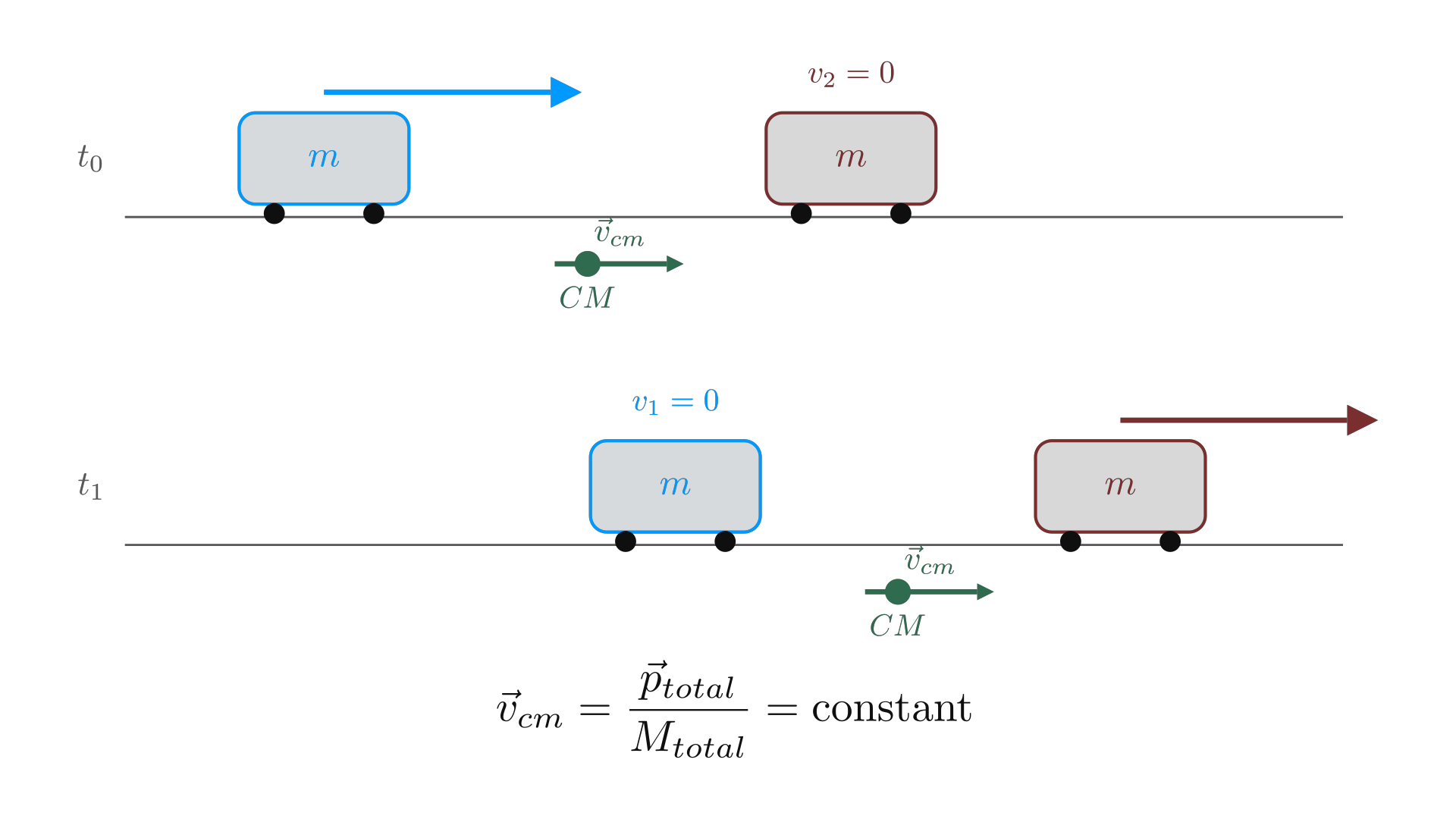
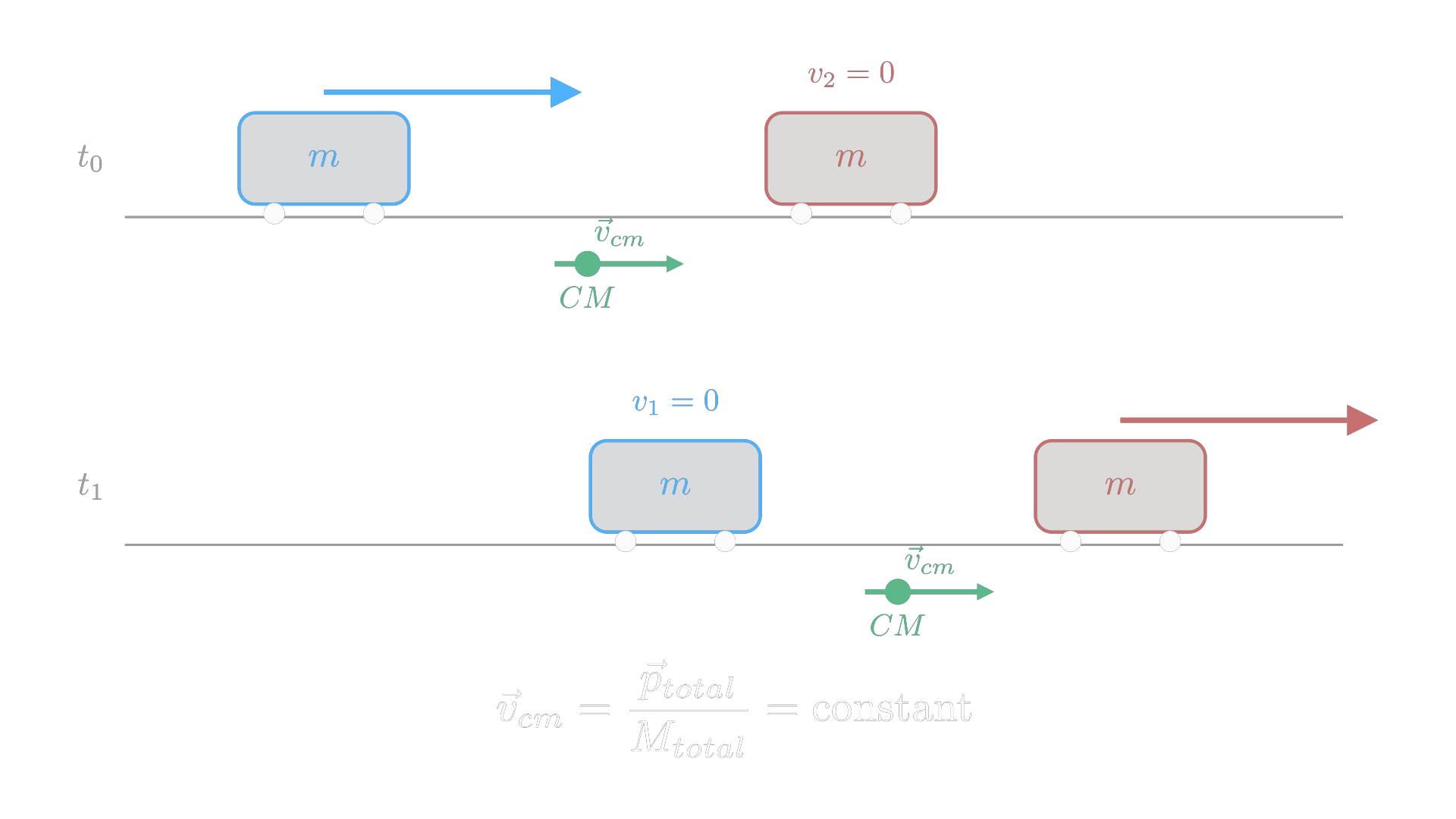
A collection of objects with individual momenta can be described as one system with one center-of-mass velocity. This velocity is constant whenever the net external force on the system is zero, even if objects within the system are bouncing off each other chaotically.
由若干各自具有动量的物体组成的整体,可用一个系统、一种质心速度(center-of-mass velocity)来描述。当系统所受净外力为零时,该速度保持恒定,即使内部物体之间正在杂乱无章地碰撞。
perfectly inelastic collision,物体粘在一起),合并后整体的末速度就是 $\vec{v}_\text{cm}$。这样不用列任何方程就能直接得出答案。
System Selection系统选择
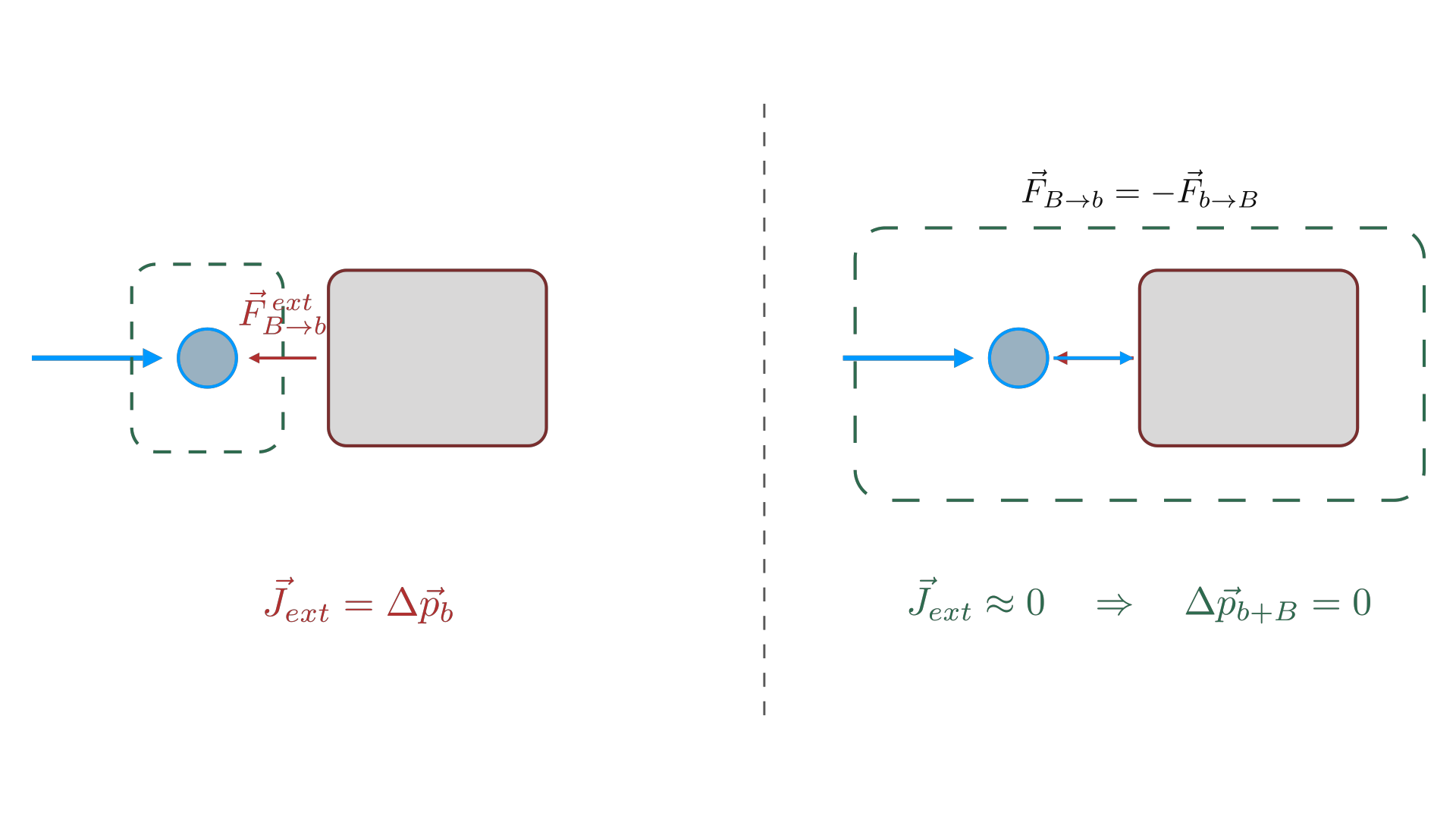
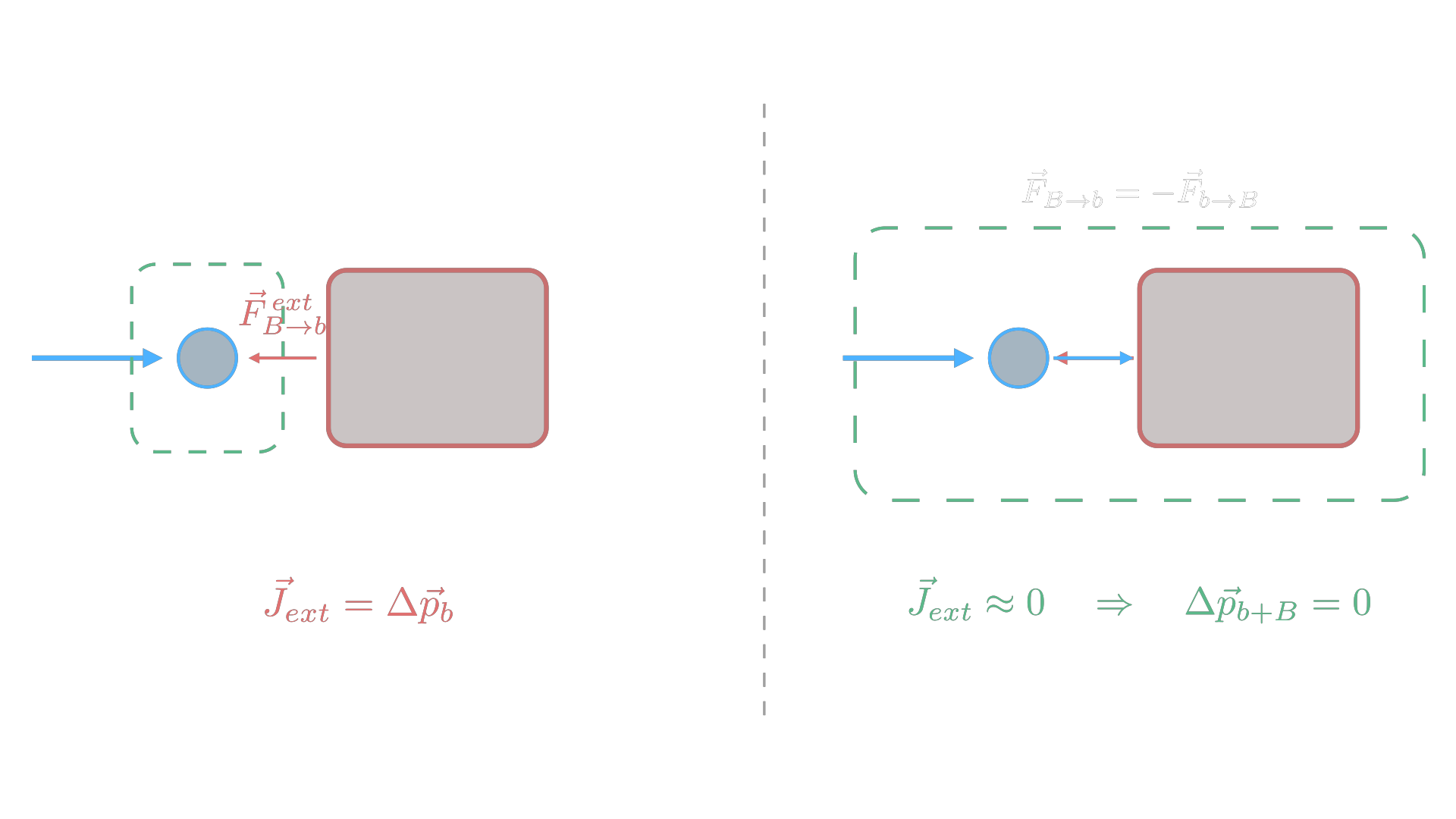
Whether momentum is conserved depends on what you choose as your system. A bullet hitting a block has external forces if you analyze the bullet alone (the block pushes on it), but if you analyze the bullet + block system, the collision forces become internal and momentum is conserved. Choosing the right system is a critical skill.
动量是否守恒取决于你把什么当作系统。如果只分析撞向木块的子弹,由于木块对子弹施力,存在外力;而如果把子弹和木块视为一个系统,碰撞力就变成内力,动量守恒。选对系统是一项关键技能。
Worked Example: Two-Cart Explosion例题:两小车"爆炸"
Two carts are on a frictionless track, held together by a compressed spring.
Cart A (2 kg) and Cart B (3 kg). The spring releases.
After the explosion, Cart A moves at 6 m/s to the left. Find Cart B's velocity.
两辆小车置于无摩擦轨道上,由压缩的弹簧夹在中间。
A 车 2 kg、B 车 3 kg,弹簧释放后
A 车以 6 m/s 向左运动。求 B 车的速度。
Worked Example: Center-of-Mass Velocity Through a Collision例题:碰撞前后的质心速度
On a frictionless track, a 2.0 kg cart moves at 5.0 m/s to the right toward a 3.0 kg cart moving at 2.0 m/s to the left. (a) Find the velocity of the center of mass. (b) If the carts stick together, what is their final velocity?
在无摩擦轨道上,一辆 2.0 kg 的小车以 5.0 m/s 向右运动,迎向一辆以 2.0 m/s 向左运动的 3.0 kg 小车。(a) 求质心速度;(b) 若两车碰后粘在一起,求共同末速度。
(c) In a second trial the collision is elastic and the carts leave at $-3.4$ m/s and $+3.6$ m/s. Show that $v_\text{cm}$ is unchanged.
(c) 第二次实验中碰撞是弹性的,两车分别以 $-3.4$ m/s 和 $+3.6$ m/s 离开。证明 $v_\text{cm}$ 不变。
Worked Example: Center of Mass of a Non-Uniform Rod and Its Momentum例题:非均匀杆的质心及其动量 Physics C
A 2.0 m rod lies along the $x$-axis from $x = 0$ to $x = 2.0$ m with linear density $\lambda(x) = (3.0\;\text{kg/m}^2)\,x$. (a) Find its mass and the position of its center of mass. (b) The rod slides along the $x$-axis without rotating at 4.0 m/s. Find its momentum.
一根长 2.0 m 的杆沿 $x$ 轴放置,从 $x = 0$ 到 $x = 2.0$ m,线密度 $\lambda(x) = (3.0\;\text{kg/m}^2)\,x$。(a) 求它的质量和质心位置;(b) 杆沿 $x$ 轴平动(不转动),速度为 4.0 m/s,求它的动量。
Before you write a conservation equation, name the system and give the reason momentum is conserved: "no net external horizontal force on cart A + cart B", or "the collision is brief, so the external impulse is negligible".
写守恒方程之前,先说明系统并给出动量守恒的理由,例如"A 车 + B 车所受水平净外力为零",或"碰撞时间很短,外力冲量可忽略"。
In an explosion from rest the total momentum is zero, so the pieces have equal and opposite momenta and $v_\text{cm}$ stays zero. When gravity acts, momentum is conserved only along the horizontal, or only during the brief collision.
从静止开始的爆炸,总动量为零,所以各碎片的动量大小相等、方向相反,$v_\text{cm}$ 保持为零。有重力作用时,动量只在水平方向守恒,或只在短暂的碰撞过程中守恒。
A ball falls freely toward the ground. Is the ball's momentum conserved? What system would make momentum conserved?一个球自由下落。球的动量守恒吗?选什么系统能使动量守恒?
No. Gravity is an external force on the ball alone, so its downward momentum grows. For the system ball + Earth, gravity is internal: the Earth gains an equal upward momentum, and the total stays constant. (The Earth's velocity change is tiny because its mass is huge.)
不守恒。对单独的球而言重力是外力,所以球向下的动量不断增大。若取"球 + 地球"为系统,重力就是内力:地球获得等量的向上动量,总动量保持不变。(地球质量极大,所以它的速度变化极小。)
A 4.0 kg rifle, free to recoil, fires a 0.020 kg bullet at 400 m/s. Find the rifle's recoil velocity.一支可以自由后坐的 4.0 kg 步枪以 400 m/s 射出一颗 0.020 kg 的子弹。求步枪的反冲速度。
Total momentum is 0 before firing: $0 = (0.020)(400) + (4.0)\,v_r$, so $v_r = -\dfrac{8.0}{4.0} = -2.0$ m/s. The rifle recoils at 2.0 m/s opposite to the bullet.
射击前总动量为 0:$0 = (0.020)(400) + (4.0)\,v_r$,所以 $v_r = -\dfrac{8.0}{4.0} = -2.0$ m/s。步枪以 2.0 m/s 沿与子弹相反的方向后坐。
Three objects move along a line: 1.0 kg at +6.0 m/s, 2.0 kg at −1.5 m/s and 3.0 kg at +1.0 m/s. Find $v_\text{cm}$. What is it after they have collided with each other several times on a frictionless surface?三个物体沿一条直线运动:1.0 kg 以 +6.0 m/s,2.0 kg 以 −1.5 m/s,3.0 kg 以 +1.0 m/s。求 $v_\text{cm}$。在无摩擦表面上它们相互碰撞几次之后,质心速度是多少?
$v_\text{cm} = \dfrac{(1.0)(6.0) + (2.0)(-1.5) + (3.0)(1.0)}{6.0} = \dfrac{6.0 - 3.0 + 3.0}{6.0} = 1.0$ m/s. After the collisions it is still 1.0 m/s, because the collision forces are internal and no net external force acts.
$v_\text{cm} = \dfrac{(1.0)(6.0) + (2.0)(-1.5) + (3.0)(1.0)}{6.0} = \dfrac{6.0 - 3.0 + 3.0}{6.0} = 1.0$ m/s。碰撞之后仍为 1.0 m/s,因为碰撞力是内力,且没有净外力。
Elastic and Inelastic Collisions弹性碰撞与非弹性碰撞
- Classify a collision as elastic, inelastic or perfectly inelastic from what happens to the total kinetic energy.
- Calculate the common final velocity in a perfectly inelastic collision and the kinetic energy lost.
- Calculate both final velocities in a one-dimensional elastic collision with the target at rest, and verify that momentum and kinetic energy are both conserved.
- Apply conservation of momentum separately to the $x$- and $y$-components in a two-dimensional collision.
- Explain why a ballistic pendulum is solved with momentum for the collision and energy for the swing.
- 根据总动能的变化,把碰撞归类(
classify)为弹性、非弹性或完全非弹性碰撞。 - 计算(
calculate)完全非弹性碰撞的共同末速度以及损失的动能。 - 计算(
calculate)靶静止的一维弹性碰撞中两个物体的末速度,并核验(verify)动量和动能都守恒。 - 在二维碰撞中,对 $x$ 分量和 $y$ 分量分别应用(
apply)动量守恒。 - 解释(
explain)为什么弹道摆要用动量处理碰撞、用能量处理摆动。
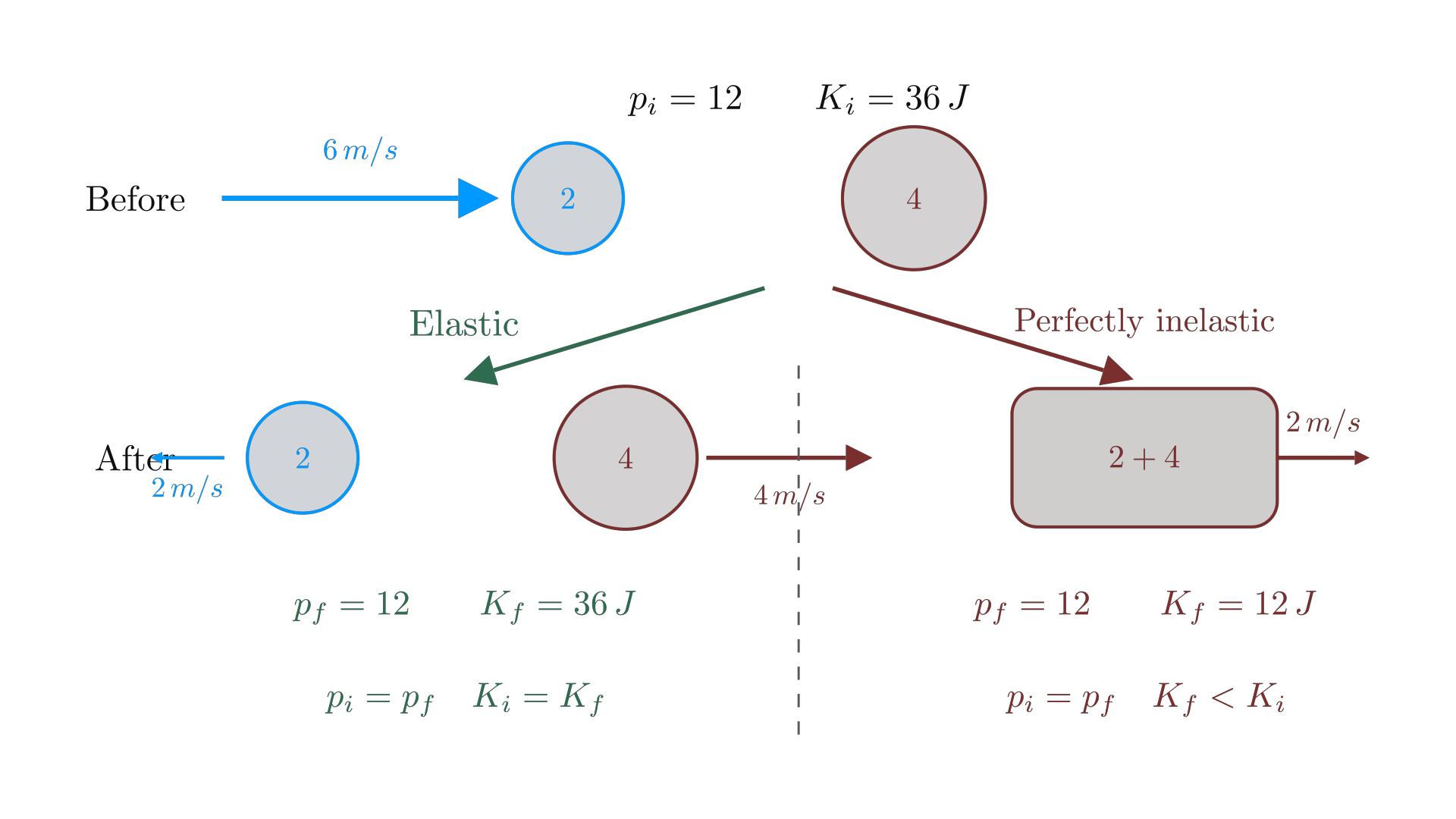
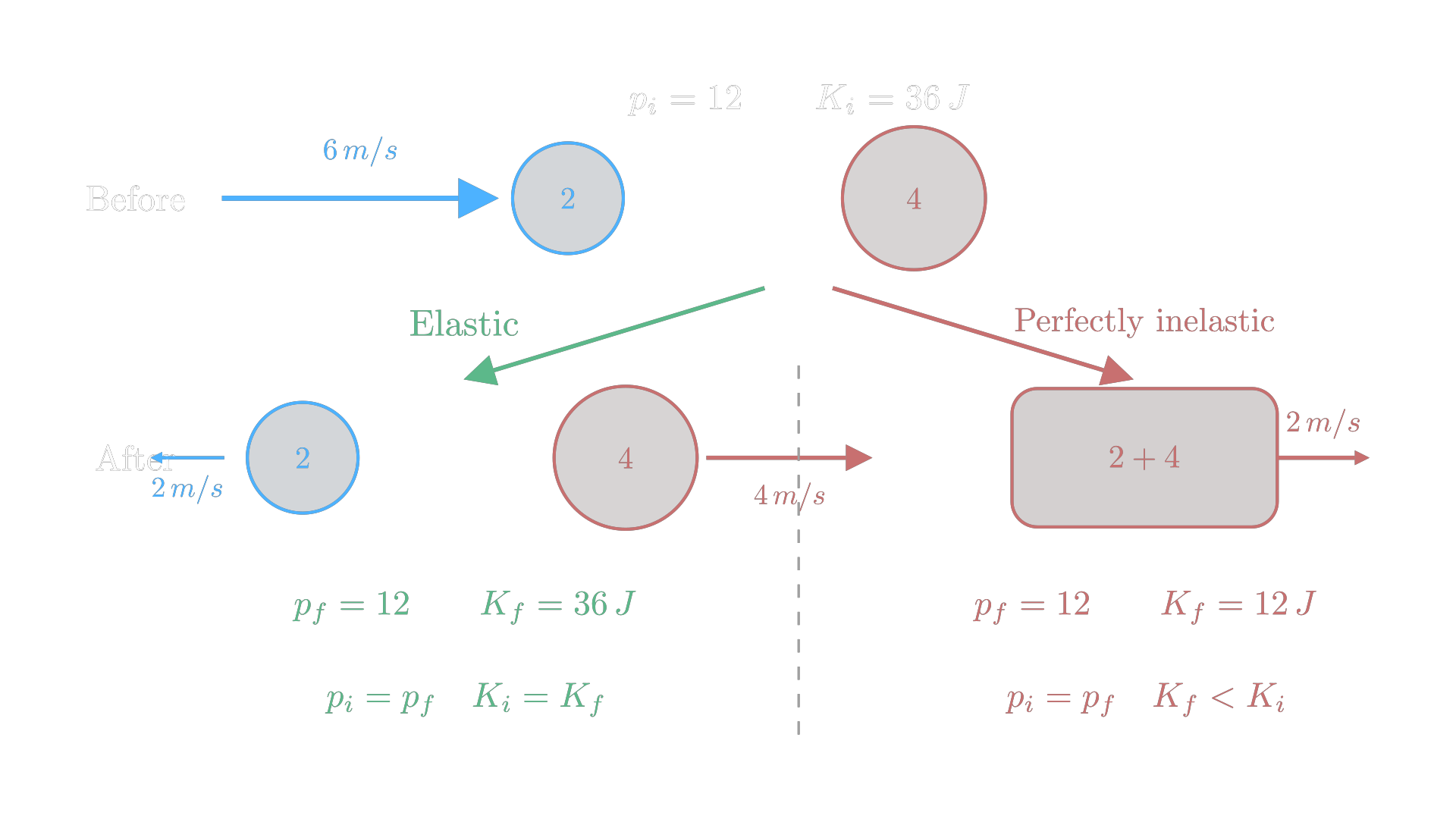
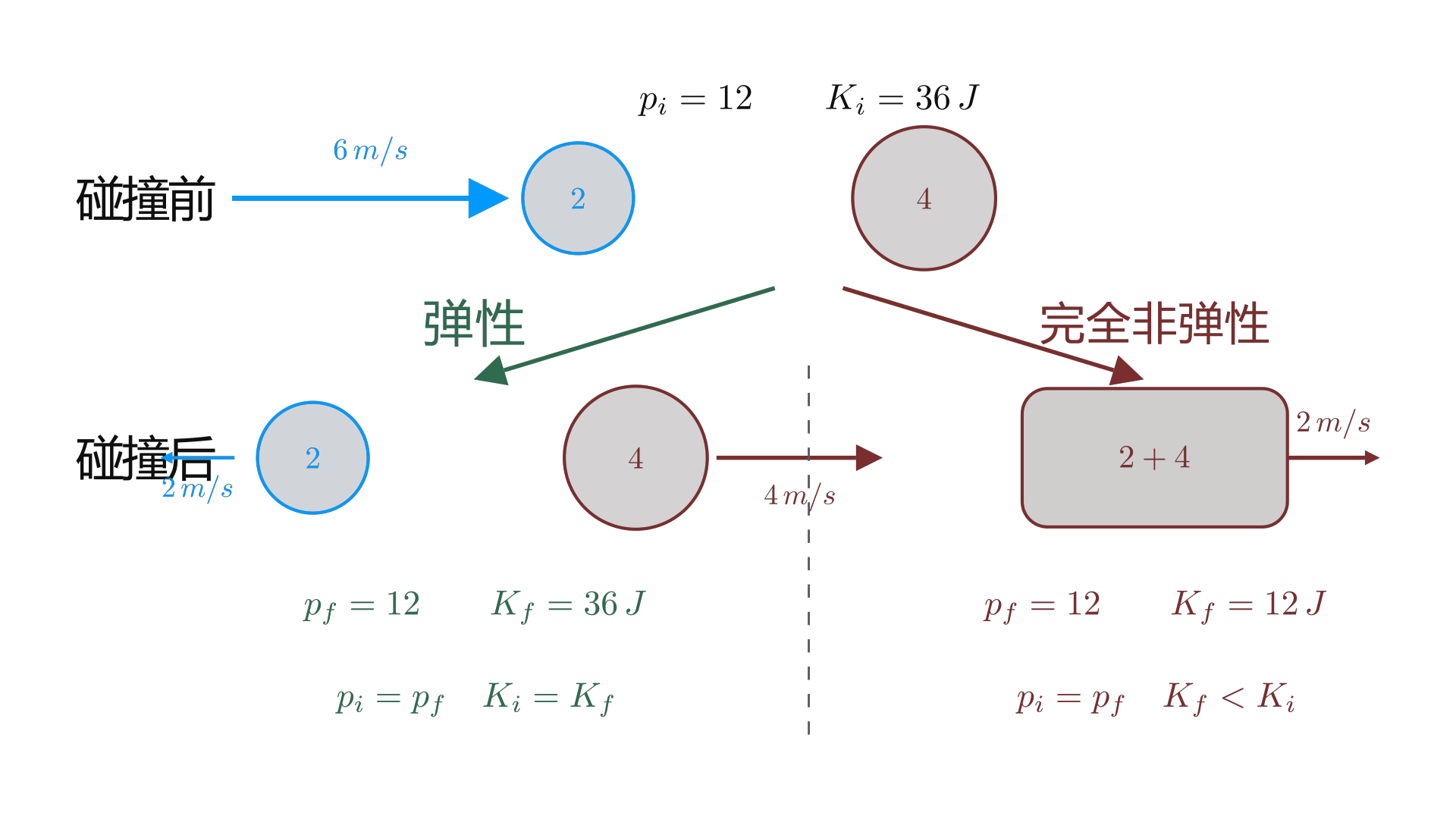
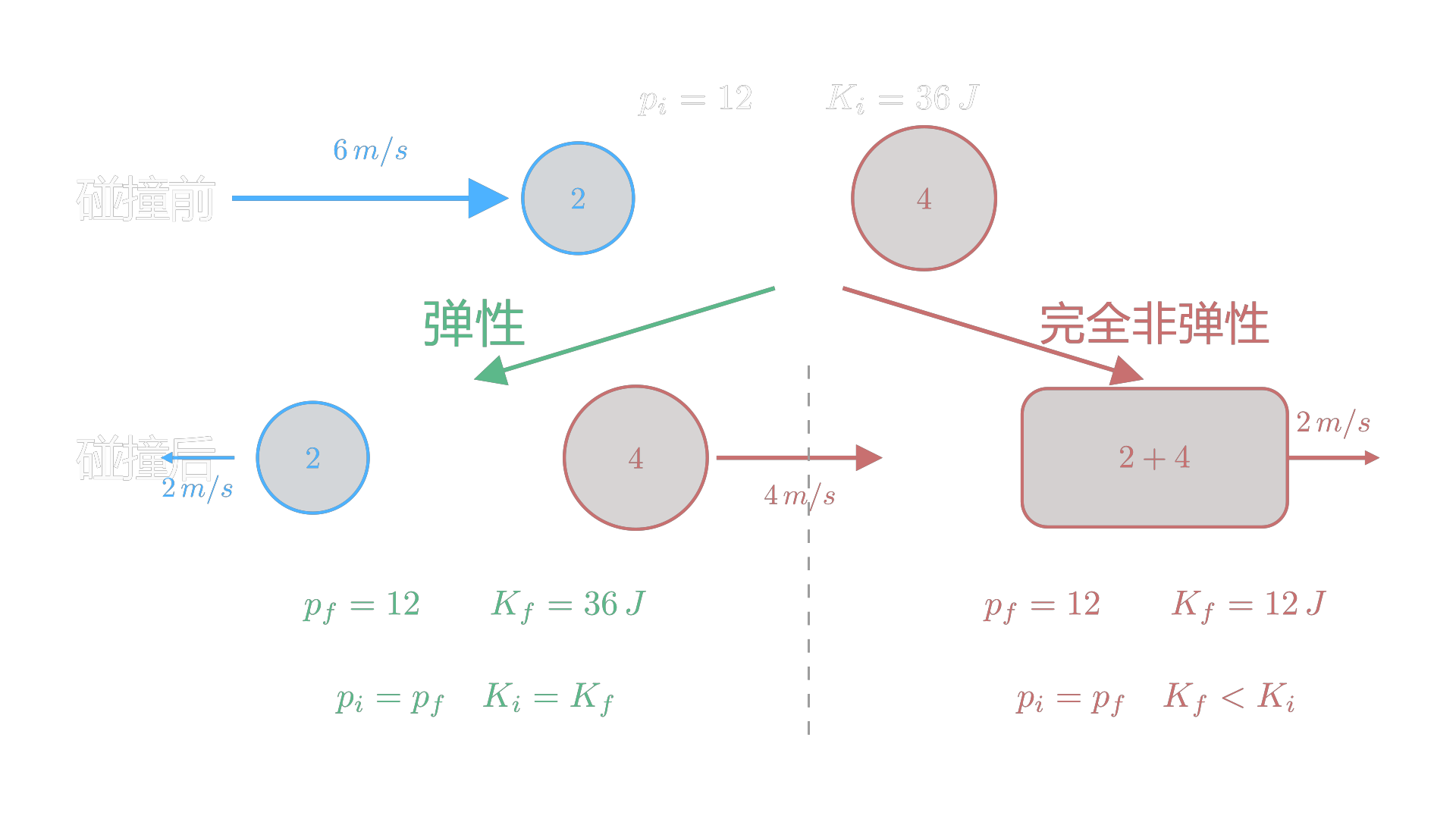
Momentum is conserved in all collisions (provided no external forces act). But kinetic energy is not necessarily conserved, and the amount of kinetic energy retained is what distinguishes different types of collisions.
所有碰撞(在无外力的前提下)都满足动量守恒,但动能未必守恒;保留下来的动能多少正是区分不同碰撞类型的关键。
elastic collision):动量和动能都守恒,$K_i = K_f$。
非弹性碰撞(inelastic collision):动量守恒,但动能下降,$K_f < K_i$;部分动能转化为热、声或形变能。
完全非弹性碰撞(perfectly inelastic collision):物体粘在一起,在满足动量守恒的前提下动能损失最大:$v_f = (m_1 v_1 + m_2 v_2) / (m_1 + m_2)$。
Perfectly Inelastic Collisions完全非弹性碰撞
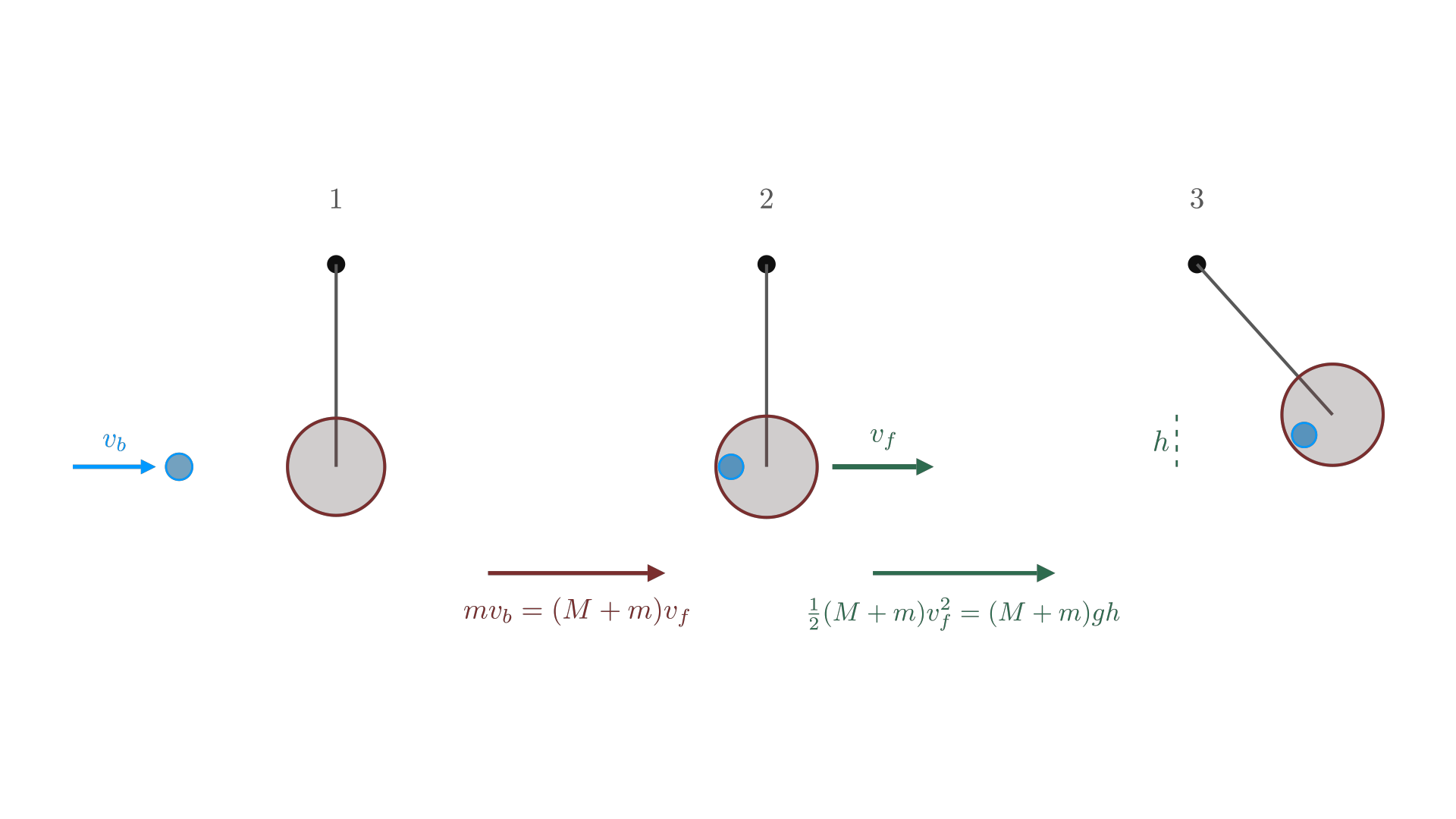
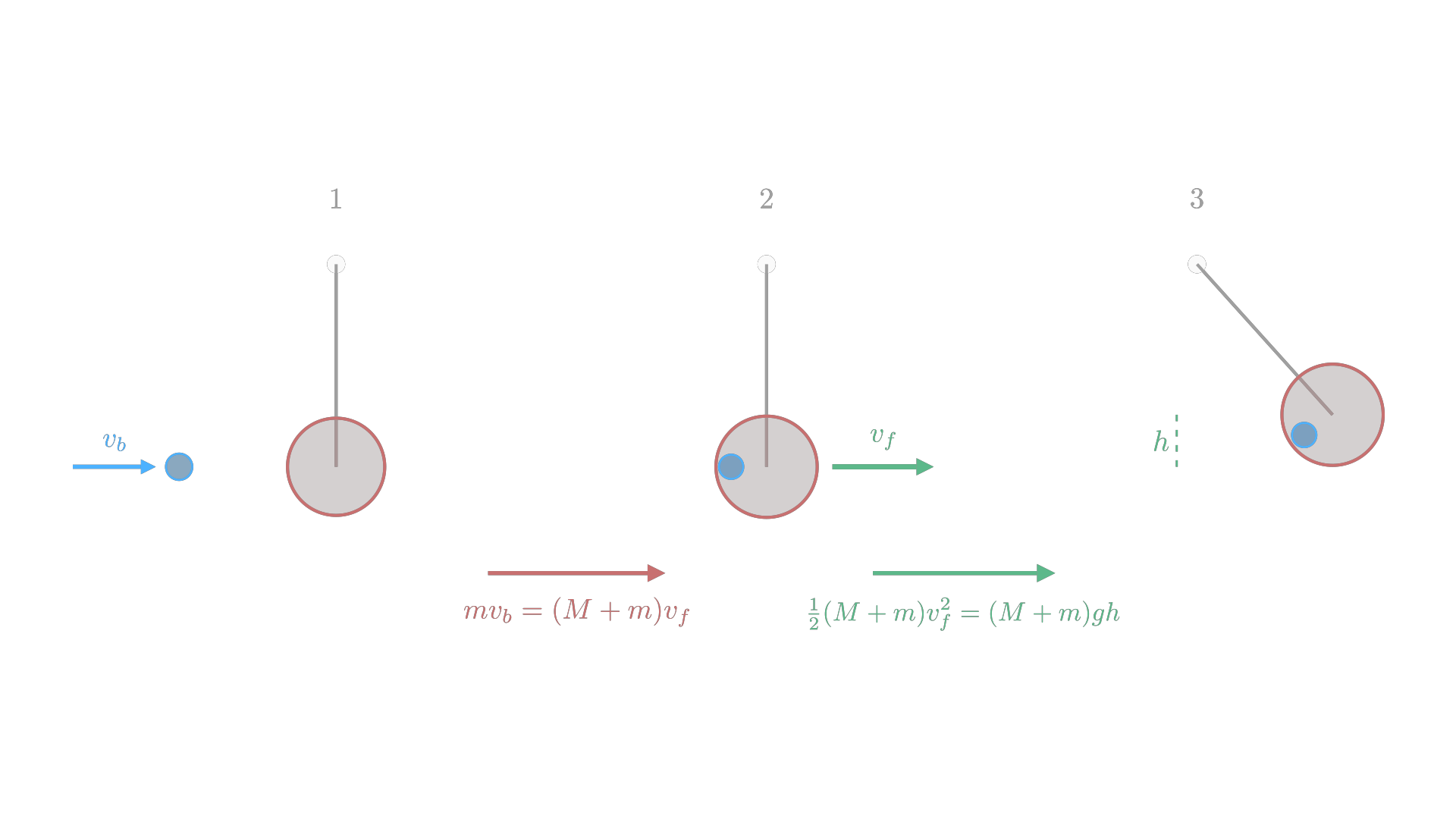
In a perfectly inelastic collision, the objects stick together and move with a common final velocity. This gives the simplest algebra: one equation, one unknown.
在完全非弹性碰撞中,物体碰后粘在一起以共同速度运动。这种情形的代数最简:一个方程一个未知数。
In 1742 Benjamin Robins described the ballistic pendulum in New Principles of Gunnery. A musket ball is fired into a heavy wooden block hung as a pendulum, and the height of the swing gives the ball's speed.
1742 年,Benjamin Robins 在《New Principles of Gunnery》中描述了弹道摆:把火枪弹射入一块悬挂成摆的厚重木块,由摆起的高度得出子弹的速度。
It was the first practical way to measure a bullet's speed. The method uses exactly the two-stage reasoning below: momentum during the impact, then energy during the swing.
这是第一种测量子弹速度的实用方法,它用的正是下面的两阶段推理:碰撞时用动量,摆升时用能量。
Wikipedia: Ballistic pendulum (Robins's apparatus and the speed formula)维基百科:弹道摆(Robins 的装置与速度公式)
Worked Example: Ballistic Pendulum例题:弹道摆(ballistic pendulum)
A 10 g bullet embeds in a 2 kg pendulum bob. The combined mass rises to a height of 0.45 m. Find the bullet's initial speed. Use $g = 10\;\text{m/s}^2$.
10 g 的子弹嵌入一个 2 kg 的摆球中。合并后的整体上升到 0.45 m 高。求子弹的初速。取 $g = 10\;\text{m/s}^2$。
Common trap: do not apply energy conservation to the collision: it is perfectly inelastic, so kinetic energy is NOT conserved there. Use momentum for the collision and energy for the swing.
常见陷阱:不要对碰撞段套用能量守恒:它是完全非弹性碰撞,动能不守恒。碰撞段用动量,上升段才用能量。
Worked Example: Perfectly Inelastic Collision with KE Tracking (FRQ-style)例题:完全非弹性碰撞 + 动能追踪(FRQ 风格)
A 2.0 kg cart moving at 6.0 m/s collides with and sticks to a 4.0 kg cart at rest on a frictionless track. (a) Find the common final velocity. (b) Find $KE_i$, $KE_f$, and $\Delta KE$. (c) What fraction of the initial kinetic energy was lost? (d) Where did that energy go?
一辆 2.0 kg 的小车以 6.0 m/s 撞向无摩擦轨道上静止的 4.0 kg 小车,撞后粘在一起。(a) 求共同末速度;(b) 求 $KE_i$、$KE_f$、$\Delta KE$;(c) 损失的动能占初动能的几分之几?(d) 这部分能量到哪里去了?
Worked Example: Elastic Collision: Verify Both Conservation Laws例题:弹性碰撞:同时核验两条守恒律
A 3.0 kg ball moving at 4.0 m/s collides elastically head-on with a 1.0 kg ball at rest. (a) Find both final velocities. (b) Verify that both momentum AND kinetic energy are conserved.
3.0 kg 的球以 4.0 m/s 与静止的 1.0 kg 球发生正向弹性碰撞。(a) 求两球的末速;(b) 同时核验动量与动能均守恒。
In a free-response answer, write both conservation lines explicitly: $p_i = p_f$ AND $KE_i = KE_f$ are the two statements that together show a collision is elastic.
在 FRQ 中,请把两条守恒方程都明确写出:$p_i = p_f$ 与 $KE_i = KE_f$ 这两条合在一起,才说明碰撞是弹性的。
Elastic Collisions弹性碰撞
Elastic collisions conserve both momentum and kinetic energy, giving you two equations. For the special case of a 1D elastic collision where object 2 is initially at rest:
弹性碰撞同时满足动量和动能守恒,因而给出两个方程。一维、靶物 2 初始静止的特殊情形:
First Principles: Deriving the Target-at-Rest Formulas第一性原理:推导靶静止公式
Principle. In a 1D elastic collision with $v_{2i} = 0$, both momentum and kinetic energy are conserved.
原理。在 $v_{2i} = 0$ 的一维弹性碰撞中,动量和动能都守恒。
- Momentum: $m_1(v_{1i} - v_{1f}) = m_2 v_{2f}$.
- Energy (times 2), factored: $m_1(v_{1i} - v_{1f})(v_{1i} + v_{1f}) = m_2 v_{2f}^2$.
- Divide step 2 by step 1: $v_{1i} + v_{1f} = v_{2f}$. The relative velocity reverses.
- Substitute into step 1 and solve: $v_{1f} = \dfrac{m_1 - m_2}{m_1 + m_2}v_{1i}$ and $v_{2f} = \dfrac{2m_1}{m_1 + m_2}v_{1i}$.
- 动量:$m_1(v_{1i} - v_{1f}) = m_2 v_{2f}$。
- 能量(乘以 2)并因式分解:$m_1(v_{1i} - v_{1f})(v_{1i} + v_{1f}) = m_2 v_{2f}^2$。
- 第 2 式除以第 1 式:$v_{1i} + v_{1f} = v_{2f}$,相对速度反向。
- 代回第 1 式求解:$v_{1f} = \dfrac{m_1 - m_2}{m_1 + m_2}v_{1i}$,$v_{2f} = \dfrac{2m_1}{m_1 + m_2}v_{1i}$。
Limiting checks. $m_1 = m_2$ gives $v_{1f} = 0$ and $v_{2f} = v_{1i}$ (Newton's cradle). $m_2 \to \infty$ gives $v_{1f} \to -v_{1i}$ (a bounce off a wall). For $m_1 = 3$ kg, $m_2 = 1$ kg and $v_{1i} = 4$ m/s: $v_{1f} = 2$ m/s, $v_{2f} = 6$ m/s, and $K$ is 24 J before and after.
极限检验。$m_1 = m_2$ 时 $v_{1f} = 0$、$v_{2f} = v_{1i}$(Newton 摆)。$m_2 \to \infty$ 时 $v_{1f} \to -v_{1i}$(撞墙反弹)。取 $m_1 = 3$ kg、$m_2 = 1$ kg、$v_{1i} = 4$ m/s:$v_{1f} = 2$ m/s,$v_{2f} = 6$ m/s,碰撞前后 $K$ 都是 24 J。
| Case情形 | After Collision碰撞后 | Example举例 |
|---|---|---|
| $m_1 = m_2$ | Ball 1 stops; Ball 2 takes its velocity球 1 停下,球 2 取得原来的速度 | Newton's cradleNewton 摆(牛顿摆) |
| $m_1 \gg m_2$ | Ball 1 barely slows; Ball 2 flies at $\approx 2v_{1i}$球 1 几乎不减速,球 2 以约 $2v_{1i}$ 飞出 | Bowling ball → tennis ball保龄球撞网球 |
| $m_1 \ll m_2$ | Ball 1 bounces back at $\approx -v_{1i}$; Ball 2 barely moves球 1 以约 $-v_{1i}$ 反弹,球 2 几乎不动 | Tennis ball → wall网球撞墙 |
Two-Dimensional Collisions二维碰撞
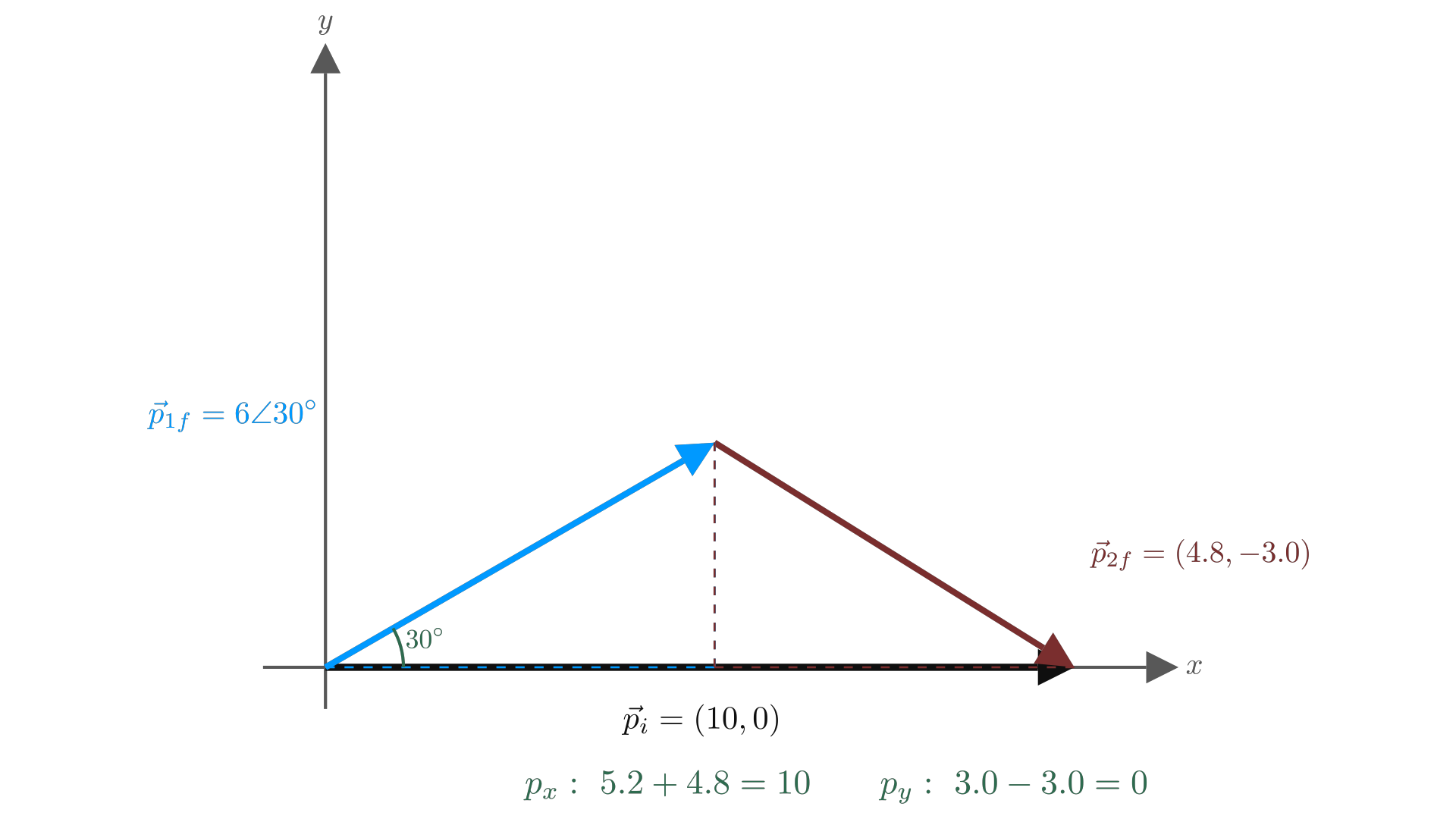
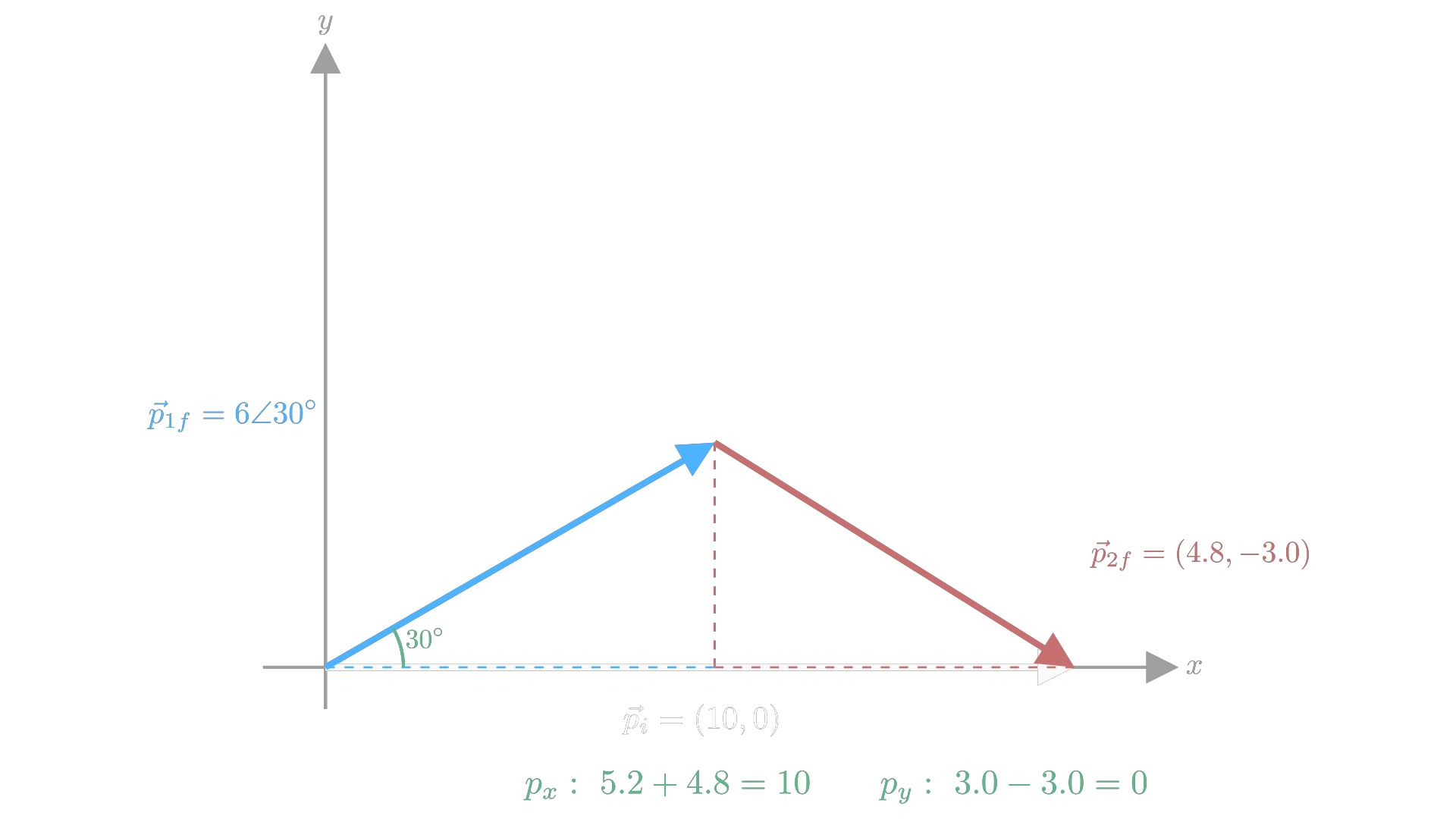
In 2D collisions, momentum is conserved independently in each direction, which gives you two equations (one for $x$, one for $y$). Handle these by resolving every velocity vector into components.
在二维碰撞中,动量在每个方向上都独立守恒,这给出两个方程($x$ 方向一个,$y$ 方向一个)。处理方法是把每个速度矢量都分解为分量。
Worked Example: Reasoning About a 2D Collision例题:定性与半定量分析二维碰撞
A 2 kg puck at 5 m/s in $+x$ hits a stationary 3 kg puck. Afterward the 2 kg puck moves upward and to the right (positive $x$ and $y$ components). (a) Set up the momentum equations. (b) Which way does the 3 kg puck move? (c) The 2 kg puck is deflected more, at the same speed. How does the 3 kg puck's motion change?
2 kg 的冰球沿 $+x$ 方向以 5 m/s 撞向静止的 3 kg 冰球。碰后 2 kg 冰球向右上方运动($x$、$y$ 分量均为正)。(a) 列出动量方程。(b) 3 kg 冰球向哪个方向运动?(c) 2 kg 冰球速率不变但偏转更大,3 kg 冰球的运动如何变化?
Worked Example: 2D Collision例题:二维碰撞 Physics C
A 2 kg puck at 5 m/s in +x hits a stationary 3 kg puck.
After: the 2 kg puck moves at 3 m/s at 30° above x-axis.
Find the 3 kg puck's velocity.
2 kg 的冰球沿 +x 方向以 5 m/s 撞向静止的 3 kg 冰球。
碰后 2 kg 冰球以 3 m/s 沿 x 轴上方 30° 方向运动。
求 3 kg 冰球的速度。
Practice: Elastic-Collision Formulas练习:弹性碰撞公式
Read the collision type from the wording. "Stick together" or "move off together" means perfectly inelastic; kinetic energy is conserved only when the question says the collision is elastic or the data show it. To classify a collision from data, calculate the total kinetic energy before and after.
从题目措辞判断碰撞类型。"粘在一起"或"一起运动"表示完全非弹性;只有题目说明碰撞是弹性的,或数据显示如此时,动能才守恒。要根据数据判断碰撞类型,就计算碰撞前后的总动能。
In two dimensions, write one momentum equation for $x$ and one for $y$; never conserve speeds or add momentum magnitudes. The target-at-rest elastic formulas apply only in one dimension with the second object initially at rest, so state those conditions when you use them.
二维情形下,$x$ 方向写一个动量方程,$y$ 方向写一个;绝不能让速率守恒或把动量大小直接相加。靶静止的弹性碰撞公式只适用于一维且第二个物体初始静止的情形,使用时要写明这些条件。
Two carts collide and bounce apart. Their total kinetic energy after the collision is 70% of the value before. What type of collision is this, and is momentum conserved?两辆小车相撞后分开,碰后总动能是碰前的 70%。这是哪种碰撞?动量守恒吗?
Inelastic (but not perfectly inelastic, because the carts separate). Momentum is still conserved if the external forces are negligible during the collision; the missing 30% of the kinetic energy becomes thermal energy, sound and deformation.
非弹性碰撞(但不是完全非弹性,因为两车分开了)。只要碰撞期间外力可忽略,动量仍然守恒;少掉的 30% 动能转化为内能、声能和形变。
A 1500 kg car moving at 20 m/s rear-ends a 1000 kg car moving at 10 m/s in the same direction, and they lock together. Find their common velocity and the kinetic energy lost.一辆 1500 kg、以 20 m/s 行驶的汽车追尾一辆同向以 10 m/s 行驶的 1000 kg 汽车,两车卡在一起。求共同速度和损失的动能。
$v_f = \dfrac{(1500)(20) + (1000)(10)}{2500} = \dfrac{40\,000}{2500} = 16$ m/s. $K_i = \tfrac{1}{2}(1500)(20)^2 + \tfrac{1}{2}(1000)(10)^2 = 300\,000 + 50\,000 = 350\,000$ J; $K_f = \tfrac{1}{2}(2500)(16)^2 = 320\,000$ J. Lost: $3.0 \times 10^4$ J.
$v_f = \dfrac{(1500)(20) + (1000)(10)}{2500} = \dfrac{40\,000}{2500} = 16$ m/s。$K_i = \tfrac{1}{2}(1500)(20)^2 + \tfrac{1}{2}(1000)(10)^2 = 300\,000 + 50\,000 = 350\,000$ J;$K_f = \tfrac{1}{2}(2500)(16)^2 = 320\,000$ J。损失:$3.0 \times 10^4$ J。
A 0.50 kg puck moving east at 4.0 m/s hits an identical puck at rest. Afterward the first puck moves off to the northeast. Set up the two momentum conditions and say in which general direction the second puck must move.一个 0.50 kg 的冰球以 4.0 m/s 向东运动,撞上一个静止的相同冰球。碰后第一个冰球向东北方向运动。写出两个动量条件,并说明第二个冰球大致应向哪个方向运动。
Initially the total momentum is $(0.50)(4.0) = 2.0\;\text{kg}\cdot\text{m/s}$ east and $0$ north. Afterward the two $x$-momenta must add to $2.0\;\text{kg}\cdot\text{m/s}$ and the two $y$-momenta must add to $0$.
初始总动量为向东 $(0.50)(4.0) = 2.0\;\text{kg}\cdot\text{m/s}$,向北为 $0$。碰后两个 $x$ 方向动量之和必须为 $2.0\;\text{kg}\cdot\text{m/s}$,两个 $y$ 方向动量之和必须为 $0$。
The first puck has northward $y$-momentum, so the second puck must have equal southward $y$-momentum: it moves to the southeast (east of south), and the equal masses mean its southward velocity component equals the first puck's northward one.
第一个冰球有向北的 $y$ 动量,所以第二个冰球必须有大小相等、向南的 $y$ 动量:它向东南方向运动,并且由于质量相等,它向南的速度分量等于第一个冰球向北的速度分量。
A 0.50 kg puck moving east at 4.0 m/s hits an identical puck at rest. Afterward the first puck moves at 2.0 m/s at 60° north of east. Find the second puck's velocity. Was the collision elastic?一个 0.50 kg 的冰球以 4.0 m/s 向东运动,撞上一个静止的相同冰球。碰后第一个冰球以 2.0 m/s 沿东偏北 60° 方向运动。求第二个冰球的速度。这次碰撞是弹性的吗?
$x$: $(0.50)(4.0) = (0.50)(2.0\cos 60°) + (0.50)\,v_{2x}$, so $v_{2x} = 4.0 - 1.0 = 3.0$ m/s. $y$: $0 = (0.50)(2.0\sin 60°) + (0.50)\,v_{2y}$, so $v_{2y} = -1.73$ m/s. Speed $= \sqrt{3.0^2 + 1.73^2} \approx 3.46$ m/s at $\arctan(1.73/3.0) = 30°$ south of east. Kinetic energy: before $\tfrac{1}{2}(0.50)(4.0)^2 = 4.0$ J; after $\tfrac{1}{2}(0.50)(2.0)^2 + \tfrac{1}{2}(0.50)(3.46)^2 \approx 1.0 + 3.0 = 4.0$ J, so it was elastic (and the pucks leave 90° apart, as equal masses do in an elastic glancing collision).
$x$:$(0.50)(4.0) = (0.50)(2.0\cos 60°) + (0.50)\,v_{2x}$,得 $v_{2x} = 4.0 - 1.0 = 3.0$ m/s。$y$:$0 = (0.50)(2.0\sin 60°) + (0.50)\,v_{2y}$,得 $v_{2y} = -1.73$ m/s。速率 $= \sqrt{3.0^2 + 1.73^2} \approx 3.46$ m/s,方向为东偏南 $\arctan(1.73/3.0) = 30°$。动能:碰前 $\tfrac{1}{2}(0.50)(4.0)^2 = 4.0$ J;碰后 $\tfrac{1}{2}(0.50)(2.0)^2 + \tfrac{1}{2}(0.50)(3.46)^2 \approx 1.0 + 3.0 = 4.0$ J,所以是弹性碰撞(两球离开方向相差 90°,这是等质量弹性斜碰的特征)。
Exam Strategy考试策略
Unit 4 has a 10-20% weighting in the multiple-choice section.
From the May 2027 exam, Section I has 42 multiple-choice questions in 85 minutes (50% of the score) and Section II has 4 free-response questions in 95 minutes (50%): one each of mathematical routines, translation between representations, experimental design and analysis, and qualitative/quantitative translation.
A calculator is permitted and reference materials are provided. The course is calculus-based, so in this unit be ready to integrate a time-varying force to find an impulse, to use $\vec{F}_\text{net} = d\vec{p}/dt$ (including for a system whose mass changes), and to find a center of mass by integration.
第 4 单元在选择题部分的占比为 10-20%。
自 2027 年 5 月的考试起,第一部分为 42 道选择题,85 分钟(占总分 50%);第二部分为 4 道自由作答题,95 分钟(占 50%),题型各一道:数学推演(mathematical routines)、表示形式转换(translation between representations)、实验设计与分析(experimental design and analysis)、定性/定量转换(qualitative/quantitative translation)。
允许使用计算器,并提供参考资料(reference materials)。本课程以微积分为基础,所以本单元要能对随时间变化的力积分求冲量,使用 $\vec{F}_\text{net} = d\vec{p}/dt$(包括质量变化的系统),并用积分求质心。
Unit 4 has a 10-15% weighting in the multiple-choice section.
From the May 2027 exam, Section I has 42 multiple-choice questions in 85 minutes (50% of the score) and Section II has 4 free-response questions in 95 minutes (50%): one each of mathematical routines, translation between representations, experimental design and analysis, and qualitative/quantitative translation.
A calculator is permitted and reference materials are provided. The course is algebra-based, so in this unit work with $\vec{p} = m\vec{v}$, impulse as average force times time or as the area under a force-time graph, and conservation of momentum in collisions and explosions.
第 4 单元在选择题部分的占比为 10-15%。
自 2027 年 5 月的考试起,第一部分为 42 道选择题,85 分钟(占总分 50%);第二部分为 4 道自由作答题,95 分钟(占 50%),题型各一道:数学推演(mathematical routines)、表示形式转换(translation between representations)、实验设计与分析(experimental design and analysis)、定性/定量转换(qualitative/quantitative translation)。
允许使用计算器,并提供参考资料(reference materials)。本课程以代数为基础,所以本单元要会使用 $\vec{p} = m\vec{v}$,把冲量看作平均力乘以时间或力-时间图下方的面积,并在碰撞和爆炸中应用动量守恒。
Preparing for Each Question Type各题型的备考
Multiple Choice)Practise these momentum tasks for multiple-choice questions: finding impulse as the area under a force-time graph, comparing momenta and impulses in different scenarios, deciding from data whether a collision is elastic or inelastic, and applying momentum conservation in one and two dimensions.
针对选择题,练习以下动量任务:把冲量求为力-时间图下方的面积;在不同情境下比较动量与冲量;根据数据判断碰撞是弹性还是非弹性;在一维和二维中应用动量守恒。
Always assign a sign convention first, and remember that a bouncing object receives more impulse than one that stops. The special-case elastic results (equal masses, heavy-on-light, light-on-heavy) let you check an answer quickly.
永远先定正负号约定,并记住:反弹的物体受到的冲量比停下的物体更大。弹性碰撞的特殊情形(等质量、大撞小、小撞大)能帮你快速检验答案。
One free-response question is an experimental design and analysis question. With momentum, you may be asked to design an experiment that tests momentum conservation using carts on a track, or to determine an unknown mass from a collision.
自由作答中有一道实验设计与分析(experimental design and analysis)题。在动量部分,你可能被要求设计一个用轨道小车检验动量守恒的实验,或借助一次碰撞测定未知质量。
Describe the measurements you would take (masses, velocities before and after), explain how you would use them to test conservation, discuss sources of error (friction, imprecise timing, rotational effects), and choose quantities to plot so that the graph is linear.
说明要测哪些量(质量、碰前与碰后速度),解释如何用这些量检验守恒,讨论误差来源(摩擦、计时不准、转动效应),并选择作图的量使图像成为直线。
FRQ 步骤清单
1. 选定系统,并声明假设外力可忽略。
2. 写出动量守恒;二维情形要按分量写。
3. 区分弹性 vs. 非弹性:若题目说"粘在一起",就是完全非弹性,用更简单的方程。
4. 写出单位,并把最终答案画框圈起。
5. 实验设计题:按顺序写出操作流程、列出所有需要测量的量、说明如何利用它们,并讨论至少一种误差来源。
Common Mistakes常见错误
1. Forgetting that momentum is a vector. You must assign signs or use components. Simply adding magnitudes is wrong whenever objects move in different directions.
2. Confusing elastic and perfectly inelastic. "Elastic" conserves KE. "Perfectly inelastic" means they stick together. Many students swap these under time pressure.
3. Assuming KE is always conserved. Kinetic energy is conserved only in elastic collisions. Momentum is conserved in all collisions (when external forces are negligible). Don't conflate the two.
4. Using the wrong equation. $v_f = (m_1 v_1 + m_2 v_2)/(m_1 + m_2)$ is only valid for perfectly inelastic collisions. Don't use it for elastic collisions.
5. Ignoring direction change in impulse. A ball bouncing back has a larger $|\Delta p|$ than a ball that stops. If it rebounds at its incoming speed, the reversal doubles the momentum change.
6. Applying momentum conservation when external forces are significant. If a collision occurs on an incline or with friction over a long time, external forces matter.
7. Mixing up impulse and momentum. Impulse is the change in momentum ($\vec{J} = \Delta\vec{p}$), not the momentum itself.
1. 忘了动量是矢量。必须先定正负号或拆成分量。只要物体方向不同,直接加大小就是错的。
2. 弄混"弹性"和"完全非弹性"。"elastic" 守恒动能;"perfectly inelastic" 指碰后粘在一起。许多学生在时间紧迫时把这两个互换。
3. 误以为动能总是守恒。只有弹性碰撞守恒动能;任何忽略外力的碰撞都守恒动量。两者不要混为一谈。
4. 用错公式。$v_f = (m_1 v_1 + m_2 v_2)/(m_1 + m_2)$ 只对完全非弹性碰撞成立,别拿它去算弹性碰撞。
5. 忽视方向变化对冲量的影响。反弹回去的球 $|\Delta p|$ 更大。若以原速率弹回,方向反转使动量变化"翻倍"。
6. 在外力不可忽略的情形下乱用动量守恒。如果碰撞发生在斜面上,或长时间含摩擦,外力就不能忽略。
7. 把冲量和动量当一回事。冲量是动量的变化($\vec{J} = \Delta\vec{p}$),不是动量本身。
Flashcards闪卡
Click a card to flip it.
点击卡片可翻面。
(Momentum Form)(Physics C)Newton 第二定律
(动量形式)
Theorem(Physics C)冲量-动量
定理
Momentum动量守恒
Collision完全非弹性
碰撞
(Equal Masses)弹性碰撞
(等质量)
(Elastic Only)相对速度规则
(仅适用弹性碰撞)
Velocity质心速度
Unit Quiz单元测验
Worked Example: 2-D Perfectly Inelastic Collision (FRQ Style)例题:二维完全非弹性碰撞(FRQ 风格) Physics C
Puck A ($m_A = 2.0\;\text{kg}$) moves east at $4.0\;\text{m/s}$ on a frictionless air table. Puck B ($m_B = 3.0\;\text{kg}$) moves north at $3.0\;\text{m/s}$. They collide and stick. (a) Find the velocity (magnitude and direction, measured north of east) of the combined puck after the collision. (b) Compute the kinetic energy lost in the collision and express it as a fraction of the initial KE.
在无摩擦气垫桌上,冰球 A($m_A = 2.0\;\text{kg}$)向东以 $4.0\;\text{m/s}$ 运动,冰球 B($m_B = 3.0\;\text{kg}$)向北以 $3.0\;\text{m/s}$ 运动。两球相撞后粘在一起。(a) 求合并体碰后的速度大小与方向(以"东偏北"角表示);(b) 求碰撞中损失的动能,并表达成初动能的几分之几。
Principle: $\vec p$ is conserved component-by-component when no external impulsive forces act. Perfectly inelastic ⇒ a single combined mass $m_A + m_B$ at the final velocity. KE is not conserved in inelastic collisions; the lost KE goes to internal modes (deformation, sound, heat).
原理:在没有外冲量力时,$\vec p$ 按分量分别守恒。完全非弹性碰撞 ⇒ 合并体质量 $m_A + m_B$ 以共同末速度运动。非弹性碰撞中动能不守恒,损失的动能转入内部自由度(形变、声、热)。
Conserve $p_x$ and $p_y$ separately:
$p_x$ 与 $p_y$ 分别守恒:
Worked Example: Ballistic Pendulum + Spring Recoil (FRQ Style)例题:弹道摆 + 弹簧反冲(FRQ 风格)
A bullet of mass $m = 0.020\;\text{kg}$ is fired horizontally with speed $v_0$ into a wooden block of mass $M = 1.98\;\text{kg}$ that hangs at rest from a long massless cord. The bullet embeds, and the bullet+block swings to a maximum height $h = 0.20\;\text{m}$ above its starting level. (a) Find the speed of the bullet+block just after impact.
质量 $m = 0.020\;\text{kg}$ 的子弹以水平速度 $v_0$ 射入由长而轻的绳悬挂、初始静止的木块($M = 1.98\;\text{kg}$)。子弹嵌入后,"子弹 + 木块"摆动到比初始位置高 $h = 0.20\;\text{m}$ 处。(a) 求碰后瞬间"子弹 + 木块"的速度。
(b) Find the bullet's initial speed $v_0$. (c) The bullet+block then falls back, separates from the cord at the lowest point, and slides along a horizontal surface into a spring of constant $k = 500\;\text{N/m}$. Find the maximum spring compression, ignoring friction. Use $g = 9.8\;\text{m/s}^2$.
(b) 求子弹的初速 $v_0$;(c) 此后"子弹 + 木块"摆回最低点,与绳脱离,在水平面上滑入弹簧常数 $k = 500\;\text{N/m}$ 的弹簧。忽略摩擦,求弹簧的最大压缩量。取 $g = 9.8\;\text{m/s}^2$。
Principle: three physically distinct steps strung together: (i) embedding is a perfectly inelastic collision (momentum conserved, KE not), (ii) the swing up is energy-conserving (KE → gravitational PE on a pendulum cord that does no work), (iii) the spring compression is energy-conserving (KE → elastic PE).
原理:把三个物理上不同的阶段串起来:(i) 嵌入是完全非弹性碰撞(动量守恒、动能不守恒);(ii) 摆上升能量守恒(动能 → 重力势能,绳张力不做功);(iii) 压缩弹簧能量守恒(动能 → 弹性势能)。
The key is to apply the right conservation law in each step and never carry KE conservation through the collision.
关键是每一步只用对应的守恒律,绝不把动能守恒带过碰撞那一步。
Three equations, one per step:
每一阶段一个方程,共三个: