AP Calculus AB/BC · 鼎睿学苑

Unit 9: Parametric Equations,
Polar Coordinates & Vector-Valued Functions

单元 9:参数方程、
极坐标与向量值函数

Extend calculus to curves in the plane: parametric & polar derivatives, arc length, vector motion, and polar areas. BC only: every topic in this unit is BC content and is not part of AB.

将微积分扩展到平面曲线:参数方程与极坐标的导数、弧长、向量运动以及极坐标面积。仅 BC:本单元每个主题都属于 BC 内容,不在 AB 范围内。

9 Topics9 个主题

Defining and Differentiating Parametric Equations
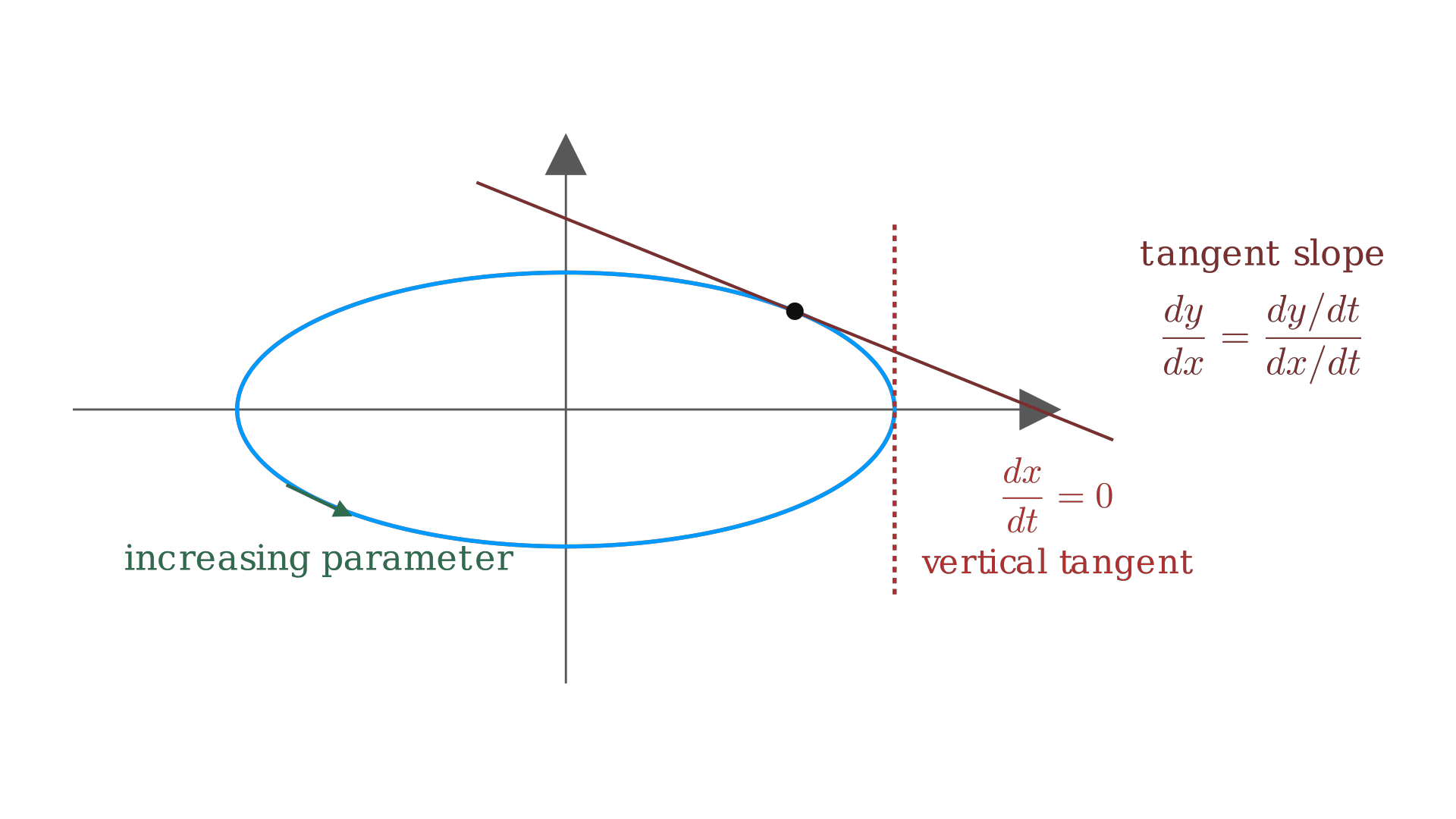
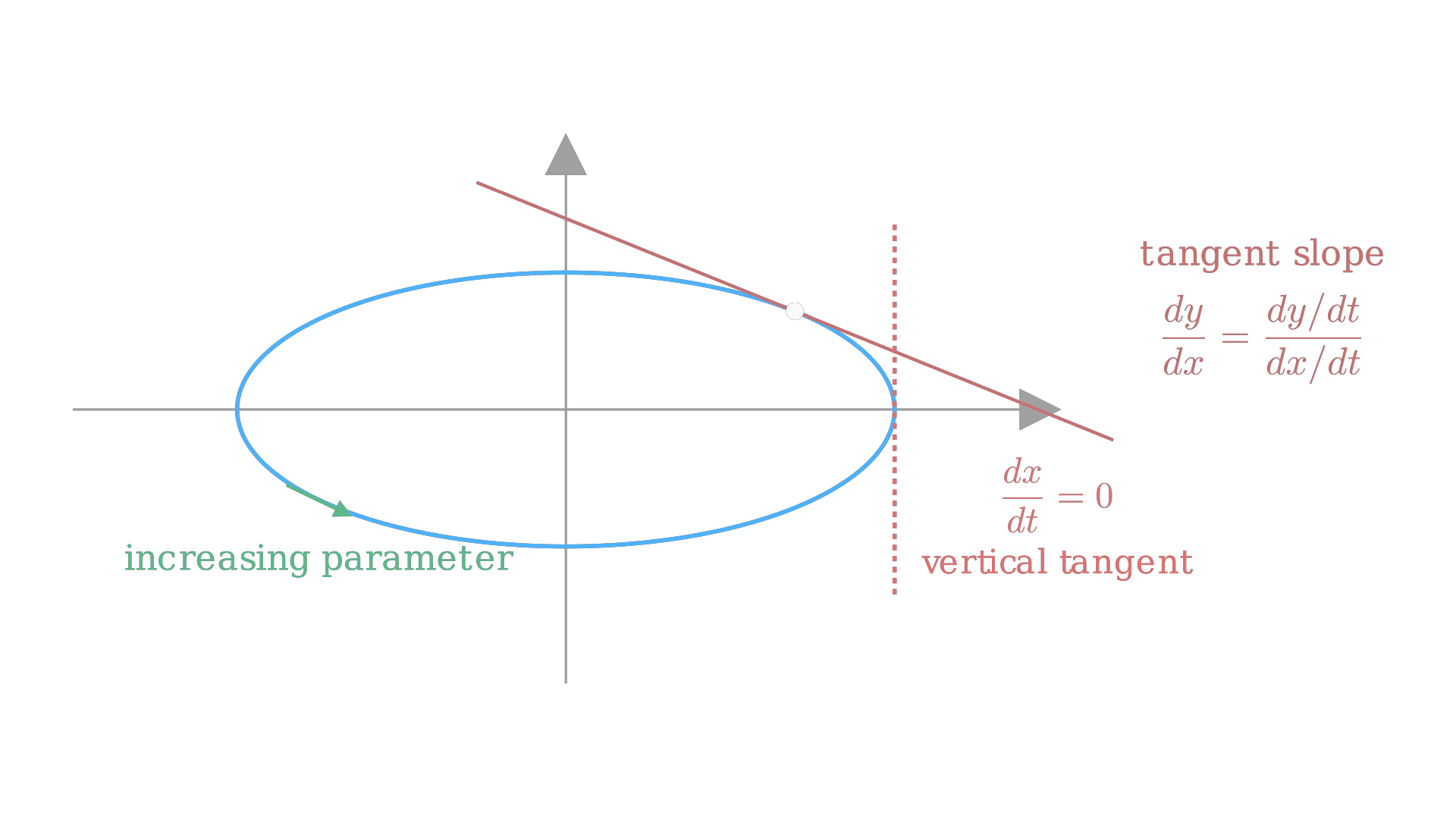
A parametric curve with its direction of travel and a tangent line at one point, the tangent's slope being the ratio (dy/dt)/(dx/dt). / 参数曲线及其行进方向,并在一点处画出切线,其斜率为 (dy/dt)/(dx/dt)。 A parametric curve with its direction of travel and a tangent line at one point, the tangent's slope being the ratio (dy/dt)/(dx/dt). / 参数曲线及其行进方向,并在一点处画出切线,其斜率为 (dy/dt)/(dx/dt)。
A parametric curve with its direction of travel and a tangent line at one point, the tangent's slope being the ratio (dy/dt)/(dx/dt).参数曲线及其行进方向,并在一点处画出切线,其斜率为 (dy/dt)/(dx/dt)。

参数方程(parametric equations)的定义与求导

Learning objectives学习目标
  • State what the parameter $t$ represents and plot points of a curve from $x(t)$ and $y(t)$.
  • Calculate $\frac{dy}{dx}$ at a point as $\frac{dy/dt}{dx/dt}$.
  • Deduce where a parametric curve has horizontal or vertical tangent lines.
  • Write an equation of the tangent line at a given value of $t$.
  • Explain the direction in which a curve is traced as $t$ increases.
  • 说明参数 $t$ 的含义,并由 $x(t)$、$y(t)$ 描点画出曲线。
  • 用 $\frac{dy/dt}{dx/dt}$ 计算某点处的 $\frac{dy}{dx}$。
  • 推断参数曲线在何处有水平切线或垂直切线(horizontal / vertical tangent)。
  • 写出给定 $t$ 值处的切线方程(tangent line)。
  • 解释随着 $t$ 增大曲线被描出的方向(direction of motion)。
Parametric Equations参数方程 A curve is defined by $x = f(t)$ and $y = g(t)$, where $t$ is the parameter. Each value of $t$ gives a point $(x, y)$ on the curve. 一条参数曲线(parametric curve)由 $x = f(t)$ 与 $y = g(t)$ 定义,其中 $t$ 是参数(parameter)。每一个 $t$ 值对应曲线上的一个点 $(x, y)$。

The slope of the tangent line to a parametric curve is found using the chain rule:

参数曲线切线(tangent line)的斜率(slope)通过链式法则(chain rule)得到:

First Derivative (Parametric)一阶导数(参数方程)
$$ \frac{dy}{dx} = \frac{\frac{dy}{dt}}{\frac{dx}{dt}} $$

provided $\frac{dx}{dt} \neq 0$

前提是 $\frac{dx}{dt} \neq 0$

Common Exam Trap常见考试陷阱 Students often compute $\frac{dy}{dt}$ or $\frac{dx}{dt}$ alone and forget to divide. The slope of the tangent is the ratio $\frac{dy}{dx}$, not either derivative alone. 学生常常只算出 $\frac{dy}{dt}$ 或 $\frac{dx}{dt}$,却忘了相除。切线斜率是比值 $\frac{dy}{dx}$,而不是其中任何一个导数本身。
Worked Example: Slope of a Parametric Curve at a Point例题:参数曲线在某点的斜率
Given已知 $x=t^2+1$, $y=t^3-3t$. Find $dy/dx$ at $t=2$.$x=t^2+1$,$y=t^3-3t$。求 $t=2$ 处的 $dy/dx$。
Derivatives求导 $$\frac{dx}{dt}=2t\ \Rightarrow\ \frac{dx}{dt}\bigg|_{t=2}=4,\qquad \frac{dy}{dt}=3t^2-3\ \Rightarrow\ \frac{dy}{dt}\bigg|_{t=2}=9$$
$\dfrac{dy}{dx}=\dfrac{9}{4}$$\dfrac{dy}{dx}=\dfrac{9}{4}$
Key Exam Concept关键考点 A parametric curve has a horizontal tangent when $\frac{dy}{dt} = 0$ (and $\frac{dx}{dt} \neq 0$), and a vertical tangent when $\frac{dx}{dt} = 0$ (and $\frac{dy}{dt} \neq 0$). 参数曲线在 $\frac{dy}{dt} = 0$(且 $\frac{dx}{dt} \neq 0$)时有水平切线;在 $\frac{dx}{dt} = 0$(且 $\frac{dy}{dt} \neq 0$)时有垂直切线。
Given $x = \sin(t)$, $y = \cos(t)$, what is $\frac{dy}{dx}$ where $\cos(t) \neq 0$?已知 $x = \sin(t)$,$y = \cos(t)$,求 $\cos(t) \neq 0$ 处的 $\frac{dy}{dx}$。
$\frac{\cos(t)}{\sin(t)}$
$\frac{\sin(t)}{\cos(t)}$
$-\frac{\sin(t)}{\cos(t)}$
$-\frac{\cos(t)}{\sin(t)}$
Correct! $\frac{dy}{dt} = -\sin(t)$, $\frac{dx}{dt} = \cos(t)$. So $\frac{dy}{dx} = \frac{-\sin(t)}{\cos(t)} = -\tan(t)$.正确!$\frac{dy}{dt} = -\sin(t)$,$\frac{dx}{dt} = \cos(t)$。所以 $\frac{dy}{dx} = \frac{-\sin(t)}{\cos(t)} = -\tan(t)$。
Find $\frac{dy}{dt} = -\sin(t)$ and $\frac{dx}{dt} = \cos(t)$. Divide them: $\frac{dy}{dx} = \frac{-\sin(t)}{\cos(t)}$.先求 $\frac{dy}{dt} = -\sin(t)$ 与 $\frac{dx}{dt} = \cos(t)$,再相除:$\frac{dy}{dx} = \frac{-\sin(t)}{\cos(t)}$。
Worked Example: Locating Horizontal and Vertical Tangents例题:求水平切线与垂直切线
Given已知 Curve $x=t^3-3t$, $y=t^2$ for $-2\le t\le 2$. Find every value of $t$ where the curve has a horizontal or vertical tangent.曲线 $x=t^3-3t$,$y=t^2$,其中 $-2\le t\le 2$。求曲线上所有具有水平切线或垂直切线的 $t$ 值。
Derivatives求导 $$\frac{dx}{dt}=3t^2-3=3(t^2-1),\qquad \frac{dy}{dt}=2t$$
Horizontal水平切线 Need $dy/dt=0$ and $dx/dt\ne 0$:需要 $dy/dt=0$ 且 $dx/dt\ne 0$: $$2t=0\ \Rightarrow\ t=0$$ Check $dx/dt$ at $t=0$: $3(0-1)=-3\ne 0$. Valid.检验 $t=0$ 处 $dx/dt$:$3(0-1)=-3\ne 0$。有效。
Vertical垂直切线 Need $dx/dt=0$ and $dy/dt\ne 0$:需要 $dx/dt=0$ 且 $dy/dt\ne 0$: $$3(t^2-1)=0\ \Rightarrow\ t=\pm 1$$ Check $dy/dt$: at $t=1$ it is $2\ne 0$; at $t=-1$ it is $-2\ne 0$. Both valid.检验 $dy/dt$:$t=1$ 时为 $2\ne 0$;$t=-1$ 时为 $-2\ne 0$。均有效。
Horizontal tangent at $t=0$; vertical tangents at $t=1$ and $t=-1$.$t=0$ 处水平切线;$t=1$ 与 $t=-1$ 处垂直切线。

The check step is not optional: if $dy/dt$ and $dx/dt$ were both zero at the same $t$, the curve would have a cusp or a discontinuity there instead of a genuine tangent, and the point must be examined separately (e.g. with a limit of the slope).

检验步骤并非可有可无:若某个 $t$ 处 $dy/dt$ 与 $dx/dt$ 同时为零,则曲线在该处可能出现尖点或不连续,而非真正的切线,需要单独分析(例如用斜率的极限)。

Worked Example: From Slope to a Full Tangent Line Equation例题:从斜率到完整的切线方程
Given已知 Same curve as the very first example: $x=t^2+1$, $y=t^3-3t$. Write an equation for the line tangent to the curve at $t=2$.沿用最初的例子:$x=t^2+1$,$y=t^3-3t$。求曲线在 $t=2$ 处的切线方程。
Slope斜率 The slope was already found above:上面已求出斜率: $$\frac{dy}{dx}\bigg|_{t=2}=\frac{9}{4}$$ A slope by itself is not a full answer: the line equation needs a point too, so plug $t=2$ into BOTH $x(t)$ and $y(t)$:只给出斜率并不是完整答案,切线方程还需要一个点,所以把 $t=2$ 同时代入 $x(t)$ 与 $y(t)$:
Point点 $$x(2)=2^2+1=5,\qquad y(2)=2^3-3(2)=8-6=2$$
Line直线 Assemble point-slope form from the point $(5,2)$ and slope $\tfrac94$:用点 $(5,2)$ 与斜率 $\tfrac94$ 写出点斜式: $$y-2=\frac{9}{4}(x-5)$$

A question that asks for the tangent line wants the equation itself, point and slope combined into one statement; stopping at "$\frac{dy}{dx} = \frac{9}{4}$" is an incomplete answer even though it is the harder half of the work. Whenever a question says "write an equation for the tangent line," treat finding the slope as step one of two, not the whole task.

题目要求切线时,要的是完整的方程,把点和斜率写在同一个表达式里;只停留在"$\frac{dy}{dx} = \frac{9}{4}$"是不完整的答案,尽管这一步其实是更难的部分。只要题目问的是"写出切线方程",就应该把求斜率当作两步中的第一步,而不是全部任务。

22 33 55 66 −2−2 22 44 xx yy t = −2 (start)t = −2(起点) (5, 2), t = 2(5, 2),t = 2 t = 0t = 0 v(2) = ⟨4, 9⟩v(2) = ⟨4, 9⟩ drawn at ¼ length按 ¼ 长度绘制
Figure 1. The curve x = t² + 1, y = t³ − 3t for −2 ≤ t ≤ 2, drawn with equal scales on both axes. The chevrons show the direction of increasing t; the curve crosses itself at (4, 0), where t = −√3 and t = √3. The blue arrow is the velocity vector ⟨4, 9⟩ at t = 2, drawn at a quarter of its length: it points along the tangent line, and its slope 9/4 is dy/dx at t = 2. The vertical tangent at t = 0 is where dx/dt = 0.图 1. 曲线 x = t² + 1,y = t³ − 3t(−2 ≤ t ≤ 2),两轴比例相同。折线箭头表示 t 增大时的运动方向;曲线在 (4, 0) 处自交,对应 t = −√3 与 t = √3。蓝色箭头是 t = 2 时的速度向量(velocity vector)⟨4, 9⟩,按四分之一长度绘制:它沿切线方向,斜率 9/4 就是 t = 2 处的 dy/dx。t = 0 处的垂直切线(vertical tangent)对应 dx/dt = 0。
Interactive Parametric Curve Tracer参数曲线交互演示

Drag the slider to trace the curve $x = 2\cos(t), \; y = \sin(t)$ and see the tangent vector at each point.

拖动滑块描绘曲线 $x = 2\cos(t), \; y = \sin(t)$,并观察每一点处的切向量。

t = 0.00
Position:位置: (2.00, 0.00)   Slope斜率 $\frac{dy}{dx}$: 0.00
Exam tip考试提示

When a question asks for a tangent line, report both the point $(x(t_0), y(t_0))$ and the slope $\frac{dy}{dx}$ at $t_0$ in one equation. If $\frac{dx}{dt}$ and $\frac{dy}{dt}$ are both $0$ at $t_0$, the quotient formula gives no answer: say so and examine that point separately rather than writing a slope.

题目问切线时,要在同一个方程里同时给出点 $(x(t_0), y(t_0))$ 与 $t_0$ 处的斜率 $\frac{dy}{dx}$。若 $t_0$ 处 $\frac{dx}{dt}$ 与 $\frac{dy}{dt}$ 同时为 $0$,商式公式给不出答案:要明确说明并单独分析该点,而不是硬写一个斜率。

Check your understanding自我检测
When does a parametric curve have a vertical tangent line?参数曲线何时有垂直切线?

When $\frac{dx}{dt} = 0$ and $\frac{dy}{dt} \neq 0$ at the same value of $t$: the slope $\frac{dy/dt}{dx/dt}$ grows without bound there. If both derivatives are $0$, the test is inconclusive.

当同一 $t$ 值处 $\frac{dx}{dt} = 0$ 且 $\frac{dy}{dt} \neq 0$ 时:此处斜率 $\frac{dy/dt}{dx/dt}$ 无界增大。若两个导数都为 $0$,则无法据此判断。

For $x = 3t - 1$, $y = t^2 + 2$, find $\frac{dy}{dx}$ at $t = 1$.对 $x = 3t - 1$,$y = t^2 + 2$,求 $t = 1$ 处的 $\frac{dy}{dx}$。

$\frac{dx}{dt} = 3$ and $\frac{dy}{dt} = 2t$, so $\frac{dy}{dx} = \frac{2t}{3}$. At $t = 1$ the slope is $\frac{2}{3}$.

$\frac{dx}{dt} = 3$,$\frac{dy}{dt} = 2t$,所以 $\frac{dy}{dx} = \frac{2t}{3}$。当 $t = 1$ 时斜率为 $\frac{2}{3}$。

Write an equation of the tangent line to $x = t^3$, $y = t^2 - 4t$ at $t = 1$.写出 $x = t^3$,$y = t^2 - 4t$ 在 $t = 1$ 处的切线方程。

$\frac{dx}{dt} = 3t^2 = 3$ and $\frac{dy}{dt} = 2t - 4 = -2$ at $t = 1$, so the slope is $-\frac{2}{3}$. The point is $(1, 1 - 4) = (1, -3)$. Tangent line: $y + 3 = -\frac{2}{3}(x - 1)$.

$t = 1$ 时 $\frac{dx}{dt} = 3t^2 = 3$,$\frac{dy}{dt} = 2t - 4 = -2$,所以斜率为 $-\frac{2}{3}$。点为 $(1, 1 - 4) = (1, -3)$。切线:$y + 3 = -\frac{2}{3}(x - 1)$。


Second Derivatives of Parametric Equations

参数方程的二阶导数(second derivative)

Learning objectives学习目标
  • State the formula $\frac{d^2y}{dx^2} = \frac{\frac{d}{dt}\left(\frac{dy}{dx}\right)}{\frac{dx}{dt}}$ and explain why it divides by $\frac{dx}{dt}$.
  • Calculate $\frac{d^2y}{dx^2}$ for a parametric curve as a function of $t$.
  • Deduce concavity at a given $t$ from the sign of $\frac{d^2y}{dx^2}$.
  • Identify the common error of dividing $\frac{d^2y}{dt^2}$ by $\frac{d^2x}{dt^2}$.
  • 写出公式 $\frac{d^2y}{dx^2} = \frac{\frac{d}{dt}\left(\frac{dy}{dx}\right)}{\frac{dx}{dt}}$,并解释为何要除以 $\frac{dx}{dt}$。
  • 把参数曲线的 $\frac{d^2y}{dx^2}$ 算成关于 $t$ 的函数。
  • 由 $\frac{d^2y}{dx^2}$ 的符号推断给定 $t$ 处的凹凸性(concavity)。
  • 识别用 $\frac{d^2y}{dt^2}$ 除以 $\frac{d^2x}{dt^2}$ 这一常见错误。

To find the concavity of a parametric curve, compute the second derivative $\frac{d^2y}{dx^2}$.

要判断参数曲线的凹凸性,需要计算二阶导数 $\frac{d^2y}{dx^2}$。

Second Derivative (Parametric)二阶导数(参数方程)
$$ \frac{d^2y}{dx^2} = \frac{\frac{d}{dt} \left[ \frac{dy}{dx} \right]}{\frac{dx}{dt}} $$
Biggest Exam Trap in Unit 9单元 9 最大陷阱 Students often compute $\frac{d^2y}{dt^2} \div \frac{d^2x}{dt^2}$. This is WRONG. You must first find $\frac{dy}{dx}$ as a function of $t$, differentiate that with respect to $t$, then divide by $\frac{dx}{dt}$. 学生常常去算 $\frac{d^2y}{dt^2} \div \frac{d^2x}{dt^2}$,这是错误的。正确做法是先把 $\frac{dy}{dx}$ 写成关于 $t$ 的函数,再对它关于 $t$ 求导,最后除以 $\frac{dx}{dt}$。

Step-by-Step Process

分步流程

Step 1: Find $\frac{dy}{dx} = \frac{\frac{dy}{dt}}{\frac{dx}{dt}}$

第 1 步:求 $\frac{dy}{dx} = \frac{\frac{dy}{dt}}{\frac{dx}{dt}}$

Step 2: Differentiate $\frac{dy}{dx}$ with respect to $t \rightarrow$ get $\frac{d}{dt}\left(\frac{dy}{dx}\right)$

第 2 步:对 $\frac{dy}{dx}$ 关于 $t$ 求导 $\rightarrow$ 得到 $\frac{d}{dt}\left(\frac{dy}{dx}\right)$

Step 3: Divide by $\frac{dx}{dt} \rightarrow \frac{d^2y}{dx^2} = \frac{\frac{d}{dt}\left(\frac{dy}{dx}\right)}{\frac{dx}{dt}}$

第 3 步:再除以 $\frac{dx}{dt}$ $\rightarrow$ $\frac{d^2y}{dx^2} = \frac{\frac{d}{dt}\left(\frac{dy}{dx}\right)}{\frac{dx}{dt}}$

Worked Example: Second Derivative例题:二阶导数
Given已知 $x=t^2$, $y=t^3$$x=t^2$,$y=t^3$
Step 1第 1 步 $$\frac{dy}{dx}=\frac{3t^2}{2t}=\frac{3t}{2}$$
Step 2第 2 步 $$\frac{d}{dt}\left[\frac{3t}{2}\right]=\frac{3}{2}$$
Step 3第 3 步 $$\frac{d^2y}{dx^2}=\frac{3/2}{2t}=\frac{3}{4t}$$
At $t=1$: $\dfrac{d^2y}{dx^2}=\dfrac34>0$, so the curve is concave up.当 $t=1$:$\dfrac{d^2y}{dx^2}=\dfrac34>0$,所以曲线凹向上。
Worked Example: Concavity on Both Sides of $t = 0$例题:$t = 0$ 两侧的凹凸性
Given已知 $x = t^2$, $y = t^3 - 3t$ for $t \neq 0$. Find $\frac{d^2y}{dx^2}$ and the concavity at $t = 1$ and $t = -1$.$x = t^2$,$y = t^3 - 3t$,$t \neq 0$。求 $\frac{d^2y}{dx^2}$,并判断 $t = 1$ 与 $t = -1$ 处的凹凸性。
Step 1第 1 步 $$\frac{dy}{dx}=\frac{3t^2-3}{2t}=\frac32\left(t-\frac1t\right)$$
Step 2第 2 步 $$\frac{d}{dt}\left[\frac{dy}{dx}\right]=\frac32\left(1+\frac{1}{t^2}\right)$$
Step 3第 3 步 Divide by $\frac{dx}{dt} = 2t$:除以 $\frac{dx}{dt} = 2t$: $$\frac{d^2y}{dx^2}=\frac{\frac32\left(1+\frac{1}{t^2}\right)}{2t}=\frac{3(t^2+1)}{4t^3}$$
Evaluate代入 $$t=1:\ \frac{3(2)}{4}=\frac32>0,\qquad t=-1:\ \frac{3(2)}{-4}=-\frac32<0$$
Concave up at $t = 1$ and concave down at $t = -1$; in general concave up for $t > 0$ and concave down for $t < 0$.$t = 1$ 处凹向上,$t = -1$ 处凹向下;一般地,$t > 0$ 时凹向上,$t < 0$ 时凹向下。

Why this works: the numerator $3(t^2+1)$ is always positive, so the sign of $\frac{d^2y}{dx^2}$ is the sign of $t^3$, which comes from dividing by $\frac{dx}{dt} = 2t$. Skipping that division would give $\frac32\left(1+\frac{1}{t^2}\right) > 0$ and the wrong answer at $t = -1$.

原理:分子 $3(t^2+1)$ 恒为正,所以 $\frac{d^2y}{dx^2}$ 的符号就是 $t^3$ 的符号,而这来自除以 $\frac{dx}{dt} = 2t$。若漏掉这一步除法,会得到 $\frac32\left(1+\frac{1}{t^2}\right) > 0$,在 $t = -1$ 处就判断错了。

Reading Concavity from the Sign of d²y/dx²从 d²y/dx² 的符号判断凹凸性 Exactly as with ordinary functions, a positive second derivative means the curve is concave up at that value of $t$ (it bends upward, like a cup), and a negative second derivative means concave down (it bends downward, like a frown). The parameter $t$ never appears directly in this interpretation: you're still reading the graph of $y$ against $x$, just computed through an intermediate variable. When a question asks you to justify concavity, give exactly this sign argument, not a description of the curve's shape from a picture. 与普通函数完全一样,二阶导数为正说明曲线在该 $t$ 值处凹向上(像杯子一样向上弯曲),为负说明凹向下(像皱眉一样向下弯曲)。参数 $t$ 在这个解读中并不直接出现:你仍然是在读 $y$ 关于 $x$ 的图像,只是通过一个中间变量计算得到。当题目要求说明凹凸性时,给出的应当正是这种符号论证,而不是凭图像描述曲线形状。
Exam tip考试提示

Write the intermediate line $\frac{d}{dt}\left(\frac{dy}{dx}\right)$ before you divide by $\frac{dx}{dt}$, so the reader can see you used the correct formula. Then justify concavity with a sentence that names the sign: "concave down at $t = -1$ because $\frac{d^2y}{dx^2} = -\frac32 < 0$ there."

在除以 $\frac{dx}{dt}$ 之前先写出中间一步 $\frac{d}{dt}\left(\frac{dy}{dx}\right)$,让读者看到你用的是正确公式。然后用一句点明符号的话说明凹凸性:"因为 $t = -1$ 处 $\frac{d^2y}{dx^2} = -\frac32 < 0$,所以曲线在该处凹向下。"

Check your understanding自我检测
Why is $\frac{d^2y}{dx^2}$ not equal to $\frac{d^2y}{dt^2} \div \frac{d^2x}{dt^2}$?为什么 $\frac{d^2y}{dx^2}$ 不等于 $\frac{d^2y}{dt^2} \div \frac{d^2x}{dt^2}$?

$\frac{d^2y}{dx^2}$ is the derivative of $\frac{dy}{dx}$ with respect to $x$. By the chain rule that equals $\frac{d}{dt}\left(\frac{dy}{dx}\right) \div \frac{dx}{dt}$. The ratio of second derivatives in $t$ measures something else and does not give the concavity of $y$ against $x$.

$\frac{d^2y}{dx^2}$ 是 $\frac{dy}{dx}$ 关于 $x$ 的导数。由链式法则,它等于 $\frac{d}{dt}\left(\frac{dy}{dx}\right) \div \frac{dx}{dt}$。关于 $t$ 的两个二阶导数之比衡量的是别的量,不能给出 $y$ 关于 $x$ 的凹凸性。

For $x = t^2$, $y = t^3$ ($t \neq 0$), is the curve concave up or down at $t = -1$?对 $x = t^2$,$y = t^3$($t \neq 0$),曲线在 $t = -1$ 处凹向上还是凹向下?

From the worked example above, $\frac{d^2y}{dx^2} = \frac{3}{4t}$. At $t = -1$ this is $-\frac34 < 0$, so the curve is concave down there.

由上面的例题,$\frac{d^2y}{dx^2} = \frac{3}{4t}$。当 $t = -1$ 时其值为 $-\frac34 < 0$,所以曲线在该处凹向下。

For $x = 2t$, $y = t^3$, find $\frac{d^2y}{dx^2}$ at $t = 2$.对 $x = 2t$,$y = t^3$,求 $t = 2$ 处的 $\frac{d^2y}{dx^2}$。

$\frac{dy}{dx} = \frac{3t^2}{2}$. Then $\frac{d}{dt}\left(\frac{dy}{dx}\right) = 3t$, and dividing by $\frac{dx}{dt} = 2$ gives $\frac{d^2y}{dx^2} = \frac{3t}{2}$. At $t = 2$ this is $3 > 0$: concave up.

$\frac{dy}{dx} = \frac{3t^2}{2}$。于是 $\frac{d}{dt}\left(\frac{dy}{dx}\right) = 3t$,再除以 $\frac{dx}{dt} = 2$ 得 $\frac{d^2y}{dx^2} = \frac{3t}{2}$。当 $t = 2$ 时其值为 $3 > 0$:凹向上。


Finding Arc Lengths of Parametric Curves
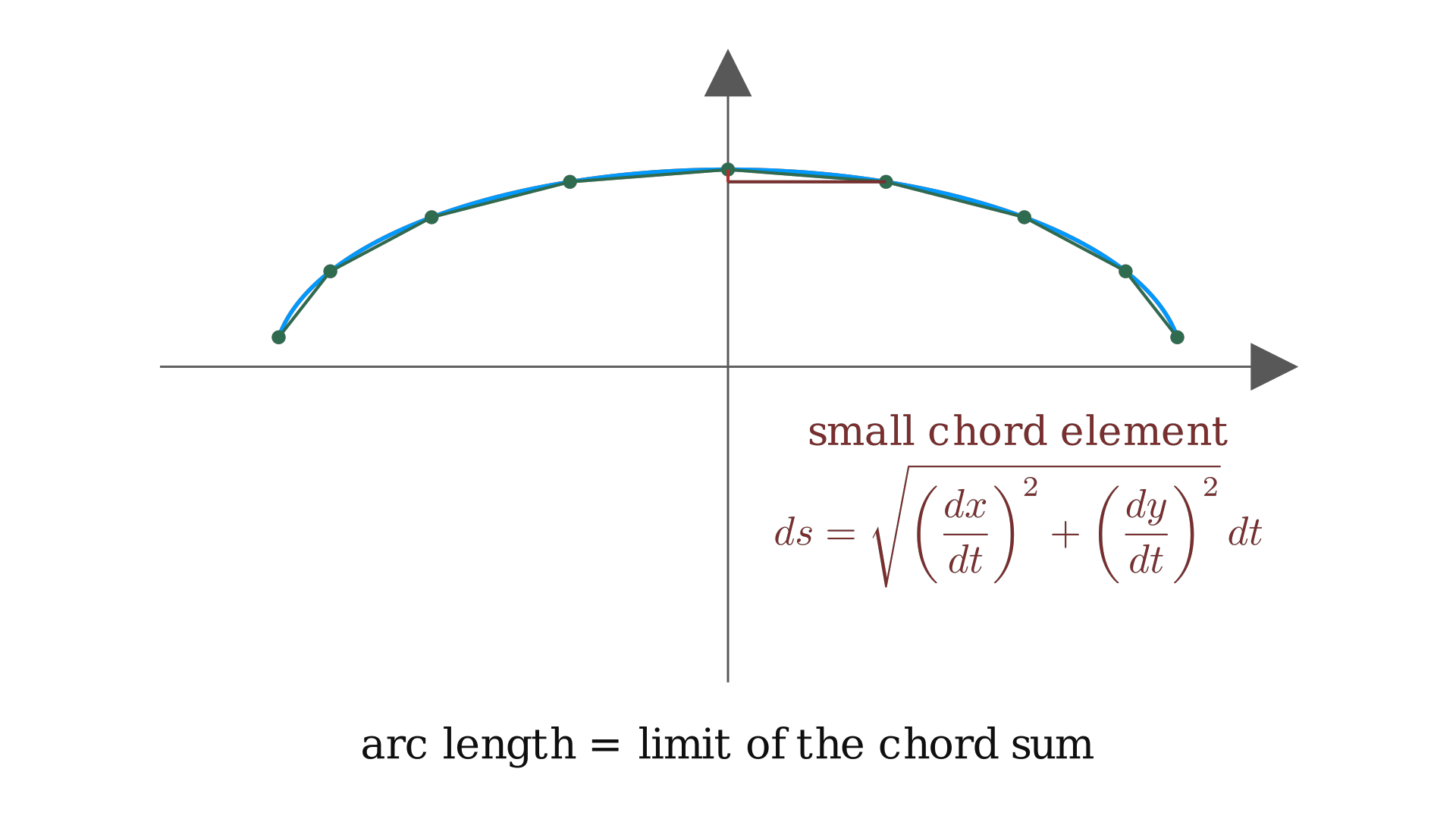
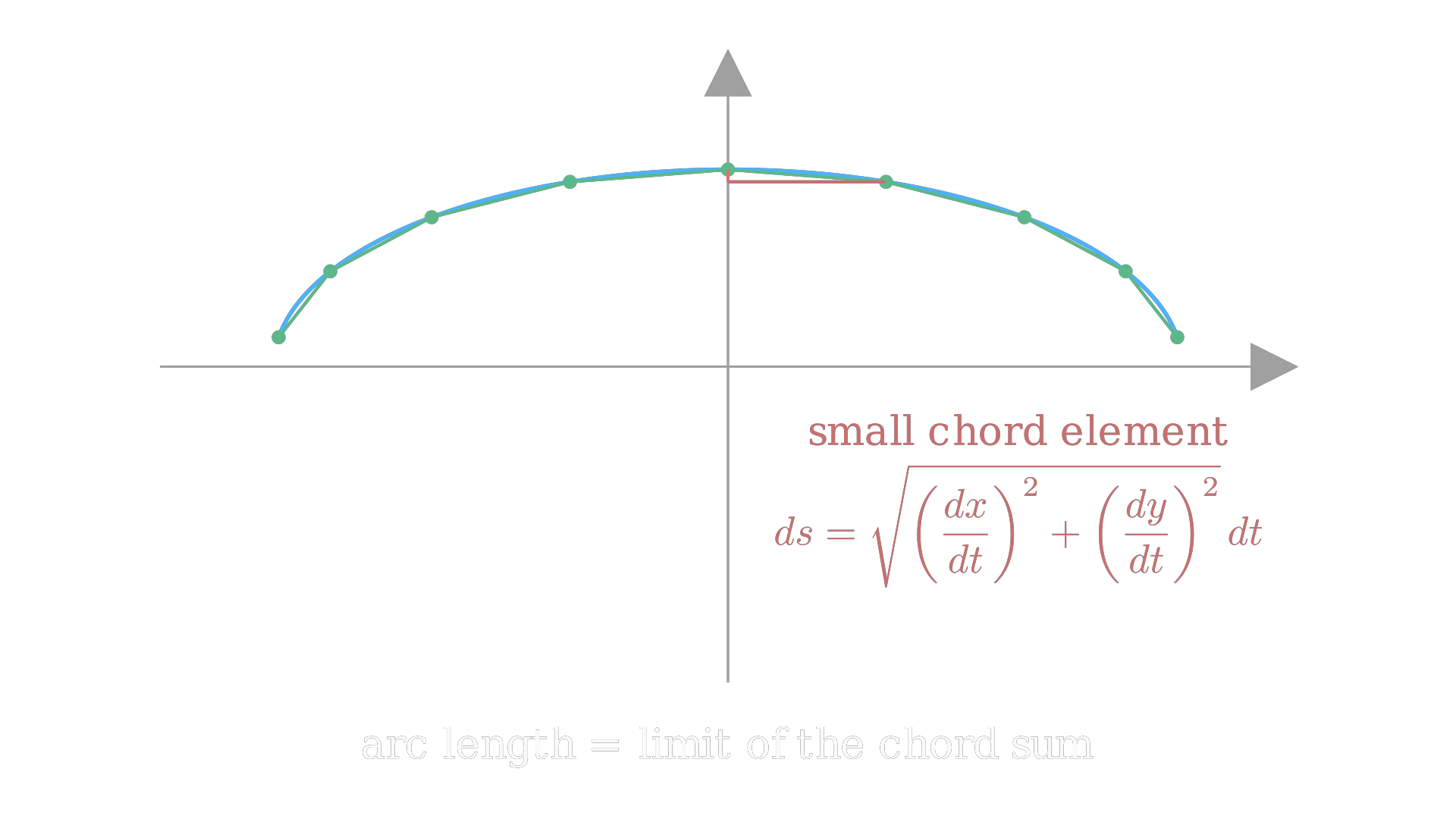
A parametric curve broken into small chords, each contributing sqrt((dx/dt)^2 + (dy/dt)^2) dt to the arc length. / 参数曲线分成若干小弦段,每段对弧长的贡献为 sqrt((dx/dt)² + (dy/dt)²) dt。 A parametric curve broken into small chords, each contributing sqrt((dx/dt)^2 + (dy/dt)^2) dt to the arc length. / 参数曲线分成若干小弦段,每段对弧长的贡献为 sqrt((dx/dt)² + (dy/dt)²) dt。
A parametric curve broken into small chords, each contributing sqrt((dx/dt)^2 + (dy/dt)^2) dt to the arc length.参数曲线分成若干小弦段,每段对弧长的贡献为 sqrt((dx/dt)² + (dy/dt)²) dt。

参数曲线的弧长(arc length)

Learning objectives学习目标
  • State the arc length formula $L = \int_a^b \sqrt{\left(\frac{dx}{dt}\right)^2 + \left(\frac{dy}{dt}\right)^2}\,dt$.
  • Explain why the integrand is the speed of a particle tracing the curve.
  • Set up an arc length integral with limits in $t$.
  • Calculate arc length exactly when a substitution works, or numerically with a calculator.
  • Explain why a curve traced twice has its length counted twice.
  • 写出弧长公式 $L = \int_a^b \sqrt{\left(\frac{dx}{dt}\right)^2 + \left(\frac{dy}{dt}\right)^2}\,dt$。
  • 解释为何被积函数就是沿曲线运动的质点的速率(speed)。
  • 列出以 $t$ 为积分限的弧长积分。
  • 在可换元时精确计算弧长,否则用计算器数值计算。
  • 解释为何被描两次的曲线其长度会被计算两次。
Arc Length (Parametric)弧长(参数方程)
$$ L = \int_{a}^{b} \sqrt{\left(\frac{dx}{dt}\right)^2 + \left(\frac{dy}{dt}\right)^2} dt $$
Key Idea核心思想 The integrand $\sqrt{(x'(t))^2 + (y'(t))^2}$ represents the speed of the particle at time $t$. Integrating speed over time gives the total distance (arc length). 被积函数 $\sqrt{(x'(t))^2 + (y'(t))^2}$ 表示质点在时间 $t$ 处的速率(speed)。对速率沿时间积分,得到的就是总路程(即弧长)。
Exam Note考试提示 When a calculator is allowed, set up the integral and evaluate it numerically. The work that matters is writing the correct integrand and limits of integration. 允许使用计算器时,列出积分式并用计算器数值求值。关键在于写对被积函数和积分上下限。
Worked Example: Arc Length例题:弧长
Given已知 Find the length of the curve $x=3t$, $y=4t$, for $0\le t\le 5$.求曲线 $x=3t$、$y=4t$ 在 $0\le t\le 5$ 上的长度。
Derivatives求导 $$\frac{dx}{dt}=3,\qquad \frac{dy}{dt}=4$$
Length弧长 $$L=\int_0^5\sqrt{9+16}\,dt=\int_0^5 5\,dt=25$$
This is just a line segment of length 25, which makes sense.这就是一段长度为 25 的线段,合情合理!
Why the Formula Uses Speed, Not Velocity为什么公式用的是速率而非速度 The arc length formula integrates $\sqrt{(x')^2 + (y')^2}$, the magnitude of the velocity vector, never its sign or direction. This is deliberate: arc length always accumulates, even if the particle momentarily reverses course. Contrast this with a straightforward integral of velocity, which would let forward and backward motion cancel out: appropriate for displacement, but never for a length or a distance, both of which can only add. 弧长公式对 $\sqrt{(x')^2 + (y')^2}$ 积分,即速度向量的模,而不涉及其符号或方向。这是有意为之:弧长总是不断累积的,即使质点中途暂时掉头也是如此。这与直接对速度积分不同:后者会让正向与反向运动相互抵消,这对位移是恰当的,但对长度或路程永远不适用,因为两者只能累加,不能相消。
Practice: Find the arc length of $x = 5\cos(t), \; y = 5\sin(t)$ for $0 \leq t \leq 2\pi$. (Hint: this is a circle of radius 5.)
练习:求 $x = 5\cos(t), \; y = 5\sin(t)$ 在 $0 \leq t \leq 2\pi$ 上的弧长。(提示:这是半径为 5 的圆。)
Worked Example: Arc Length of a Curved (Non-Linear) Path例题:曲线(非直线)路径的弧长
Given已知 Find the length of $x=t^2$, $y=\tfrac23 t^3$ for $0\le t\le 2$.求 $x=t^2$、$y=\tfrac23 t^3$ 在 $0\le t\le 2$ 上的长度。
Derivatives求导 $$\frac{dx}{dt}=2t,\qquad \frac{dy}{dt}=2t^2$$
Integrand被积函数 Set up the integrand ($t\ge 0$ on this interval, so $\sqrt{t^2}=t$):列出被积函数(此区间 $t\ge 0$,故 $\sqrt{t^2}=t$): $$\sqrt{(2t)^2+(2t^2)^2}=\sqrt{4t^2+4t^4}=2t\sqrt{1+t^2}$$
Substitute换元 Let $u=1+t^2$, so $du=2t\,dt$. This cancels the $2t$ out front exactly:令 $u=1+t^2$,$du=2t\,dt$,恰好消去前面的 $2t$: $$L=\int_0^2 2t\sqrt{1+t^2}\,dt=\int_1^5\sqrt{u}\,du=\left[\tfrac23u^{3/2}\right]_1^5=\tfrac23\left(5\sqrt5-1\right)\approx 6.79$$

Unlike the straight-line example above, this integrand does not simplify to a constant. Most arc-length integrals have no elementary antiderivative and are evaluated numerically on a calculator, but recognizing the $u$-substitution here (when it is available) turns a calculator problem into an exact closed form, which is worth checking for before reaching for technology.

与上面的直线例子不同,此被积函数不能化简为常数。大多数弧长积分没有初等原函数,需用计算器数值求值,但若能识别出此处可用的 $u$ 替换,就能把计算器题变为精确的闭式解,值得在诉诸计算器前先检查一下。

Exam tip考试提示

Keep everything in $t$: the integrand uses $\frac{dx}{dt}$ and $\frac{dy}{dt}$, and the limits are $t$-values, not $x$-values. Write the full integral before pressing calculator keys, so a reader can check the setup separately from the number.

全部用 $t$ 表示:被积函数用 $\frac{dx}{dt}$ 与 $\frac{dy}{dt}$,积分限是 $t$ 值而不是 $x$ 值。按计算器之前先写出完整积分式,让读者能把列式与数值分开检查。

Check your understanding自我检测
What does the integrand $\sqrt{(x'(t))^2 + (y'(t))^2}$ represent physically?被积函数 $\sqrt{(x'(t))^2 + (y'(t))^2}$ 的物理意义是什么?

It is the speed of a particle whose position at time $t$ is $(x(t), y(t))$: the magnitude of the velocity vector. Integrating speed over time gives distance travelled along the path, which is the arc length.

它是位置为 $(x(t), y(t))$ 的质点在时间 $t$ 的速率,即速度向量的模。速率对时间积分得到沿路径走过的路程,也就是弧长。

Find the exact length of $x = 1 + 3t^2$, $y = 4 + 2t^3$ for $0 \le t \le 1$.求 $x = 1 + 3t^2$,$y = 4 + 2t^3$ 在 $0 \le t \le 1$ 上的精确长度。

$\frac{dx}{dt} = 6t$ and $\frac{dy}{dt} = 6t^2$, so the integrand is $\sqrt{36t^2 + 36t^4} = 6t\sqrt{1+t^2}$ for $t \ge 0$. With $u = 1 + t^2$: $L = \int_1^2 3\sqrt{u}\,du = 2\left(2\sqrt2 - 1\right) \approx 3.657$.

$\frac{dx}{dt} = 6t$,$\frac{dy}{dt} = 6t^2$,所以当 $t \ge 0$ 时被积函数为 $\sqrt{36t^2 + 36t^4} = 6t\sqrt{1+t^2}$。令 $u = 1 + t^2$:$L = \int_1^2 3\sqrt{u}\,du = 2\left(2\sqrt2 - 1\right) \approx 3.657$。

Set up (do not evaluate by hand) the length of $x = t^2$, $y = \sin t$ for $0 \le t \le \pi$.列出(不必手算)$x = t^2$,$y = \sin t$ 在 $0 \le t \le \pi$ 上的长度。

$L = \int_0^{\pi} \sqrt{4t^2 + \cos^2 t}\,dt$. This has no elementary antiderivative; a calculator gives $L \approx 10.354$.

$L = \int_0^{\pi} \sqrt{4t^2 + \cos^2 t}\,dt$。它没有初等原函数;用计算器得 $L \approx 10.354$。


Defining and Differentiating Vector-Valued Functions
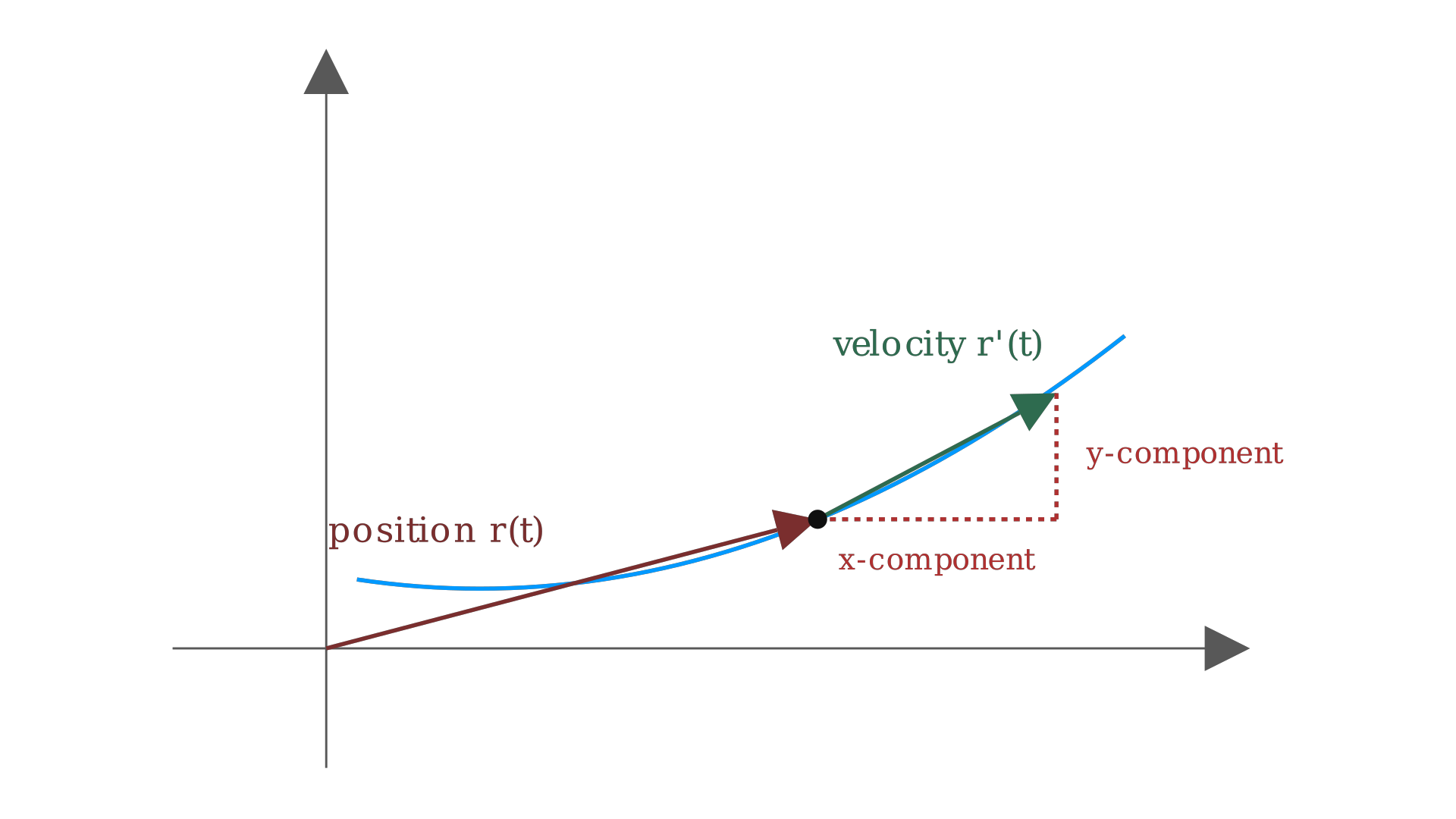
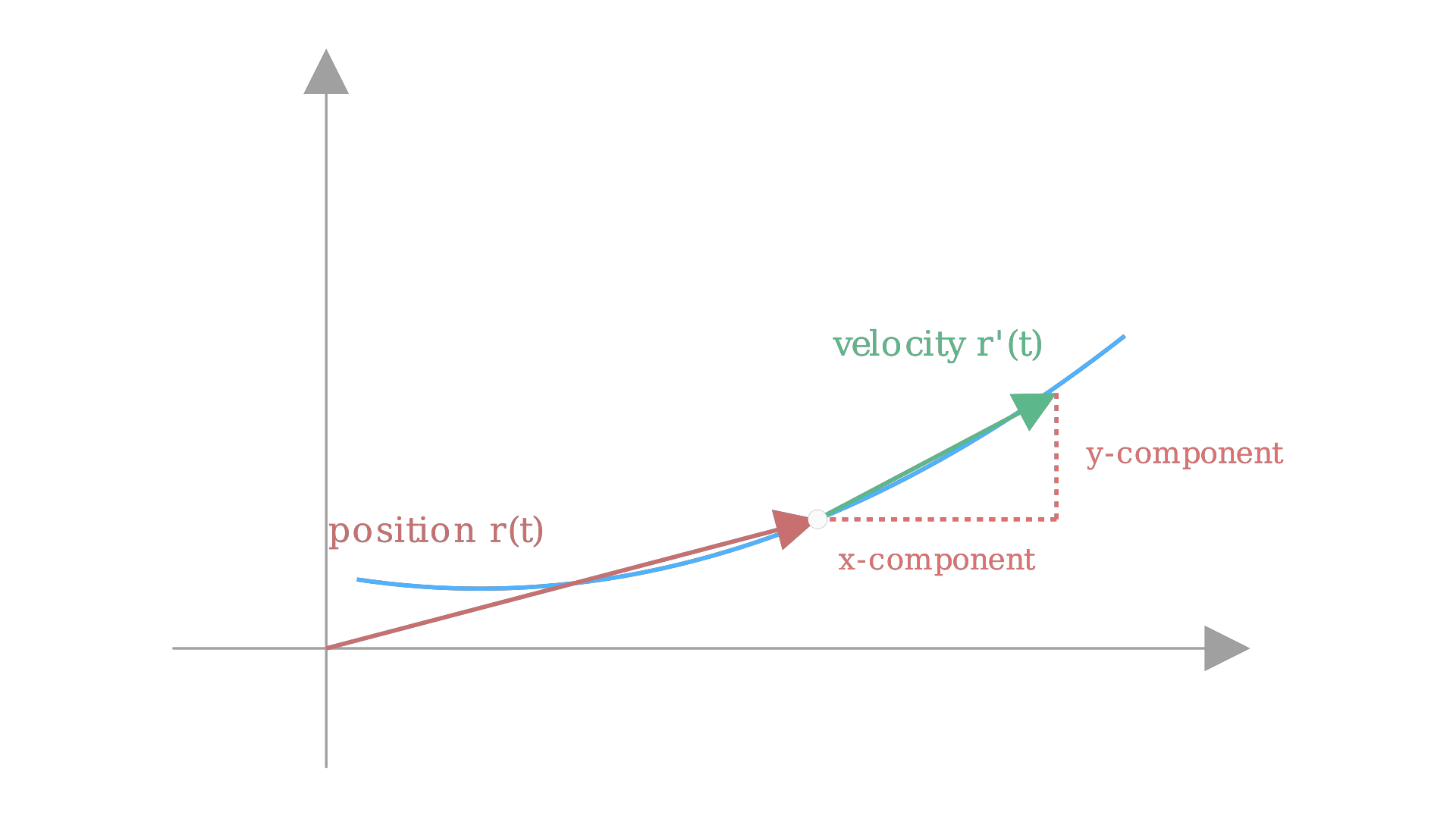
A plane trajectory with the position vector r(t) and the velocity vector r'(t) at one point, the velocity shown with its x- and y-components. / 平面轨迹上某一点的位置向量 r(t) 与速度向量 r'(t),并画出速度的 x、y 分量。 A plane trajectory with the position vector r(t) and the velocity vector r'(t) at one point, the velocity shown with its x- and y-components. / 平面轨迹上某一点的位置向量 r(t) 与速度向量 r'(t),并画出速度的 x、y 分量。
A plane trajectory with the position vector r(t) and the velocity vector r'(t) at one point, the velocity shown with its x- and y-components.平面轨迹上某一点的位置向量 r(t) 与速度向量 r'(t),并画出速度的 x、y 分量。

向量值函数(vector-valued function)的定义与求导

Learning objectives学习目标
  • State the meaning of $\mathbf{r}(t) = \langle x(t), y(t) \rangle$ as a position vector.
  • Calculate velocity $\mathbf{v}(t) = \mathbf{r}'(t)$ and acceleration $\mathbf{a}(t) = \mathbf{r}''(t)$ component by component.
  • Calculate speed as the magnitude $|\mathbf{v}(t)|$.
  • Explain why the velocity vector is tangent to the path and points in the direction of motion.
  • Deduce the slope of the path from the velocity components.
  • 说明 $\mathbf{r}(t) = \langle x(t), y(t) \rangle$ 作为位置向量(position vector)的含义。
  • 按分量计算速度 $\mathbf{v}(t) = \mathbf{r}'(t)$ 与加速度 $\mathbf{a}(t) = \mathbf{r}''(t)$。
  • 把速率计算为模 $|\mathbf{v}(t)|$。
  • 解释为何速度向量与路径相切并指向运动方向。
  • 由速度分量推断路径的斜率。
Vector-Valued Function向量值函数 A function of the form $\mathbf{r}(t) = \langle x(t), y(t) \rangle = x(t)\mathbf{i} + y(t)\mathbf{j}$. It gives the position of a particle in the plane at time $t$. 形如 $\mathbf{r}(t) = \langle x(t), y(t) \rangle = x(t)\mathbf{i} + y(t)\mathbf{j}$ 的函数,给出质点在时间 $t$ 处于平面中的位置(position)。

Differentiation works component-wise:

求导按分量逐一进行:

Derivative of Vector Function向量值函数的导数
$$ \mathbf{r}'(t) = \langle x'(t), y'(t) \rangle $$

The derivative $\mathbf{r}'(t)$ gives the velocity vector $\mathbf{v}(t)$. Its direction is tangent to the curve at that point.

导数 $\mathbf{r}'(t)$ 即为速度向量(velocity vector) $\mathbf{v}(t)$。它的方向(direction)与曲线在该点处的切线相切。

Connection联系 Parametric equations and vector-valued functions describe the exact same thing: planar motion. The notation is different, but the calculus is identical. 参数方程与向量值函数描述的是同一件事:平面运动(planar motion)。记号不同,但微积分的内容完全一样。
Worked Example: Velocity and Speed from a Position Vector例题:由位置向量求速度与速率
Given已知 $\mathbf r(t)=\langle t^2-1,\ 2t+3\rangle$. Find the velocity vector and speed at $t=2$.$\mathbf r(t)=\langle t^2-1,\ 2t+3\rangle$。求 $t=2$ 时的速度向量与速率。
Velocity速度 Differentiate component-wise:按分量求导: $$\mathbf r'(t)=\langle 2t,\ 2\rangle\ \Rightarrow\ \mathbf r'(2)=\langle 4,\ 2\rangle$$
Speed速率 Speed is the magnitude of the velocity vector:速率是速度向量的模: $$\left|\mathbf r'(2)\right|=\sqrt{4^2+2^2}=\sqrt{20}=2\sqrt5$$
The vector $\langle 4,2\rangle$ also gives the direction of motion, tangent to the curve at $t=2$.向量 $\langle 4,2\rangle$ 同时给出了运动方向,即曲线在 $t=2$ 处的切线方向。
Worked Example: Velocity and Acceleration on an Ellipse例题:椭圆上的速度与加速度
Given已知 $\mathbf r(t) = \langle 3\cos t,\ 2\sin t\rangle$. Find the velocity, speed and acceleration at $t = \frac{\pi}{2}$.$\mathbf r(t) = \langle 3\cos t,\ 2\sin t\rangle$。求 $t = \frac{\pi}{2}$ 时的速度、速率与加速度。
Velocity速度 $$\mathbf v(t)=\langle -3\sin t,\ 2\cos t\rangle\ \Rightarrow\ \mathbf v\left(\tfrac{\pi}{2}\right)=\langle -3,\ 0\rangle$$
Speed速率 $$\left|\mathbf v\left(\tfrac{\pi}{2}\right)\right|=\sqrt{(-3)^2+0^2}=3$$
Acceleration加速度 $$\mathbf a(t)=\langle -3\cos t,\ -2\sin t\rangle\ \Rightarrow\ \mathbf a\left(\tfrac{\pi}{2}\right)=\langle 0,\ -2\rangle$$
At $t = \frac{\pi}{2}$ the particle is at $(0, 2)$, moving left with speed $3$; the acceleration $\langle 0, -2\rangle$ points straight down, toward the centre of the ellipse.$t = \frac{\pi}{2}$ 时质点位于 $(0, 2)$,以速率 $3$ 向左运动;加速度 $\langle 0, -2\rangle$ 竖直向下,指向椭圆中心。

Why this works: each component is an ordinary function of $t$, so the derivative rules apply to each one separately. Since $\mathbf v \cdot \mathbf a = 0$ here, the speed is momentarily neither increasing nor decreasing: the speed $\sqrt{9\sin^2 t + 4\cos^2 t}$ reaches its maximum value $3$ at $t = \frac{\pi}{2}$.

原理:每个分量都是 $t$ 的普通函数,所以求导法则可以分别作用于每个分量。此处 $\mathbf v \cdot \mathbf a = 0$,速率在该瞬间既不增加也不减小:速率 $\sqrt{9\sin^2 t + 4\cos^2 t}$ 在 $t = \frac{\pi}{2}$ 处取得最大值 $3$。

Exam tip考试提示

Match the form of the answer to the word in the question: "velocity vector" or "acceleration vector" needs both components, $\langle a, b\rangle$; "speed" needs one non-negative number, $\sqrt{a^2+b^2}$. Giving a vector when speed is asked, or the reverse, answers a different question.

答案形式要与题目用词对应:"速度向量"(velocity vector)或"加速度向量"要给出两个分量 $\langle a, b\rangle$;"速率"(speed)只要一个非负数 $\sqrt{a^2+b^2}$。问速率却给向量(或反之),等于回答了另一个问题。

Check your understanding自我检测
For $\mathbf r(t) = \langle t^3,\ 4t\rangle$, find the velocity and the speed at $t = 1$.对 $\mathbf r(t) = \langle t^3,\ 4t\rangle$,求 $t = 1$ 时的速度与速率。

$\mathbf v(t) = \langle 3t^2, 4\rangle$, so $\mathbf v(1) = \langle 3, 4\rangle$ and the speed is $\sqrt{9 + 16} = 5$.

$\mathbf v(t) = \langle 3t^2, 4\rangle$,所以 $\mathbf v(1) = \langle 3, 4\rangle$,速率为 $\sqrt{9 + 16} = 5$。

In which direction does the velocity vector point, relative to the path?速度向量相对于路径指向哪个方向?

Along the tangent line to the path at that point, in the direction the particle is moving (the direction of increasing $t$).

沿路径在该点的切线方向,并指向质点运动的方向($t$ 增大的方向)。

For $\mathbf r(t) = \langle \sin(2t),\ e^t\rangle$, find $\mathbf v(0)$, $\mathbf a(0)$ and the slope $\frac{dy}{dx}$ of the path at $t = 0$.对 $\mathbf r(t) = \langle \sin(2t),\ e^t\rangle$,求 $\mathbf v(0)$、$\mathbf a(0)$ 以及路径在 $t = 0$ 处的斜率 $\frac{dy}{dx}$。

$\mathbf v(t) = \langle 2\cos(2t), e^t\rangle$, so $\mathbf v(0) = \langle 2, 1\rangle$. $\mathbf a(t) = \langle -4\sin(2t), e^t\rangle$, so $\mathbf a(0) = \langle 0, 1\rangle$. Slope $= \frac{y'(0)}{x'(0)} = \frac12$.

$\mathbf v(t) = \langle 2\cos(2t), e^t\rangle$,所以 $\mathbf v(0) = \langle 2, 1\rangle$。$\mathbf a(t) = \langle -4\sin(2t), e^t\rangle$,所以 $\mathbf a(0) = \langle 0, 1\rangle$。斜率 $= \frac{y'(0)}{x'(0)} = \frac12$。


Integrating Vector-Valued Functions

向量值函数的积分(integral)

Learning objectives学习目标
  • State that a vector-valued function is integrated component by component, with one constant per component.
  • Calculate a position function from a velocity function and an initial position.
  • Calculate a later position as initial position plus $\int_a^b \mathbf{v}(t)\,dt$.
  • Calculate a definite integral of a vector-valued function as a vector.
  • 说明向量值函数按分量积分,每个分量各有一个常数。
  • 由速度函数与初始位置求出位置函数(initial value problem)。
  • 把之后的位置计算为初始位置加上 $\int_a^b \mathbf{v}(t)\,dt$。
  • 把向量值函数的定积分算成一个向量。

Integration also works component-wise:

积分同样按分量逐一进行:

Integral of Vector Function向量值函数的积分
$$ \int \mathbf{r}(t) dt = \left\langle \int x(t) dt, \int y(t) dt \right\rangle + \mathbf{C} $$
Initial Value Problems初值问题 Given $\mathbf{v}(t) = \langle x'(t), y'(t) \rangle$ and an initial position $\mathbf{r}(t_0) = \langle x_0, y_0 \rangle$, integrate each component and solve for the constants using the initial conditions. 已知 $\mathbf{v}(t) = \langle x'(t), y'(t) \rangle$ 和初始位置 $\mathbf{r}(t_0) = \langle x_0, y_0 \rangle$,对每个分量积分,再用初始条件解出积分常数。
Worked Example: Vector IVP例题:向量初值问题
Given已知 $\mathbf r'(t)=\langle 2t,\ e^t\rangle$, $\ \mathbf r(0)=\langle 3,\ 1\rangle$$\mathbf r'(t)=\langle 2t,\ e^t\rangle$,$\ \mathbf r(0)=\langle 3,\ 1\rangle$
Integrate积分 Integrate component-wise:按分量积分: $$x(t)=t^2+C_1,\qquad y(t)=e^t+C_2$$
Initial condition初始条件 Apply $\mathbf r(0)=\langle 3,1\rangle$:代入 $\mathbf r(0)=\langle 3,1\rangle$: $$x(0)=0+C_1=3\ \Rightarrow\ C_1=3,\qquad y(0)=1+C_2=1\ \Rightarrow\ C_2=0$$
Solution: $\mathbf r(t)=\langle t^2+3,\ e^t\rangle$解:$\mathbf r(t)=\langle t^2+3,\ e^t\rangle$
Worked Example: Position at a Later Time from a Definite Integral例题:用定积分求之后时刻的位置
Given已知 A particle has $\mathbf v(t) = \langle 6t^2,\ 2t - 4\rangle$ and $\mathbf r(1) = \langle 2,\ -1\rangle$. Find $\mathbf r(3)$.质点的 $\mathbf v(t) = \langle 6t^2,\ 2t - 4\rangle$,且 $\mathbf r(1) = \langle 2,\ -1\rangle$。求 $\mathbf r(3)$。
Set up列式 Position at $t = 3$ is position at $t = 1$ plus the net change:$t = 3$ 时的位置等于 $t = 1$ 时的位置加上净变化: $$\mathbf r(3)=\mathbf r(1)+\int_1^3\mathbf v(t)\,dt$$
xx 分量 $$\int_1^3 6t^2\,dt=\left[2t^3\right]_1^3=54-2=52$$
yy 分量 $$\int_1^3 (2t-4)\,dt=\left[t^2-4t\right]_1^3=(9-12)-(1-4)=0$$
$\mathbf r(3) = \langle 2 + 52,\ -1 + 0\rangle = \langle 54,\ -1\rangle$$\mathbf r(3) = \langle 2 + 52,\ -1 + 0\rangle = \langle 54,\ -1\rangle$

Why this works: the Fundamental Theorem of Calculus applies to each component, so $\int_1^3 \mathbf v\,dt$ is the displacement from $t = 1$ to $t = 3$. A net $y$-change of $0$ does not mean the particle stood still vertically: $y'(t) < 0$ before $t = 2$ and $y'(t) > 0$ after, and the two pieces cancel.

原理:微积分基本定理(Fundamental Theorem of Calculus)对每个分量都成立,所以 $\int_1^3 \mathbf v\,dt$ 是从 $t = 1$ 到 $t = 3$ 的位移。$y$ 方向净变化为 $0$ 并不表示质点在竖直方向没动:$t = 2$ 之前 $y'(t) < 0$,之后 $y'(t) > 0$,两部分相互抵消。

Exam tip考试提示

For "where is the particle at time $b$?", write the structure $\mathbf r(b) = \mathbf r(a) + \int_a^b \mathbf v(t)\,dt$ (or the $x$ and $y$ versions) before computing. It shows where the initial condition enters, and it works with a calculator when the antiderivative is not elementary.

遇到"质点在时刻 $b$ 位于何处"时,计算前先写出结构 $\mathbf r(b) = \mathbf r(a) + \int_a^b \mathbf v(t)\,dt$(或 $x$、$y$ 分量形式)。它表明初始条件从哪里进入,而且在原函数不是初等函数时也能配合计算器使用。

Check your understanding自我检测
Why does integrating $\mathbf v(t) = \langle x'(t), y'(t)\rangle$ produce two constants of integration?为什么对 $\mathbf v(t) = \langle x'(t), y'(t)\rangle$ 积分会产生两个积分常数?

Each component is integrated separately, and each antiderivative has its own constant. Together they form a constant vector $\mathbf C = \langle C_1, C_2\rangle$, fixed by the two coordinates of the initial position.

每个分量分别积分,每个原函数都有自己的常数。两者合成一个常向量 $\mathbf C = \langle C_1, C_2\rangle$,由初始位置的两个坐标确定。

Evaluate $\int_0^1 \langle 2t,\ 3t^2\rangle\,dt$.计算 $\int_0^1 \langle 2t,\ 3t^2\rangle\,dt$。

$\left\langle \left[t^2\right]_0^1, \left[t^3\right]_0^1 \right\rangle = \langle 1, 1\rangle$.

$\left\langle \left[t^2\right]_0^1, \left[t^3\right]_0^1 \right\rangle = \langle 1, 1\rangle$。

A particle has $\mathbf v(t) = \langle 4t,\ e^t\rangle$ and $\mathbf r(0) = \langle 1,\ 2\rangle$. Find $\mathbf r(t)$ and $\mathbf r(1)$.质点的 $\mathbf v(t) = \langle 4t,\ e^t\rangle$,$\mathbf r(0) = \langle 1,\ 2\rangle$。求 $\mathbf r(t)$ 与 $\mathbf r(1)$。

$x(t) = 2t^2 + C_1$ with $C_1 = 1$; $y(t) = e^t + C_2$ with $1 + C_2 = 2$, so $C_2 = 1$. Thus $\mathbf r(t) = \langle 2t^2 + 1,\ e^t + 1\rangle$ and $\mathbf r(1) = \langle 3,\ e + 1\rangle \approx \langle 3,\ 3.718\rangle$.

$x(t) = 2t^2 + C_1$,$C_1 = 1$;$y(t) = e^t + C_2$,由 $1 + C_2 = 2$ 得 $C_2 = 1$。所以 $\mathbf r(t) = \langle 2t^2 + 1,\ e^t + 1\rangle$,$\mathbf r(1) = \langle 3,\ e + 1\rangle \approx \langle 3,\ 3.718\rangle$。


Solving Motion Problems: Parametric & Vector-Valued

求解运动问题:参数方程与向量值函数

Learning objectives学习目标
  • State the formulas for position, velocity, speed, acceleration, displacement and total distance in the plane.
  • Calculate displacement as $\int_a^b \mathbf{v}(t)\,dt$ and total distance as $\int_a^b |\mathbf{v}(t)|\,dt$.
  • Deduce whether speed is increasing or decreasing from the sign of $\mathbf{v} \cdot \mathbf{a}$.
  • Explain why distance travelled can exceed the magnitude of the displacement.
  • Interpret the sign of $x'(t)$ or $y'(t)$ as horizontal or vertical direction of motion.
  • 写出平面运动中位置、速度、速率、加速度、位移与总路程的公式。
  • 把位移计算为 $\int_a^b \mathbf{v}(t)\,dt$,把总路程计算为 $\int_a^b |\mathbf{v}(t)|\,dt$。
  • 由 $\mathbf{v} \cdot \mathbf{a}$ 的符号推断速率是增加还是减小。
  • 解释为何走过的路程可以大于位移(displacement)的大小。
  • 把 $x'(t)$ 或 $y'(t)$ 的符号解释为水平或竖直方向的运动方向。
Quick Reference: Planar Motion速查表:平面运动
Quantity量Formula公式
Position位置$\mathbf{r}(t) = \langle x(t), y(t) \rangle$
Velocity速度$\mathbf{v}(t) = \langle x'(t), y'(t) \rangle$
Speed速率$|\mathbf{v}(t)| = \sqrt{(x'(t))^2 + (y'(t))^2}$
Acceleration加速度$\mathbf{a}(t) = \langle x''(t), y''(t) \rangle$
Displacement位移$\int_{a}^{b} \mathbf{v}(t) dt = \left\langle \int_{a}^{b} x'(t) dt, \int_{a}^{b} y'(t) dt \right\rangle$
Total Distance总路程$\int_{a}^{b} |\mathbf{v}(t)| dt \quad$ (Arc Length)(即弧长)
Displacement ≠ Distance位移 ≠ 路程 Displacement = net change in position (a vector). Distance = total path length (always a positive scalar). Integrate the velocity vector for displacement; integrate speed (magnitude of velocity) for distance. 位移是位置的净变化(一个向量);路程是总路径长度(一个正的标量)。对速度向量积分得到位移;对速率(速度的模,magnitude)积分得到路程。
Speed Increasing vs Decreasing速率递增还是递减 Speed is increasing when the velocity and acceleration vectors "agree", specifically when the dot product $\mathbf{v}(t) \cdot \mathbf{a}(t) > 0$. Speed is decreasing when $\mathbf{v}(t) \cdot \mathbf{a}(t) < 0$. 当速度向量与加速度向量(acceleration vector)"方向一致"时,速率在增加;具体来说,就是点积 $\mathbf{v}(t) \cdot \mathbf{a}(t) > 0$。当 $\mathbf{v}(t) \cdot \mathbf{a}(t) < 0$ 时,速率在减小。
A particle moves with velocity $\mathbf{v}(t) = \langle 3, 4 \rangle$. What is its speed?质点(particle)以速度 $\mathbf{v}(t) = \langle 3, 4 \rangle$ 运动,其速率是多少?
7
5
$\sqrt{7}$
12
Correct! Speed = $|\mathbf{v}(t)| = \sqrt{3^2 + 4^2} = \sqrt{9 + 16} = \sqrt{25} = 5$.正确!速率 = $|\mathbf{v}(t)| = \sqrt{3^2 + 4^2} = \sqrt{9 + 16} = \sqrt{25} = 5$。
Speed is the magnitude of the velocity vector: $\sqrt{3^2 + 4^2} = \sqrt{25} = 5$. Don't just add the components!速率是速度向量的模:$\sqrt{3^2 + 4^2} = \sqrt{25} = 5$。不要直接把两个分量相加!
Worked Example: Is Speed Increasing or Decreasing?例题:速率是在增加还是减小
Given已知 A particle has $x(t)=t^2-4t$ and $y(t)=t^3-3t$. Is its speed increasing or decreasing at $t=1$?质点满足 $x(t)=t^2-4t$,$y(t)=t^3-3t$。求 $t=1$ 时速率是在增加还是减小。
Velocity速度 $$x'(t)=2t-4\ \Rightarrow\ x'(1)=-2,\qquad y'(t)=3t^2-3\ \Rightarrow\ y'(1)=0$$
Acceleration加速度 $$x''(t)=2,\qquad y''(t)=6t\ \Rightarrow\ y''(1)=6$$
Dot product点积 Test the sign of $\mathbf v(t)\cdot\mathbf a(t)$:检验 $\mathbf v(t)\cdot\mathbf a(t)$ 的符号: $$\mathbf v(1)\cdot\mathbf a(1)=(-2)(2)+(0)(6)=-4+0=-4<0$$
A negative dot product means speed is DECREASING at $t=1$.点积为负,说明 $t=1$ 时速率在减小。

This dot-product test is the 2D analogue of the familiar 1D rule "speed increases when velocity and acceleration have the same sign." Here it is applied component-by-component and summed, exactly like any other dot product, with no need to separately compute the speed function and differentiate it.

这一点积判别法是一维中"速度与加速度同号时速率增加"这一熟悉规则的二维类比。此处逐分量相乘再求和,与任何其他点积计算方式完全一致,无需另外求出速率函数再对其求导。

Practice: A particle has velocity $\mathbf{v}(t) = \langle 2t, 3 \rangle$ and position $\mathbf{r}(0) = \langle 1, -2 \rangle$. Find $x(2)$.
练习:质点速度为 $\mathbf{v}(t) = \langle 2t, 3 \rangle$,位置 $\mathbf{r}(0) = \langle 1, -2 \rangle$。求 $x(2)$。
Worked Example: Total Distance vs. Displacement例题:总路程与位移
Given已知 A particle has velocity $\mathbf v(t)=\langle 2,\ 3t^2-3\rangle$ for $0\le t\le 2$. Find (a) the displacement in $y$ and (b) the total distance traveled in $y$.质点速度为 $\mathbf v(t)=\langle 2,\ 3t^2-3\rangle$,$0\le t\le 2$。求 (a) $y$ 方向的位移,(b) $y$ 方向的总路程。
(a) Displacement(a) 位移 Integrate the velocity component directly:直接对速度分量积分: $$\int_0^2(3t^2-3)\,dt=\left[t^3-3t\right]_0^2=(8-6)-0=2$$
(b) Sign check(b) 符号检查 First check whether the $y$-velocity changes sign on $[0,2]$:先检查 $y$ 方向速度在 $[0,2]$ 上是否变号: $$3t^2-3=0\ \Rightarrow\ t=1$$ The velocity is negative on $[0,1]$ and positive on $[1,2]$.$[0,1]$ 上速度为负,$[1,2]$ 上为正。
(b) Distance(b) 路程 Split the integral and take the absolute value of each piece:分段积分,每段取绝对值: $$\int_0^1|3t^2-3|\,dt+\int_1^2|3t^2-3|\,dt=2+4=6$$
Distance (6) is greater than $|\text{displacement}|$ (2) because the particle reversed direction. This only happens when velocity changes sign.路程(6)大于 $|\text{位移}|$(2),因为质点中途改变了方向。只有速度变号时才会出现这种情况。
Exam tip考试提示

Total distance is $\int_a^b \sqrt{(x'(t))^2 + (y'(t))^2}\,dt$, one integral of speed; it is not $\int |x'(t)|\,dt + \int |y'(t)|\,dt$. For speed increasing or decreasing at an instant, state the sign of $\mathbf v \cdot \mathbf a$ with its value, for example "$\mathbf v(1) \cdot \mathbf a(1) = -4 < 0$, so speed is decreasing."

总路程是 $\int_a^b \sqrt{(x'(t))^2 + (y'(t))^2}\,dt$,即速率的一个积分;它不是 $\int |x'(t)|\,dt + \int |y'(t)|\,dt$。判断某一时刻速率增减时,写出 $\mathbf v \cdot \mathbf a$ 的数值和符号,例如"$\mathbf v(1) \cdot \mathbf a(1) = -4 < 0$,所以速率在减小"。

Check your understanding自我检测
What is the difference between displacement and total distance travelled?位移与总路程有什么区别?

Displacement $\int_a^b \mathbf v(t)\,dt$ is the net change in position, a vector. Total distance $\int_a^b |\mathbf v(t)|\,dt$ is the length of the path, a non-negative number. They differ whenever the particle doubles back.

位移 $\int_a^b \mathbf v(t)\,dt$ 是位置的净变化,是一个向量。总路程 $\int_a^b |\mathbf v(t)|\,dt$ 是路径的长度,是一个非负数。只要质点折返,两者就不同。

At $t = 2$ a particle has $\mathbf v(2) = \langle 1,\ -2\rangle$ and $\mathbf a(2) = \langle 3,\ 1\rangle$. Is its speed increasing or decreasing at $t = 2$?$t = 2$ 时质点的 $\mathbf v(2) = \langle 1,\ -2\rangle$,$\mathbf a(2) = \langle 3,\ 1\rangle$。$t = 2$ 时其速率在增加还是减小?

$\mathbf v(2) \cdot \mathbf a(2) = (1)(3) + (-2)(1) = 1 > 0$, so the speed is increasing at $t = 2$.

$\mathbf v(2) \cdot \mathbf a(2) = (1)(3) + (-2)(1) = 1 > 0$,所以 $t = 2$ 时速率在增加。

A particle has $\mathbf v(t) = \langle 2t,\ t^2 - 1\rangle$ for $0 \le t \le 3$. Find the total distance travelled and the magnitude of the displacement.质点的 $\mathbf v(t) = \langle 2t,\ t^2 - 1\rangle$,$0 \le t \le 3$。求总路程与位移的大小。

Speed $= \sqrt{4t^2 + (t^2-1)^2} = \sqrt{(t^2+1)^2} = t^2 + 1$, so distance $= \int_0^3 (t^2 + 1)\,dt = 9 + 3 = 12$. Displacement $= \langle \left[t^2\right]_0^3, \left[\tfrac{t^3}{3} - t\right]_0^3 \rangle = \langle 9, 6\rangle$, magnitude $\sqrt{117} \approx 10.817 < 12$.

速率 $= \sqrt{4t^2 + (t^2-1)^2} = \sqrt{(t^2+1)^2} = t^2 + 1$,所以路程 $= \int_0^3 (t^2 + 1)\,dt = 9 + 3 = 12$。位移 $= \langle \left[t^2\right]_0^3, \left[\tfrac{t^3}{3} - t\right]_0^3 \rangle = \langle 9, 6\rangle$,大小为 $\sqrt{117} \approx 10.817 < 12$。


Defining Polar Coordinates & Differentiating in Polar Form
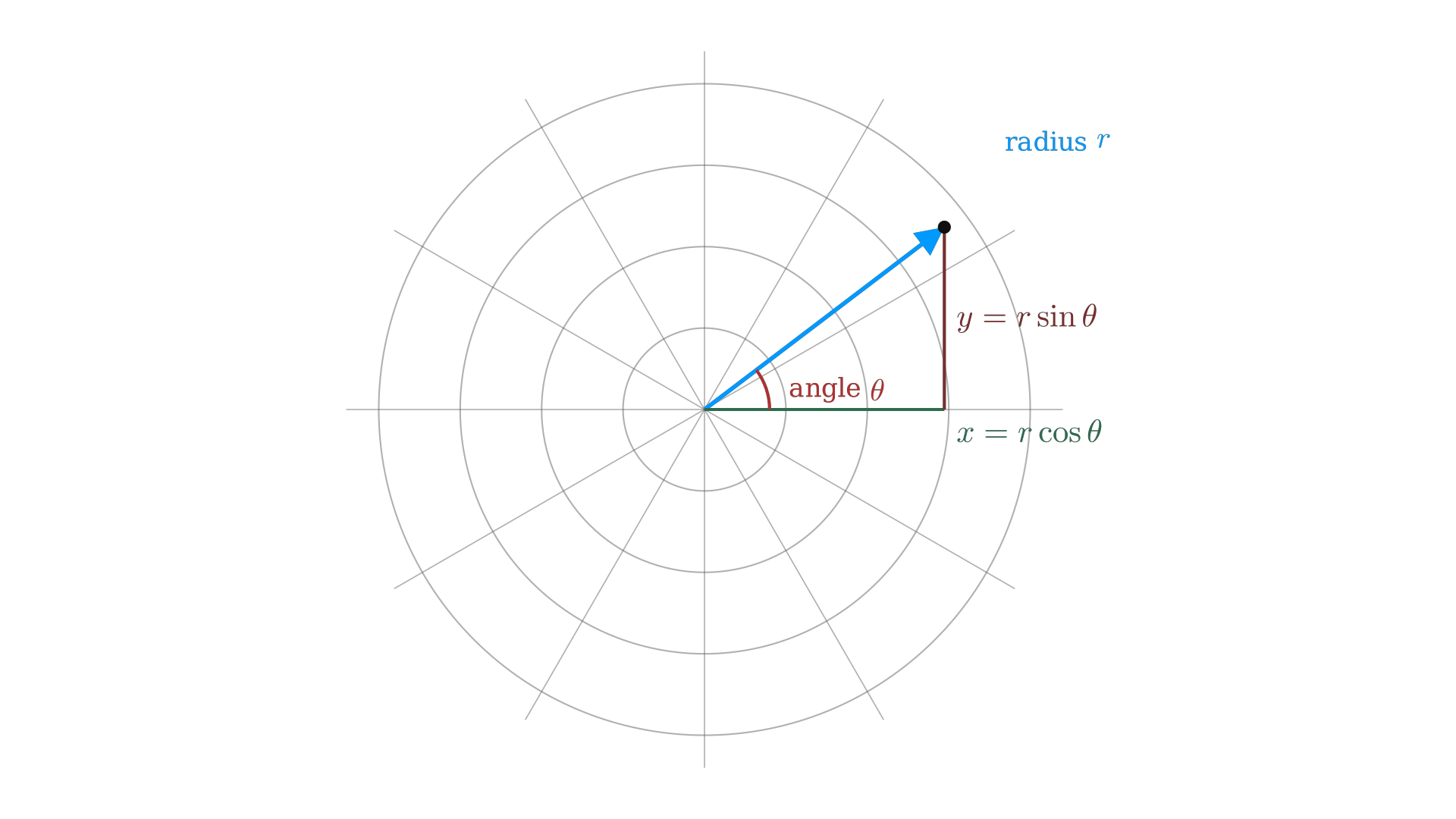
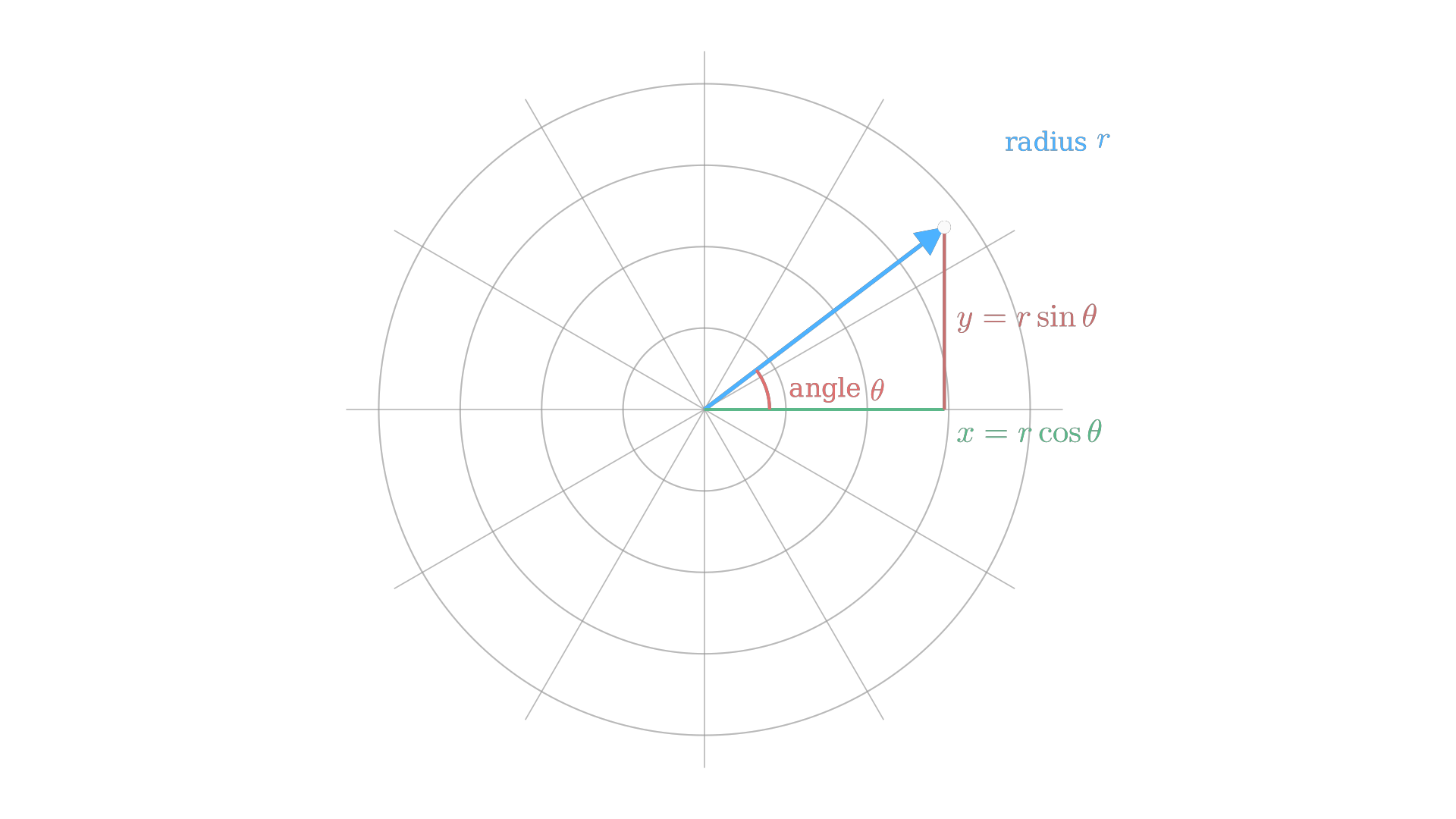
A polar grid with a point located by its radius r and angle theta, together with the conversion right triangle giving x = r cos(theta) and y = r sin(theta). / 极坐标网格上用半径 r 与角 theta 定位的点,以及给出 x = r cos(theta)、y = r sin(theta) 的转换直角三角形。 A polar grid with a point located by its radius r and angle theta, together with the conversion right triangle giving x = r cos(theta) and y = r sin(theta). / 极坐标网格上用半径 r 与角 theta 定位的点,以及给出 x = r cos(theta)、y = r sin(theta) 的转换直角三角形。
A polar grid with a point located by its radius r and angle theta, together with the conversion right triangle giving x = r cos(theta) and y = r sin(theta).极坐标网格上用半径 r 与角 theta 定位的点,以及给出 x = r cos(theta)、y = r sin(theta) 的转换直角三角形。

极坐标(polar coordinate)的定义与极坐标求导

Learning objectives学习目标
  • Convert between polar $(r, \theta)$ and rectangular $(x, y)$ coordinates.
  • Explain why a polar curve $r = f(\theta)$ is a parametric curve with parameter $\theta$.
  • Calculate $\frac{dy}{dx}$ for a polar curve using the product rule.
  • Interpret the sign of $\frac{dr}{d\theta}$ as the point moving toward or away from the pole.
  • Deduce the tangent line at the pole when $r(\theta_0) = 0$ and $r'(\theta_0) \neq 0$.
  • 在极坐标 $(r, \theta)$ 与直角坐标 $(x, y)$ 之间转换。
  • 解释为何极坐标曲线 $r = f(\theta)$ 是以 $\theta$ 为参数的参数曲线。
  • 用乘积法则(product rule)计算极坐标曲线的 $\frac{dy}{dx}$。
  • 把 $\frac{dr}{d\theta}$ 的符号解释为点在靠近还是远离极点(pole)。
  • 当 $r(\theta_0) = 0$ 且 $r'(\theta_0) \neq 0$ 时,推断极点处的切线。
Polar Coordinates极坐标 A point is described by $(r, \theta)$ where $r$ = directed distance from origin and $\theta$ = angle from positive x-axis. Convert to rectangular: $x = r\cos(\theta)$, $y = r\sin(\theta)$. 一个点用 $(r, \theta)$ 表示,其中 $r$ 是从极点(pole)出发的有向距离(极径,radius),$\theta$ 是从极轴(polar axis)量起的角度(极角,angle)。极坐标与直角坐标的转换:$x = r\cos(\theta)$,$y = r\sin(\theta)$。

A polar curve $r = f(\theta)$ is a special case of parametric equations where $\theta$ is the parameter:

极坐标曲线(polar curve)$r = f(\theta)$ 是参数方程的特殊情形,其中 $\theta$ 担任参数:

$x(\theta) = f(\theta)\cos(\theta)$

$y(\theta) = f(\theta)\sin(\theta)$

Derivative in Polar

极坐标下的导数

Slope of Polar Curve极坐标曲线的斜率
$$ \frac{dy}{dx} = \frac{\frac{dy}{d\theta}}{\frac{dx}{d\theta}} = \frac{f'(\theta)\sin(\theta) + f(\theta)\cos(\theta)}{f'(\theta)\cos(\theta) - f(\theta)\sin(\theta)} $$
Product Rule Required!必须用乘积法则! Because $x = r\cos(\theta)$ and $y = r\sin(\theta)$, you must use the product rule when differentiating with respect to $\theta$. Remember: $r$ is a function of $\theta$. 因为 $x = r\cos(\theta)$、$y = r\sin(\theta)$,对 $\theta$ 求导时必须使用乘积法则。记住:$r$ 是 $\theta$ 的函数。
Worked Example: Slope of a Polar Curve例题:极坐标曲线的斜率
Given已知 Find $dy/dx$ for $r=1+\sin\theta$ at $\theta=\pi/2$.求 $r=1+\sin\theta$ 在 $\theta=\pi/2$ 处的 $dy/dx$。
Set up列式 Write $x(\theta)$ and $y(\theta)$:先写出 $x(\theta)$ 与 $y(\theta)$: $$x=r\cos\theta=(1+\sin\theta)\cos\theta,\qquad y=r\sin\theta=(1+\sin\theta)\sin\theta$$
Differentiate求导 Use the product rule on each:分别用乘积法则求导: $$\frac{dx}{d\theta}=\cos\theta\cos\theta+(1+\sin\theta)(-\sin\theta)=\cos^2\theta-\sin\theta-\sin^2\theta$$ $$\frac{dy}{d\theta}=\cos\theta\sin\theta+(1+\sin\theta)\cos\theta=2\sin\theta\cos\theta+\cos\theta$$
Evaluate代入 At $\theta=\pi/2$ we have $\cos\theta=0$ and $\sin\theta=1$:代入 $\theta=\pi/2$($\cos\theta=0$,$\sin\theta=1$): $$\frac{dx}{d\theta}=0-1-1=-2,\qquad \frac{dy}{d\theta}=0+0=0$$
$\dfrac{dy}{dx}=\dfrac{0}{-2}=0$, a horizontal tangent at the top of the cardioid.$\dfrac{dy}{dx}=\dfrac{0}{-2}=0$,即心脏线顶点处的水平切线。
Tangent Lines at the Pole极点处的切线 When a polar curve passes through the pole, $r(\theta_0) = 0$ for some angle $\theta_0$, you do not need to grind through the full product-rule quotient at all. Since $x = r\cos\theta$ and $y = r\sin\theta$ both vanish when $r = 0$, the derivatives collapse to $\frac{dx}{d\theta} = r'(\theta_0)\cos\theta_0$ and $\frac{dy}{d\theta} = r'(\theta_0)\sin\theta_0$, so $r'(\theta_0)$ cancels straight out of the quotient. The tangent line at the pole is simply the ray $\theta = \theta_0$, with slope $\tan(\theta_0)$, provided $r'(\theta_0) \neq 0$ (if $r'(\theta_0)$ is also zero, this shortcut does not apply and the point needs separate treatment). 当极坐标曲线经过极点时,即某个角度 $\theta_0$ 处 $r(\theta_0) = 0$,其实完全不需要硬算完整的乘积法则商式。因为 $r = 0$ 时 $x = r\cos\theta$ 与 $y = r\sin\theta$ 都为零,导数会化简为 $\frac{dx}{d\theta} = r'(\theta_0)\cos\theta_0$ 与 $\frac{dy}{d\theta} = r'(\theta_0)\sin\theta_0$,于是 $r'(\theta_0)$ 直接从商式中约掉。极点处的切线就是射线 $\theta = \theta_0$,斜率为 $\tan(\theta_0)$,前提是 $r'(\theta_0) \neq 0$(如果 $r'(\theta_0)$ 也恰好为零,这个捷径就不适用了,该点需要单独处理)。
Worked Example: Tangent Line at the Pole例题:极点处的切线
Given已知 Find the tangent line to $r=\sin(2\theta)$ at the pole, for the petal that begins at $\theta=0$.求 $r=\sin(2\theta)$ 在极点处的切线,取从 $\theta=0$ 开始的花瓣。
Pole angle极点角 $r=0$ when $\sin(2\theta)=0$, so $\theta=0$ is a pole angle for this petal.当 $\sin(2\theta)=0$ 时 $r=0$,故此花瓣对应的极点角为 $\theta=0$。
Shortcut捷径 Since $r'(\theta)=2\cos(2\theta)$, we get $r'(0)=2\ne 0$, so the shortcut applies. The tangent line at the pole is $\theta=0$, with slope:由 $r'(\theta)=2\cos(2\theta)$ 得 $r'(0)=2\ne 0$,捷径可用。极点处切线为 $\theta=0$,斜率: $$\tan(0)=0$$
Verify验证 Verify with the full quotient, $x=\sin(2\theta)\cos\theta$, $y=\sin(2\theta)\sin\theta$:用完整商式验证,$x=\sin(2\theta)\cos\theta$,$y=\sin(2\theta)\sin\theta$: $$\frac{dx}{d\theta}=2\cos(2\theta)\cos\theta-\sin(2\theta)\sin\theta\ \Rightarrow\ 2(1)(1)-0=2$$ $$\frac{dy}{d\theta}=2\cos(2\theta)\sin\theta+\sin(2\theta)\cos\theta\ \Rightarrow\ 2(1)(0)+0(1)=0$$
$\dfrac{dy}{dx}=\dfrac02=0$, which matches the shortcut exactly.$\dfrac{dy}{dx}=\dfrac02=0$,与捷径结果完全一致。

The full quotient always agrees with the shortcut when $r'(\theta_0) \neq 0$, so on the exam it is faster and equally rigorous to jump straight to $\tan(\theta_0)$ once you have confirmed the curve actually reaches the pole at that angle.

只要 $r'(\theta_0) \neq 0$,完整商式的结果必然与捷径一致,所以在考试中,一旦确认曲线在该角度确实经过极点,直接跳到 $\tan(\theta_0)$ 既更快,也同样严谨。

Exam tip考试提示

Do not confuse $\frac{dr}{d\theta}$ with $\frac{dy}{dx}$. A question about the curve's slope or tangent line needs the full quotient $\frac{dy/d\theta}{dx/d\theta}$; a question about whether the point is moving toward or away from the origin needs the sign of $\frac{dr}{d\theta}$ together with the sign of $r$.

不要把 $\frac{dr}{d\theta}$ 与 $\frac{dy}{dx}$ 混淆。问曲线的斜率或切线时,需要完整商式 $\frac{dy/d\theta}{dx/d\theta}$;问点在靠近还是远离原点时,需要 $\frac{dr}{d\theta}$ 的符号,并结合 $r$ 的符号。

Check your understanding自我检测
Convert the polar point $(r, \theta) = \left(2, \frac{\pi}{3}\right)$ to rectangular coordinates.把极坐标点 $(r, \theta) = \left(2, \frac{\pi}{3}\right)$ 化为直角坐标。

$x = 2\cos\frac{\pi}{3} = 1$ and $y = 2\sin\frac{\pi}{3} = \sqrt3$, so the point is $(1, \sqrt3)$.

$x = 2\cos\frac{\pi}{3} = 1$,$y = 2\sin\frac{\pi}{3} = \sqrt3$,所以该点为 $(1, \sqrt3)$。

For $r = 3 - 2\sin\theta$ at $\theta = \frac{\pi}{6}$, is the point moving toward or away from the origin as $\theta$ increases?对 $r = 3 - 2\sin\theta$,在 $\theta = \frac{\pi}{6}$ 处,随着 $\theta$ 增大,点在靠近还是远离原点?

$r\left(\frac{\pi}{6}\right) = 3 - 1 = 2 > 0$ and $\frac{dr}{d\theta} = -2\cos\theta = -\sqrt3 < 0$. Since $r$ is positive and decreasing, the distance from the origin is decreasing: the point moves toward the origin.

$r\left(\frac{\pi}{6}\right) = 3 - 1 = 2 > 0$,$\frac{dr}{d\theta} = -2\cos\theta = -\sqrt3 < 0$。由于 $r$ 为正且在减小,到原点的距离在减小:点在靠近原点。

Find $\frac{dy}{dx}$ for $r = 2\cos\theta$ at $\theta = \frac{\pi}{4}$.求 $r = 2\cos\theta$ 在 $\theta = \frac{\pi}{4}$ 处的 $\frac{dy}{dx}$。

$x = 2\cos^2\theta$ and $y = 2\sin\theta\cos\theta = \sin(2\theta)$. Then $\frac{dx}{d\theta} = -2\sin(2\theta) = -2$ and $\frac{dy}{d\theta} = 2\cos(2\theta) = 0$ at $\theta = \frac{\pi}{4}$, so $\frac{dy}{dx} = 0$: a horizontal tangent at the top $(1, 1)$ of this circle.

$x = 2\cos^2\theta$,$y = 2\sin\theta\cos\theta = \sin(2\theta)$。于是 $\theta = \frac{\pi}{4}$ 时 $\frac{dx}{d\theta} = -2\sin(2\theta) = -2$,$\frac{dy}{d\theta} = 2\cos(2\theta) = 0$,所以 $\frac{dy}{dx} = 0$:在这个圆的最高点 $(1, 1)$ 处有水平切线。


Area of a Polar Region: Single Curve
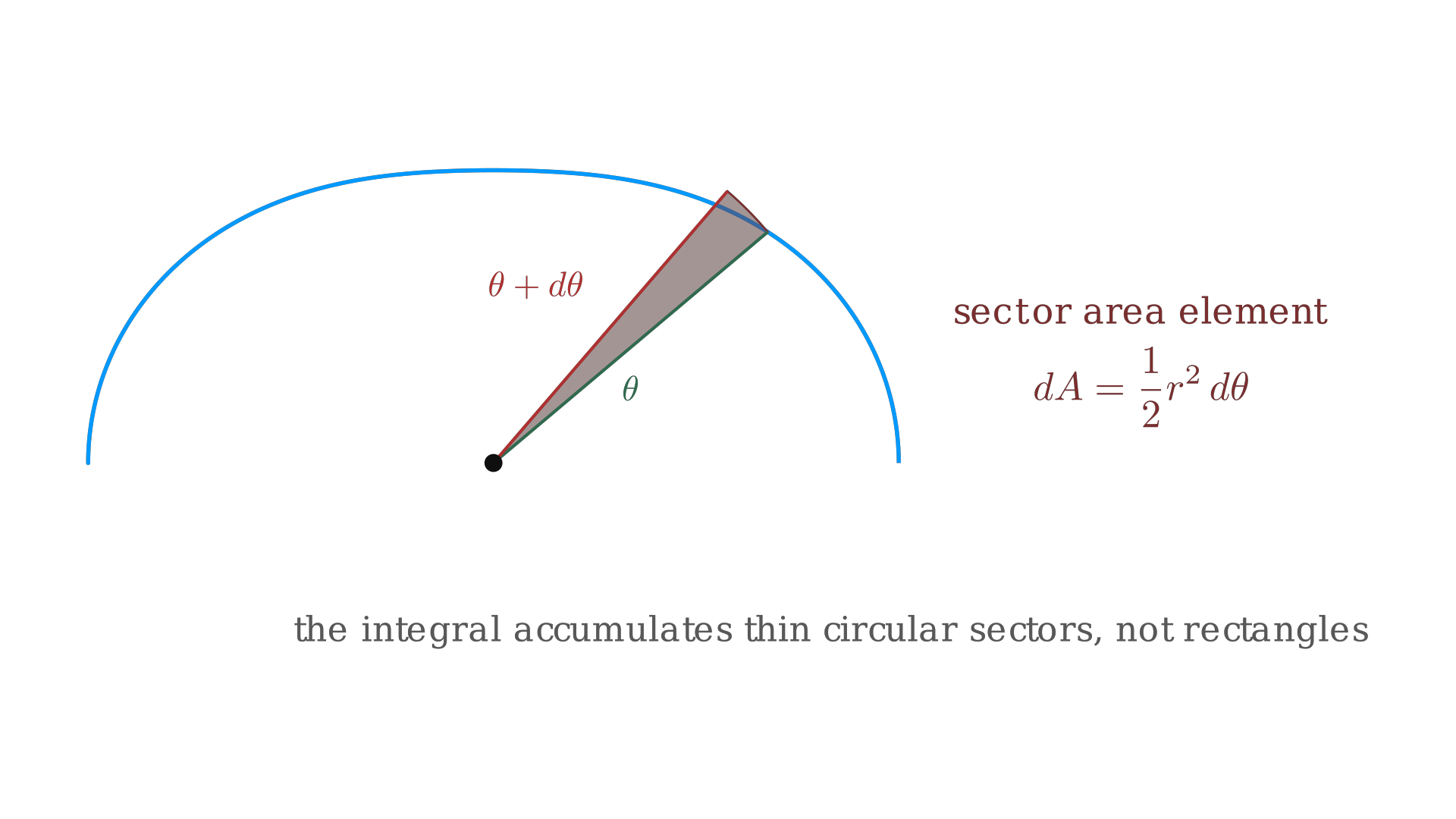
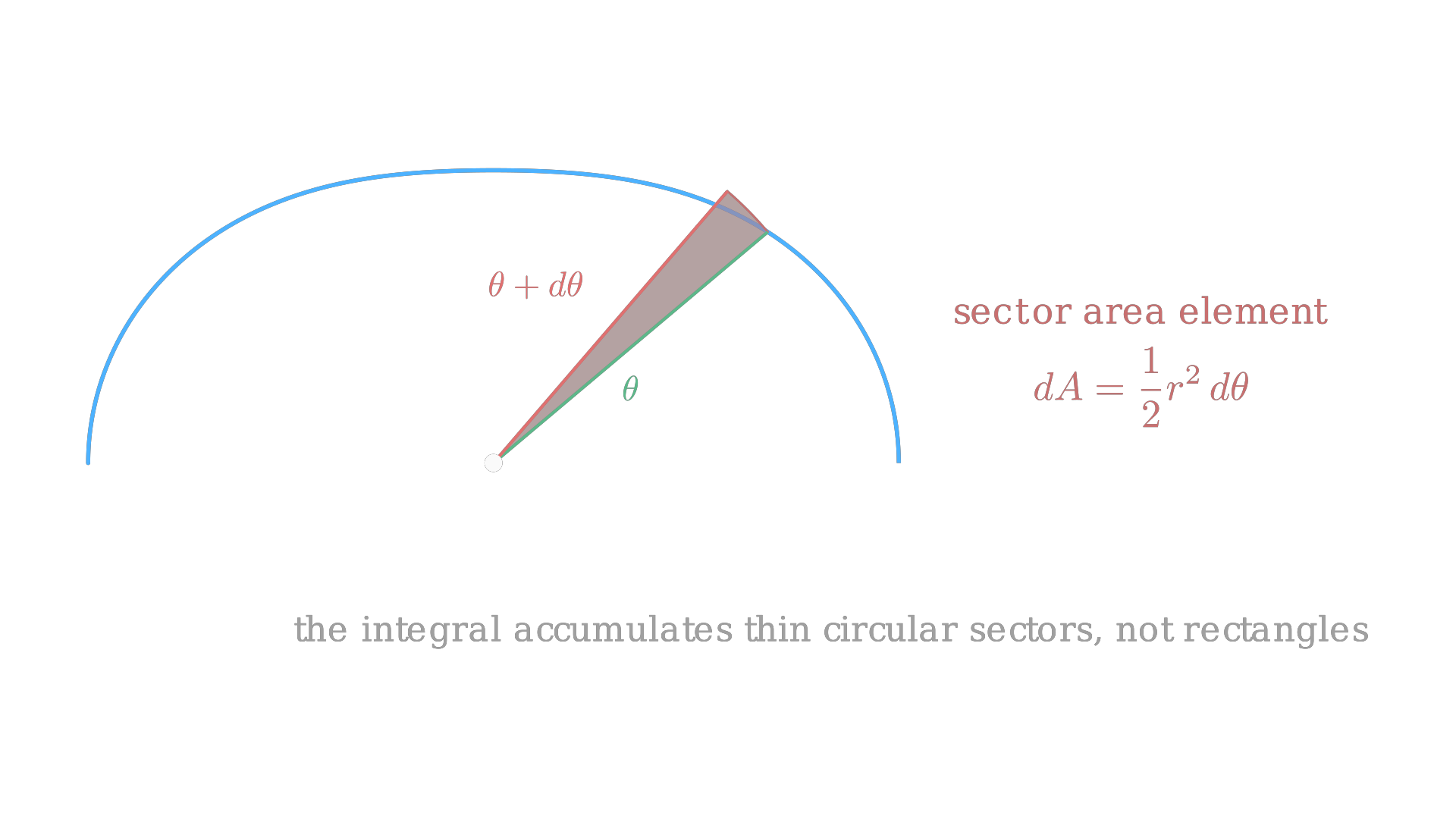
A polar curve with a thin sector element between theta and theta + dtheta, whose area (1/2) r^2 dtheta the integral accumulates. / 极坐标曲线上介于 theta 与 theta + dtheta 之间的细扇形元素,其面积 (1/2) r² dtheta 由积分累加。 A polar curve with a thin sector element between theta and theta + dtheta, whose area (1/2) r^2 dtheta the integral accumulates. / 极坐标曲线上介于 theta 与 theta + dtheta 之间的细扇形元素,其面积 (1/2) r² dtheta 由积分累加。
A polar curve with a thin sector element between theta and theta + dtheta, whose area (1/2) r^2 dtheta the integral accumulates.极坐标曲线上介于 theta 与 theta + dtheta 之间的细扇形元素,其面积 (1/2) r² dtheta 由积分累加。

极坐标区域的面积:单曲线

Learning objectives学习目标
  • State the polar area formula $A = \frac12\int_{\alpha}^{\beta} r^2\,d\theta$ and explain it from the area of a thin sector.
  • Deduce limits $\alpha$ and $\beta$ that sweep a region exactly once, often from consecutive zeros of $r$.
  • Calculate polar areas exactly using $\cos^2 u = \frac{1 + \cos 2u}{2}$ and $\sin^2 u = \frac{1 - \cos 2u}{2}$.
  • Use symmetry to compute one piece of a region and multiply.
  • Calculate polar areas numerically with a calculator when no exact antiderivative is practical.
  • 写出极坐标面积公式 $A = \frac12\int_{\alpha}^{\beta} r^2\,d\theta$,并用细扇形(sector)面积解释它。
  • 推断恰好扫过区域一次的积分限 $\alpha$ 与 $\beta$,通常取 $r$ 的相邻零点。
  • 用 $\cos^2 u = \frac{1 + \cos 2u}{2}$ 与 $\sin^2 u = \frac{1 - \cos 2u}{2}$ 精确计算极坐标面积。
  • 利用对称性(symmetry)先算区域的一部分再乘倍数。
  • 在精确原函数不便求出时,用计算器数值计算极坐标面积。
Polar Area Formula极坐标面积公式
$$ A = \frac{1}{2} \int_{\alpha}^{\beta} [r(\theta)]^2 d\theta $$
Where It Comes From公式由来 The area of a thin circular sector with radius $r$ and angle $d\theta$ is $\frac{1}{2}r^2 d\theta$. Integrating these sectors from $\theta = \alpha$ to $\theta = \beta$ gives total area. 半径为 $r$、角度为 $d\theta$ 的薄圆扇形的面积是 $\frac{1}{2}r^2 d\theta$。把这些扇形从 $\theta = \alpha$ 到 $\theta = \beta$ 积分,就得到极坐标曲线所围面积。
Common Exam Traps常见考试陷阱 1. Forgetting the $\frac{1}{2}$ in front of the integral. 1. 忘记积分前的 $\frac{1}{2}$。 2. Forgetting to square $r$: the integrand is $[r(\theta)]^2$. 2. 忘记把 $r$ 平方:被积函数是 $[r(\theta)]^2$。 3. Using wrong limits: sketch the curve first to identify bounds! 3. 积分上下限写错:先画出极坐标曲线再确定边界!
AP Trap: Bounds Must Sweep the Region Exactly OnceAP 陷阱:积分上下限必须恰好扫过区域一次 For the circle $r=2\sin\theta$, the area is $\tfrac12\int_0^{\pi}(2\sin\theta)^2\,d\theta=\pi$. Using $0$ to $2\pi$ traces the circle twice (for $\pi<\theta<2\pi$, $r$ is negative and the same points are covered again) and gives $2\pi$. Always find the $\theta$-interval where the curve is traced once, usually between consecutive zeros of $r$. 对圆 $r=2\sin\theta$,面积为 $\tfrac12\int_0^{\pi}(2\sin\theta)^2\,d\theta=\pi$。若取 $0$ 到 $2\pi$,圆会被描两次($\pi<\theta<2\pi$ 时 $r$ 为负,覆盖的是同样的点),得到 $2\pi$。务必先找出曲线只被描一次的 $\theta$ 区间,通常取 $r$ 相邻两个零点之间。
Worked Example: Area of One Petal of $r = \cos(2\theta)$例题:求 $r = \cos(2\theta)$ 一个花瓣的面积
Given已知 $r=\cos(2\theta)$ is a rose with 4 petals. One petal runs from $\theta=-\pi/4$ to $\theta=\pi/4$ (where $r\ge 0$).$r=\cos(2\theta)$ 是一个 4 瓣玫瑰线。一个花瓣:$\theta$ 从 $-\pi/4$ 到 $\pi/4$(此时 $r\ge 0$)。
Set up列式 $$A=\frac12\int_{-\pi/4}^{\pi/4}\left[\cos(2\theta)\right]^2d\theta$$
Identity恒等式 Use $\cos^2u=\dfrac{1+\cos 2u}{2}$:用恒等式 $\cos^2u=\dfrac{1+\cos 2u}{2}$: $$A=\frac12\int_{-\pi/4}^{\pi/4}\frac{1+\cos(4\theta)}{2}\,d\theta=\frac14\left[\theta+\frac{\sin(4\theta)}{4}\right]_{-\pi/4}^{\pi/4}$$
$A=\dfrac14\left[\left(\dfrac{\pi}{4}+0\right)-\left(-\dfrac{\pi}{4}+0\right)\right]=\dfrac14\cdot\dfrac{\pi}{2}=\dfrac{\pi}{8}$$A=\dfrac14\left[\left(\dfrac{\pi}{4}+0\right)-\left(-\dfrac{\pi}{4}+0\right)\right]=\dfrac14\cdot\dfrac{\pi}{2}=\dfrac{\pi}{8}$
11 OO θ = 0, r = 2θ = 0,r = 2 θ = π/2, r = 1θ = π/2,r = 1 A = 3π/8 + 1 ≈ 2.18A = 3π/8 + 1 ≈ 2.18 r = 1 + cos θr = 1 + cos θ
Figure 2. The cardioid r = 1 + cos θ drawn to scale (the tick on the horizontal axis is at distance 1 from the pole O). As θ runs from 0 to π/2 the radius shrinks from r = 2 to r = 1 and sweeps the shaded region, whose area is ½∫ r² dθ over 0 ≤ θ ≤ π/2 = 3π/8 + 1 ≈ 2.18 (worked example below). The whole cardioid, 0 ≤ θ ≤ 2π, has area 3π/2.图 2. 按比例绘制的心脏线(cardioid)r = 1 + cos θ(水平轴上的刻度到极点 O 的距离为 1)。当 θ 从 0 变到 π/2 时,极径从 r = 2 缩短到 r = 1,扫出阴影区域,其面积为 0 ≤ θ ≤ π/2 上的 ½∫ r² dθ = 3π/8 + 1 ≈ 2.18(见下方例题)。整条心脏线(0 ≤ θ ≤ 2π)的面积为 3π/2。
Worked Example: Area Swept by a Cardioid over a Quarter Turn例题:心脏线在四分之一圈内扫过的面积
Given已知 Find the area of the region swept by $r = 1 + \cos\theta$ for $0 \le \theta \le \frac{\pi}{2}$ (the shaded region in Figure 2).求 $r = 1 + \cos\theta$ 在 $0 \le \theta \le \frac{\pi}{2}$ 上扫过的区域面积(图 2 中的阴影区域)。
Set up列式 $$A=\frac12\int_0^{\pi/2}(1+\cos\theta)^2\,d\theta$$
Expand展开 Square, then use $\cos^2\theta = \frac{1+\cos 2\theta}{2}$:先平方,再用 $\cos^2\theta = \frac{1+\cos 2\theta}{2}$: $$(1+\cos\theta)^2=1+2\cos\theta+\cos^2\theta=\frac32+2\cos\theta+\frac12\cos 2\theta$$
Integrate积分 $$A=\frac12\left[\frac32\theta+2\sin\theta+\frac14\sin 2\theta\right]_0^{\pi/2}=\frac12\left(\frac{3\pi}{4}+2+0\right)$$
$A = \frac{3\pi}{8} + 1 \approx 2.178$$A = \frac{3\pi}{8} + 1 \approx 2.178$

Why this works: each thin sector between $\theta$ and $\theta + d\theta$ has area $\frac12 r^2\,d\theta$, and the integral adds them from $\theta = 0$ to $\theta = \frac{\pi}{2}$. Check: the whole cardioid has area $\frac{3\pi}{2} \approx 4.712$, and this quarter turn holds the widest part of it, so $2.178$ (about $46\%$) is reasonable.

原理:$\theta$ 与 $\theta + d\theta$ 之间的每个细扇形面积为 $\frac12 r^2\,d\theta$,积分把它们从 $\theta = 0$ 累加到 $\theta = \frac{\pi}{2}$。检验:整条心脏线的面积为 $\frac{3\pi}{2} \approx 4.712$,而这四分之一圈包含了它最宽的部分,所以 $2.178$(约 $46\%$)是合理的。

What is the area enclosed by the polar curve $r = 3$ from $\theta = 0$ to $\theta = 2\pi$?极坐标曲线 $r = 3$ 在 $\theta = 0$ 到 $\theta = 2\pi$ 所围的面积是多少?
$9\pi$
$3\pi$
$6\pi$
$18\pi$
Correct! $A = \frac{1}{2} \int_{0}^{2\pi} (3)^2 d\theta = \frac{1}{2}(9)(2\pi) = 9\pi$. Makes sense, as it's a circle of radius $3$ ($\pi r^2 = 9\pi$).正确!$A = \frac{1}{2} \int_{0}^{2\pi} (3)^2 d\theta = \frac{1}{2}(9)(2\pi) = 9\pi$。这正是半径为 $3$ 的圆的面积($\pi r^2 = 9\pi$)。
$A = \frac{1}{2} \int_{0}^{2\pi} r^2 d\theta = \frac{1}{2} \int_{0}^{2\pi} 9 d\theta = \frac{1}{2}(9)(2\pi) = 9\pi$. Remember the $\frac{1}{2}$ and to square $r$!$A = \frac{1}{2} \int_{0}^{2\pi} r^2 d\theta = \frac{1}{2} \int_{0}^{2\pi} 9 d\theta = \frac{1}{2}(9)(2\pi) = 9\pi$。别忘了那个 $\frac{1}{2}$,也别忘了把 $r$ 平方!
Interactive Polar Area Visualizer极坐标面积交互演示

See the shaded area swept out by $r = 1 + \cos(\theta)$ (cardioid) as $\beta$ increases. The area accumulates as $\frac{1}{2}\int_0^{\beta} r^2\,d\theta$.

观察心脏线 $r = 1 + \cos(\theta)$ 随 $\beta$ 增大所扫出的阴影面积。累计面积按 $\frac{1}{2}\int_0^{\beta} r^2\,d\theta$ 增长。

β = π
Area so far:当前面积: 0   Full area ($0$ to $2\pi$):完整面积($0$ 到 $2\pi$): 3π/2 ≈ 4.712
Exam tip考试提示

Write the $\frac12$, the square and the limits in the integral before simplifying: $\frac12\int_{\alpha}^{\beta} (r(\theta))^2\,d\theta$. Then check the limits by tracing the curve: if $r$ turns negative inside $[\alpha, \beta]$, the integral is also counting points on the opposite side of the pole.

化简之前先在积分里写出 $\frac12$、平方与积分限:$\frac12\int_{\alpha}^{\beta} (r(\theta))^2\,d\theta$。然后沿曲线描一遍来检查积分限:若 $r$ 在 $[\alpha, \beta]$ 内变为负数,积分也在计入极点另一侧的点。

Check your understanding自我检测
Where do the $\frac12$ and the square in $\frac12\int r^2\,d\theta$ come from?$\frac12\int r^2\,d\theta$ 中的 $\frac12$ 与平方从何而来?

A circular sector of radius $r$ and angle $d\theta$ has area $\frac12 r^2\,d\theta$ (a fraction $\frac{d\theta}{2\pi}$ of $\pi r^2$). The integral adds these thin sectors.

半径为 $r$、圆心角为 $d\theta$ 的扇形面积为 $\frac12 r^2\,d\theta$(即 $\pi r^2$ 的 $\frac{d\theta}{2\pi}$)。积分把这些细扇形累加起来。

Find the area enclosed by $r = 4\cos\theta$.求 $r = 4\cos\theta$ 所围的面积。

The circle is traced once for $-\frac{\pi}{2} \le \theta \le \frac{\pi}{2}$. $A = \frac12\int_{-\pi/2}^{\pi/2} 16\cos^2\theta\,d\theta = 8 \cdot \frac{\pi}{2} = 4\pi$, matching a circle of radius $2$.

当 $-\frac{\pi}{2} \le \theta \le \frac{\pi}{2}$ 时圆恰好被描一次。$A = \frac12\int_{-\pi/2}^{\pi/2} 16\cos^2\theta\,d\theta = 8 \cdot \frac{\pi}{2} = 4\pi$,与半径为 $2$ 的圆一致。

Find the area of the upper half of the cardioid $r = 1 + \cos\theta$, $0 \le \theta \le \pi$.求心脏线 $r = 1 + \cos\theta$ 上半部分($0 \le \theta \le \pi$)的面积。

$A = \frac12\int_0^{\pi}\left(\frac32 + 2\cos\theta + \frac12\cos 2\theta\right)d\theta = \frac12 \cdot \frac{3\pi}{2} = \frac{3\pi}{4} \approx 2.356$, half of the full area $\frac{3\pi}{2}$.

$A = \frac12\int_0^{\pi}\left(\frac32 + 2\cos\theta + \frac12\cos 2\theta\right)d\theta = \frac12 \cdot \frac{3\pi}{2} = \frac{3\pi}{4} \approx 2.356$,是全部面积 $\frac{3\pi}{2}$ 的一半。


Area Between Two Polar Curves
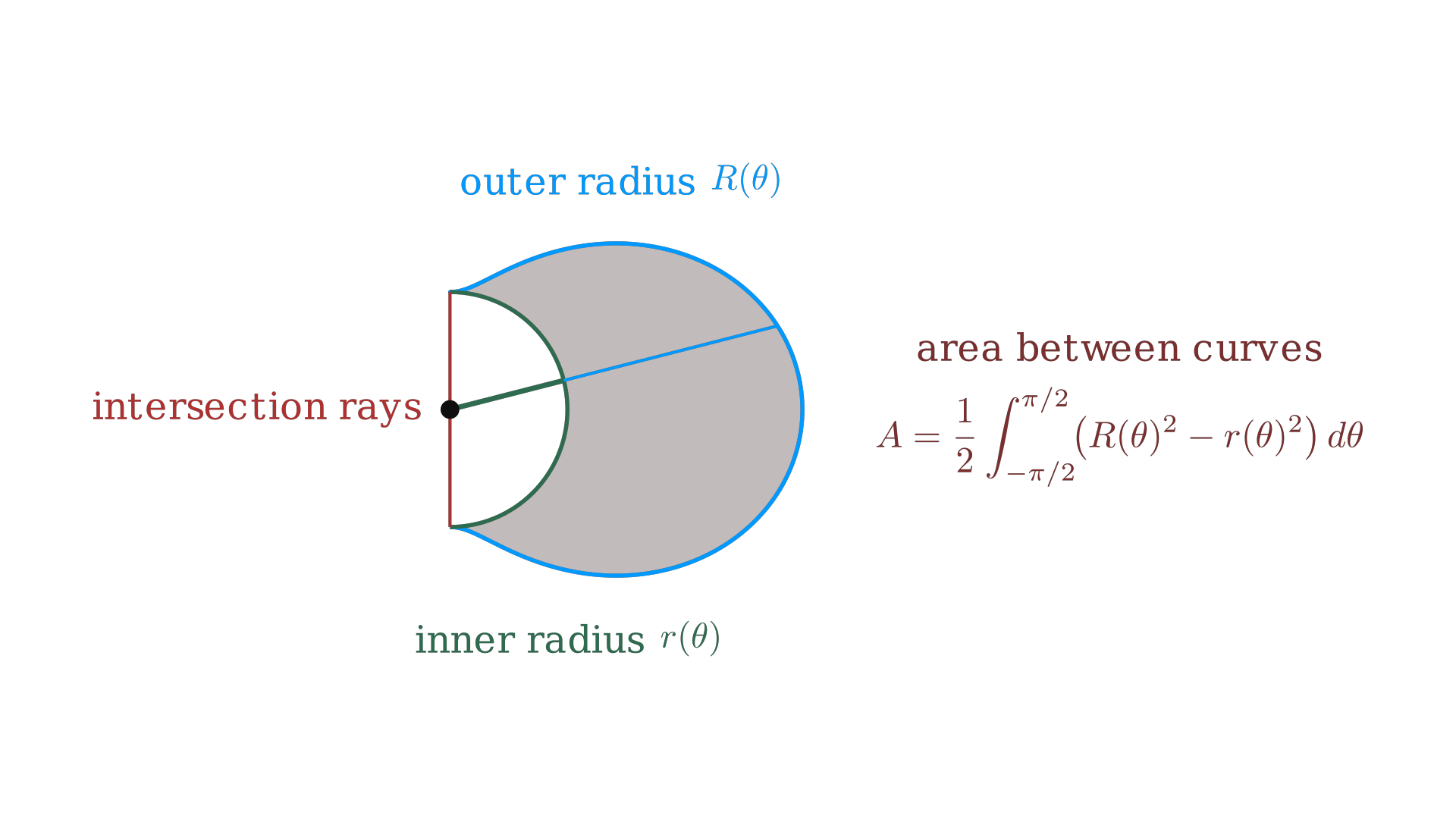
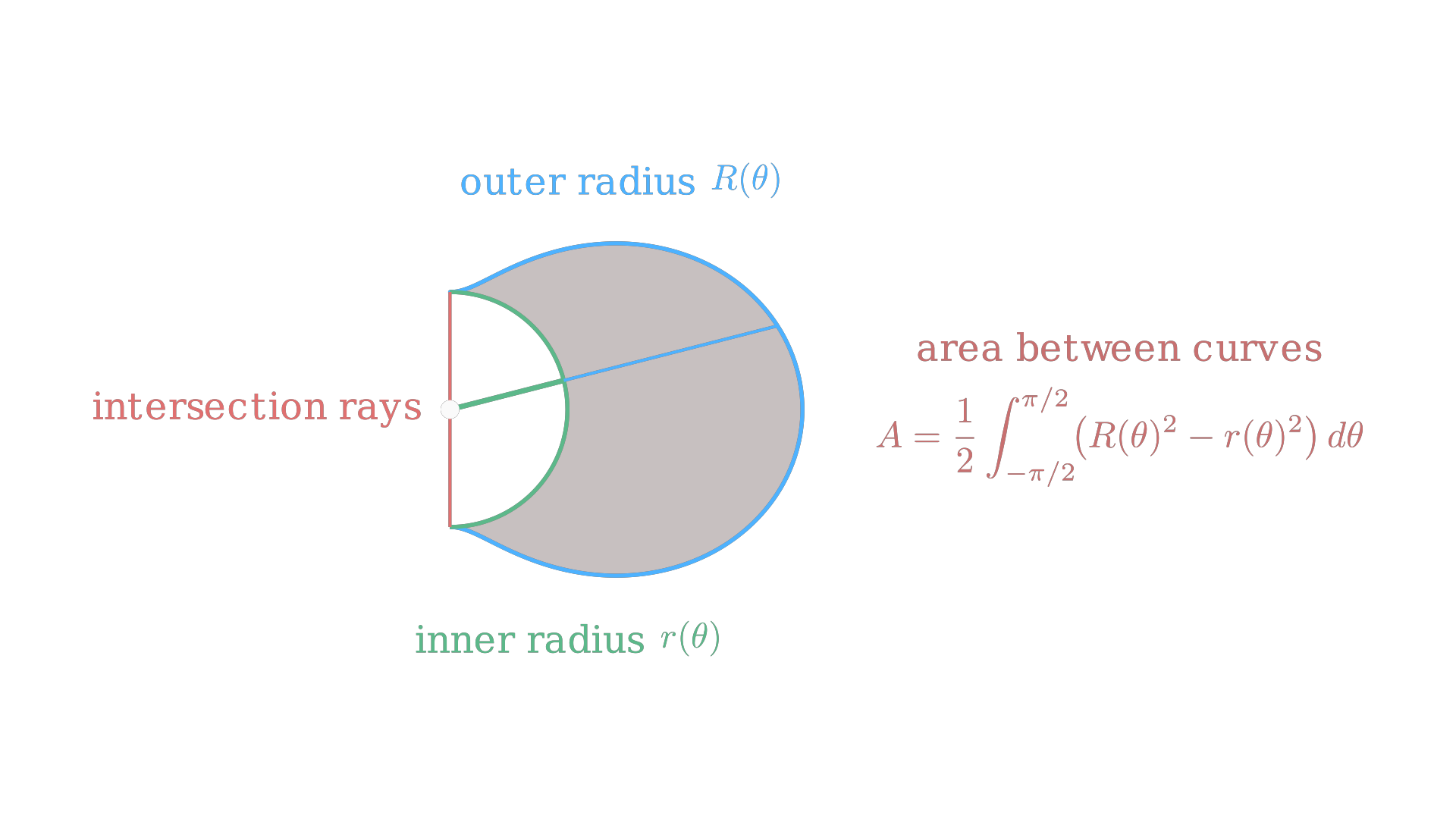
Two polar curves with the rays at their intersection angles, the enclosed region shaded and the outer/inner radii identified on each angular piece. / 两条极坐标曲线及其交点射线,封闭区域填色,并在每段角度区间上标出外半径与内半径。 Two polar curves with the rays at their intersection angles, the enclosed region shaded and the outer/inner radii identified on each angular piece. / 两条极坐标曲线及其交点射线,封闭区域填色,并在每段角度区间上标出外半径与内半径。
Two polar curves with the rays at their intersection angles, the enclosed region shaded and the outer/inner radii identified on each angular piece.两条极坐标曲线及其交点射线,封闭区域填色,并在每段角度区间上标出外半径与内半径。

两条极坐标曲线之间的面积

Learning objectives学习目标
  • State the formula $A = \frac12\int_{\alpha}^{\beta} \left(r_{\text{outer}}^2 - r_{\text{inner}}^2\right)d\theta$.
  • Calculate intersection angles by solving $r_1(\theta) = r_2(\theta)$.
  • Check separately whether both curves pass through the pole.
  • Deduce which curve is outer on each $\theta$-interval by testing an angle inside it.
  • Explain why the squares are subtracted inside the integral, not $(r_{\text{outer}} - r_{\text{inner}})^2$.
  • 写出公式 $A = \frac12\int_{\alpha}^{\beta} \left(r_{\text{outer}}^2 - r_{\text{inner}}^2\right)d\theta$。
  • 解 $r_1(\theta) = r_2(\theta)$ 求出交点角(intersection)。
  • 单独检查两条曲线是否都经过极点。
  • 在每个 $\theta$ 区间内取一个角检验,推断哪条曲线在外。
  • 解释为何在积分内相减的是两个平方,而不是 $(r_{\text{outer}} - r_{\text{inner}})^2$。
Area Between Polar Curves两极坐标曲线之间的面积
$$ A = \frac{1}{2} \int_{\alpha}^{\beta} \left( [r_{\text{outer}}(\theta)]^2 - [r_{\text{inner}}(\theta)]^2 \right) d\theta $$
Key Steps关键步骤 1. Sketch both curves to identify which is outer vs inner. 1. 画出两条曲线,分辨外曲线与内曲线。 2. Find intersection points by setting $r_1 = r_2$ (these determine $\alpha$ and $\beta$). 2. 解 $r_1 = r_2$ 找出交点(这些点确定 $\alpha$ 与 $\beta$)。 3. Apply the formula: subtract squares inside the integral, not outside. 3. 代公式:把两个平方放到积分内部相减,不要在积分外面相减。
Worked Example: Area Inside One Curve and Outside Another例题:一条曲线内、另一条曲线外的面积
Given已知 Find the area inside $r=2$ and outside $r=2-2\sin\theta$.求 $r=2$ 内部、$r=2-2\sin\theta$ 外部的面积。
Step 1第 1 步 Find intersections by setting the curves equal:令两曲线相等,求交点: $$2=2-2\sin\theta\ \Rightarrow\ \sin\theta=0\ \Rightarrow\ \theta=0,\ \pi$$
Step 2第 2 步 On this interval, check which curve is outer. At $\theta=\pi/2$: $r=2-2\sin(\pi/2)=0$, so $r=2$ (the circle) is outer.在该区间上检查哪条曲线在外。当 $\theta=\pi/2$ 时:$r=2-2\sin(\pi/2)=0$,所以 $r=2$(圆)在外。
Step 3第 3 步 Apply outer$^2-$inner$^2$ over the interval where $r=2$ is outer ($0$ to $\pi$):在 $r=2$ 为外曲线的区间($0$ 到 $\pi$)上代入“外$^2-$内$^2$”: $$A=\frac12\int_0^{\pi}\left[2^2-(2-2\sin\theta)^2\right]d\theta$$ Expand $(2-2\sin\theta)^2=4-8\sin\theta+4\sin^2\theta$:展开 $(2-2\sin\theta)^2=4-8\sin\theta+4\sin^2\theta$: $$A=\frac12\int_0^{\pi}\left[8\sin\theta-4\sin^2\theta\right]d\theta$$
Step 4第 4 步 Integrate, using $\sin^2\theta=\dfrac{1-\cos 2\theta}{2}$:用 $\sin^2\theta=\dfrac{1-\cos 2\theta}{2}$ 积分: $$A=\frac12\left[-8\cos\theta-2\theta+\sin 2\theta\right]_0^{\pi}=\frac12\left(16-2\pi\right)$$
$A=8-\pi$$A=8-\pi$
Intersections at the Pole Can Hide极点处的交点容易被漏掉 Setting $r_1(\theta) = r_2(\theta)$ and solving finds every point where the two curves cross at the same angle $\theta$. It misses any point where both curves pass through the pole, $r = 0$, but at different angles, because the pole is a single point no matter which $\theta$ gets you there. Before trusting the intersections from $r_1 = r_2$, always check separately whether $r_1(\theta) = 0$ and $r_2(\theta) = 0$ each have a solution; if both do, the pole itself is an extra intersection point that the algebra alone will never reveal. 解 $r_1(\theta) = r_2(\theta)$ 只能找出两条曲线在同一个角度 $\theta$ 处相交的点,却会漏掉两条曲线各自在不同角度经过极点($r=0$)的情形,因为极点是同一个点,无论是哪个 $\theta$ 到达那里。在信任 $r_1 = r_2$ 给出的交点之前,务必单独检查 $r_1(\theta) = 0$ 与 $r_2(\theta) = 0$ 是否各自有解;如果两者都有解,极点本身就是一个额外的交点,而这一点单靠代数是永远发现不了的。
Worked Example: Finding the Hidden Intersection at the Pole例题:找出隐藏在极点处的交点
Given已知 Curves $r_1=2\cos\theta$ and $r_2=2\sin\theta$: two circles of radius 1, one centered on the $x$-axis and one on the $y$-axis, both through the origin. Find every intersection point.曲线 $r_1=2\cos\theta$,$r_2=2\sin\theta$:两个半径为 1 的圆,一个圆心在 $x$ 轴上,一个在 $y$ 轴上,都经过原点。求所有交点。
Step 1第 1 步 Set the expressions equal:令两表达式相等: $$2\cos\theta=2\sin\theta\ \Rightarrow\ \tan\theta=1\ \Rightarrow\ \theta=\frac{\pi}{4}\quad(\text{in }[0,2\pi))$$ At $\theta=\pi/4$: $r=2\cos(\pi/4)=\sqrt2$.$\theta=\pi/4$ 时:$r=2\cos(\pi/4)=\sqrt2$。
Step 2第 2 步 Check the pole separately; do not skip this:单独检查极点,这一步不能省略: $$r_1=2\cos\theta=0\ \text{at}\ \theta=\frac{\pi}{2},\qquad r_2=2\sin\theta=0\ \text{at}\ \theta=0$$ Both curves reach $r=0$, just at different $\theta$ values, so the pole IS a shared point, even though $\theta=\pi/2$ and $\theta=0$ never solve $r_1=r_2$.两条曲线都能达到 $r=0$,只是 $\theta$ 值不同,所以极点确实是两条曲线的公共点,即使 $\theta=\pi/2$ 与 $\theta=0$ 从未同时满足 $r_1=r_2$。
Conclusion: TWO intersection points in total, $\left(\sqrt2,\ \pi/4\right)$ found algebraically, and the pole, found by the separate check.结论:共有两个交点,$\left(\sqrt2,\ \pi/4\right)$ 由代数求出;以及极点,由单独检查求出。

A student who only solves $r_1 = r_2$ finds one of the two intersections and would then set up an area-between-curves integral with the wrong bounds, since the missing pole intersection is often exactly where the "outer" and "inner" curve swap roles.

如果只解 $r_1 = r_2$,就只能找到两个交点中的一个,接下来列出的两曲线间面积积分很可能用错边界,因为遗漏的这个极点交点往往正是"外曲线"与"内曲线"互换角色的位置。

Exam tip考试提示

Show the intersection work and the outer/inner test before the integral, for example "$2\cos\theta = 1$ at $\theta = \pm\frac{\pi}{3}$; at $\theta = 0$, $2 > 1$ so $r = 2\cos\theta$ is outer." If the outer curve changes partway, split the integral at that angle.

在写积分之前先写出求交点和判断内外的过程,例如"$2\cos\theta = 1$ 得 $\theta = \pm\frac{\pi}{3}$;$\theta = 0$ 时 $2 > 1$,所以 $r = 2\cos\theta$ 在外"。如果外曲线在中途改变,就在该角度处把积分拆开。

Check your understanding自我检测
Why is the integrand $r_{\text{outer}}^2 - r_{\text{inner}}^2$ and not $(r_{\text{outer}} - r_{\text{inner}})^2$?为什么被积函数是 $r_{\text{outer}}^2 - r_{\text{inner}}^2$ 而不是 $(r_{\text{outer}} - r_{\text{inner}})^2$?

The region is the big sector minus the small sector at each angle: $\frac12 r_{\text{outer}}^2\,d\theta - \frac12 r_{\text{inner}}^2\,d\theta$. Squaring the difference would be the area of a sector of radius $r_{\text{outer}} - r_{\text{inner}}$, which is a different, smaller shape.

在每个角度上,区域是大扇形减去小扇形:$\frac12 r_{\text{outer}}^2\,d\theta - \frac12 r_{\text{inner}}^2\,d\theta$。把差平方得到的是半径为 $r_{\text{outer}} - r_{\text{inner}}$ 的扇形面积,那是另一个更小的图形。

Find the angles $\theta$ in $[-\pi, \pi)$ where $r = 2\cos\theta$ and $r = 1$ intersect.求 $r = 2\cos\theta$ 与 $r = 1$ 在 $[-\pi, \pi)$ 内相交的角 $\theta$。

$2\cos\theta = 1$ gives $\cos\theta = \frac12$, so $\theta = \pm\frac{\pi}{3}$. The circle $r = 1$ never reaches the pole, so there is no extra intersection there.

$2\cos\theta = 1$ 得 $\cos\theta = \frac12$,所以 $\theta = \pm\frac{\pi}{3}$。圆 $r = 1$ 不经过极点,所以那里没有额外的交点。

Find the area inside $r = 2\cos\theta$ and outside $r = 1$.求 $r = 2\cos\theta$ 内部、$r = 1$ 外部的面积。

$A = \frac12\int_{-\pi/3}^{\pi/3}\left(4\cos^2\theta - 1\right)d\theta = \frac12\int_{-\pi/3}^{\pi/3}\left(1 + 2\cos 2\theta\right)d\theta = \frac12\left[\theta + \sin 2\theta\right]_{-\pi/3}^{\pi/3} = \frac{\pi}{3} + \frac{\sqrt3}{2} \approx 1.913$.

$A = \frac12\int_{-\pi/3}^{\pi/3}\left(4\cos^2\theta - 1\right)d\theta = \frac12\int_{-\pi/3}^{\pi/3}\left(1 + 2\cos 2\theta\right)d\theta = \frac12\left[\theta + \sin 2\theta\right]_{-\pi/3}^{\pi/3} = \frac{\pi}{3} + \frac{\sqrt3}{2} \approx 1.913$。


Exam Strategy for Unit 9

单元 9 考试策略

MC
Multiple Choice: Question Types to Practise选择题:需要练习的题型

Find $\frac{dy}{dx}$ for a parametric curve at a specific t-value.

在指定的 t 值处求 $\frac{dy}{dx}$(参数曲线)。

Set up an arc length or polar area integral, with or without evaluating it.

列出弧长或极坐标面积的积分(有时需要求值,有时只需列式)。

Determine speed, velocity, or acceleration from vector components.

由向量分量求速率、速度或加速度。

Identify horizontal/vertical tangents on parametric curves.

判断参数曲线上的水平切线或垂直切线。

FR
Free Response: Question Types to Practise自由作答题:需要练习的题型

Particle in the plane: Given velocity components, find position, speed, total distance, or acceleration. Finding position usually means solving an initial value problem.

平面内的质点:给出速度分量,求位置、速率、总路程或加速度。求位置通常就是解一个初值问题。

Polar area: Set up and evaluate area integrals, for example between two curves or for one petal of a rose.

极坐标面积:列出并计算面积积分,例如两条曲线之间的面积,或玫瑰线一个花瓣的面积。

Top Mistakes to Avoid最常见的错误 1. Computing $\frac{d^2y}{dx^2}$ by dividing $\frac{d^2y}{dt^2}$ by $\frac{d^2x}{dt^2}$. 1. 用 $\frac{d^2y}{dt^2}$ 除以 $\frac{d^2x}{dt^2}$ 来算 $\frac{d^2y}{dx^2}$。 2. Forgetting the $\frac{1}{2}$ or the square in polar area integrals. 2. 极坐标面积积分里忘掉 $\frac{1}{2}$ 或忘记把 $r$ 平方。 3. Confusing displacement (vector) with distance traveled (scalar integral of speed). 3. 把位移(向量)与路程(速率的标量积分)弄混。 4. Forgetting initial conditions $+C$ in vector IVPs. 4. 在向量初值问题里忘记加初始条件给出的 $+C$。

Flashcards: Click to Flip

闪卡:点击翻面

First derivative $\frac{dy}{dx}$ for parametric curves?参数曲线的一阶导数 $\frac{dy}{dx}$?

$$ \frac{\frac{dy}{dt}}{\frac{dx}{dt}} $$
provided $\frac{dx}{dt} \neq 0$前提 $\frac{dx}{dt} \neq 0$
Second derivative $\frac{d^2y}{dx^2}$ for parametric curves?参数曲线的二阶导数 $\frac{d^2y}{dx^2}$?

$$ \frac{\frac{d}{dt}\left(\frac{dy}{dx}\right)}{\frac{dx}{dt}} $$
NOT quotient of 2nd derivatives.不是两个二阶导数相除。
Arc length (parametric distance)?参数曲线弧长?

$$ \int_{a}^{b} \sqrt{\left(\frac{dx}{dt}\right)^2 + \left(\frac{dy}{dt}\right)^2} dt $$
Speed of a particle in the plane?平面内质点的速率?

$$ |\mathbf{v}(t)| = \sqrt{(x'(t))^2 + (y'(t))^2} $$
Polar area formula?极坐标面积公式?

$$ A = \frac{1}{2} \int_{\alpha}^{\beta} [r(\theta)]^2 d\theta $$
When is speed increasing?速率何时递增?

When $\mathbf{v}(t) \cdot \mathbf{a}(t) > 0$
(Velocity and acceleration agree)
当 $\mathbf{v}(t) \cdot \mathbf{a}(t) > 0$ 时
(速度与加速度方向一致)

Unit 9 Practice Quiz

单元 9 练习测验

1. Given $x = t^2 - 1$, $y = 2t + 3$, find $\frac{dy}{dx}$ for $t \neq 0$.1. 已知 $x = t^2 - 1$、$y = 2t + 3$,求 $t \neq 0$ 时的 $\frac{dy}{dx}$。
$t$
$2t$
$\frac{1}{2t}$
$\frac{1}{t}$
Correct! $\frac{dx}{dt} = 2t$, $\frac{dy}{dt} = 2$. So $\frac{dy}{dx} = \frac{2}{2t} = \frac{1}{t}$.正确!$\frac{dx}{dt} = 2t$,$\frac{dy}{dt} = 2$。所以 $\frac{dy}{dx} = \frac{2}{2t} = \frac{1}{t}$。
$\frac{dx}{dt} = 2t$ and $\frac{dy}{dt} = 2$. Divide $\frac{dy}{dt}$ by $\frac{dx}{dt}$ to get $\frac{2}{2t} = \frac{1}{t}$.$\frac{dx}{dt} = 2t$、$\frac{dy}{dt} = 2$。用 $\frac{dy}{dt}$ 除以 $\frac{dx}{dt}$ 得到 $\frac{2}{2t} = \frac{1}{t}$。
2. To find $\frac{d^2y}{dx^2}$ for a parametric curve, you should:2. 求参数曲线的 $\frac{d^2y}{dx^2}$,应当:
Divide $\frac{d^2y}{dt^2}$ by $\frac{d^2x}{dt^2}$用 $\frac{d^2y}{dt^2}$ 除以 $\frac{d^2x}{dt^2}$
Take the derivative of $\frac{dy}{dx}$ with respect to $t$ and stop there对 $\frac{dy}{dx}$ 关于 $t$ 求导后就停止
Take $\frac{d}{dt}\left[\frac{dy}{dx}\right]$ and divide by $\frac{dx}{dt}$先算 $\frac{d}{dt}\left[\frac{dy}{dx}\right]$,再除以 $\frac{dx}{dt}$
Square $\frac{dy}{dx}$把 $\frac{dy}{dx}$ 平方
Correct! $\frac{d^2y}{dx^2} = \frac{\frac{d}{dt}(\frac{dy}{dx})}{\frac{dx}{dt}}$. Dividing by $\frac{dx}{dt}$ is the chain-rule step that turns a rate in $t$ into a rate in $x$.正确!$\frac{d^2y}{dx^2} = \frac{\frac{d}{dt}(\frac{dy}{dx})}{\frac{dx}{dt}}$。除以 $\frac{dx}{dt}$ 正是把关于 $t$ 的变化率换成关于 $x$ 的变化率的链式法则步骤。
The correct process is to differentiate $\frac{dy}{dx}$ with respect to $t$, then divide that result by $\frac{dx}{dt}$.正确流程:先对 $\frac{dy}{dx}$ 关于 $t$ 求导,再把结果除以 $\frac{dx}{dt}$。
3. The total distance traveled by a particle with velocity $\mathbf{v}(t) = \langle \cos t, \sin t \rangle$ from $t = 0$ to $t = \pi$ is:3. 质点速度为 $\mathbf{v}(t) = \langle \cos t, \sin t \rangle$,从 $t = 0$ 到 $t = \pi$ 的总路程是:
$0$
$\pi$
$2\pi$
$2$
Correct! Speed = $\sqrt{\cos^2 t + \sin^2 t} = 1$. Distance = $\int_0^{\pi} 1\,dt = \pi$.正确!速率 = $\sqrt{\cos^2 t + \sin^2 t} = 1$。路程 = $\int_0^{\pi} 1\,dt = \pi$。
Speed = $|\mathbf{v}(t)| = \sqrt{\cos^2 t + \sin^2 t} = 1$. Total distance = $\int_0^{\pi} 1\,dt = \pi$. Don't confuse distance with displacement!速率 = $|\mathbf{v}(t)| = \sqrt{\cos^2 t + \sin^2 t} = 1$。总路程 = $\int_0^{\pi} 1\,dt = \pi$。注意不要把路程与位移混淆!
4. The area of one petal of $r = \sin(2\theta)$ is:4. 曲线 $r = \sin(2\theta)$ 一个花瓣的面积是:
$\frac{\pi}{8}$
$\frac{\pi}{4}$
$\frac{\pi}{2}$
$\pi$
Correct! One petal runs from $\theta = 0$ to $\theta = \frac{\pi}{2}$. $A = \frac{1}{2}\int_0^{\pi/2} \sin^2(2\theta)\,d\theta = \frac{1}{2} \cdot \frac{\pi}{4} = \frac{\pi}{8}$.正确!一个花瓣对应 $\theta$ 从 $0$ 到 $\frac{\pi}{2}$。$A = \frac{1}{2}\int_0^{\pi/2} \sin^2(2\theta)\,d\theta = \frac{1}{2} \cdot \frac{\pi}{4} = \frac{\pi}{8}$。
One petal of $r = \sin(2\theta)$ goes from $0$ to $\frac{\pi}{2}$. Using the half-angle identity: $A = \frac{1}{2}\int_0^{\pi/2} \sin^2(2\theta)\,d\theta = \frac{\pi}{8}$.$r = \sin(2\theta)$ 的一个花瓣对应 $\theta \in [0, \frac{\pi}{2}]$。用半角恒等式:$A = \frac{1}{2}\int_0^{\pi/2} \sin^2(2\theta)\,d\theta = \frac{\pi}{8}$。
5. At time $t = t_0$ a particle has $\mathbf{v}(t_0) = \langle 2, -3 \rangle$ and $\mathbf{a}(t_0) = \langle 1, 4 \rangle$. At that instant, is its speed increasing or decreasing?5. 在时刻 $t = t_0$,质点的 $\mathbf{v}(t_0) = \langle 2, -3 \rangle$,$\mathbf{a}(t_0) = \langle 1, 4 \rangle$。在该瞬间,其速率在递增还是递减?
Increasing, because acceleration is nonzero递增,因为加速度不为零
Increasing, because $|\mathbf{a}| > 0$递增,因为 $|\mathbf{a}| > 0$
Decreasing, because $\mathbf{v} \cdot \mathbf{a} < 0$递减,因为 $\mathbf{v} \cdot \mathbf{a} < 0$
Cannot be determined无法判断
Correct! $\mathbf{v} \cdot \mathbf{a} = (2)(1) + (-3)(4) = 2 - 12 = -10 < 0$. Since the dot product is negative, speed is decreasing.正确!$\mathbf{v} \cdot \mathbf{a} = (2)(1) + (-3)(4) = 2 - 12 = -10 < 0$。点积为负,说明速率正在减小。
Check the dot product: $\mathbf{v} \cdot \mathbf{a} = (2)(1) + (-3)(4) = -10 < 0$. When $\mathbf{v} \cdot \mathbf{a} < 0$, velocity and acceleration oppose each other, so speed decreases.先算点积:$\mathbf{v} \cdot \mathbf{a} = (2)(1) + (-3)(4) = -10 < 0$。当 $\mathbf{v} \cdot \mathbf{a} < 0$ 时,速度与加速度方向相反,速率递减。

Readiness Checklist

备考清单

Click each item you've mastered. Aim for 100% before exam day.

点击你已经掌握的每一项。考试前争取做到 100%。

0 / 15 mastered0 / 15 已掌握

鼎睿学苑 · Dingrui Scholars · AP Calculus AB/BC Unit 9 Notes