Unit 4: Contextual Applications
of Differentiation
单元 4:求导的
情境应用
Apply derivatives to real-world motion, related rates, linear approximation, and indeterminate limits: the bridge from technique to meaning.
将导数应用于现实世界中的运动、相关变化率、线性近似与不定式极限:从计算技巧通向意义理解的桥梁。
Interpreting the Meaning of the Derivative in Context
情境中导数(derivative)意义的解读
- Interpret \(f'(a)\) in context with the input value, the direction of change, the magnitude and the units.
- Determine the units of a derivative from the units of the function and of its input.
- Distinguish the average rate of change over an interval from the instantaneous rate at a point.
- Estimate a derivative from a table with a difference quotient and interpret the estimate.
- Explain why a derivative describes how the original quantity changes, not how the derivative changes.
- 结合情境解读 \(f'(a)\):写出输入值、变化方向、变化大小和单位。
- 由函数及其输入的单位确定导数的单位。
- 区分区间上的平均变化率(
average rate of change)与某点的瞬时变化率。 - 用差商(
difference quotient)从表格估算导数,并解读这个估计值。 - 解释导数描述的是原始量如何变化,而不是导数本身如何变化。
At its core, the derivative \(f'(x)\) measures the instantaneous rate of change of the output with respect to the input. In pure mathematics, that means the slope of the tangent line. In every applied problem, however, those abstract words acquire concrete meaning: dollars per year, litres per minute, degrees per hour, people per day. The ability to translate between "derivative" and "rate of change in context" is the core skill of every applied problem in this unit.
从本质上讲,导数 \(f'(x)\) 度量的是输出对输入的瞬时变化率(instantaneous rate of change)。在纯数学中,这就是切线(tangent line)的斜率(slope)。但在每一道应用题中,这些抽象的字眼都会获得具体含义:每年多少美元、每分钟多少升、每小时多少度、每天多少人。能否在"导数"与"情境中的变化率"之间自如转换,是本单元每一道应用题的核心技能。
When an exam question says, "Interpret \(f'(3) = -7\) in the context of the problem," it is asking for a complete sentence: At \(x = 3\), the [quantity described by \(f\)] is [decreasing / increasing] at a rate of [|value|] [units of \(f\) per unit of \(x\)]. You must include all four pieces: the specific input value, the direction of change, the magnitude, and the units.
当考题写"请在题意背景下解读 \(f'(3) = -7\)"时,它要求的是一句完整的句子:在 \(x = 3\) 时,[由 \(f\) 描述的量] 正以 [|数值|] [\(f\) 的单位 每 \(x\) 的单位] 的速率 [递减 / 递增]。四个要素缺一不可:具体的输入值、变化的方向、变化的大小,以及测量单位(units of measurement)。
decreasing);导数为正 → 递增(increasing)。千万不要说"导数正在变化";导数告诉你的是原始量是如何变化的。
velocity)为……"。速度、加速度(acceleration)和速率(speed)这几个词专用于运动问题。在非运动情境中,请用"变化率(rate of change)",并让措辞与题目场景一致。
Worked Example: Interpreting a Derivative in Context例题:在情境中解读一个导数
The population of a city, \(P(t)\), is measured in thousands of people, where \(t\) is years since 2010. We are told \(P'(8) = 2.4\).
某城市的人口 \(P(t)\) 以千人为单位计量,其中 \(t\) 表示自 2010 年起的年数。已知 \(P'(8) = 2.4\)。
Step 1: Identify the variables and units
第 1 步:辨明变量与单位
\(P(t)\) represents population, measured in thousands of people. The input \(t\) is measured in years since 2010.
\(P(t)\) 表示人口,以千人为单位。输入 \(t\) 以自 2010 年起的年数为单位。
\[ \text{Units of }P'(t)=\frac{\text{thousands of people}}{\text{year}} \]Step 2: Evaluate the time in context
第 2 步:把时间放回情境
Since \(t=8\), the calendar year is \(2010+8=2018\).
由 \(t=8\),对应的公历年份为 \(2010+8=2018\)。
Step 3: State the interpretation in a full sentence
第 3 步:用一句完整的话作出解读
At \(t=8\) (that is, in 2018), the population of the city is increasing at a rate of \(2.4\) thousand people per year.
在 \(t=8\)(即 2018 年)时,该城市的人口正以 每年 \(2.4\) 千人 的速率递增。
Worked Example: Estimating a Derivative from a Table例题:由表格估算导数
The volume of water in a tank, \(V(t)\) litres, is recorded at selected times \(t\) minutes: \(V(0)=150\), \(V(4)=138\), \(V(10)=111\). Estimate \(V'(7)\) and interpret it.
水箱中水的体积 \(V(t)\)(升)在若干时刻 \(t\)(分钟)的记录为:\(V(0)=150\),\(V(4)=138\),\(V(10)=111\)。估算 \(V'(7)\) 并解读。
Step 1: Choose the interval
第 1 步:选择区间
\(t=7\) lies between the table values \(t=4\) and \(t=10\), the smallest interval that contains it.
\(t=7\) 位于表中 \(t=4\) 与 \(t=10\) 之间,这是包含它的最小区间。
Step 2: Compute the difference quotient
第 2 步:计算差商
\[ V'(7)\approx\frac{V(10)-V(4)}{10-4}=\frac{111-138}{6}=\frac{-27}{6}=-4.5 \]Step 3: Interpret with units
第 3 步:结合单位解读
At \(t=7\) minutes, the volume of water in the tank is decreasing at approximately \(4.5\) litres per minute.
在 \(t=7\) 分钟时,水箱中水的体积正以约每分钟 \(4.5\) 升的速率减少。
When a question says "interpret", write one complete sentence with four parts: the input value with its units ("at \(t=7\) minutes"), the quantity in context, "increasing" or "decreasing", and the rate with units ("litres per minute"). A sign alone ("\(V'(7)\) is negative") or a bare number is an incomplete interpretation.
题目要求"解读"(interpret)时,写一句完整的话,包含四个部分:带单位的输入值("在 \(t=7\) 分钟时")、情境中的量、"递增"或"递减",以及带单位的变化率("每分钟多少升")。只写符号("\(V'(7)\) 为负")或只写一个数字都是不完整的解读。
If \(R(t)\) is revenue in dollars and \(t\) is time in months, what are the units of \(R'(t)\)?若 \(R(t)\) 表示收入(美元),\(t\) 表示时间(月),\(R'(t)\) 的单位是什么?
Dollars per month: output units divided by input units.
美元每月:输出单位除以输入单位。
The height of a plant is \(H(t)\) centimetres after \(t\) days, and \(H'(12)=0.8\). Interpret \(H'(12)=0.8\) in context.某植物在 \(t\) 天后的高度为 \(H(t)\) 厘米,且 \(H'(12)=0.8\)。结合情境解读 \(H'(12)=0.8\)。
On day \(12\), the height of the plant is increasing at a rate of \(0.8\) centimetres per day.
在第 \(12\) 天,植物的高度正以每天 \(0.8\) 厘米的速率增加。
A room's temperature \(T(t)\) in °F at \(t\) minutes has \(T(0)=72\), \(T(5)=64\), \(T(9)=60\). Estimate \(T'(7)\) and interpret it.房间温度 \(T(t)\)(°F)在 \(t\) 分钟时满足 \(T(0)=72\),\(T(5)=64\),\(T(9)=60\)。估算 \(T'(7)\) 并解读。
Use the smallest interval containing \(t=7\): \(T'(7)\approx\frac{T(9)-T(5)}{9-5}=\frac{60-64}{4}=-1\). At \(t=7\) minutes, the temperature is decreasing at approximately \(1\) °F per minute.
用包含 \(t=7\) 的最小区间:\(T'(7)\approx\frac{T(9)-T(5)}{9-5}=\frac{60-64}{4}=-1\)。在 \(t=7\) 分钟时,温度正以约每分钟 \(1\) °F 的速率下降。
Straight-Line Motion: Position, Velocity, & Acceleration
直线运动(straight-line motion):位置、速度与加速度
- Calculate velocity \(v(t)=s'(t)\) and acceleration \(a(t)=v'(t)\) from a position function.
- Determine when a particle is at rest, moving left or right, and changing direction.
- Deduce whether a particle is speeding up or slowing down from the signs of \(v\) and \(a\).
- Distinguish speed \(|v(t)|\) from velocity.
- Calculate displacement and total distance travelled from the position at the turning points.
- 由位置函数计算速度 \(v(t)=s'(t)\) 与加速度 \(a(t)=v'(t)\)。
- 判断质点何时静止、何时向左或向右运动、何时改变方向。
- 由 \(v\) 与 \(a\) 的符号推断质点在加速还是减速。
- 区分速率(
speed)\(|v(t)|\) 与速度。 - 利用折返点处的位置计算位移(
displacement)与总路程(total distance)。
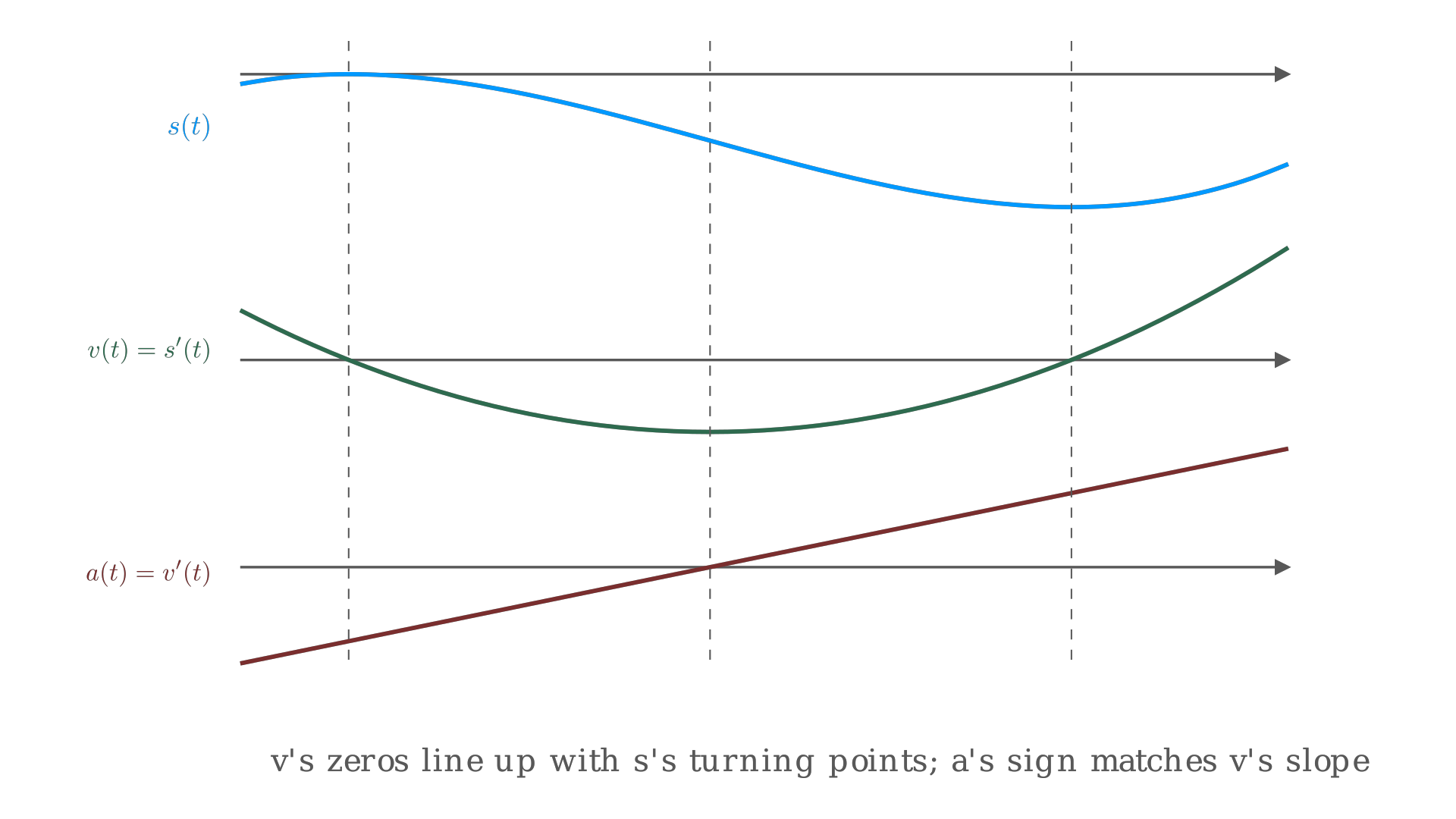
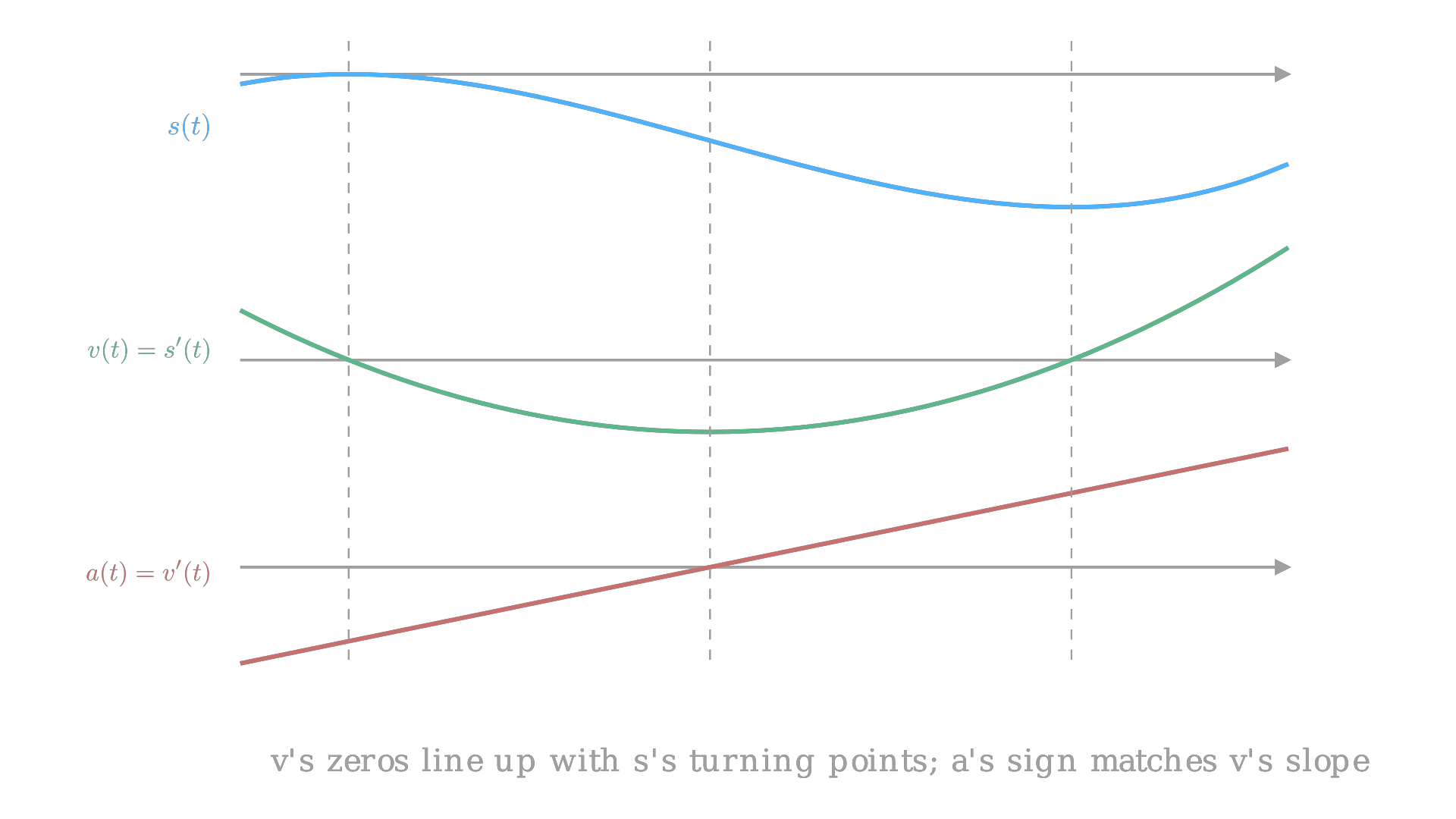
Rectilinear (straight-line) motion is the most iconic application of the derivative. A particle moves along a line, and its position at time \(t\) is \(s(t)\) (or \(x(t)\)). Differentiation links position, velocity, and acceleration in a clean chain:
直线(直线方向)运动是导数最具代表性的应用。质点(particle)沿一条直线运动,时刻 \(t\) 时的位置(position)为 \(s(t)\)(或 \(x(t)\))。求导(differentiate)把位置、速度(velocity)和加速度(acceleration)串成一条干净的链条:
Key Relationships
关键关系
| Quantity | Definition | Sign Meaning |
|---|---|---|
| Position \(s(t)\) | Location on the number line | Positive → right of origin; negative → left |
| Velocity \(v(t) = s'(t)\) | Rate of change of position | \(v > 0\) → moving right; \(v < 0\) → moving left |
| Speed \(|v(t)|\) | Magnitude of velocity | Always \(\geq 0\); how fast regardless of direction |
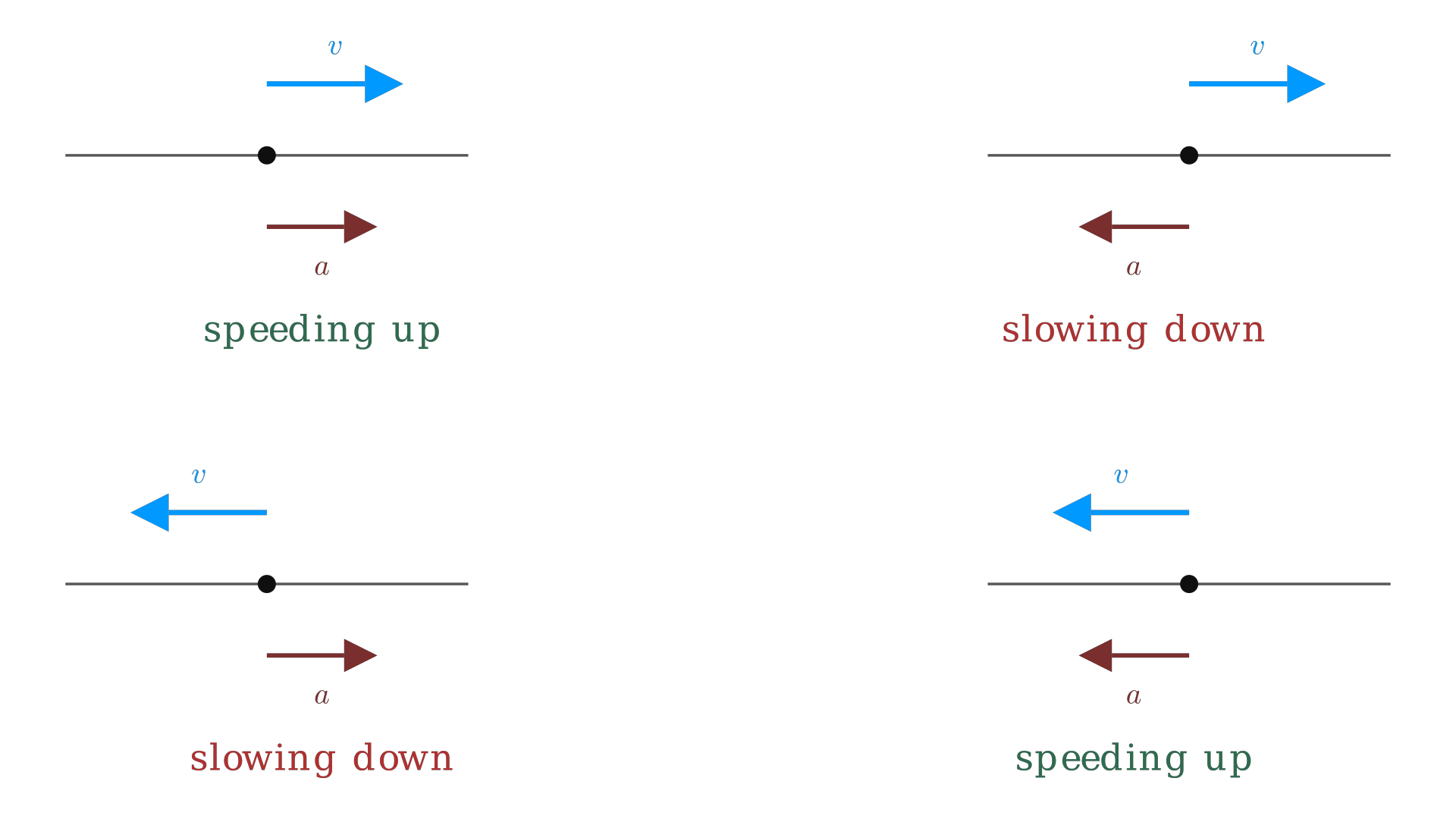
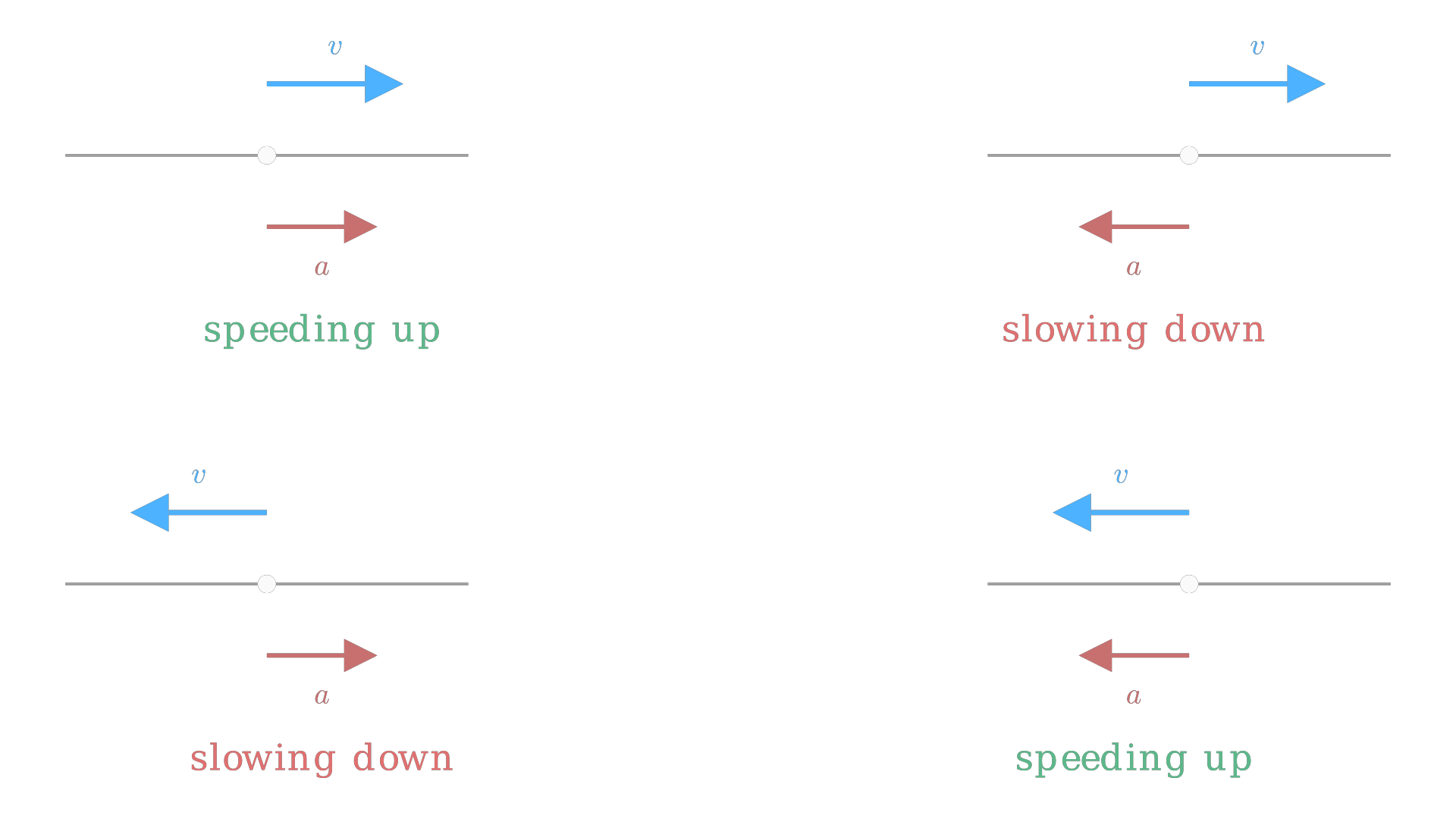
| Acceleration \(a(t) = v'(t)\) | Rate of change of velocity | Same sign as \(v\) → speeding up; opposite → slowing down |
| 量 | 定义 | 符号含义 |
|---|---|---|
| 位置 \(s(t)\) | 在数轴上的位置 | 正 → 原点右侧;负 → 原点左侧 |
| 速度 \(v(t) = s'(t)\) | 位置的变化率 | \(v > 0\) → 向右运动;\(v < 0\) → 向左运动 |
速率(speed) \(|v(t)|\) | 速度的大小 | 始终 \(\geq 0\);不论方向,只看快慢 |
| 加速度 \(a(t) = v'(t)\) | 速度的变化率 | 与 \(v\) 同号 → 加速;异号 → 减速 |
direction)加速。
Worked Example: Analyzing Particle Motion例题:分析质点运动(particle motion)
A particle moves along the \(x\)-axis with position \(s(t) = t^3 - 6t^2 + 9t + 2\) for \(t \geq 0\).
某质点沿 \(x\) 轴运动,当 \(t \geq 0\) 时其位置为 \(s(t) = t^3 - 6t^2 + 9t + 2\)。
Step 1: Differentiate to find velocity and acceleration
第 1 步:求导得到速度和加速度
\[ v(t)=s'(t)=3t^2-12t+9=3(t-1)(t-3) \] \[ a(t)=v'(t)=6t-12=6(t-2) \]Step 2: Find when the particle is at rest
第 2 步:判断质点何时静止
A particle is at rest when \(v(t)=0\).
当 \(v(t)=0\) 时质点处于静止。
\[ 3(t-1)(t-3)=0 \quad \Rightarrow \quad t=1,\;3 \]Step 3: Analyze the sign of velocity
第 3 步:分析速度的符号
Moving right.
向右运动。
Moving left.
向左运动。
So the particle changes direction at \(t=1\) and \(t=3\), because the sign of \(v\) changes at both times.
因此质点在 \(t=1\) 与 \(t=3\) 处改变方向,因为在这两个时刻 \(v\) 的符号都发生了变化。
Step 4: Check speeding up or slowing down
第 4 步:判断是加速还是减速
At \(t=2\):
当 \(t=2\) 时:
\[ v(2)=3(2-1)(2-3)=-3, \qquad a(2)=6(2-2)=0 \]Since acceleration is zero, the particle is neither speeding up nor slowing down at that instant.
由于加速度为零,质点在此瞬时既不加速也不减速。
At \(t=0.5\):
当 \(t=0.5\) 时:
\[ v(0.5)=3(-0.5)(-2.5)=3.75, \qquad a(0.5)=6(-1.5)=-9 \]Velocity is positive and acceleration is negative, so the signs are opposite. The particle is slowing down.
速度为正、加速度为负,二者异号。质点正在减速。
Worked Example: Displacement and Total Distance例题:位移与总路程
The particle above has position \(s(t)=t^3-6t^2+9t+2\). Find its displacement and its total distance travelled on \(0\le t\le 4\), and decide whether it is speeding up or slowing down at \(t=4\).
上面的质点位置为 \(s(t)=t^3-6t^2+9t+2\)。求它在 \(0\le t\le 4\) 上的位移和总路程,并判断在 \(t=4\) 时它在加速还是减速。
Step 1: Evaluate position at the endpoints and turning points
第 1 步:求端点与折返点处的位置
The particle turns at \(t=1\) and \(t=3\), where \(v\) changes sign.
质点在 \(t=1\) 与 \(t=3\) 处折返,此时 \(v\) 变号。
\[ s(0)=2,\quad s(1)=1-6+9+2=6,\quad s(3)=27-54+27+2=2,\quad s(4)=64-96+36+2=6 \]Step 2: Find the displacement
第 2 步:求位移
\[ s(4)-s(0)=6-2=4 \]Step 3: Add the distances of each leg
第 3 步:把每一段的路程相加
\[ |s(1)-s(0)|+|s(3)-s(1)|+|s(4)-s(3)|=4+4+4=12 \]Step 4: Speeding up or slowing down at \(t=4\)
第 4 步:判断 \(t=4\) 时加速还是减速
\[ v(4)=3(4-1)(4-3)=9>0,\qquad a(4)=6(4-2)=12>0 \]Velocity and acceleration are both positive, so the particle is speeding up at \(t=4\). Displacement is \(4\) units; total distance is \(12\) units.
速度与加速度同为正,所以质点在 \(t=4\) 时加速。位移为 \(4\) 个单位;总路程为 \(12\) 个单位。
For "speeding up or slowing down", state both signs and compare them, for example "\(v(0.5)>0\) and \(a(0.5)<0\) have opposite signs, so the particle is slowing down". The sign of \(a\) alone is not a reason. For "changes direction", cite the sign change of \(v\), not only \(v=0\).
回答"加速还是减速"时,要写出两个符号并加以比较,例如"\(v(0.5)>0\) 而 \(a(0.5)<0\),二者异号,所以质点在减速"。只看 \(a\) 的符号不能作为理由。回答"改变方向"时,要指出 \(v\) 变号,而不只是 \(v=0\)。
A particle has position \(s(t)=t^2-6t\) for \(t\ge 0\). When is it at rest?某质点位置为 \(s(t)=t^2-6t\)(\(t\ge 0\))。它何时静止?
\(v(t)=2t-6=0\) gives \(t=3\). The particle is at rest at \(t=3\) (and \(v\) changes from negative to positive there, so it also changes direction).
\(v(t)=2t-6=0\) 得 \(t=3\)。质点在 \(t=3\) 时静止(且 \(v\) 在该处由负变正,所以它也改变了方向)。
For \(s(t)=t^3-3t\), is the particle speeding up or slowing down at \(t=0.5\)?对于 \(s(t)=t^3-3t\),质点在 \(t=0.5\) 时是在加速还是减速?
\(v(t)=3t^2-3\), so \(v(0.5)=0.75-3=-2.25\); \(a(t)=6t\), so \(a(0.5)=3\). The signs are opposite, so the particle is slowing down.
\(v(t)=3t^2-3\),所以 \(v(0.5)=0.75-3=-2.25\);\(a(t)=6t\),所以 \(a(0.5)=3\)。二者异号,所以质点在减速。
For \(s(t)=t^2-6t\) on \(0\le t\le 5\), find the displacement and the total distance travelled.对于 \(s(t)=t^2-6t\),在 \(0\le t\le 5\) 上求位移与总路程。
The particle turns at \(t=3\). \(s(0)=0\), \(s(3)=-9\), \(s(5)=-5\). Displacement \(=s(5)-s(0)=-5\). Total distance \(=|-9-0|+|-5-(-9)|=9+4=13\).
质点在 \(t=3\) 处折返。\(s(0)=0\),\(s(3)=-9\),\(s(5)=-5\)。位移 \(=s(5)-s(0)=-5\)。总路程 \(=|-9-0|+|-5-(-9)|=9+4=13\)。
Rates of Change in Applied Contexts Other Than Motion
非运动情境中的变化率
- Interpret a derivative in a non-motion context with correct units.
- Calculate a rate of change from a model and state its meaning in a full sentence.
- Explain marginal cost as the approximate cost of producing one more unit.
- Compare average and instantaneous rates of change from a table or a model.
- Deduce from the sign of a rate whether the quantity is increasing or decreasing.
- 在非运动情境中用正确的单位解读导数。
- 由模型计算变化率,并用一句完整的话说明其含义。
- 把边际成本(
marginal cost)解释为多生产一个单位的近似成本。 - 由表格或模型比较平均变化率与瞬时变化率。
- 由变化率的符号推断该量是在增加还是在减少。
The derivative as a rate of change extends far beyond moving particles. Any time a quantity depends on another quantity and you want to know how fast the first is changing with respect to the second, you are looking at a derivative. The underlying mathematical structure is identical to motion problems; only the vocabulary and units change.
导数作为变化率的应用范围远远超出运动中的质点。任何时候,只要一个量依赖于另一个量,而你想知道前者关于后者的变化快慢,看到的就是导数。其底层的数学结构与运动问题完全相同,只是用词和单位换了一套。
Common real-world contexts include population growth, the spread of a disease, the temperature of a cooling object, the rate at which a company's revenue changes with the number of units sold (marginal revenue), the rate water flows into or out of a tank, and the changing concentration of a chemical in a mixture. In every case, the derivative of the quantity function gives the instantaneous rate of change, and its units are always the output units divided by the input units.
常见的现实情境包括:人口增长(指数增长(exponential growth)的典型例子)、疾病传播、冷却物体的温度、公司收入随售出数量的变化(边际收入)、水流入或流出水箱的速率、混合物中化学物质浓度的变化。在所有这些情境中,量函数的导数给出瞬时变化率,单位始终是输出单位除以输入单位。
function)是什么?自变量是什么?导数在告诉我什么?回答好这三个问题,无论情境是什么,计算过程都是一样的。
average)变化率为 \(\frac{f(b) - f(a)}{b - a}\),即割线(secant line)的斜率。在 \(x = a\) 处的瞬时(instantaneous)变化率为 \(f'(a)\),即切线的斜率。要能区分这两者,尤其当数据以表格形式给出时(此时你只能算出表中相邻点之间的平均变化率)。
Worked Example: Non-Motion Rate of Change例题:非运动情境的变化率
The temperature of coffee, in °F, \(t\) minutes after being poured is modelled by \(T(t) = 70 + 130e^{-0.04t}\). Find and interpret \(T'(10)\).
咖啡倒出后 \(t\) 分钟时的温度(单位:°F)由模型 \(T(t) = 70 + 130e^{-0.04t}\) 给出。求 \(T'(10)\) 并加以解读。
Step 1: Differentiate the model
第 1 步:对模型求导
\[ T'(t)=130\bigl(-0.04\bigr)e^{-0.04t}=-5.2e^{-0.04t} \]The derivative has units of degrees Fahrenheit per minute.
该导数的单位为华氏度每分钟。
Step 2: Evaluate at \(t=10\)
第 2 步:代入 \(t=10\) 求值
\[ T'(10)=-5.2e^{-0.4}\approx -5.2(0.6703)\approx -3.486 \]Step 3: Interpret the result
第 3 步:解读结果
At 10 minutes after the coffee is poured, the temperature of the coffee is decreasing at a rate of about \(3.486\) °F per minute.
在咖啡倒出后第 10 分钟时,咖啡的温度正以约每分钟 \(3.486\) °F的速率递减。
Worked Example: Marginal Cost例题:边际成本
The cost of producing \(x\) units is \(C(x)=0.02x^2+5x+300\) dollars. Find and interpret \(C'(100)\), then compare it with the actual cost of the 101st unit.
生产 \(x\) 个单位的成本为 \(C(x)=0.02x^2+5x+300\) 美元。求 \(C'(100)\) 并解读,再与第 101 个单位的实际成本比较。
Step 1: Differentiate
第 1 步:求导
\[ C'(x)=0.04x+5 \]The units are dollars per unit produced.
单位为美元每单位产品。
Step 2: Evaluate at \(x=100\)
第 2 步:代入 \(x=100\)
\[ C'(100)=0.04(100)+5=9 \]Step 3: Compare with the actual extra cost
第 3 步:与实际增加的成本比较
\[ C(101)-C(100)=0.02(101^2-100^2)+5(1)=0.02(201)+5=9.02 \]Step 4: Interpret
第 4 步:解读
When \(100\) units are being produced, the cost is increasing at \(9\) dollars per unit, so the 101st unit costs about \(9\) dollars (the exact extra cost is \(9.02\) dollars).
当产量为 \(100\) 个单位时,成本正以每单位 \(9\) 美元的速率增加,所以第 101 个单位的成本约为 \(9\) 美元(实际增加的成本为 \(9.02\) 美元)。
Match the vocabulary to the context: write "the temperature of the coffee is decreasing at about \(3.486\) °F per minute", not "the velocity of the temperature". When only a table is given, a rate you compute between rows is an average rate, so call your estimate of an instantaneous rate "approximately".
措辞要与情境一致:写"咖啡的温度正以约每分钟 \(3.486\) °F 的速率下降",而不是"温度的速度"。只给出表格时,在相邻两行之间算出的是平均变化率,所以用它估计瞬时变化率时要说"约"。
An oil slick has area \(A(t)\) square metres after \(t\) hours, and \(A'(3)=40\). Interpret this value.油膜在 \(t\) 小时后的面积为 \(A(t)\) 平方米,且 \(A'(3)=40\)。解读这个数值。
At \(t=3\) hours, the area of the oil slick is increasing at a rate of \(40\) square metres per hour.
在 \(t=3\) 小时时,油膜面积正以每小时 \(40\) 平方米的速率增加。
A town's population is \(P(t)=500e^{0.03t}\) people after \(t\) years. Find \(P'(10)\) and interpret it.某镇 \(t\) 年后的人口为 \(P(t)=500e^{0.03t}\) 人。求 \(P'(10)\) 并解读。
\(P'(t)=15e^{0.03t}\), so \(P'(10)=15e^{0.3}\approx 20.248\). At \(t=10\) years, the population is increasing at about \(20.248\) people per year.
\(P'(t)=15e^{0.03t}\),所以 \(P'(10)=15e^{0.3}\approx 20.248\)。在 \(t=10\) 年时,人口正以约每年 \(20.248\) 人的速率增加。
For \(f(x)=x^2\), compute the average rate of change on \([1,3]\) and the instantaneous rate at \(x=1\). Why do they differ?对 \(f(x)=x^2\),求 \([1,3]\) 上的平均变化率以及 \(x=1\) 处的瞬时变化率。二者为什么不同?
Average: \(\frac{f(3)-f(1)}{3-1}=\frac{9-1}{2}=4\). Instantaneous: \(f'(x)=2x\), so \(f'(1)=2\). They differ because \(f'\) increases across the interval; the secant slope \(4\) equals the tangent slope at \(x=2\), not at \(x=1\).
平均:\(\frac{f(3)-f(1)}{3-1}=\frac{9-1}{2}=4\)。瞬时:\(f'(x)=2x\),所以 \(f'(1)=2\)。二者不同是因为 \(f'\) 在该区间上递增;割线斜率 \(4\) 等于 \(x=2\) 处而不是 \(x=1\) 处的切线斜率。
Introduction to Related Rates
相关变化率(related rates)入门
- Explain why differentiating with respect to \(t\) applies the chain rule to every changing variable.
- Write an equation that relates the changing quantities before substituting any numbers.
- Differentiate a relating equation implicitly with respect to time.
- Calculate an unknown rate from known rates and values at a given instant.
- Interpret the sign of a computed rate as increasing or decreasing, with units.
- 解释为什么关于 \(t\) 求导时要对每个变化的变量使用链式法则。
- 在代入任何数值之前,写出联系各变化量的方程。
- 把联系方程关于时间做隐式求导(
implicit differentiation)。 - 由给定瞬时的已知变化率和已知值求出未知变化率。
- 结合单位,把所得变化率的符号解读为递增或递减。
In a related-rates problem, two or more quantities are changing with respect to time, and they are connected by an equation. You know the rate of change of one quantity and need to find the rate of change of another. The chain rule is the engine that makes this work: since every variable depends on \(t\) (time), differentiating the connecting equation with respect to \(t\) links the rates.
在相关变化率问题中,两个或多个量都随时间变化,并由一个方程相互联系。已知某个量的变化率,要求另一个量的变化率。能让这一切成立的引擎正是链式法则(chain rule):由于每个变量都依赖于 \(t\)(时间),将这一联系方程对 \(t\) 求导,便把各个变化率连接了起来。
The Five-Step Framework
五步框架
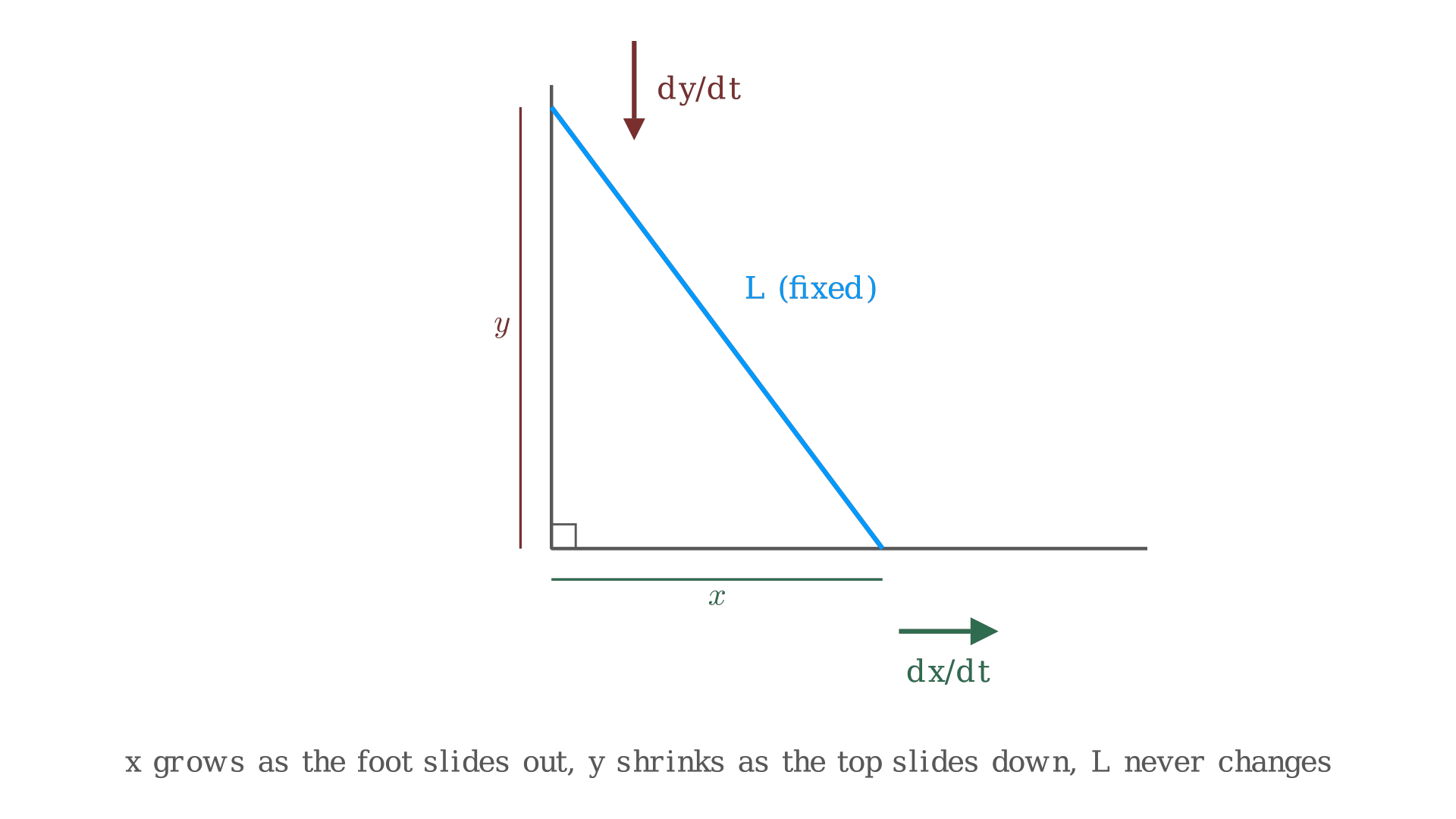
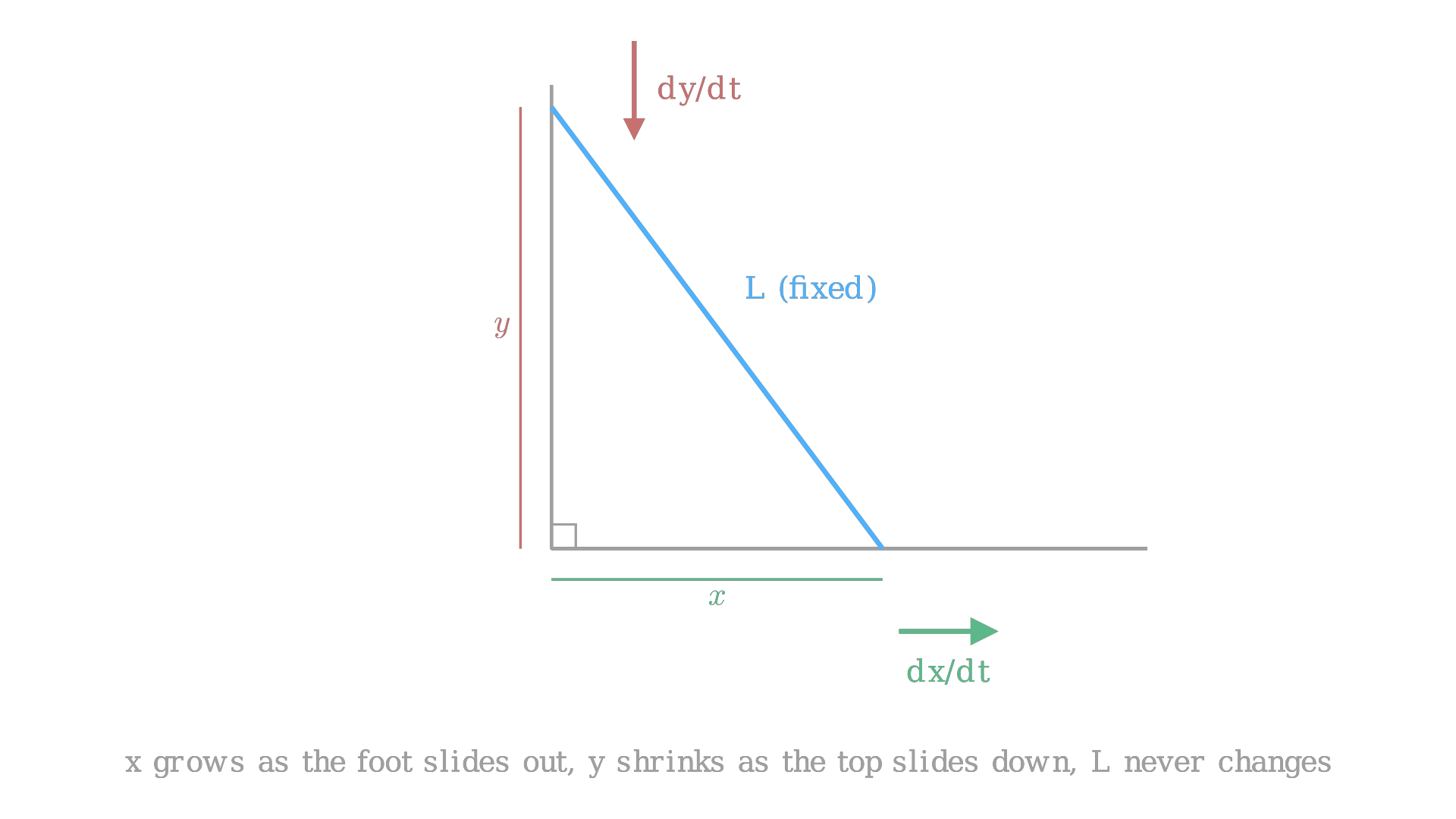
Related-rates problems follow a consistent procedure. First, draw a picture and label all variables (not specific numbers, unless they are constants). Second, write an equation that relates the variables. Third, differentiate both sides with respect to \(t\), applying the chain rule to every variable. Fourth, substitute all known values at the specific instant. Fifth, solve for the unknown rate and interpret the result with units.
相关变化率问题遵循一套固定流程。第一,画图并标出所有变量(不要标具体数值,除非该数值是常量)。第二,写出方程把变量联系起来。第三,对两边关于 \(t\) 求导,对每一个变量都用链式法则。第四,代入在指定瞬时下所有已知值。第五,解出未知的变化率,并附上单位解读结果。
Worked Example: Growing Square (the five steps, minimal version)例题:变大的正方形(最简版五步)
The side of a square increases at \(4\) cm/s. How fast is the area increasing when the side is \(6\) cm? This example exists purely to show the five steps with nothing else to distract from them.
正方形的边长以 \(4\) cm/s 的速率增大。当边长为 \(6\) cm 时,面积增大的速率是多少?这个例子的唯一目的是纯粹展示这五步,不掺杂其它干扰。
Step 1: Draw & label
第 1 步:画图并标注
Let \(s\) be the side length (in cm) and \(A\) be the area (in cm²), both functions of time \(t\).
设 \(s\) 为边长(cm),\(A\) 为面积(cm²),二者都是时间 \(t\) 的函数。
Step 2: Write the equation
第 2 步:写出方程
\[A = s^2\]Step 3: Differentiate with respect to $t$
第 3 步:关于 $t$ 求导
\[\frac{dA}{dt} = 2s\,\frac{ds}{dt}\]Step 4: Substitute the known values
第 4 步:代入已知值
At the instant in question, \(s = 6\) and \(\frac{ds}{dt} = 4\):
在该瞬时,\(s = 6\),\(\frac{ds}{dt} = 4\):
\[\frac{dA}{dt} = 2(6)(4) = 48\]Step 5: Solve & interpret
第 5 步:解出并解读
The area is increasing at \(48\) cm²/s when the side is \(6\) cm. Notice that the substitution in Step 4 happens strictly after differentiating in Step 3, exactly the order the pitfall above warns you to preserve.
当边长为 \(6\) cm 时,面积以 \(48\) cm²/s 的速率增大。注意第 4 步的代入严格发生在第 3 步求导之后,这正是上面的陷阱提示中要求保持的顺序。
Worked Example: Two Rates Linked by a Product例题:由乘积联系的两个变化率
The quantities \(x\) and \(y\) are differentiable functions of \(t\) with \(xy=12\). At the instant when \(x=3\), \(\frac{dx}{dt}=2\). Find \(\frac{dy}{dt}\) at that instant.
量 \(x\) 与 \(y\) 都是 \(t\) 的可微函数,且 \(xy=12\)。在 \(x=3\) 的瞬时,\(\frac{dx}{dt}=2\)。求该瞬时的 \(\frac{dy}{dt}\)。
Step 1: Differentiate with respect to \(t\) (product rule)
第 1 步:关于 \(t\) 求导(乘积法则)
\[ x\frac{dy}{dt}+y\frac{dx}{dt}=0 \]Step 2: Find \(y\) at the instant
第 2 步:求该瞬时的 \(y\)
\[ 3y=12\;\Rightarrow\;y=4 \]Step 3: Substitute and solve
第 3 步:代入并求解
\[ 3\frac{dy}{dt}+4(2)=0\;\Rightarrow\;\frac{dy}{dt}=-\frac{8}{3} \]At that instant \(y\) is decreasing at \(\frac{8}{3}\) units per unit of time.
在该瞬时 \(y\) 正以每单位时间 \(\frac{8}{3}\) 个单位的速率减小。
Write the general equation and its \(\frac{d}{dt}\) form before any changing value appears. A true constant (a ladder's length, a tank's fixed dimensions) may be substituted at the start; a quantity that changes, such as \(x\) or \(r\), is substituted only after differentiating. Give every rate its units, for example cm²/s.
在任何变化量的数值出现之前,先写出一般方程及其 \(\frac{d}{dt}\) 形式。真正的常量(梯子长度、水箱的固定尺寸)可以一开始就代入;会变化的量,例如 \(x\) 或 \(r\),只能在求导之后代入。每个变化率都要写单位,例如 cm²/s。
Differentiate \(x^2+y^2=25\) with respect to \(t\), where \(x\) and \(y\) both depend on \(t\).\(x\) 与 \(y\) 都依赖于 \(t\),把 \(x^2+y^2=25\) 关于 \(t\) 求导。
\(2x\frac{dx}{dt}+2y\frac{dy}{dt}=0\). Each term gets a chain-rule factor; the constant \(25\) differentiates to \(0\).
\(2x\frac{dx}{dt}+2y\frac{dy}{dt}=0\)。每一项都带出链式法则的因子;常数 \(25\) 求导为 \(0\)。
In the growing-square example, what goes wrong if you substitute \(s=6\) into \(A=s^2\) before differentiating?在变大的正方形例题中,如果在求导前把 \(s=6\) 代入 \(A=s^2\),会出什么问题?
You get \(A=36\), a constant, whose derivative is \(0\). That wrongly says the area is not changing, when in fact \(\frac{dA}{dt}=48\) cm²/s.
会得到常数 \(A=36\),其导数为 \(0\)。这错误地表示面积不变,而实际上 \(\frac{dA}{dt}=48\) cm²/s。
The edge of a cube grows at \(0.5\) cm/s. How fast is the volume increasing when the edge is \(4\) cm?立方体的棱长以 \(0.5\) cm/s 的速率增大。当棱长为 \(4\) cm 时,体积增大的速率是多少?
\(V=s^3\), so \(\frac{dV}{dt}=3s^2\frac{ds}{dt}=3(16)(0.5)=24\). The volume is increasing at \(24\) cm³/s.
\(V=s^3\),所以 \(\frac{dV}{dt}=3s^2\frac{ds}{dt}=3(16)(0.5)=24\)。体积正以 \(24\) cm³/s 的速率增大。
Solving Related Rates Problems
求解相关变化率问题
- Translate a word problem into an equation among the changing quantities.
- Use the Pythagorean theorem, area and volume formulas and similar triangles to relate the variables.
- Eliminate an extra variable with similar triangles before differentiating, as in a conical tank.
- Calculate the unknown rate at the given instant and state it with units.
- Interpret the sign of the answer in the context of the problem.
- 把文字题翻译成各变化量之间的方程。
- 用勾股定理、面积与体积公式以及相似三角形(
similar triangles)联系各变量。 - 在求导之前用相似三角形消去多余的变量,例如圆锥形水箱问题。
- 求出指定瞬时的未知变化率,并写明单位。
- 结合题目情境解读答案的符号。
This topic puts the five-step framework from Topic 4.4 into practice. The key challenge is translating a word problem into a mathematical equation and then correctly applying implicit differentiation with respect to time. Let's work through the most common problem types.
本节把小节 4.4 的五步框架付诸实战。关键挑战在于:把文字题翻译成数学方程,然后正确地对时间做隐式求导。下面我们逐一处理最常见的几类题型。
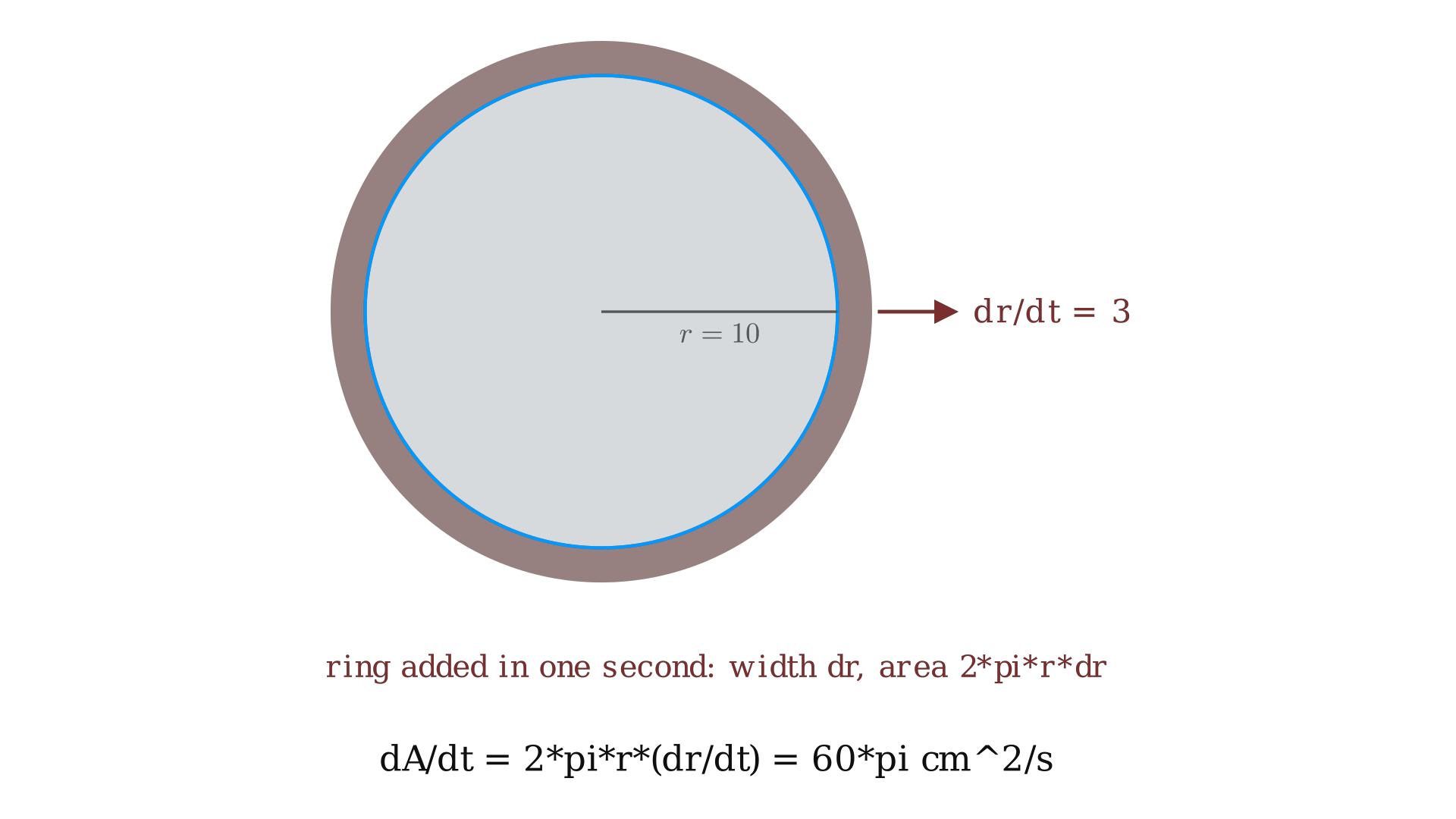
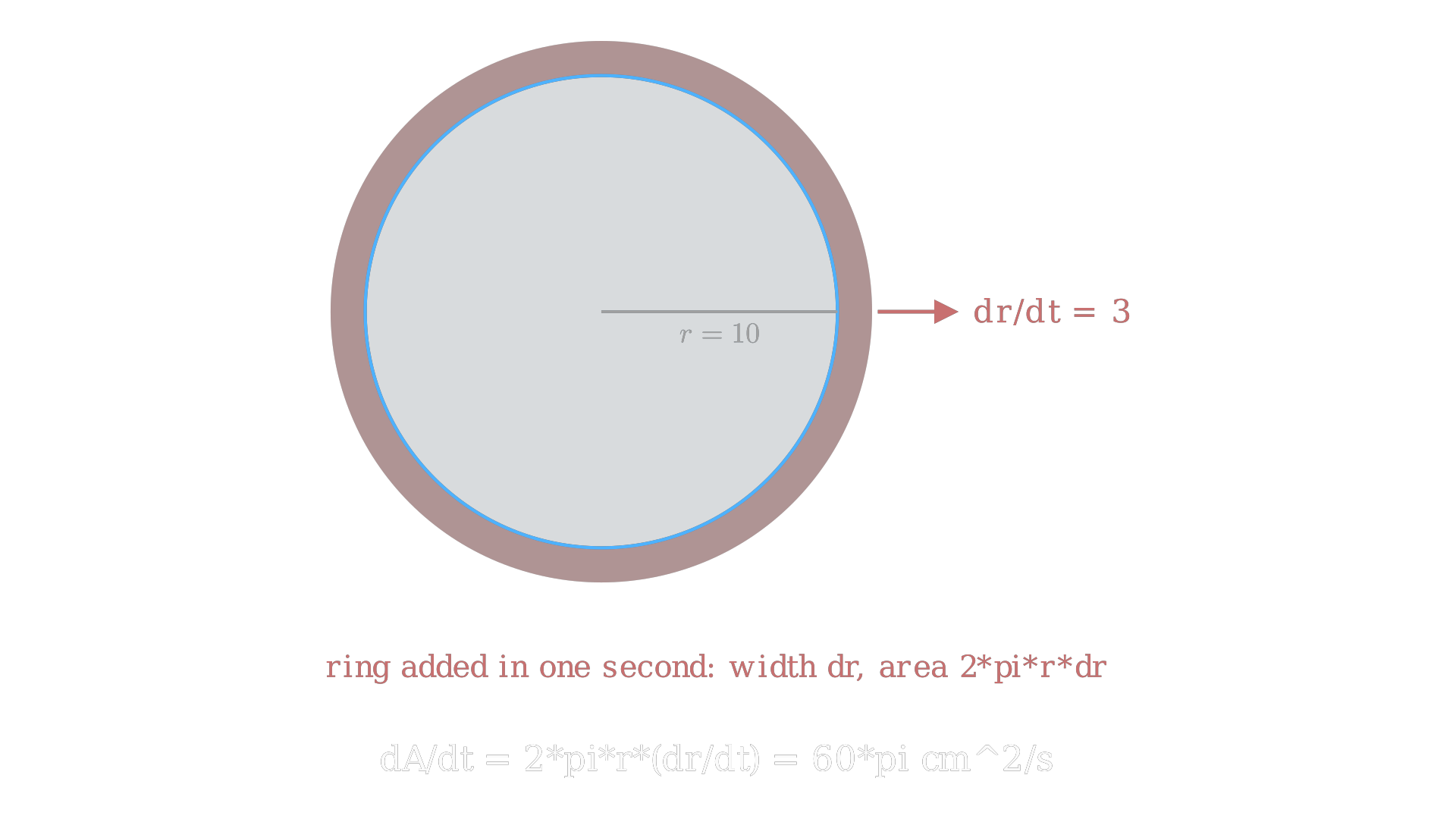
Expanding circle: \(A = \pi r^2\) → \(\frac{dA}{dt} = 2\pi r \frac{dr}{dt}\)
Expanding sphere: \(V = \frac{4}{3}\pi r^3\) → \(\frac{dV}{dt} = 4\pi r^2 \frac{dr}{dt}\)
Right triangle (ladder): \(x^2 + y^2 = L^2\) → \(2x\frac{dx}{dt} + 2y\frac{dy}{dt} = 0\)
Cone filling: \(V = \frac{1}{3}\pi r^2 h\) (may need to eliminate \(r\) using similar triangles)
扩张的圆: \(A = \pi r^2\) → \(\frac{dA}{dt} = 2\pi r \frac{dr}{dt}\)
膨胀的球: \(V = \frac{4}{3}\pi r^3\) → \(\frac{dV}{dt} = 4\pi r^2 \frac{dr}{dt}\)
直角三角形(梯子): \(x^2 + y^2 = L^2\) → \(2x\frac{dx}{dt} + 2y\frac{dy}{dt} = 0\)
圆锥注水: \(V = \frac{1}{3}\pi r^2 h\) (可能需要用相似三角形消去 \(r\))
Worked Example: Expanding Circle例题:扩张的圆
A stone dropped in a pond creates a circular ripple whose radius increases at \(3\) cm/s. How fast is the area increasing when the radius is \(10\) cm?
一颗石子落入池塘,激起一圈圆形涟漪,其半径以 \(3\) cm/s 的速率增大。当半径为 \(10\) cm 时,圆面积增大的速率是多少?
Step 1: Write the relationship
第 1 步:写出关系式
\[ A=\pi r^2 \]Step 2: Differentiate with respect to time
第 2 步:关于时间求导
\[ \frac{dA}{dt}=2\pi r\frac{dr}{dt} \]Step 3: Substitute the known values
第 3 步:代入已知值
\[ \frac{dA}{dt}=2\pi(10)(3)=60\pi \]Step 4: State the answer with units
第 4 步:给出带单位的答案
When the radius is \(10\) cm, the area is increasing at
当半径为 \(10\) cm 时,面积增大的速率为
\[ \frac{dA}{dt}=60\pi\text{ cm}^2/\text{s}\approx 188.5\text{ cm}^2/\text{s} \]Worked Example: Sliding Ladder例题:滑动的梯子
A 13-foot ladder leans against a wall. The base slides away at \(2\) ft/s. How fast is the top sliding down when the base is \(5\) feet from the wall?
一架 13 英尺长的梯子靠在墙上。梯脚以 \(2\) ft/s 的速率向外滑动。当梯脚距墙 \(5\) 英尺时,梯顶向下滑动的速率是多少?
Step 1: Relate the variables
第 1 步:写出变量关系
Let \(x\) be the distance of the base from the wall and \(y\) be the height of the top on the wall. Then
设 \(x\) 为梯脚到墙的距离,\(y\) 为梯顶在墙上的高度,则
\[ x^2+y^2=13^2=169 \]Step 2: Find \(y\) at the instant of interest
第 2 步:求指定瞬时的 \(y\)
When \(x=5\),
当 \(x=5\) 时,
\[ 5^2+y^2=169 \Rightarrow 25+y^2=169 \Rightarrow y^2=144 \Rightarrow y=12 \]Step 3: Differentiate with respect to time
第 3 步:关于时间求导
\[ 2x\frac{dx}{dt}+2y\frac{dy}{dt}=0 \]Step 4: Substitute known values and solve
第 4 步:代入已知值并求解
\[ 2(5)(2)+2(12)\frac{dy}{dt}=0 \] \[ 20+24\frac{dy}{dt}=0 \] \[ \frac{dy}{dt}=-\frac{20}{24}=-\frac{5}{6} \]Step 5: Interpret the sign
第 5 步:解读符号
The negative sign means the height is decreasing, so the top of the ladder is sliding down at
负号表示高度在减小,因此梯顶正在以下列速率向下滑动:
\[ \left|\frac{dy}{dt}\right|=\frac{5}{6}\text{ ft/s} \]Worked Example: Filling a Conical Tank例题:向圆锥形水箱注水
An inverted conical tank has top radius \(5\) ft and height \(10\) ft (Figure 1). Water flows in at \(2\) ft³/min. How fast is the water level rising when the water is \(4\) ft deep?
一个倒置的圆锥形水箱顶部半径为 \(5\) ft,高为 \(10\) ft(图 1)。水以 \(2\) ft³/min 的速率注入。当水深为 \(4\) ft 时,水面上升的速率是多少?
Step 1: Relate \(r\) and \(h\) by similar triangles
第 1 步:用相似三角形联系 \(r\) 与 \(h\)
\[ \frac{r}{h}=\frac{5}{10}\;\Rightarrow\;r=\frac{h}{2} \]Step 2: Write the volume in terms of \(h\) only
第 2 步:把体积只用 \(h\) 表示
\[ V=\frac{1}{3}\pi r^2h=\frac{1}{3}\pi\left(\frac{h}{2}\right)^2h=\frac{\pi h^3}{12} \]Step 3: Differentiate with respect to \(t\)
第 3 步:关于 \(t\) 求导
\[ \frac{dV}{dt}=\frac{\pi h^2}{4}\,\frac{dh}{dt} \]Step 4: Substitute \(h=4\) and \(\frac{dV}{dt}=2\)
第 4 步:代入 \(h=4\) 与 \(\frac{dV}{dt}=2\)
\[ 2=\frac{\pi(16)}{4}\,\frac{dh}{dt}=4\pi\frac{dh}{dt}\;\Rightarrow\;\frac{dh}{dt}=\frac{1}{2\pi}\approx 0.159 \]When the water is \(4\) ft deep, the water level is rising at \(\frac{1}{2\pi}\approx 0.159\) ft/min.
当水深为 \(4\) ft 时,水面正以 \(\frac{1}{2\pi}\approx 0.159\) ft/min 的速率上升。
In a cone problem, eliminate \(r\) with similar triangles before you differentiate: differentiating \(V=\frac{1}{3}\pi r^2h\) with both \(r\) and \(h\) changing needs the product rule and a second rate you are not given. Finish with a sentence that names the quantity, its direction, its rate and its units.
做圆锥问题时,在求导之前用相似三角形消去 \(r\):若 \(r\) 与 \(h\) 都在变化时直接对 \(V=\frac{1}{3}\pi r^2h\) 求导,就要用乘积法则,还需要一个题目没有给出的变化率。最后用一句话写明是哪个量、变化方向、变化率和单位。
A \(10\)-ft ladder slides so its base moves away from the wall at \(1\) ft/s. How fast is the top moving when the base is \(6\) ft from the wall?一架 \(10\) 英尺长的梯子下滑,梯脚以 \(1\) ft/s 的速率离开墙。当梯脚距墙 \(6\) 英尺时,梯顶移动的速率是多少?
\(x^2+y^2=100\); at \(x=6\), \(y=8\). Then \(2(6)(1)+2(8)\frac{dy}{dt}=0\), so \(\frac{dy}{dt}=-\frac{12}{16}=-\frac{3}{4}\). The top slides down the wall at \(\frac{3}{4}\) ft/s.
\(x^2+y^2=100\);当 \(x=6\) 时 \(y=8\)。于是 \(2(6)(1)+2(8)\frac{dy}{dt}=0\),所以 \(\frac{dy}{dt}=-\frac{12}{16}=-\frac{3}{4}\)。梯顶以 \(\frac{3}{4}\) ft/s 的速率沿墙下滑。
In the conical-tank example, why can't you substitute \(r=2\) into \(V=\frac{1}{3}\pi r^2h\) before differentiating?在圆锥形水箱例题中,为什么不能在求导之前把 \(r=2\) 代入 \(V=\frac{1}{3}\pi r^2h\)?
Because \(r\) changes as the tank fills. Fixing \(r=2\) treats the water as a cylinder-like shape with constant radius and gives the wrong rate; use \(r=\frac{h}{2}\), which holds at every instant.
因为注水时 \(r\) 在变化。把 \(r=2\) 固定下来相当于把水看成半径不变的形状,会得到错误的变化率;应使用每一时刻都成立的 \(r=\frac{h}{2}\)。
The radius of a sphere increases at \(0.2\) cm/s. How fast is the volume increasing when \(r=10\) cm?球的半径以 \(0.2\) cm/s 的速率增大。当 \(r=10\) cm 时,体积增大的速率是多少?
\(\frac{dV}{dt}=4\pi r^2\frac{dr}{dt}=4\pi(100)(0.2)=80\pi\approx 251.327\) cm³/s.
\(\frac{dV}{dt}=4\pi r^2\frac{dr}{dt}=4\pi(100)(0.2)=80\pi\approx 251.327\) cm³/s。
Approximating Values Using Local Linearity & Linearization
用局部线性与线性近似(linear approximation)估算函数值
- Write the linearization \(L(x)=f(a)+f'(a)(x-a)\) of a function at a point.
- Use the linearization to approximate a function value near \(x=a\).
- Determine from the sign of \(f''\) whether the approximation is an overestimate or an underestimate.
- Explain why the approximation is better the closer \(x\) is to \(a\).
- Approximate values of a function known only through \(f(a)\) and a formula or value for \(f'\).
- 写出函数在某点处的线性近似 \(L(x)=f(a)+f'(a)(x-a)\)。
- 用线性近似估算 \(x=a\) 附近的函数值。
- 由 \(f''\) 的符号判断近似是高估(
overestimate)还是低估(underestimate)。 - 解释为什么 \(x\) 离 \(a\) 越近,近似越好。
- 在只知道 \(f(a)\) 以及 \(f'\) 的公式或数值时估算函数值。
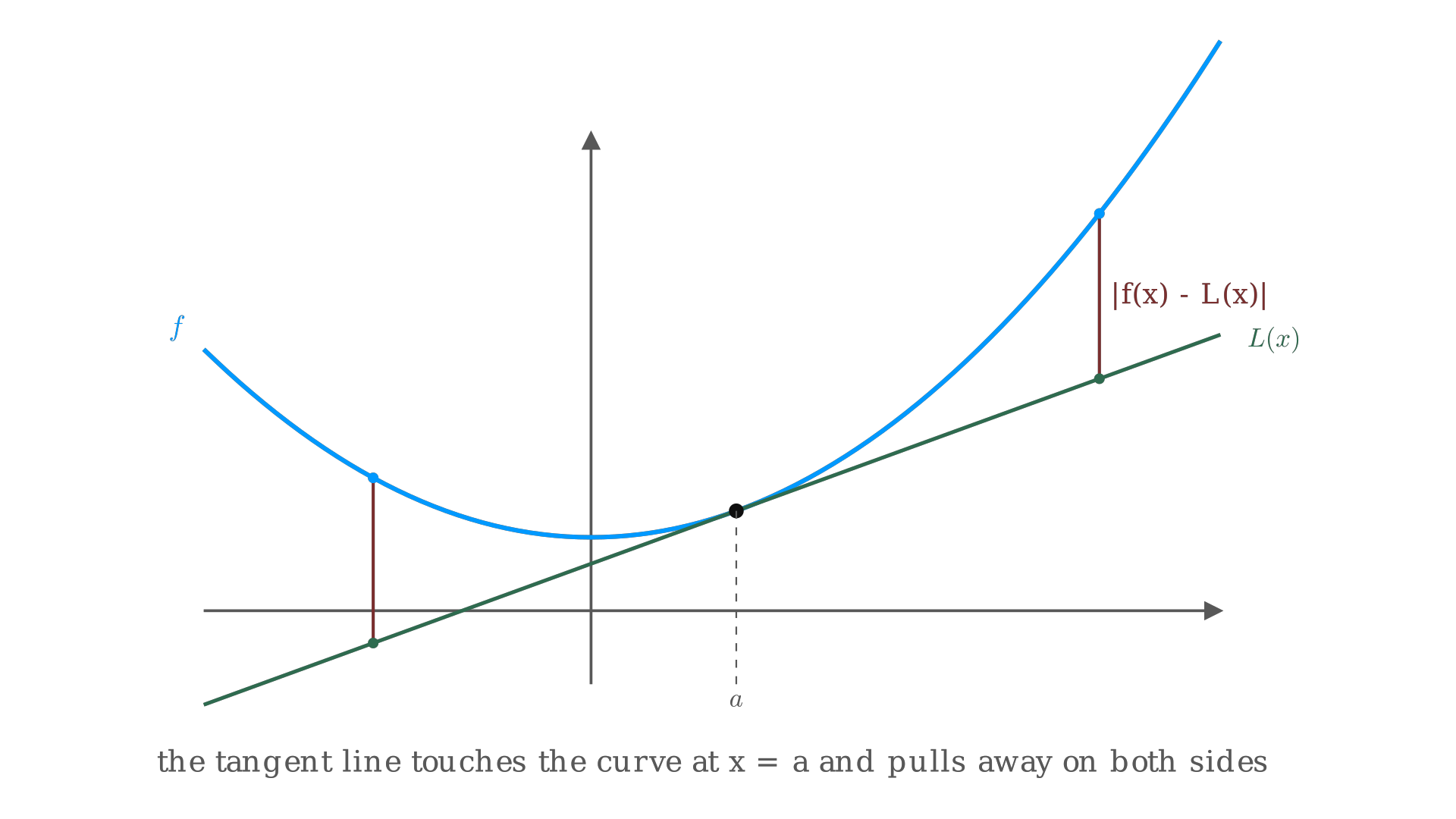
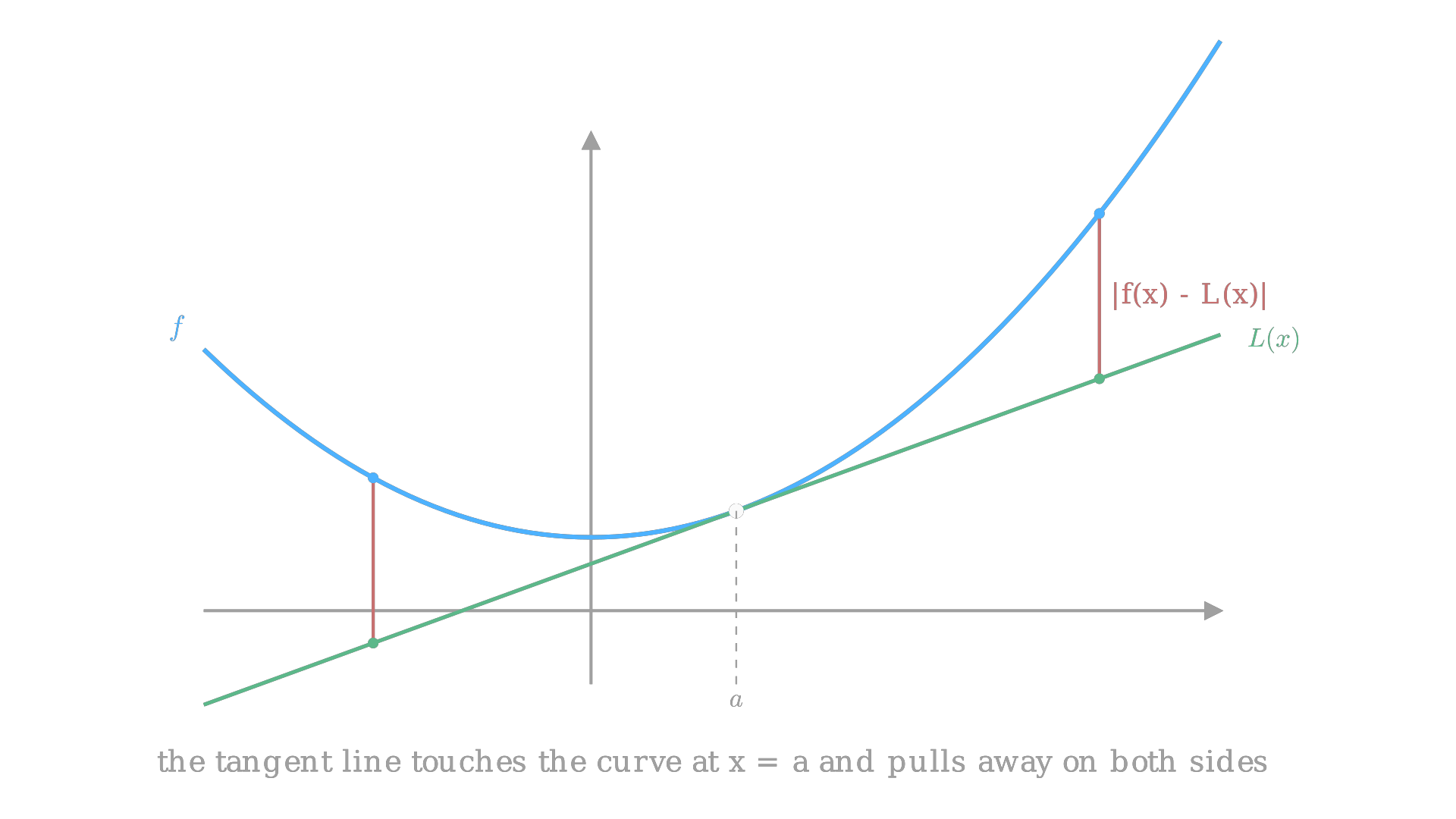
Near the point of tangency, a differentiable function looks almost like its tangent line. This is the principle of local linearity: if you zoom in closely enough around a point, the curve becomes indistinguishable from a straight line. We exploit this by using the tangent line to approximate function values that would otherwise be difficult to calculate.
在切点附近,可微函数看起来几乎与它的切线(tangent line)完全一样。这就是局部线性原理:把一个点附近放得足够大,曲线就变得与一条直线无法区分。我们利用这一点,用切线来近似(approximation)那些原本难以直接计算的函数值。
tangent line approximation)(线性近似)Why would you use an approximation instead of computing \(f(x)\) exactly? In many problems the function is defined only by a differential equation or a table, so no exact formula is available. The tangent line approximation lets you estimate nearby values using only a single known point and the derivative there.
为什么要用近似而不直接精确计算 \(f(x)\)?在许多题目中,函数只由微分方程或表格定义,根本拿不到显式公式。切线近似允许你只用一个已知点和那里的导数值,就估出附近的函数值。
Over- and Underestimates
高估与低估
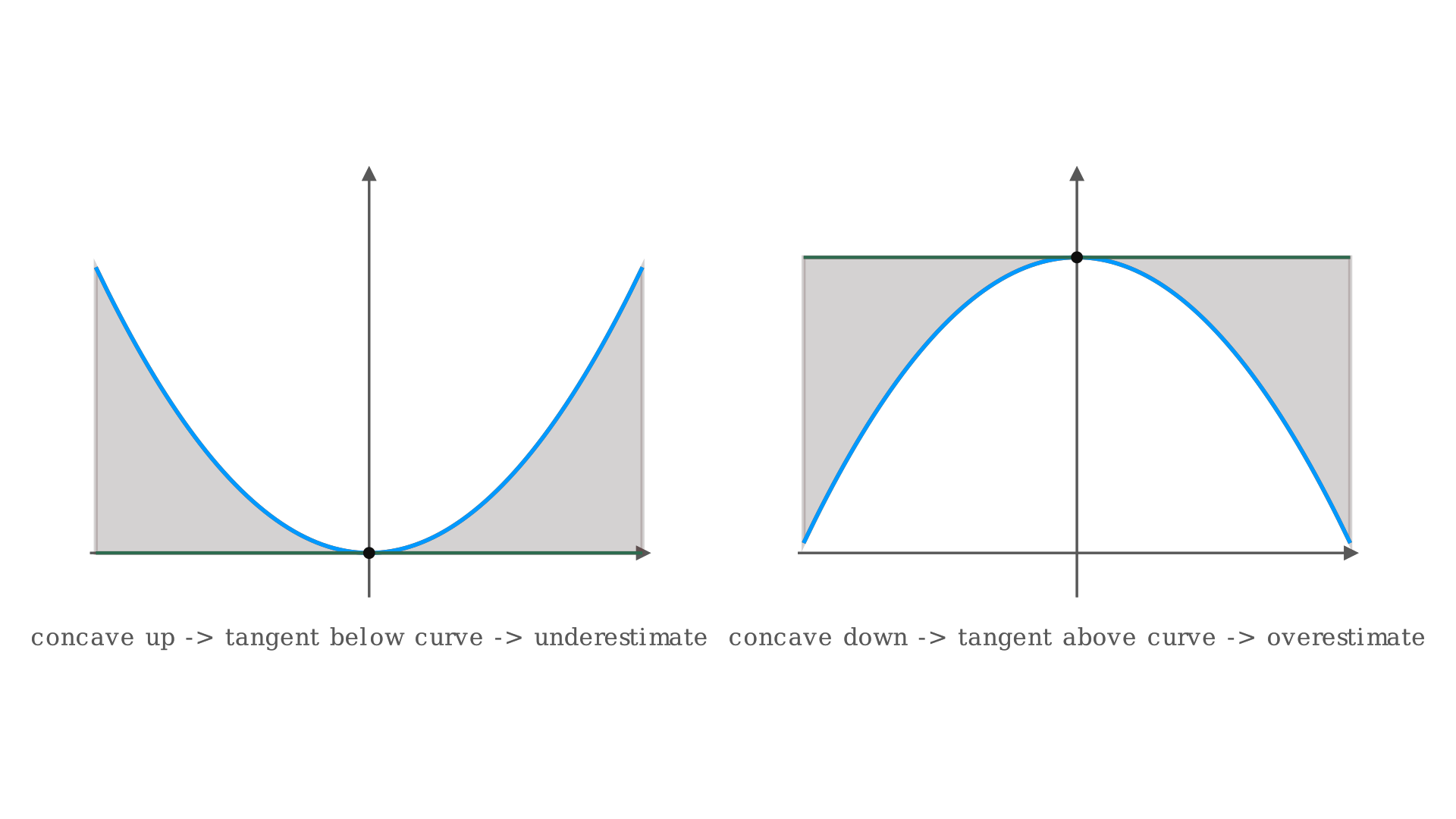
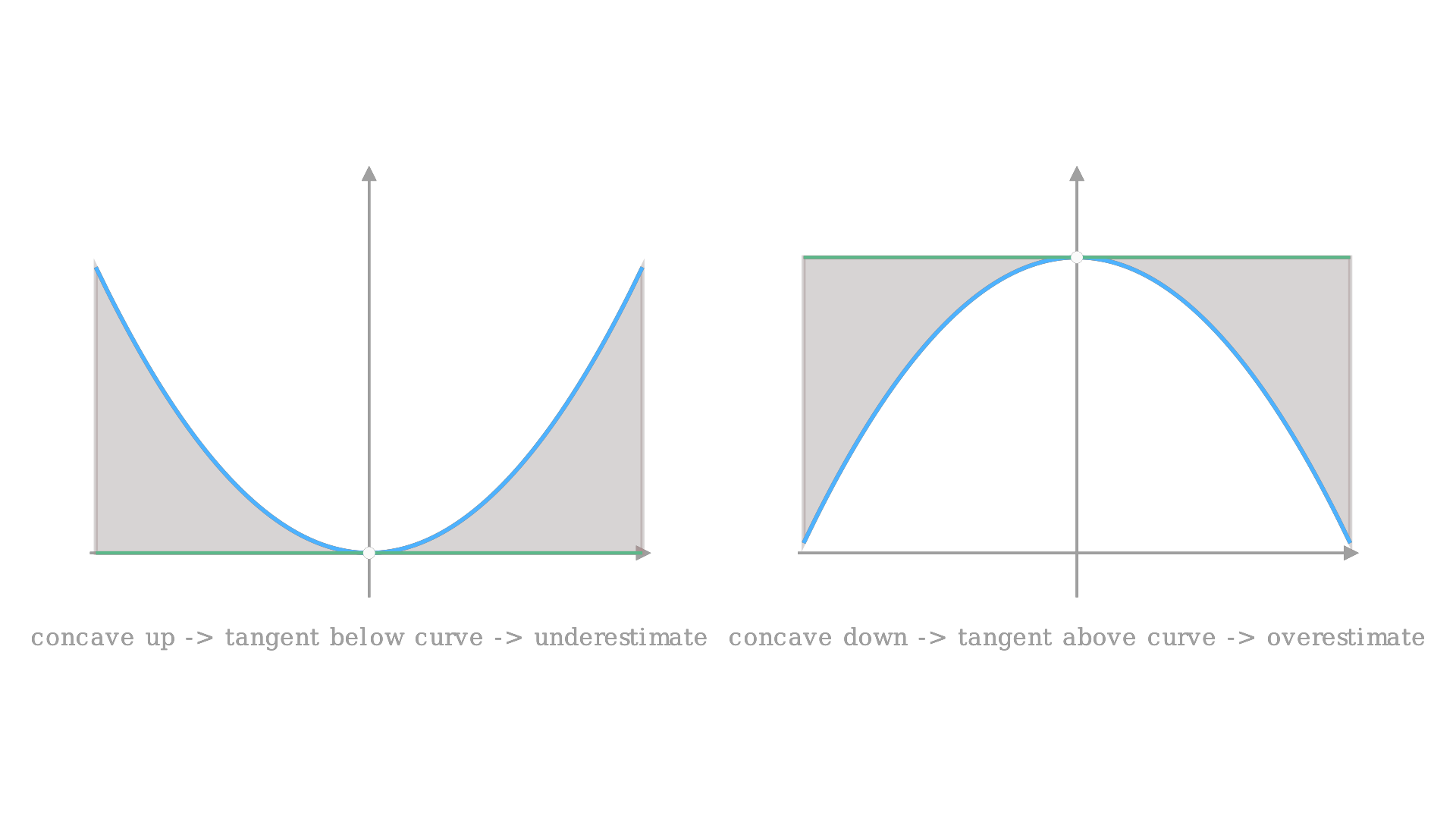
The tangent line approximation is not always on the same side of the curve. Whether it overestimates or underestimates depends on the concavity of \(f\) near the point of tangency.
切线近似并不总在曲线的同一侧。它是高估还是低估,取决于 \(f\) 在切点附近的凹凸性(concavity)。
concave up)(\(f'' > 0\)),切线位于曲线下方,因此线性近似是低估。若 \(f\) 在 \(a\) 附近下凹(concave down)(\(f'' < 0\)),切线位于曲线上方,因此线性近似是高估。可以这样记忆:上凹像一只碗:任意点处的切线都贴在碗底之下。
Worked Example: Approximating \(\sqrt{26}\)例题:近似 \(\sqrt{26}\)
Use the linearization of \(f(x) = \sqrt{x}\) at \(a = 25\) to approximate \(\sqrt{26}\).
用 \(f(x) = \sqrt{x}\) 在 \(a = 25\) 处的线性近似来估算 \(\sqrt{26}\)。
Step 1: Compute \(f(a)\) and \(f'(a)\)
第 1 步:求 \(f(a)\) 与 \(f'(a)\)
\[ f(25)=\sqrt{25}=5 \] \[ f'(x)=\frac{1}{2\sqrt{x}} \quad \Rightarrow \quad f'(25)=\frac{1}{2\cdot 5}=\frac{1}{10} \]Step 2: Build the linearization
第 2 步:构造线性近似
\[ L(x)=f(a)+f'(a)(x-a)=5+\frac{1}{10}(x-25) \]Step 3: Approximate the target value
第 3 步:近似目标值
\[ L(26)=5+\frac{1}{10}(26-25)=5+0.1=5.1 \]Step 4: Check whether the estimate is high or low
第 4 步:判断估计偏高还是偏低
\[ f''(x)=-\frac{1}{4x^{3/2}}<0 \]Because \(f\) is concave down near \(x=25\), the tangent line lies above the curve. Therefore, \(5.1\) is an overestimate of \(\sqrt{26}\).
因为 \(f\) 在 \(x=25\) 附近下凹,切线位于曲线之上。因此 \(5.1\) 是 \(\sqrt{26}\) 的高估。
Worked Example: Approximating from a Derivative Formula例题:由导数公式进行近似
A function satisfies \(f(1)=4\) and \(f'(x)=\sqrt{x+3}\). Use the tangent line at \(x=1\) to approximate \(f(1.2)\), and decide whether the estimate is too large or too small.
某函数满足 \(f(1)=4\) 且 \(f'(x)=\sqrt{x+3}\)。用 \(x=1\) 处的切线估算 \(f(1.2)\),并判断估计值偏大还是偏小。
Step 1: Find the slope at \(x=1\)
第 1 步:求 \(x=1\) 处的斜率
\[ f'(1)=\sqrt{1+3}=2 \]Step 2: Build the tangent line and evaluate
第 2 步:写出切线并求值
\[ L(x)=4+2(x-1),\qquad L(1.2)=4+2(0.2)=4.4 \]Step 3: Use concavity to judge the error
第 3 步:用凹凸性判断误差
\[ f''(x)=\frac{1}{2\sqrt{x+3}}>0\quad\text{for } x>-3 \]\(f\) is concave up on \([1,1.2]\), so the tangent line lies below the graph: \(f(1.2)\approx 4.4\) is an underestimate.
\(f\) 在 \([1,1.2]\) 上上凹,所以切线位于图像下方:\(f(1.2)\approx 4.4\) 是低估。
To justify "overestimate" or "underestimate", cite the sign of \(f''\) on the interval between \(a\) and the target \(x\), for example "\(f''(x)<0\) on \([25,26]\), so the graph is concave down and the tangent line lies above it". The sign of \(f'\) says nothing about the direction of the error.
要论证"高估"或"低估",就引用 \(f''\) 在 \(a\) 与目标 \(x\) 之间区间上的符号,例如"\(f''(x)<0\) 在 \([25,26]\) 上成立,所以图像下凹,切线位于其上方"。\(f'\) 的符号与误差方向无关。
Given \(f(2)=5\) and \(f'(2)=-3\), use the tangent line at \(x=2\) to approximate \(f(1.9)\).已知 \(f(2)=5\) 与 \(f'(2)=-3\),用 \(x=2\) 处的切线估算 \(f(1.9)\)。
\(L(1.9)=5+(-3)(1.9-2)=5+0.3=5.3\).
\(L(1.9)=5+(-3)(1.9-2)=5+0.3=5.3\)。
Find the linearization of \(f(x)=\ln x\) at \(a=1\) and use it to approximate \(\ln 1.1\). Is the estimate too large or too small?求 \(f(x)=\ln x\) 在 \(a=1\) 处的线性近似,并用它估算 \(\ln 1.1\)。估计值偏大还是偏小?
\(f(1)=0\), \(f'(1)=1\), so \(L(x)=x-1\) and \(L(1.1)=0.1\). Since \(f''(x)=-\frac{1}{x^2}<0\), the graph is concave down and \(0.1\) is an overestimate (indeed \(\ln 1.1\approx 0.0953\)).
\(f(1)=0\),\(f'(1)=1\),所以 \(L(x)=x-1\),\(L(1.1)=0.1\)。由于 \(f''(x)=-\frac{1}{x^2}<0\),图像下凹,\(0.1\) 是高估(事实上 \(\ln 1.1\approx 0.0953\))。
Use the tangent line to \(y=e^x\) at \(x=0\) to approximate \(e^{0.2}\), and explain from Figure 2's idea why the estimate is on the low side.用 \(y=e^x\) 在 \(x=0\) 处的切线估算 \(e^{0.2}\),并按图 2 的思路解释为什么估计值偏低。
\(L(x)=1+x\), so \(e^{0.2}\approx 1.2\). Because \(\frac{d^2}{dx^2}e^x=e^x>0\), the graph is concave up and the tangent line lies below it, so \(1.2\) is an underestimate (indeed \(e^{0.2}\approx 1.2214\)).
\(L(x)=1+x\),所以 \(e^{0.2}\approx 1.2\)。因为 \(\frac{d^2}{dx^2}e^x=e^x>0\),图像上凹,切线位于其下方,所以 \(1.2\) 是低估(事实上 \(e^{0.2}\approx 1.2214\))。
Using L'Hôpital's Rule for Indeterminate Forms
用洛必达法则(L'Hôpital's rule)处理不定式(indeterminate form)
- Identify the forms \(\frac{0}{0}\) and \(\frac{\infty}{\infty}\) by evaluating the limits of numerator and denominator.
- Apply L'Hôpital's Rule by differentiating the numerator and the denominator separately.
- Apply the rule again when the new limit is still indeterminate.
- Rewrite a \(0 \cdot \infty\) product as a quotient before applying the rule.
- Explain why the rule gives a wrong answer when the form is not indeterminate.
- 分别求分子、分母的极限,辨识 \(\frac{0}{0}\) 与 \(\frac{\infty}{\infty}\) 形式。
- 分别对分子和分母求导来应用洛必达法则。
- 当新的极限仍是不定式时再次应用该法则。
- 在应用法则之前把 \(0 \cdot \infty\) 型乘积改写成商。
- 解释为什么形式不是不定式时,该法则会给出错误答案。
Sometimes direct substitution into a limit yields \(\frac{0}{0}\) or \(\frac{\infty}{\infty}\), forms that are called indeterminate because they do not have a definite value without further analysis. L'Hôpital's Rule provides an elegant resolution: under these conditions, the limit of the ratio equals the limit of the ratio of the derivatives.
有时直接代入求极限会得到 \(\frac{0}{0}\) 或 \(\frac{\infty}{\infty}\),这类形式称为不定式,因为不做进一步分析无法确定其值。洛必达法则给出了一个优雅的解决方法:在这些条件下,比值的极限等于导数之比的极限(limit)。
quotient rule)。不要把 \(\frac{f}{g}\) 当作一个整体分式来求导。
Worked Example: \(\displaystyle\lim_{x \to 0}\frac{\sin x}{x}\)例题:\(\displaystyle\lim_{x \to 0}\frac{\sin x}{x}\)
Step 1: Verify the indeterminate form
第 1 步:验证不定式形式
\[ \lim_{x\to 0}\frac{\sin x}{x} \to \frac{\sin 0}{0}=\frac{0}{0} \]Since the form is \(\frac{0}{0}\), L'Hôpital's Rule applies.
由于形式为 \(\frac{0}{0}\),洛必达法则适用。
Step 2: Differentiate numerator and denominator separately
第 2 步:分别对分子、分母求导
\[ \lim_{x\to 0}\frac{\sin x}{x}=\lim_{x\to 0}\frac{\cos x}{1} \]Step 3: Evaluate the simplified limit
第 3 步:求出简化后的极限
\[ \lim_{x\to 0}\frac{\cos x}{1}=\frac{\cos 0}{1}=1 \]Worked Example: Applying L'Hôpital's Rule Twice例题:两次应用洛必达法则
Find \(\displaystyle\lim_{x \to 0}\frac{1 - \cos x}{x^2}\).
求 \(\displaystyle\lim_{x \to 0}\frac{1 - \cos x}{x^2}\)。
Step 1: Check the original form
第 1 步:检查原始形式
\[ \lim_{x\to 0}\frac{1-\cos x}{x^2}\to \frac{1-\cos 0}{0^2}=\frac{0}{0} \]So L'Hôpital's Rule applies.
因此洛必达法则适用。
Step 2: Apply L'Hôpital's Rule once
第 2 步:应用一次洛必达法则
\[ \lim_{x\to 0}\frac{1-\cos x}{x^2}=\lim_{x\to 0}\frac{\sin x}{2x} \]Step 3: Check again
第 3 步:再次检查
\[ \lim_{x\to 0}\frac{\sin x}{2x}\to \frac{0}{0} \]The result is still indeterminate, so apply L'Hôpital's Rule a second time.
结果仍为不定式,因此再次应用洛必达法则。
Step 4: Apply L'Hôpital's Rule again and evaluate
第 4 步:再次应用洛必达法则并求值
\[ \lim_{x\to 0}\frac{\sin x}{2x}=\lim_{x\to 0}\frac{\cos x}{2}=\frac{\cos 0}{2}=\frac{1}{2} \]Worked Example: Rewriting \(0 \cdot \infty\) for L'Hôpital (\(\displaystyle\lim_{x \to 0^+}\, x \ln x\))例题:把 \(0 \cdot \infty\) 改写后再用洛必达(\(\displaystyle\lim_{x \to 0^+}\, x \ln x\))
L'Hôpital does not apply directly to a \(0 \cdot \infty\) form. The strategy is to move one factor to the denominator so the limit becomes \(\frac{0}{0}\) or \(\frac{\infty}{\infty}\), then apply L'Hôpital.
洛必达法则不能直接用于 \(0 \cdot \infty\) 形式。策略是把其中一个因子移到分母,使极限变成 \(\frac{0}{0}\) 或 \(\frac{\infty}{\infty}\),再用洛必达。
Step 1: Identify the indeterminate form
第 1 步:辨明不定式形式
As \(x \to 0^+\): \(x \to 0\) and \(\ln x \to -\infty\). So the form is \(0 \cdot (-\infty)\). This is indeterminate, but L'Hôpital does not apply yet; we need a quotient.
当 \(x \to 0^+\) 时:\(x \to 0\) 且 \(\ln x \to -\infty\)。因此形式为 \(0 \cdot (-\infty)\)。这是不定式,但此时洛必达法则还不适用:我们需要一个商。
Step 2: Rewrite as \(\frac{\infty}{\infty}\)
第 2 步:改写为 \(\frac{\infty}{\infty}\)
Move \(x\) into the denominator as \(\dfrac{1}{1/x}\):
把 \(x\) 写成 \(\dfrac{1}{1/x}\) 移入分母:
\[ x \ln x \;=\; \dfrac{\ln x}{\,1/x\,} \]As \(x \to 0^+\): \(\ln x \to -\infty\) and \(\dfrac{1}{x} \to +\infty\). The new form is \(\dfrac{-\infty}{+\infty}\), so now L'Hôpital applies.
当 \(x \to 0^+\) 时:\(\ln x \to -\infty\) 且 \(\dfrac{1}{x} \to +\infty\)。新的形式为 \(\dfrac{-\infty}{+\infty}\),现在可以用洛必达了。
Step 3: Apply L'Hôpital's Rule
第 3 步:应用洛必达法则
\[ \lim_{x\to 0^+}\frac{\ln x}{1/x} \;=\; \lim_{x\to 0^+}\frac{\,1/x\,}{-1/x^{2}} \;=\; \lim_{x\to 0^+}\frac{1}{x}\cdot\bigl(-x^{2}\bigr) \;=\; \lim_{x\to 0^+}\bigl(-x\bigr) \]Step 4: Evaluate
第 4 步:求值
\[ \lim_{x\to 0^+}\bigl(-x\bigr) \;=\; 0 \]Therefore \(\displaystyle\lim_{x\to 0^+}x\ln x = 0\).
因此 \(\displaystyle\lim_{x\to 0^+}x\ln x = 0\)。
Before writing "by L'Hôpital's Rule", show the check in one line, such as "\(\lim_{x\to 0}(e^x-1)=0\) and \(\lim_{x\to 0}x=0\)". Keep the limit notation on every line until the final value; dropping "lim" turns the work into a false equation.
在写"由洛必达法则"之前,用一行写出验证,例如"\(\lim_{x\to 0}(e^x-1)=0\) 且 \(\lim_{x\to 0}x=0\)"。在得到最终值之前,每一行都保留极限记号;漏写"lim"会使过程变成错误的等式。
Evaluate \(\displaystyle\lim_{x\to 0}\frac{\sin 3x}{x}\).求 \(\displaystyle\lim_{x\to 0}\frac{\sin 3x}{x}\)。
The form is \(\frac{0}{0}\). Differentiating top and bottom: \(\lim_{x\to 0}\frac{3\cos 3x}{1}=3\).
形式为 \(\frac{0}{0}\)。分子分母分别求导:\(\lim_{x\to 0}\frac{3\cos 3x}{1}=3\)。
Evaluate \(\displaystyle\lim_{x\to\infty}\frac{\ln x}{x}\).求 \(\displaystyle\lim_{x\to\infty}\frac{\ln x}{x}\)。
The form is \(\frac{\infty}{\infty}\). Then \(\lim_{x\to\infty}\frac{1/x}{1}=0\).
形式为 \(\frac{\infty}{\infty}\)。于是 \(\lim_{x\to\infty}\frac{1/x}{1}=0\)。
A student writes \(\displaystyle\lim_{x\to 0}\frac{x+1}{x+2}=\lim_{x\to 0}\frac{1}{1}=1\). What is wrong, and what is the correct limit?某学生写出 \(\displaystyle\lim_{x\to 0}\frac{x+1}{x+2}=\lim_{x\to 0}\frac{1}{1}=1\)。错在哪里?正确的极限是多少?
The form at \(x=0\) is \(\frac{1}{2}\), not indeterminate, so L'Hôpital's Rule does not apply. Direct substitution gives the correct limit \(\frac{1}{2}\).
在 \(x=0\) 处形式为 \(\frac{1}{2}\),不是不定式,所以洛必达法则不适用。直接代入得到正确的极限 \(\frac{1}{2}\)。
Exam Strategy
应试策略
Multiple Choice: Contextual Interpretation
A multiple-choice item may list several interpretations of a derivative and ask which one is correct. Look for the answer that includes: (1) a specific time/input, (2) "increasing" or "decreasing", (3) the correct magnitude, and (4) correct units. Wrong options often swap units, confuse total change with rate, or omit "per unit."
选择题:情境解读
选择题可能列出一个导数的几种解读,问哪一项正确。要找包含以下四个要素的选项:(1) 具体的时刻/输入值,(2) "递增"或"递减",(3) 正确的数值大小,(4) 正确的单位。错误选项常常会换错单位、把总变化与变化率混淆,或漏掉"每单位"。
Free Response: Related Rates
Show the reasoning, not just the number: the equation you start with, the derivative step, the substitution step, and the interpretation with units. A bare numerical answer with no equation is an incomplete solution.
自由回答:相关变化率
要写出推理过程而不只是数值:所用的方程、求导的步骤、代入的步骤,以及带单位的解读。只有数值而没有方程的解答是不完整的。
Table Problems
When a function is given by a table and you're asked for a rate of change at a specific point, use the average rate of change over the smallest interval containing that point. If asked to approximate using linearization, use the tangent line built from nearby table values.
表格题
当函数以表格形式给出,题目要求某点处的变化率时,使用包含该点的最小区间上的平均变化率。如要求用线性近似来估算,则使用由邻近表格值构造的切线。
L'Hôpital's Rule: Show the Check
In a free-response answer, state explicitly that the limit has the form $0/0$ or $\infty/\infty$ before applying L'Hôpital's Rule. Writing "by L'Hôpital's Rule" without this verification is an incomplete justification. Also remember: differentiate the numerator and denominator separately; do not use the quotient rule on the fraction.
洛必达法则:写出验证
在自由回答题中,应用洛必达法则之前要明确说明极限为 $0/0$ 或 $\infty/\infty$。只写"由洛必达法则"而不验证,论证是不完整的。另外,要分别对分子、分母求导;不要把这个分式当作整体用商的法则(quotient rule)。
Common Mistakes
常见错误
1. Missing units in interpretations. "The population is increasing at 2.4" is incomplete. It must be "2.4 thousand people per year."
2. Confusing speed with velocity. Speed \(= |v(t)|\) and is always non-negative. Saying "the speed is \(-5\)" is meaningless.
3. Substituting before differentiating in related rates. Plugging in numbers before taking \(\frac{d}{dt}\) kills the problem. Variables first, numbers after.
4. Applying L'Hôpital's without verifying the form. If the limit is not \(\frac{0}{0}\) or \(\frac{\infty}{\infty}\), L'Hôpital's Rule does not apply. Applying it anyway produces a wrong answer.
5. Using the quotient rule instead of L'Hôpital's. L'Hôpital's says differentiate top and bottom separately. It is not the derivative of the fraction.
6. Forgetting concavity when assessing over/underestimate. Without knowing whether \(f\) is concave up or down, you cannot say whether a linearization is too high or too low.
7. Saying "the derivative is changing" instead of "the quantity is changing." The derivative describes how the original quantity changes. Say "the temperature is decreasing," not "the derivative is decreasing."
1. 解读时漏写单位。"人口正以 2.4 增长"是不完整的。必须写成"每年 2.4 千人"。
2. 把速率与速度混为一谈。速率 \(= |v(t)|\),始终非负。说"速率为 \(-5\)"毫无意义。
3. 相关变化率里在求导前就代数。在 \(\frac{d}{dt}\) 之前代入数值会把问题做坏。先保留变量,后代数。
4. 不验证形式就用洛必达。如果极限不是 \(\frac{0}{0}\) 或 \(\frac{\infty}{\infty}\),洛必达法则不适用。强行使用会得到错误答案。
5. 用商的法则代替洛必达。洛必达要求分子分母分别求导,不是把整个分式作为商求导。
6. 判断高估/低估时忘记凹凸性。不知道 \(f\) 是上凹还是下凹,就无法判断线性近似偏高还是偏低。
7. 说"导数在变化"而不是"该量在变化"。导数描述原始量是如何变化的。要说"温度在降低",而不是"导数在减小"。
Flashcards
闪卡
Click any card to flip it.
点击任意卡片可翻转。
underestimate低估
\[\lim\frac{f}{g} = \lim\frac{f'}{g'}\]
overestimate高估
Unit Quiz
单元小测
Readiness Checklist
备考清单
Click each item you've mastered. Aim for 100% before exam day.
点击你已掌握的每一项。考试之前争取做到 100%。
- Interpret the derivative as a rate of change in a real-world context在现实情境中把导数解读为变化率
- Analyze straight-line motion using position, velocity, and acceleration用位置、速度和加速度分析直线运动
- Determine when an object is speeding up vs. slowing down判断物体何时加速、何时减速
- Use units correctly when interpreting derivatives in context在情境中解读导数时正确使用单位
- Set up related-rates equations from a geometric relationship由几何关系建立相关变化率方程
- Differentiate both sides of an implicit equation with respect to time对隐式方程两边关于时间求导
- Solve classic related-rates problems (ladder, cone, shadow, balloon)求解经典相关变化率问题(梯子、圆锥、影子、气球)
- Construct a linearization $L(x) = f(a) + f'(a)(x-a)$构造线性近似 $L(x) = f(a) + f'(a)(x-a)$
- Use linear approximation to estimate function values near a point用线性近似估算某点附近的函数值
- Recognize when approximation over- or underestimates (concavity)识别近似何时高估或低估(凹凸性)
- Identify indeterminate forms $0/0$ and $\infty/\infty$辨识不定式 $0/0$ 与 $\infty/\infty$
- Apply L'Hôpital's Rule with correct justification of hypotheses在正确验证前提下应用洛必达法则
- Rewrite a $0 \cdot \infty$ form as $\frac{0}{0}$ or $\frac{\infty}{\infty}$ before applying L'Hôpital (e.g., $x \ln x$)在使用洛必达前把 $0 \cdot \infty$ 改写为 $\frac{0}{0}$ 或 $\frac{\infty}{\infty}$(如 $x \ln x$)
- Select the appropriate tool (derivative rule, related rates, L'Hôpital) per problem针对每道题选择合适的工具(求导法则、相关变化率、洛必达)
AP-Style Practice Problems
AP 风格练习题
Exam-level practice for this unit: multiple-choice plus extended-response items in the AP style. Built for top-score prep; go here after you've worked through the notes and the in-page quizzes above.
本单元的考试级练习:AP 风格的选择题与简答题。为冲刺高分准备;建议在完成上方笔记和小测之后再进入。