Unit 10: Infinite Sequences
and Series
单元 10:无穷数列
与级数
Discover how the sum of infinitely many terms can converge to a finite value. Master convergence tests, Taylor & Maclaurin series, and error bounds.
探索无穷多项之和如何收敛到一个有限值。掌握各类收敛判别法、泰勒与麦克劳林级数,以及误差界。
Defining Convergent & Divergent Infinite Series
定义收敛与发散的无穷级数
- Define the $n$th partial sum $S_n$ of a series.
- State the definition of a convergent series in terms of $\lim_{n\to\infty} S_n$.
- Distinguish a convergent sequence of terms from a convergent series.
- Calculate the sum of a telescoping or geometric series from a formula for $S_n$.
- Explain why $a_n \to 0$ alone does not show that a series converges.
- 定义级数的第 $n$ 个部分和 $S_n$。
- 用 $\lim_{n\to\infty} S_n$ 表述级数收敛(
convergent series)的定义。 - 区分各项组成的数列收敛与级数收敛。
- 由 $S_n$ 的公式计算裂项相消级数或等比级数的和。
- 解释为什么仅有 $a_n \to 0$ 不能说明级数收敛。
infinite series)是无穷多项之和:$\displaystyle\sum_{n=1}^{\infty} a_n = a_1 + a_2 + a_3 + \cdots$。核心问题是:此和会趋近于某个有限值,还是无界增长?
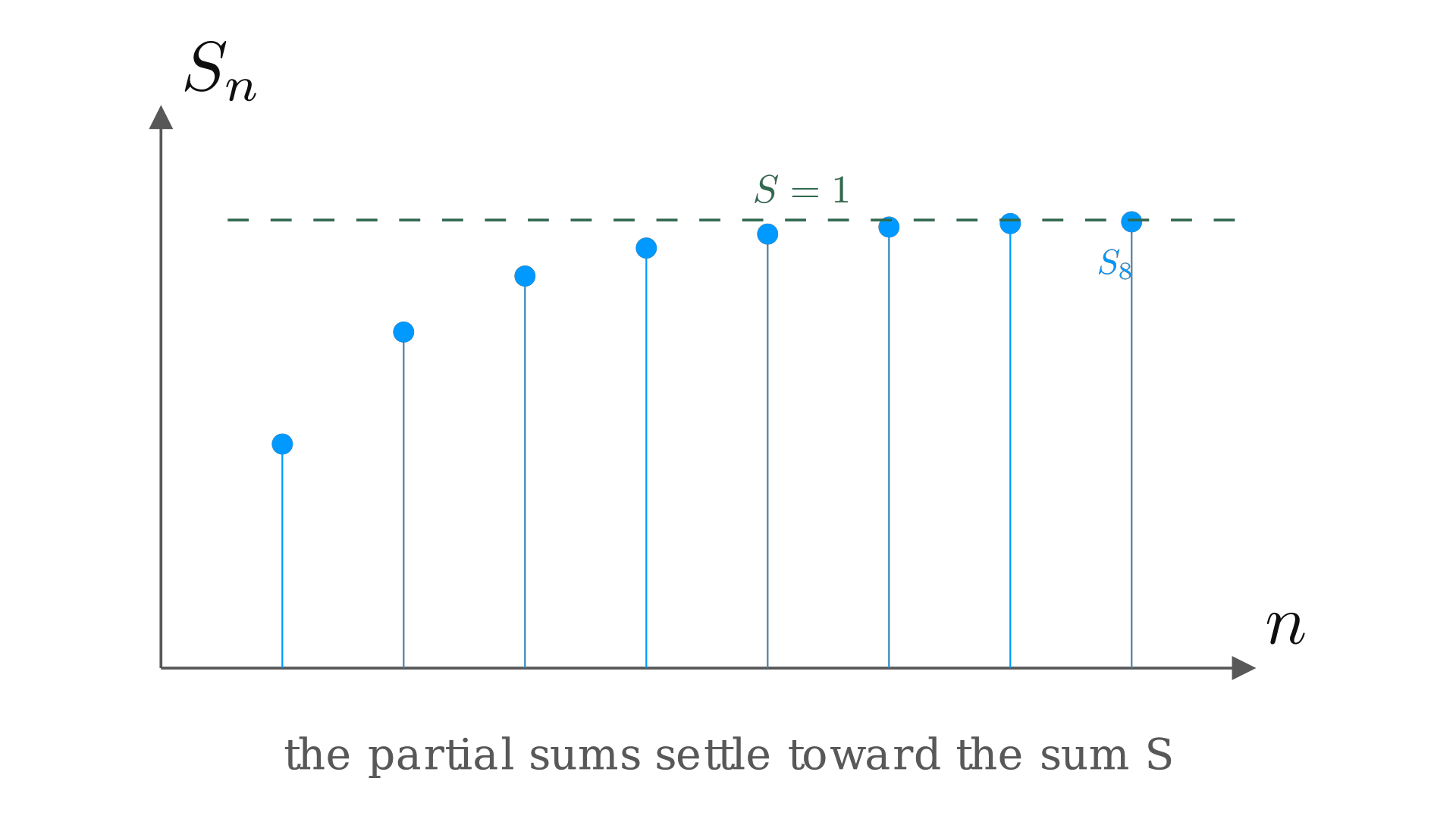
We answer this by looking at partial sums. The $n$th partial sum is $S_n = a_1 + a_2 + \cdots + a_n$. If the sequence of partial sums $\{S_n\}$ converges to a finite limit $S$, then the series converges to $S$. Otherwise, it diverges.
我们通过部分和(partial sum)来回答。第 $n$ 个部分和为 $S_n = a_1 + a_2 + \cdots + a_n$。若部分和数列(sequence of partial sums) $\{S_n\}$ 收敛(converge)到有限极限 $S$,则该级数收敛到 $S$;否则,该级数发散(diverge)。
sequence):有序的数字列表 $\{a_n\}$。看每一项(term)是否趋近某个值。
Series: The sum of a sequence. Does the running total approach a value?
级数(series):数列各项的累加。看累加和是否趋近某个值。
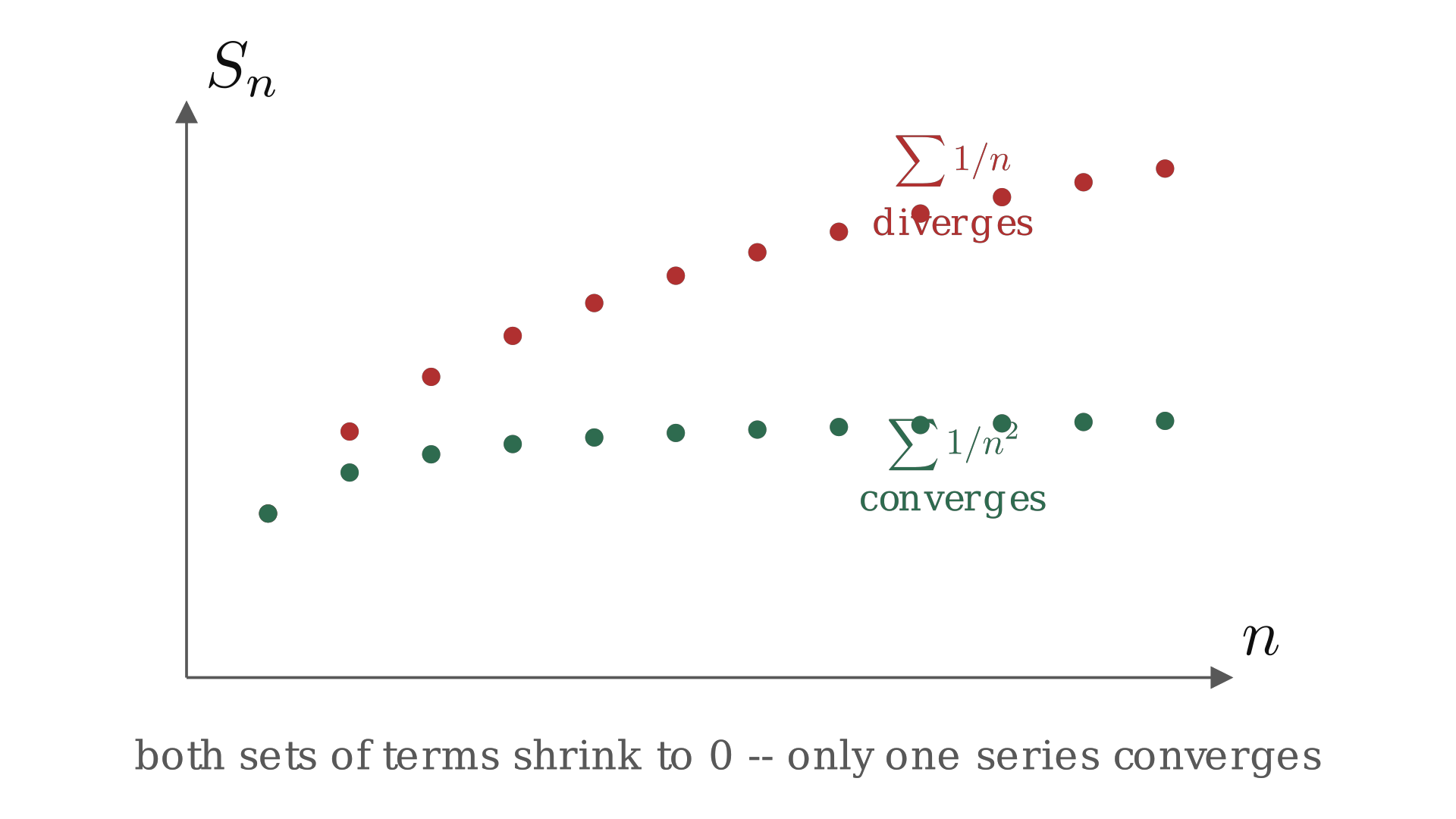
A sequence can converge while its corresponding series diverges. For example, $a_n = 1/n \to 0$, but $\sum 1/n = \infty$.
数列可以收敛而对应的级数发散。例如,$a_n = 1/n \to 0$,但 $\sum 1/n = \infty$。
Worked Example: Telescoping Series例题:裂项相消级数
Worked Example: Partial Sums of $\sum 1/2^n$例题:$\sum 1/2^n$ 的部分和
When a question gives a formula for $S_n$, the sum of the series is $\lim_{n\to\infty} S_n$, and a single term is $a_n = S_n - S_{n-1}$ for $n \ge 2$. Conclude in words with the limit shown, for example: since $\lim_{n\to\infty} S_n = 1$, the series converges to $1$. Do not confuse the limit of the terms with the limit of the partial sums.
若题目给出 $S_n$ 的公式,级数的和就是 $\lim_{n\to\infty} S_n$,单独一项为 $a_n = S_n - S_{n-1}$($n \ge 2$)。写结论时要写出极限,例如:因为 $\lim_{n\to\infty} S_n = 1$,所以级数收敛到 $1$。不要把各项的极限与部分和的极限混为一谈。
The partial sums of a series are $S_n = \dfrac{3n}{n+1}$. Find $a_5$ and the sum of the series.某级数的部分和为 $S_n = \dfrac{3n}{n+1}$。求 $a_5$ 及该级数的和。
$a_5 = S_5 - S_4 = \dfrac{15}{6} - \dfrac{12}{5} = 2.5 - 2.4 = \dfrac{1}{10}$. The sum is $\lim_{n\to\infty} \dfrac{3n}{n+1} = 3$, so the series converges to $3$.
$a_5 = S_5 - S_4 = \dfrac{15}{6} - \dfrac{12}{5} = 2.5 - 2.4 = \dfrac{1}{10}$。级数的和为 $\lim_{n\to\infty} \dfrac{3n}{n+1} = 3$,即级数收敛到 $3$。
True or false: if $\lim_{n\to\infty} a_n = 0$, then $\sum a_n$ converges.判断对错:若 $\lim_{n\to\infty} a_n = 0$,则 $\sum a_n$ 收敛。
False. The harmonic series has $a_n = 1/n \to 0$, but $\sum 1/n$ diverges. Terms tending to $0$ is necessary for convergence, not sufficient.
错误。调和级数满足 $a_n = 1/n \to 0$,但 $\sum 1/n$ 发散。各项趋于 $0$ 是收敛的必要条件,而非充分条件。
Find the sum of $\displaystyle\sum_{n=1}^{\infty}\left(\frac1n-\frac{1}{n+2}\right)$.求 $\displaystyle\sum_{n=1}^{\infty}\left(\frac1n-\frac{1}{n+2}\right)$ 的和。
Writing out the terms, everything cancels except the first two positive parts and the last two negative parts: $S_n = 1 + \tfrac12 - \tfrac{1}{n+1} - \tfrac{1}{n+2}$. As $n \to \infty$, $S_n \to \tfrac32$, so the series converges to $\tfrac32$.
写出各项后,除了前两个正项和最后两个负项外全部相消:$S_n = 1 + \tfrac12 - \tfrac{1}{n+1} - \tfrac{1}{n+2}$。当 $n \to \infty$ 时 $S_n \to \tfrac32$,所以级数收敛到 $\tfrac32$。
Working with Geometric Series
处理等比级数
- Identify the first term $a$ and ratio $r$ of a geometric series written in any form.
- State that a geometric series with $a \ne 0$ converges if and only if $|r| < 1$.
- Calculate the sum $\dfrac{a}{1-r}$, using the first term actually written.
- Explain why the series diverges when $|r| \ge 1$.
- Write a repeating decimal as a geometric series and as a fraction.
- 识别任意形式的等比级数的首项 $a$ 与公比 $r$。
- 说明首项 $a \ne 0$ 的等比级数当且仅当 $|r| < 1$ 时收敛。
- 用实际写出的首项计算和 $\dfrac{a}{1-r}$。
- 解释当 $|r| \ge 1$ 时级数为何发散。
- 把循环小数写成等比级数并化为分数。
A geometric series has a constant ratio $r$ between consecutive terms. It is the most important series to recognize because it is one of the few with a clean closed-form sum.
等比级数(geometric series)相邻两项之比为常数 $r$。这是最重要的可识别级数,因为它是少数有简洁闭式求和公式的级数之一。
For $a \ne 0$: converges if and only if $|r| < 1$; diverges if $|r| \geq 1$.
当 $a \ne 0$ 时:当且仅当 $|r| < 1$ 时收敛;当 $|r| \geq 1$ 时发散。
Worked Example: Geometric Series例题:等比级数
Worked Example: A Repeating Decimal例题:循环小数
Before writing $\dfrac{a}{1-r}$, state $|r| < 1$ as the reason the series converges. Take $a$ to be the first term of the series as written: $\sum_{n=1}^{\infty}(2/3)^n$ starts at $2/3$, so its sum is $2$, not $3$.
写 $\dfrac{a}{1-r}$ 之前,先写明 $|r| < 1$ 作为收敛的理由。$a$ 取级数实际写出的第一项:$\sum_{n=1}^{\infty}(2/3)^n$ 从 $2/3$ 开始,所以和为 $2$,而不是 $3$。
Find $\displaystyle\sum_{n=2}^{\infty}\frac{5}{3^n}$.求 $\displaystyle\sum_{n=2}^{\infty}\frac{5}{3^n}$。
The first term ($n=2$) is $5/9$ and $r = 1/3$, with $|r| < 1$. Sum $= \dfrac{5/9}{1-1/3} = \dfrac{5/9}{2/3} = \dfrac56$.
第一项($n=2$)为 $5/9$,$r = 1/3$,且 $|r| < 1$。和 $= \dfrac{5/9}{1-1/3} = \dfrac{5/9}{2/3} = \dfrac56$。
For which $x$ does $\displaystyle\sum_{n=0}^{\infty}\left(\frac{x}{3}\right)^n$ converge, and what is its sum there?$\displaystyle\sum_{n=0}^{\infty}\left(\frac{x}{3}\right)^n$ 对哪些 $x$ 收敛?收敛时和为多少?
It is geometric with $a = 1$ and $r = x/3$. It converges when $|x/3| < 1$, that is $-3 < x < 3$, and then the sum is $\dfrac{1}{1-x/3} = \dfrac{3}{3-x}$.
这是 $a = 1$、$r = x/3$ 的等比级数。当 $|x/3| < 1$,即 $-3 < x < 3$ 时收敛,此时和为 $\dfrac{1}{1-x/3} = \dfrac{3}{3-x}$。
Does $\displaystyle\sum_{n=0}^{\infty}(-1)^n$ converge?$\displaystyle\sum_{n=0}^{\infty}(-1)^n$ 是否收敛?
No. Here $r = -1$, so $|r| = 1$. The partial sums are $1, 0, 1, 0, \ldots$, which have no finite limit, and that is what divergence means. The $n$th term test confirms it: the terms do not tend to $0$, which is enough to prove divergence (but terms tending to $0$ would not prove convergence).
不收敛。此处 $r = -1$,$|r| = 1$。部分和依次为 $1, 0, 1, 0, \ldots$,没有有限的极限,这正是发散的含义。第 $n$ 项判别法也可确认:各项不趋于 $0$,这足以证明发散(但各项趋于 $0$ 并不能证明收敛)。
The $n$th Term Test for Divergence
第 $n$ 项发散判别法
- State the $n$th term test for divergence.
- Apply the test as the first check on any series.
- Calculate $\lim_{n\to\infty} a_n$ for rational, exponential and oscillating terms.
- Explain why the test is inconclusive when $\lim_{n\to\infty} a_n = 0$.
- Deduce divergence when the limit of the terms does not exist.
- 表述第 $n$ 项发散判别法。
- 把该判别法作为任何级数的第一步检查。
- 计算有理式、指数式与振荡项的 $\lim_{n\to\infty} a_n$。
- 解释当 $\lim_{n\to\infty} a_n = 0$ 时该判别法为何不能下结论。
- 当各项的极限不存在时推出级数发散。
nth-term test)harmonic series))。因此 “$\lim a_n = 0$” 不意味着级数收敛。
Worked Example: nth Term Test例题:第 n 项判别法
Worked Example: A Limit Equal to $e$例题:极限为 $e$ 的情形
Write the limit and its value, then the conclusion with the test named: $\lim_{n\to\infty} a_n = \tfrac12 \ne 0$, so the series diverges by the $n$th term test. Never use this test to claim convergence; if the limit is $0$, say the test is inconclusive and choose another test.
写出极限及其值,再写出带判别法名称的结论:$\lim_{n\to\infty} a_n = \tfrac12 \ne 0$,所以由第 $n$ 项判别法级数发散。不要用该判别法得出收敛;若极限为 $0$,应写明判别法不能下结论,再换用其他判别法。
Does $\displaystyle\sum_{n=1}^{\infty}\frac{2n^2+1}{5n^2-n}$ converge?$\displaystyle\sum_{n=1}^{\infty}\frac{2n^2+1}{5n^2-n}$ 是否收敛?
No. Dividing top and bottom by $n^2$ gives $\lim_{n\to\infty} a_n = \tfrac25 \ne 0$, so the series diverges by the $n$th term test.
不收敛。分子分母同除以 $n^2$ 得 $\lim_{n\to\infty} a_n = \tfrac25 \ne 0$,所以由第 $n$ 项判别法级数发散。
Does $\displaystyle\sum_{n=1}^{\infty}\frac{(-1)^n n}{2n+1}$ converge?$\displaystyle\sum_{n=1}^{\infty}\frac{(-1)^n n}{2n+1}$ 是否收敛?
No. $|a_n| = \dfrac{n}{2n+1} \to \tfrac12$, so the terms swing between values near $\tfrac12$ and $-\tfrac12$ and $\lim_{n\to\infty} a_n$ does not exist. Since the terms do not tend to $0$, the series diverges by the $n$th term test.
不收敛。$|a_n| = \dfrac{n}{2n+1} \to \tfrac12$,所以各项在接近 $\tfrac12$ 与 $-\tfrac12$ 的值之间摆动,$\lim_{n\to\infty} a_n$ 不存在。各项不趋于 $0$,所以由第 $n$ 项判别法级数发散。
The terms of $\displaystyle\sum_{n=1}^{\infty}\ln\frac{n}{n+1}$ tend to $0$. Does the series converge?$\displaystyle\sum_{n=1}^{\infty}\ln\frac{n}{n+1}$ 的各项趋于 $0$。该级数是否收敛?
The $n$th term test is inconclusive. Write $a_n = \ln n - \ln(n+1)$; the sum telescopes to $S_n = \ln 1 - \ln(n+1) = -\ln(n+1)$, which tends to $-\infty$. The series diverges even though $a_n \to 0$.
第 $n$ 项判别法不能下结论。写成 $a_n = \ln n - \ln(n+1)$,求和时裂项相消得 $S_n = \ln 1 - \ln(n+1) = -\ln(n+1)$,趋于 $-\infty$。虽然 $a_n \to 0$,级数仍发散。
Integral Test for Convergence
收敛的积分判别法
- State the hypotheses of the integral test: $f$ positive, continuous and decreasing for $x \ge 1$ (or from some point on), with $a_n = f(n)$.
- Verify that $f$ is decreasing with $f'(x) < 0$ or with a clear reason.
- Evaluate the improper integral $\int_1^{\infty} f(x)\,dx$ as a limit.
- Deduce whether the series converges or diverges from the integral.
- Explain why the value of the integral is not the sum of the series.
- 表述积分判别法的条件:$f$ 在 $x \ge 1$(或从某点起)上为正、连续且单调递减,且 $a_n = f(n)$。
- 用 $f'(x) < 0$ 或明确的理由验证 $f$ 单调递减。
- 以极限的形式计算反常积分 $\int_1^{\infty} f(x)\,dx$。
- 由积分推出级数收敛或发散。
- 解释为什么积分的值不是级数的和。
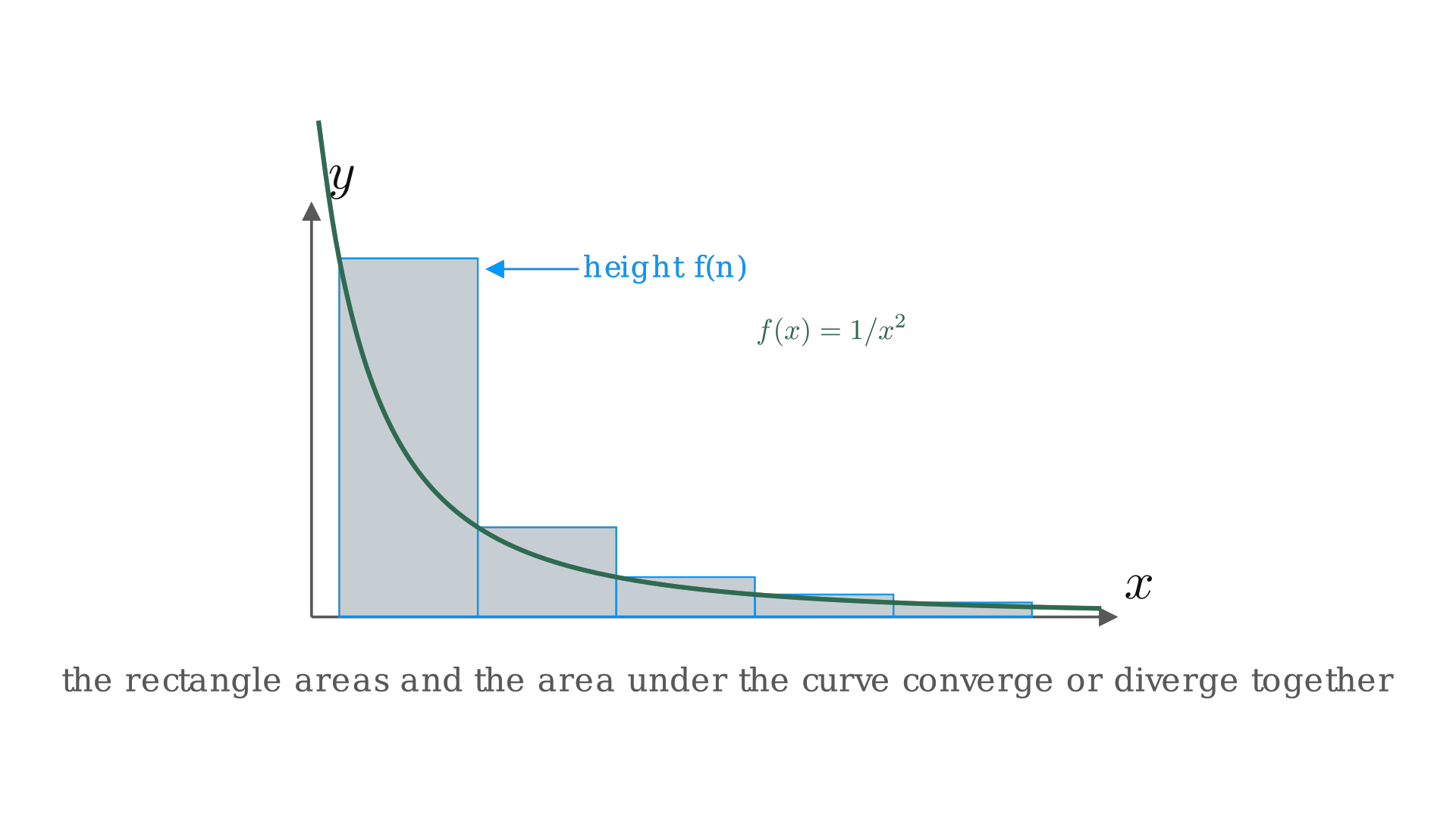
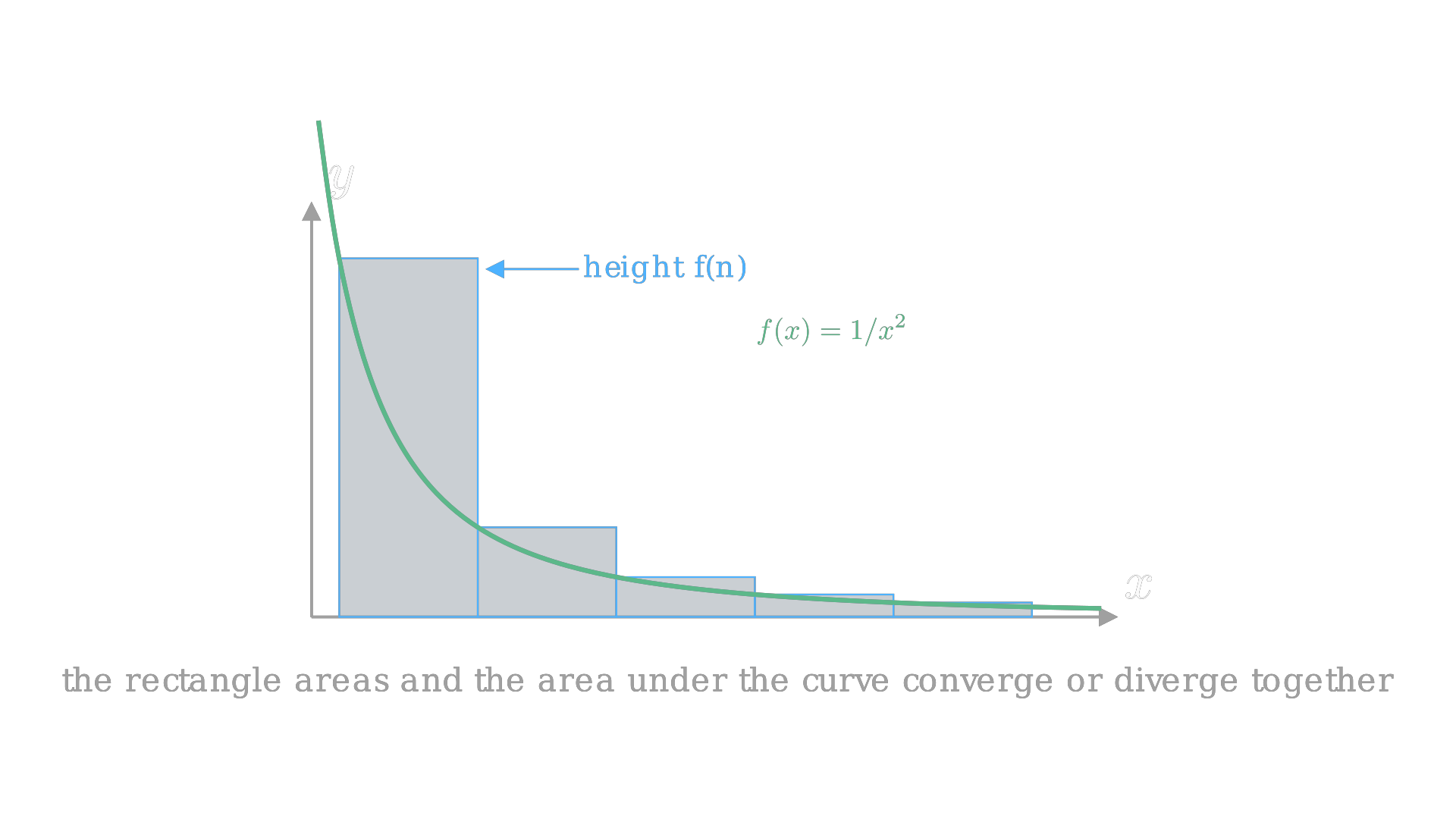
integral test)将级数与反常积分联系起来。若 $f$ 在 $[1, \infty)$ 上为正、连续且单调递减,并且 $a_n = f(n)$,则 $\sum a_n$ 与 $\int_1^{\infty} f(x)\,dx$ 同时收敛或同时发散。
Worked Example: Integral Test例题:积分判别法
Worked Example: A Series That Diverges Slowly例题:缓慢发散的级数
Start the integral at the same index as the series, show why $f$ is decreasing (a derivative or a one-line reason), write the improper integral as $\lim_{b\to\infty}$, and conclude about the series, not only the integral. The integral's value is not the series' sum.
积分的下限与级数的起始指标相同;说明 $f$ 为何单调递减(求导或一句话理由);把反常积分写成 $\lim_{b\to\infty}$ 的形式;结论要落在级数上,而不只是积分上。积分的值不是级数的和。
Use the integral test on $\displaystyle\sum_{n=1}^{\infty} n e^{-n^2}$.对 $\displaystyle\sum_{n=1}^{\infty} n e^{-n^2}$ 使用积分判别法。
$f(x) = xe^{-x^2}$ is positive and continuous for $x \ge 1$, and $f'(x) = e^{-x^2}(1-2x^2) < 0$ there, so $f$ is decreasing. $\int_1^{\infty} xe^{-x^2}\,dx = \lim_{b\to\infty}\Big[-\tfrac12 e^{-x^2}\Big]_1^{b} = \dfrac{1}{2e}$, which is finite, so the series converges.
$f(x) = xe^{-x^2}$ 在 $x \ge 1$ 上为正且连续,且 $f'(x) = e^{-x^2}(1-2x^2) < 0$,故 $f$ 单调递减。$\int_1^{\infty} xe^{-x^2}\,dx = \lim_{b\to\infty}\Big[-\tfrac12 e^{-x^2}\Big]_1^{b} = \dfrac{1}{2e}$,为有限值,所以级数收敛。
$\int_1^{\infty} \dfrac{dx}{x^2} = 1$. Is $\displaystyle\sum_{n=1}^{\infty}\frac{1}{n^2}$ equal to $1$?$\int_1^{\infty} \dfrac{dx}{x^2} = 1$。$\displaystyle\sum_{n=1}^{\infty}\frac{1}{n^2}$ 等于 $1$ 吗?
No. The integral test shows only that the series converges. Already $S_2 = 1 + \tfrac14 = 1.25 > 1$, so the sum is larger than $1$.
不等于。积分判别法只说明级数收敛。仅 $S_2 = 1 + \tfrac14 = 1.25 > 1$,所以和大于 $1$。
Why can the integral test not be applied directly to $\displaystyle\sum_{n=1}^{\infty}\frac{2+\sin n}{n^2}$? How can you decide it instead?为什么不能直接对 $\displaystyle\sum_{n=1}^{\infty}\frac{2+\sin n}{n^2}$ 使用积分判别法?应如何判定?
$f(x) = (2+\sin x)/x^2$ is not decreasing, because $\sin x$ makes it wobble, so a hypothesis fails. Instead compare: $0 < \dfrac{2+\sin n}{n^2} \le \dfrac{3}{n^2}$, and $\sum 3/n^2$ converges, so the series converges by the direct comparison test.
$f(x) = (2+\sin x)/x^2$ 因 $\sin x$ 的起伏而不单调递减,条件不满足。改用比较:$0 < \dfrac{2+\sin n}{n^2} \le \dfrac{3}{n^2}$,而 $\sum 3/n^2$ 收敛,所以由比较判别法级数收敛。
Harmonic Series and $p$-Series
调和级数与 $p$ 级数
- State the $p$-series rule: $\sum 1/n^p$ converges if $p > 1$ and diverges if $p \le 1$.
- Rewrite roots and products as a single power of $n$ to read off $p$.
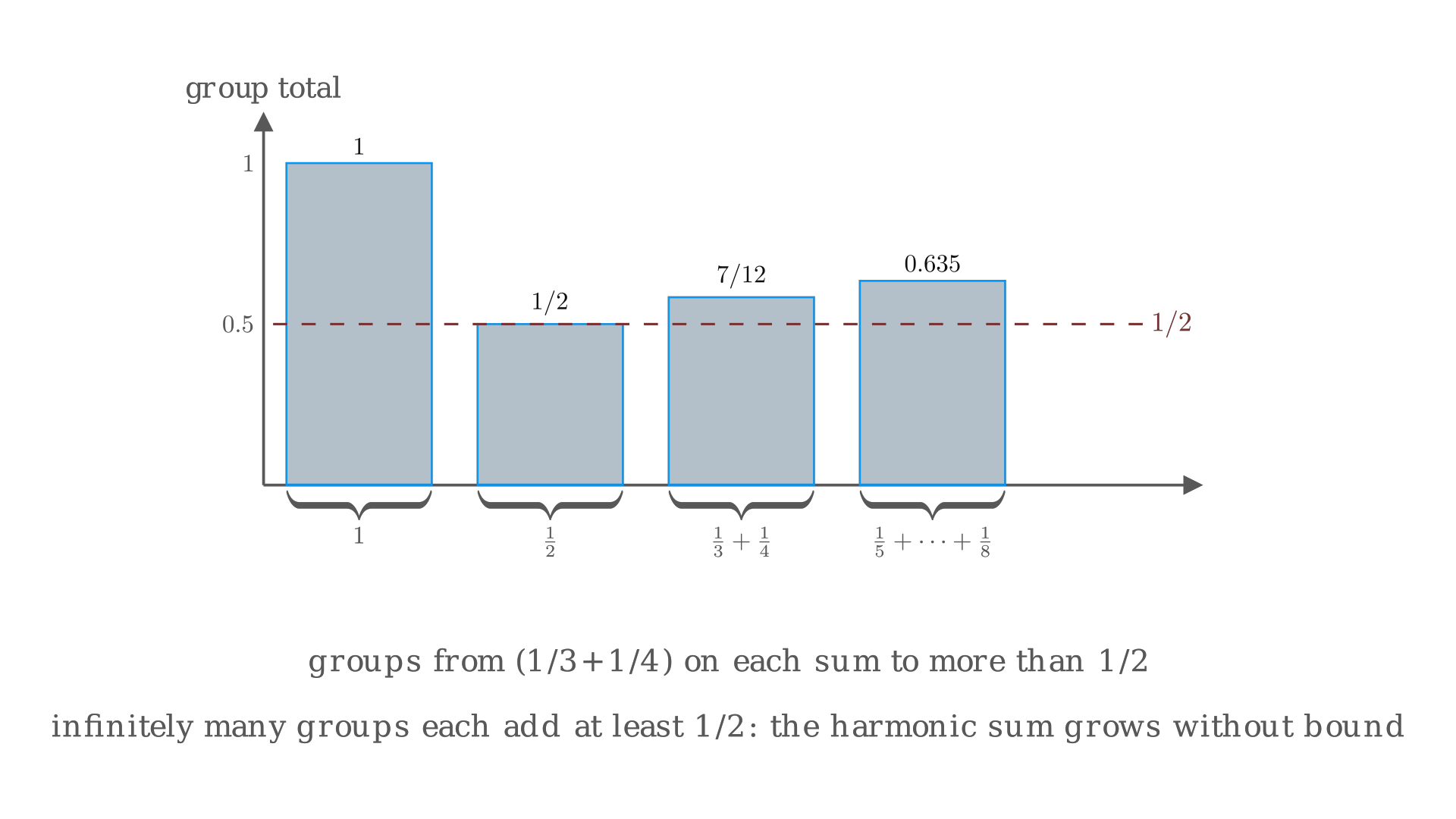
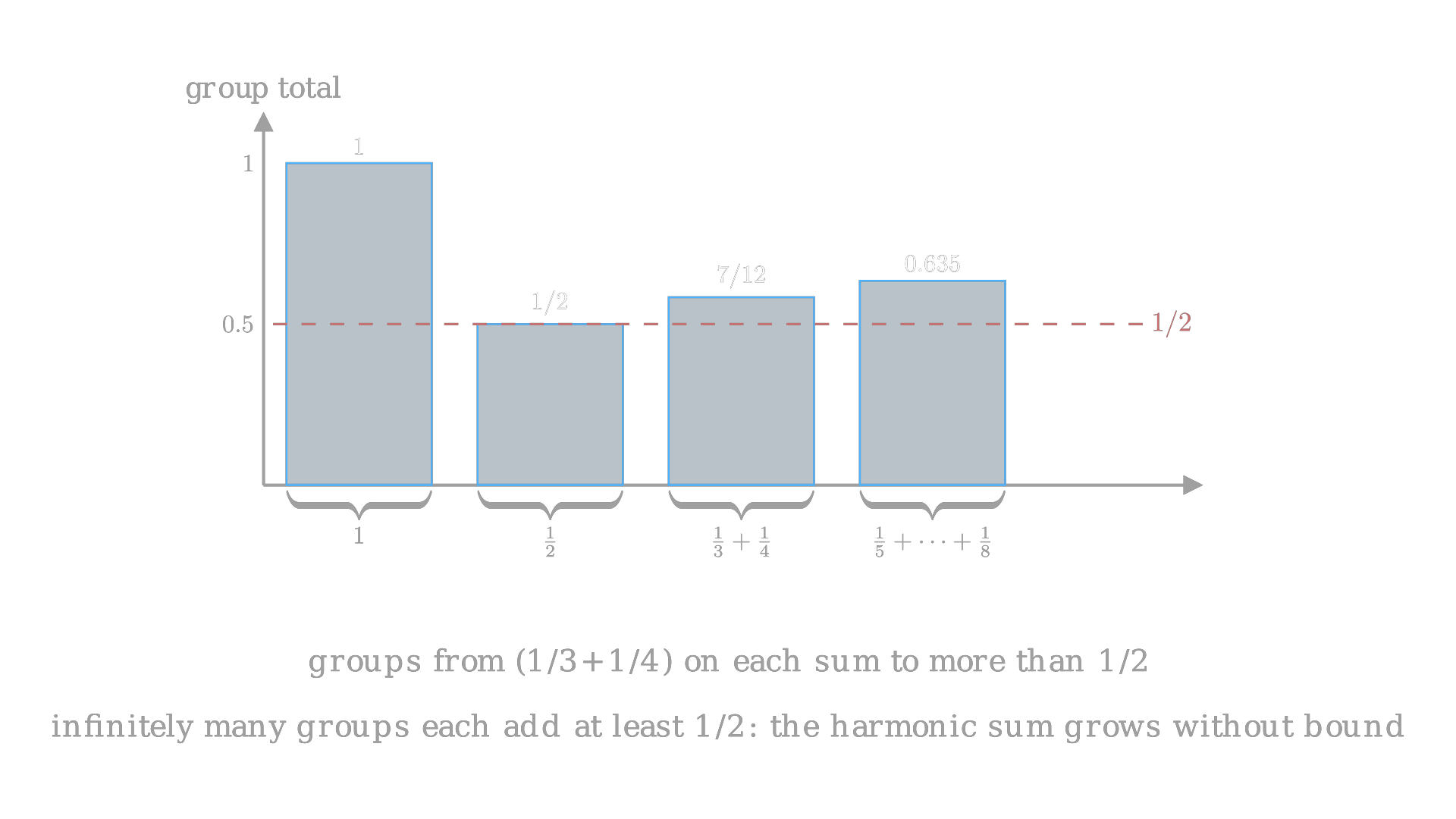
- Explain why the harmonic series diverges even though $1/n \to 0$.
- Distinguish a $p$-series $\sum 1/n^p$ from a geometric series $\sum 1/p^n$.
- Justify the $p$-series rule with the integral test.
- 表述 $p$ 级数规则:$\sum 1/n^p$ 在 $p > 1$ 时收敛,在 $p \le 1$ 时发散。
- 把根式与乘积改写为 $n$ 的单一幂次,从而读出 $p$。
- 解释为什么尽管 $1/n \to 0$,调和级数仍发散。
- 区分 $p$ 级数 $\sum 1/n^p$ 与等比级数 $\sum 1/p^n$。
- 用积分判别法论证 $p$ 级数规则。
Two important families of series that you should know by name and be able to classify instantly.
两类重要的级数族:必须能按名称识别并立刻判断其收敛性。
| Series级数 | Form形式 | Convergence收敛性 |
|---|---|---|
Harmonic Series调和级数(harmonic series) |
$\displaystyle\sum_{n=1}^{\infty} \frac{1}{n}$ | Diverges发散 |
| Alternating Harmonic交错调和级数 | $\displaystyle\sum_{n=1}^{\infty} \frac{(-1)^{n+1}}{n}$ | Converges (to $\ln 2$)收敛(到 $\ln 2$) |
$p$-Series$p$ 级数(p-series) |
$\displaystyle\sum_{n=1}^{\infty} \frac{1}{n^p}$ | Converges if $p > 1$; diverges if $p \leq 1$$p > 1$ 时收敛;$p \leq 1$ 时发散 |
Worked Example: Rewrite, Then Read Off $p$例题:先改写,再读出 $p$
Worked Example: Proving the $p$-Series Rule例题:证明 $p$ 级数规则
Convert every root to an exponent before reading $p$, and give the reason in full: a $p$-series with $p = \tfrac32 > 1$, so it converges. Check which letter is in the exponent: $\sum 1/n^2$ is a $p$-series, while $\sum 1/2^n$ is geometric.
读 $p$ 之前先把根式化为指数,并完整写出理由:这是 $p = \tfrac32 > 1$ 的 $p$ 级数,所以收敛。看清指数位置上是哪个字母:$\sum 1/n^2$ 是 $p$ 级数,而 $\sum 1/2^n$ 是等比级数。
Does $\displaystyle\sum_{n=1}^{\infty}\frac{5}{n^{0.99}}$ converge?$\displaystyle\sum_{n=1}^{\infty}\frac{5}{n^{0.99}}$ 是否收敛?
No. It is $5$ times a $p$-series with $p = 0.99 \le 1$, so it diverges.
不收敛。它是 $p = 0.99 \le 1$ 的 $p$ 级数的 $5$ 倍,所以发散。
Both $\sum_{n=1}^{\infty} 1/n^2$ and $\sum_{n=1}^{\infty} 1/2^n$ converge. Which one is a $p$-series, and which one can you sum exactly with a formula from this unit?$\sum_{n=1}^{\infty} 1/n^2$ 与 $\sum_{n=1}^{\infty} 1/2^n$ 都收敛。哪个是 $p$ 级数?哪个可以用本单元的公式求出精确和?
$\sum 1/n^2$ is the $p$-series ($p = 2$). $\sum 1/2^n$ is geometric with $a = \tfrac12$ and $r = \tfrac12$, so its sum is $\dfrac{1/2}{1-1/2} = 1$.
$\sum 1/n^2$ 是 $p$ 级数($p = 2$)。$\sum 1/2^n$ 是 $a = \tfrac12$、$r = \tfrac12$ 的等比级数,其和为 $\dfrac{1/2}{1-1/2} = 1$。
For which values of $k$ does $\displaystyle\sum_{n=1}^{\infty}\frac{1}{n^{2k-1}}$ converge?$k$ 取哪些值时 $\displaystyle\sum_{n=1}^{\infty}\frac{1}{n^{2k-1}}$ 收敛?
It is a $p$-series with $p = 2k - 1$. It converges when $2k - 1 > 1$, that is $k > 1$.
这是 $p = 2k - 1$ 的 $p$ 级数。当 $2k - 1 > 1$,即 $k > 1$ 时收敛。
Comparison Tests for Convergence
收敛的比较判别法
- State the direct comparison test, including which direction of inequality proves what.
- State the limit comparison test with positive terms and $0 < L < \infty$.
- Choose a benchmark $p$-series or geometric series from the dominant terms.
- Explain why a comparison in the wrong direction proves nothing.
- Apply each test with a written inequality or limit and a named benchmark.
- 表述比较判别法,包括不等式的哪个方向能证明什么。
- 表述极限比较判别法:各项为正且 $0 < L < \infty$。
- 根据主导项选取作为基准的 $p$ 级数或等比级数。
- 解释方向错误的比较为何什么也证明不了。
- 使用每种判别法时写出不等式或极限,并点名基准级数。
Direct Comparison Test (DCT)
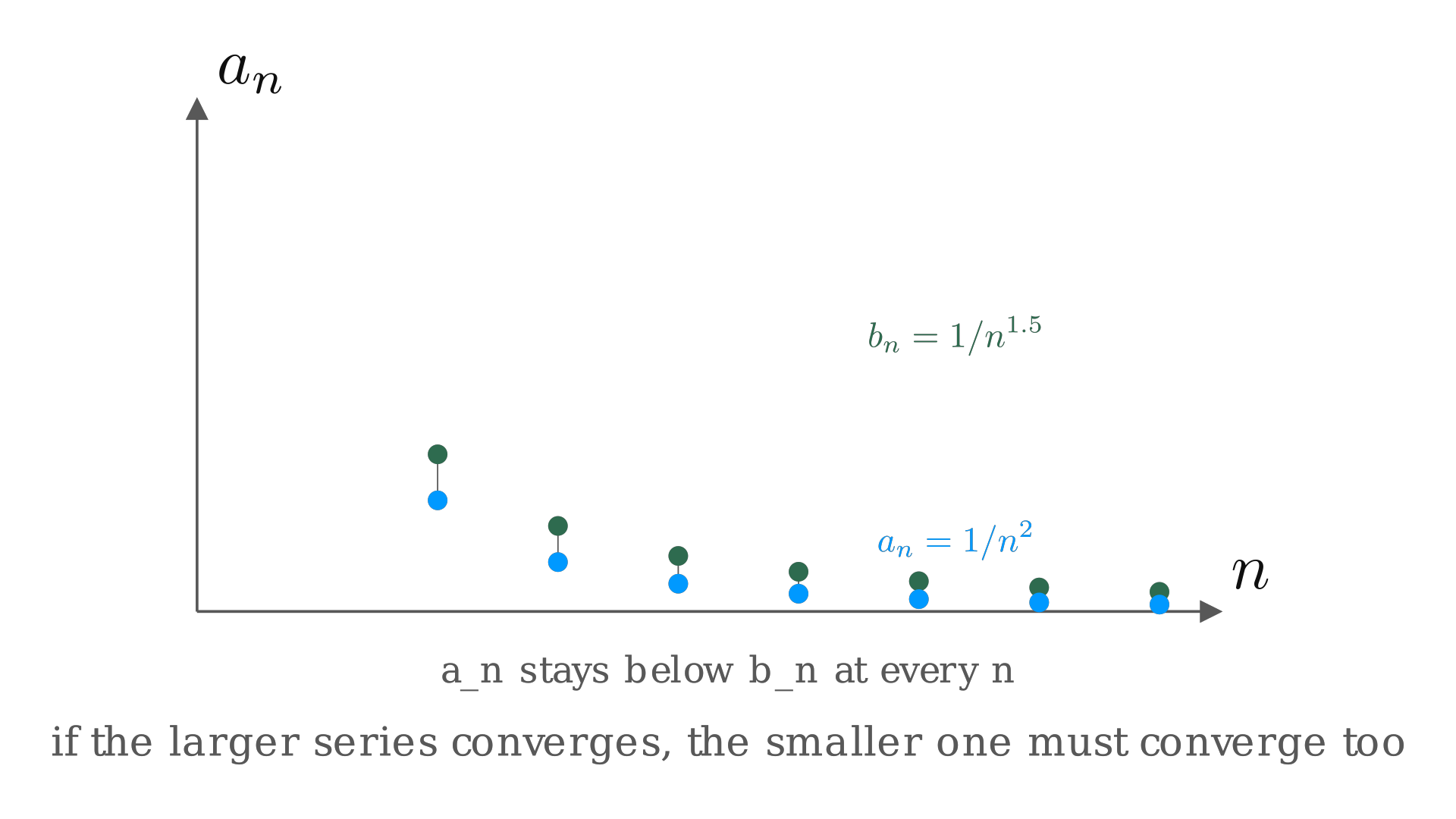
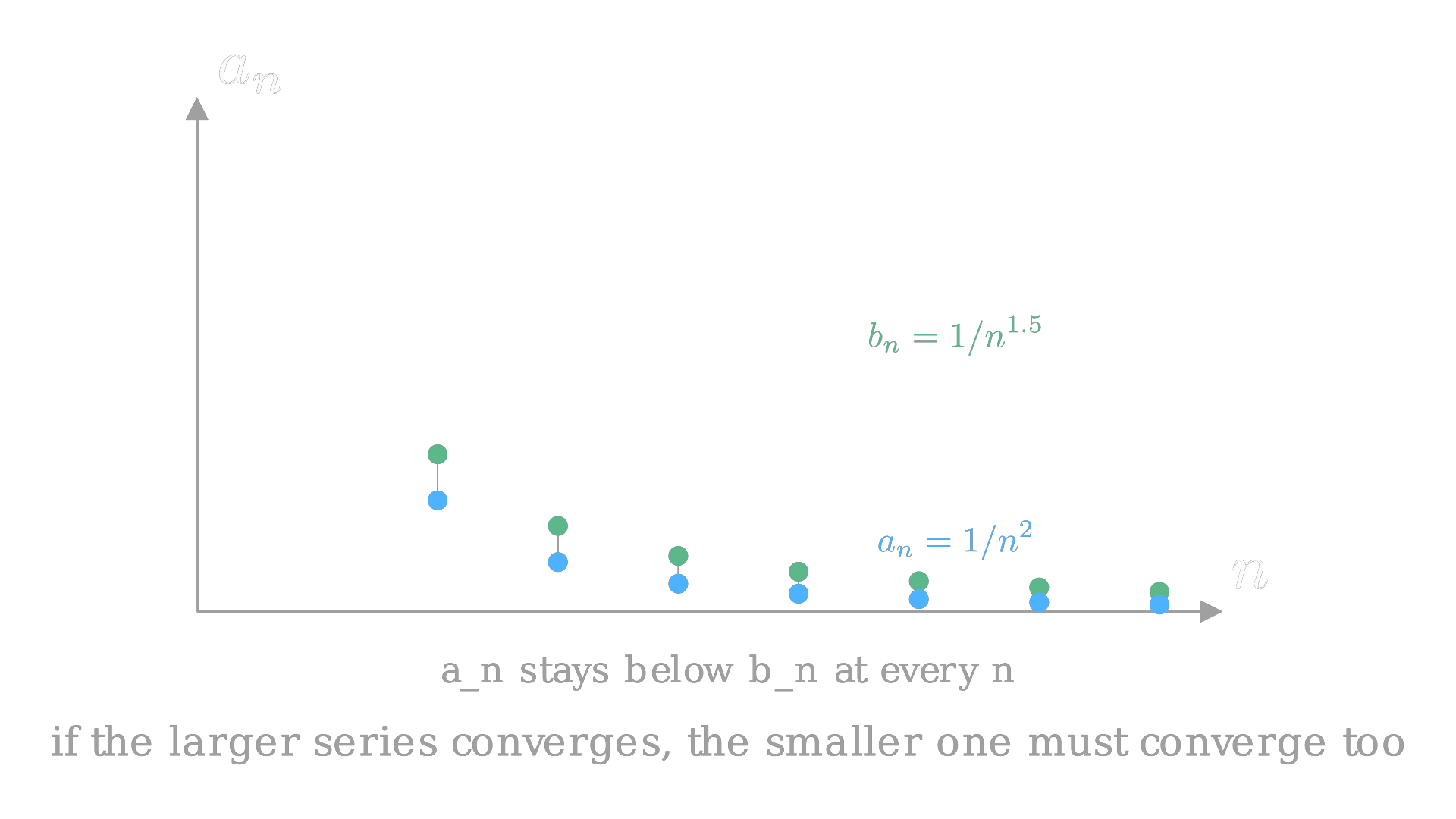
比较判别法(direct comparison test,DCT)
Limit Comparison Test (LCT)
极限比较判别法(limit comparison test,LCT)
Worked Example: Limit Comparison Test例题:极限比较判别法
Worked Example: Direct Comparison with a Geometric Series例题:与等比级数直接比较
For the direct comparison test write the inequality, its direction and the benchmark's behaviour, for example $0 < a_n \le 1/3^n$ and $\sum 1/3^n$ converges. Being smaller than a divergent series, or larger than a convergent one, proves nothing. For the limit comparison test, show the limit, state $0 < L < \infty$, and name the benchmark.
使用比较判别法时,写出不等式、其方向以及基准级数的敛散性,例如 $0 < a_n \le 1/3^n$ 且 $\sum 1/3^n$ 收敛。小于发散级数,或大于收敛级数,都证明不了什么。使用极限比较判别法时,写出极限,说明 $0 < L < \infty$,并点名基准级数。
Does $\displaystyle\sum_{n=1}^{\infty}\frac{\ln n}{n}$ converge?$\displaystyle\sum_{n=1}^{\infty}\frac{\ln n}{n}$ 是否收敛?
No. For $n \ge 3$, $\ln n > 1$, so $\dfrac{\ln n}{n} > \dfrac1n$. The harmonic series diverges, so the series diverges by the direct comparison test (dropping the first two terms does not change divergence).
不收敛。当 $n \ge 3$ 时 $\ln n > 1$,所以 $\dfrac{\ln n}{n} > \dfrac1n$。调和级数发散,所以由比较判别法级数发散(去掉前两项不影响发散性)。
A student writes $\dfrac{1}{n^2+1} < \dfrac1n$ and concludes nothing. Why, and what comparison works?某学生写出 $\dfrac{1}{n^2+1} < \dfrac1n$ 后无法下结论。为什么?哪种比较可行?
Being smaller than the divergent harmonic series gives no information. Use $\dfrac{1}{n^2+1} < \dfrac{1}{n^2}$ instead: $\sum 1/n^2$ is a convergent $p$-series ($p = 2$), so the series converges.
小于发散的调和级数不能提供任何信息。改用 $\dfrac{1}{n^2+1} < \dfrac{1}{n^2}$:$\sum 1/n^2$ 是收敛的 $p$ 级数($p = 2$),所以级数收敛。
Use the limit comparison test on $\displaystyle\sum_{n=1}^{\infty}\frac{1}{\sqrt{n^2+1}}$.对 $\displaystyle\sum_{n=1}^{\infty}\frac{1}{\sqrt{n^2+1}}$ 使用极限比较判别法。
Compare with $b_n = 1/n$: $\displaystyle\lim_{n\to\infty}\frac{a_n}{b_n} = \lim_{n\to\infty}\frac{n}{\sqrt{n^2+1}} = 1$, and $0 < 1 < \infty$. Since $\sum 1/n$ diverges, the series diverges.
与 $b_n = 1/n$ 比较:$\displaystyle\lim_{n\to\infty}\frac{a_n}{b_n} = \lim_{n\to\infty}\frac{n}{\sqrt{n^2+1}} = 1$,且 $0 < 1 < \infty$。因为 $\sum 1/n$ 发散,所以级数发散。
Alternating Series Test for Convergence
交错级数收敛判别法
- State the three conditions of the alternating series test: $b_n > 0$, $b_n$ decreasing (at least eventually), and $\lim_{n\to\infty} b_n = 0$.
- Verify that $b_n$ is decreasing with algebra or with $f'(x) < 0$.
- Apply the test to series written with $(-1)^n$ or $(-1)^{n+1}$.
- Explain why failing a condition makes the test inconclusive, not a proof of divergence.
- Use the $n$th term test when $b_n$ does not tend to $0$.
- 表述交错级数判别法的三个条件:$b_n > 0$,$b_n$ 单调递减(至少从某项起),且 $\lim_{n\to\infty} b_n = 0$。
- 用代数方法或 $f'(x) < 0$ 验证 $b_n$ 单调递减。
- 对用 $(-1)^n$ 或 $(-1)^{n+1}$ 写出的级数应用该判别法。
- 解释为何某个条件不满足只说明判别法不能下结论,而不是证明发散。
- 当 $b_n$ 不趋于 $0$ 时改用第 $n$ 项判别法。
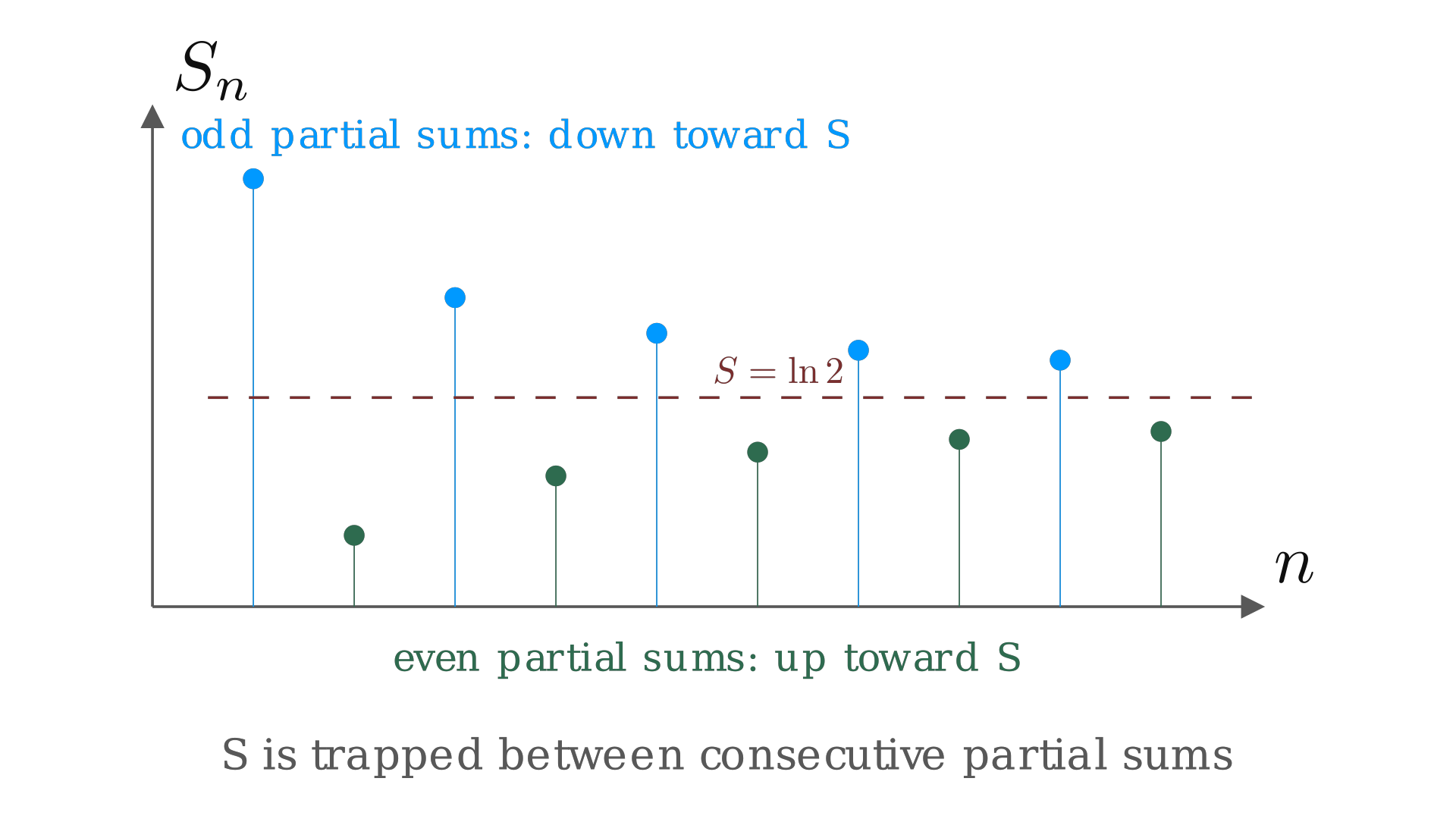
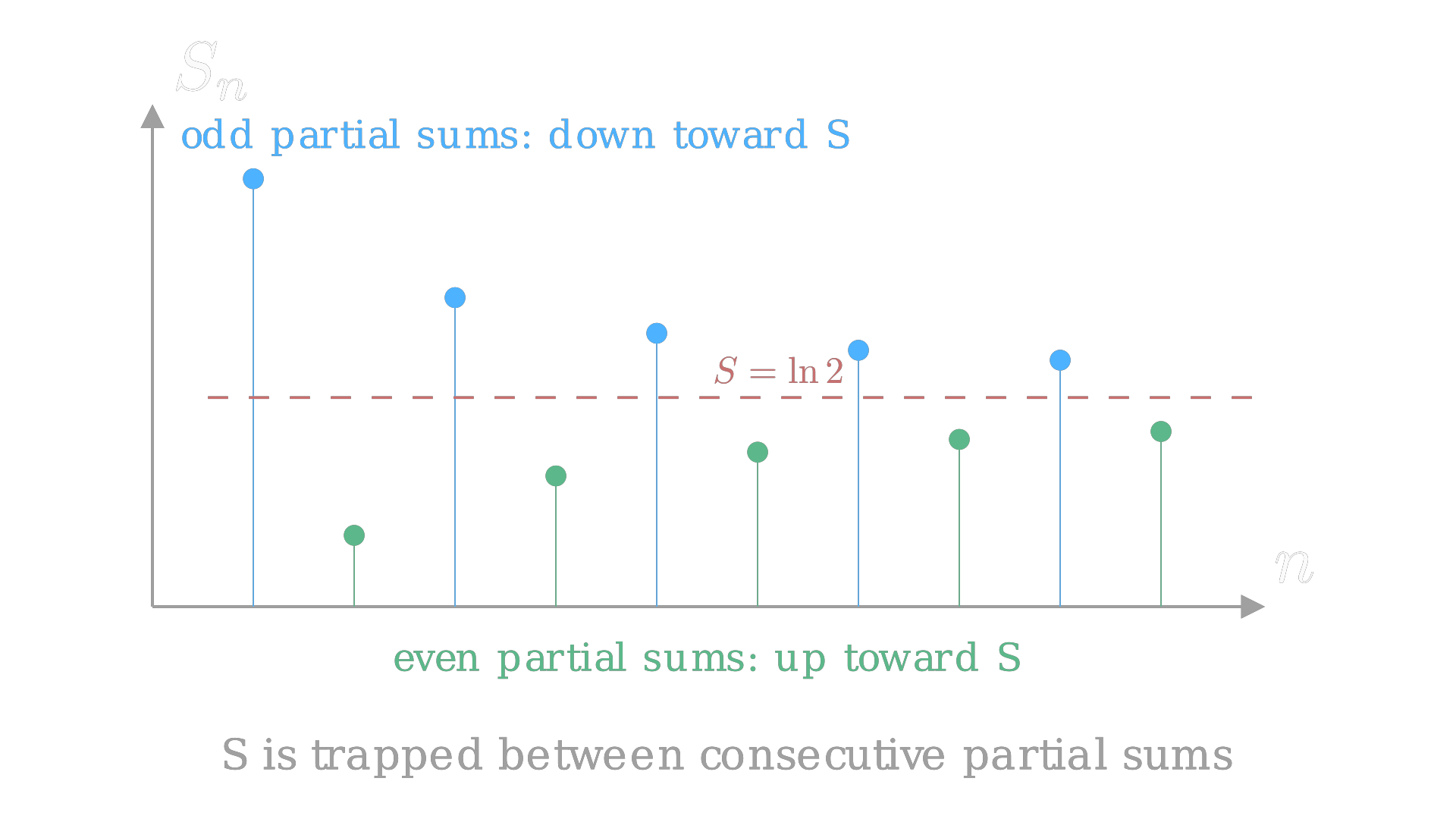
alternating series test,莱布尼茨判别法)Worked Example: Alternating Series Test例题:交错级数判别法
Worked Example: Decreasing Only Eventually例题:从某项起才递减
Name all three conditions in your justification: $b_n > 0$, $b_{n+1} \le b_n$ with a reason, and $\lim_{n\to\infty} b_n = 0$. If $\lim_{n\to\infty} b_n \ne 0$, the alternating series test says nothing; the divergence conclusion comes from the $n$th term test.
论证中写出全部三个条件:$b_n > 0$,$b_{n+1} \le b_n$(附理由),以及 $\lim_{n\to\infty} b_n = 0$。若 $\lim_{n\to\infty} b_n \ne 0$,交错级数判别法不给出结论;发散的结论来自第 $n$ 项判别法。
Does $\displaystyle\sum_{n=0}^{\infty}\frac{(-1)^n}{2n+1}$ converge?$\displaystyle\sum_{n=0}^{\infty}\frac{(-1)^n}{2n+1}$ 是否收敛?
Yes. $b_n = \dfrac{1}{2n+1} > 0$, it decreases because the denominator increases, and $b_n \to 0$. By the alternating series test the series converges.
收敛。$b_n = \dfrac{1}{2n+1} > 0$,因分母递增而单调递减,且 $b_n \to 0$。由交错级数判别法,级数收敛。
A student says an alternating series diverges because its $b_n$ is not decreasing. Is that reasoning valid?某学生说一个交错级数发散,因为它的 $b_n$ 不是单调递减的。这个推理正确吗?
No. When a hypothesis fails, the alternating series test is inconclusive; it never proves divergence. Another test (for example the $n$th term test, or absolute convergence) must decide.
不正确。条件不满足时,交错级数判别法不能下结论;它从不证明发散。必须用其他判别法(例如第 $n$ 项判别法或绝对收敛)来判定。
Does $\displaystyle\sum_{n=1}^{\infty}\frac{(-1)^n (n+3)}{n}$ converge?$\displaystyle\sum_{n=1}^{\infty}\frac{(-1)^n (n+3)}{n}$ 是否收敛?
No. $b_n = \dfrac{n+3}{n} \to 1$, so the terms do not tend to $0$; the series diverges by the $n$th term test.
不收敛。$b_n = \dfrac{n+3}{n} \to 1$,各项不趋于 $0$;由第 $n$ 项判别法级数发散。
Ratio Test for Convergence
收敛的比值判别法
- Calculate $L = \lim_{n\to\infty}\left|\dfrac{a_{n+1}}{a_n}\right|$, simplifying factorials and powers first.
- State the conclusions: absolute convergence if $L < 1$, divergence if $L > 1$ or $L = \infty$, no conclusion if $L = 1$.
- Identify series where the ratio test works well (factorials, exponentials).
- Explain why the ratio test is inconclusive for every $p$-series and rational term.
- Choose another test when $L = 1$.
- 先化简阶乘与幂,再计算 $L = \lim_{n\to\infty}\left|\dfrac{a_{n+1}}{a_n}\right|$。
- 表述结论:$L < 1$ 时绝对收敛,$L > 1$ 或 $L = \infty$ 时发散,$L = 1$ 时不能下结论。
- 识别比值判别法适用的级数(含阶乘、指数)。
- 解释为何比值判别法对每个 $p$ 级数和有理式通项都不能下结论。
- 当 $L = 1$ 时换用其他判别法。
ratio test)
If $L < 1$ → series converges absolutely
If $L > 1$ (or $L = \infty$) → series diverges
If $L = 1$ → inconclusive
若 $L < 1$ → 级数绝对收敛(absolute convergence)
若 $L > 1$(或 $L = \infty$) → 级数发散
若 $L = 1$ → 不能下结论
Worked Example: Ratio Test例题:比值判别法
Worked Example: Ratio Test (Convergent)例题:比值判别法(收敛情形)
Write the ratio with absolute value bars, cancel before taking the limit (for example $\dfrac{(n+1)!}{n!} = n+1$), state the value of $L$, and compare it with $1$ in words. If $L = 1$, write that the ratio test is inconclusive and switch tests.
写出带绝对值的比值,先约分再取极限(例如 $\dfrac{(n+1)!}{n!} = n+1$),写出 $L$ 的值,并用文字与 $1$ 比较。若 $L = 1$,写明比值判别法不能下结论,再换用其他判别法。
Use the ratio test on $\displaystyle\sum_{n=1}^{\infty}\frac{n}{2^n}$.对 $\displaystyle\sum_{n=1}^{\infty}\frac{n}{2^n}$ 使用比值判别法。
$\left|\dfrac{a_{n+1}}{a_n}\right| = \dfrac{n+1}{2^{n+1}}\cdot\dfrac{2^n}{n} = \dfrac{n+1}{2n} \to \dfrac12$. Since $L = \tfrac12 < 1$, the series converges absolutely.
$\left|\dfrac{a_{n+1}}{a_n}\right| = \dfrac{n+1}{2^{n+1}}\cdot\dfrac{2^n}{n} = \dfrac{n+1}{2n} \to \dfrac12$。因为 $L = \tfrac12 < 1$,级数绝对收敛。
What does the ratio test say about $\displaystyle\sum_{n=1}^{\infty}\frac{n^3}{n^4+1}$, and how do you decide the series?比值判别法对 $\displaystyle\sum_{n=1}^{\infty}\frac{n^3}{n^4+1}$ 给出什么结论?应如何判定该级数?
The ratio tends to $L = 1$, so the ratio test is inconclusive. Limit comparison with $1/n$: $\dfrac{n^3/(n^4+1)}{1/n} = \dfrac{n^4}{n^4+1} \to 1$, and $\sum 1/n$ diverges, so the series diverges.
比值趋于 $L = 1$,比值判别法不能下结论。与 $1/n$ 作极限比较:$\dfrac{n^3/(n^4+1)}{1/n} = \dfrac{n^4}{n^4+1} \to 1$,而 $\sum 1/n$ 发散,所以级数发散。
Does $\displaystyle\sum_{n=1}^{\infty}\frac{2^n\, n!}{n^n}$ converge?$\displaystyle\sum_{n=1}^{\infty}\frac{2^n\, n!}{n^n}$ 是否收敛?
$\dfrac{a_{n+1}}{a_n} = \dfrac{2^{n+1}(n+1)!}{(n+1)^{n+1}}\cdot\dfrac{n^n}{2^n\, n!} = \dfrac{2(n+1)\,n^n}{(n+1)^{n+1}} = 2\left(\dfrac{n}{n+1}\right)^n$. Since $\left(\dfrac{n}{n+1}\right)^n = \dfrac{1}{(1+1/n)^n} \to \dfrac1e$, $L = \dfrac2e \approx 0.736 < 1$, so the series converges absolutely.
$\dfrac{a_{n+1}}{a_n} = \dfrac{2^{n+1}(n+1)!}{(n+1)^{n+1}}\cdot\dfrac{n^n}{2^n\, n!} = \dfrac{2(n+1)\,n^n}{(n+1)^{n+1}} = 2\left(\dfrac{n}{n+1}\right)^n$。因为 $\left(\dfrac{n}{n+1}\right)^n = \dfrac{1}{(1+1/n)^n} \to \dfrac1e$,所以 $L = \dfrac2e \approx 0.736 < 1$,级数绝对收敛。
Determining Absolute or Conditional Convergence
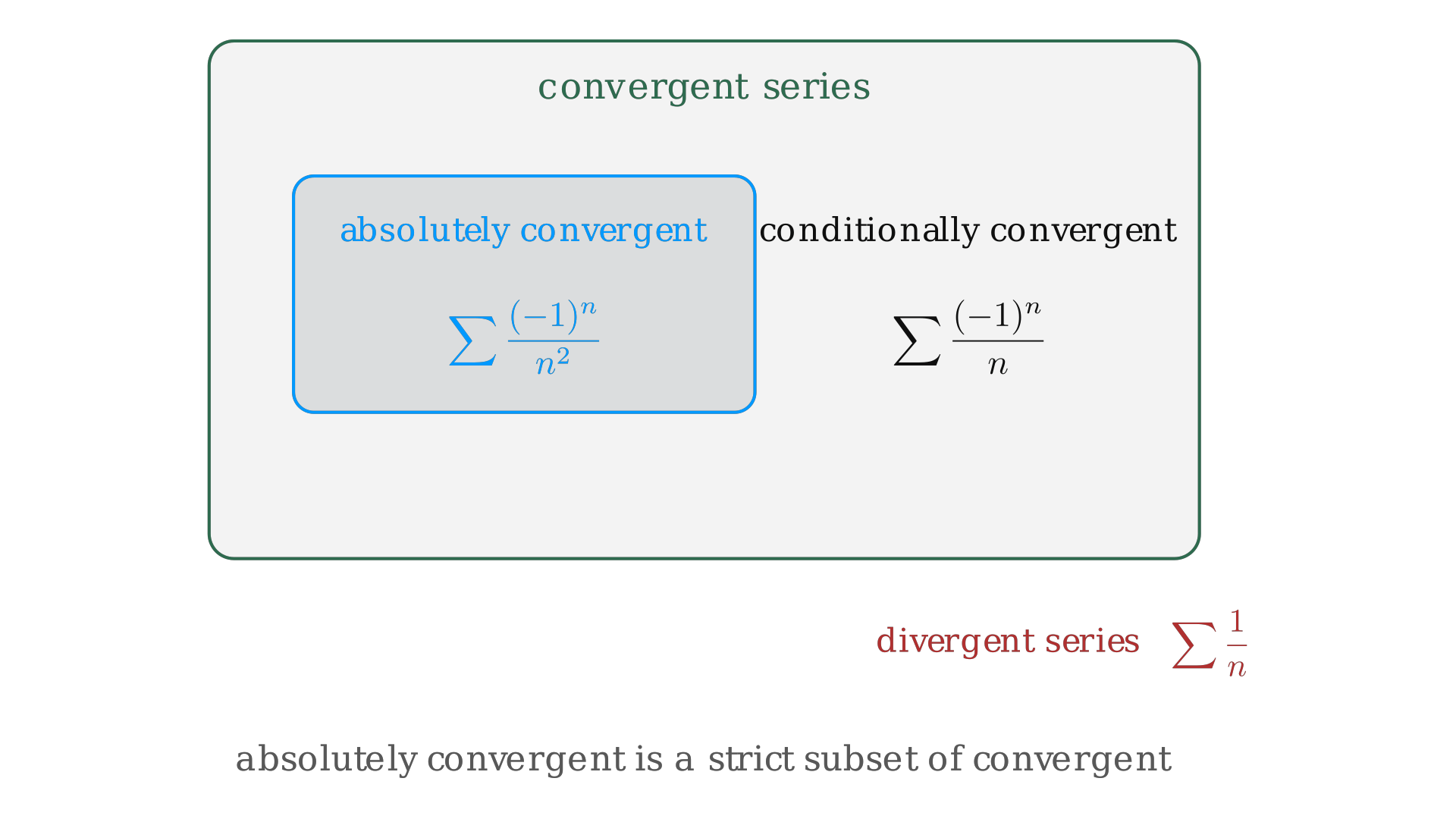
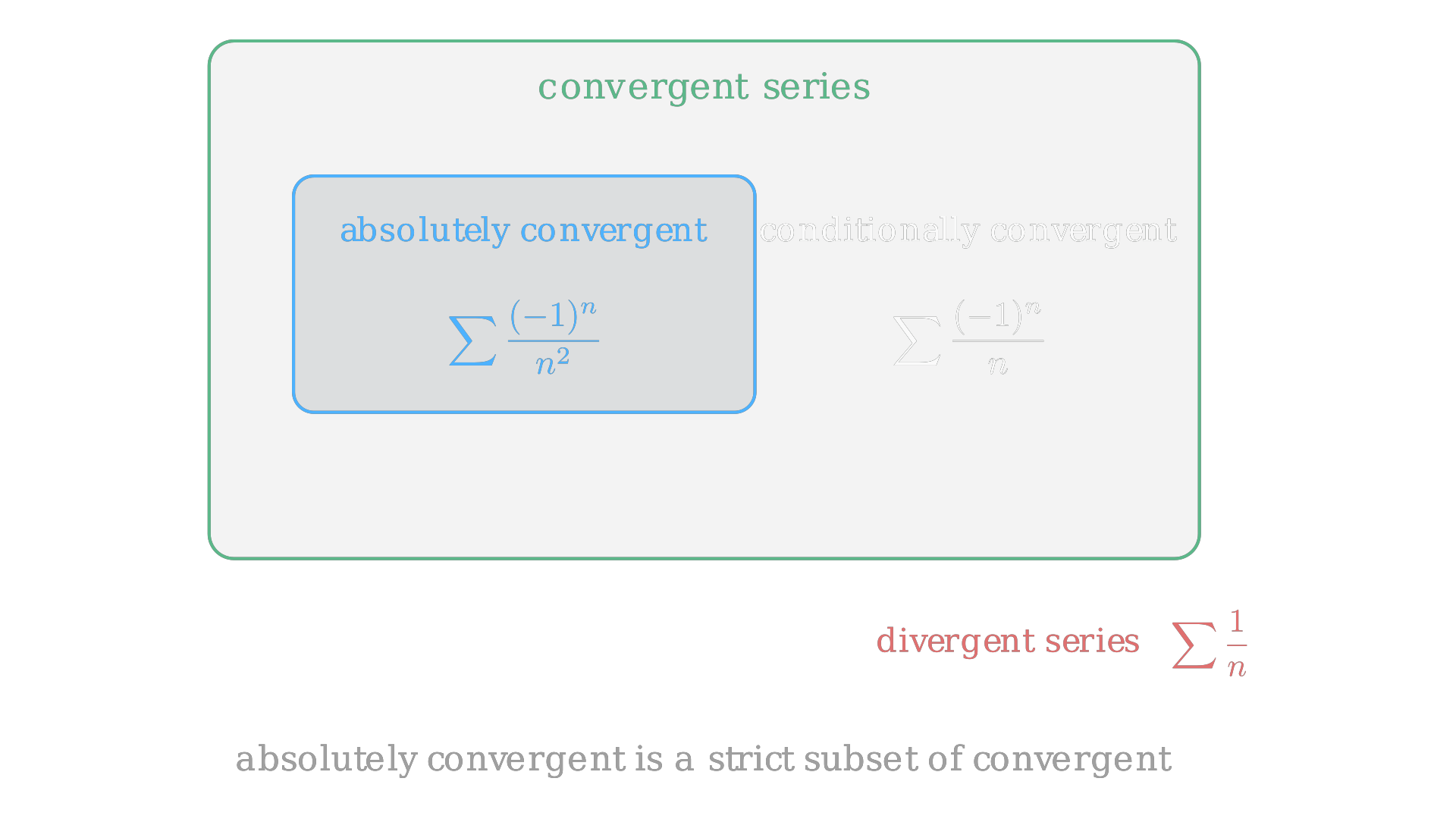
判别绝对收敛或条件收敛
- Define absolute convergence and conditional convergence.
- State that absolute convergence implies convergence, and that the converse is false.
- Test $\sum |a_n|$ first, with a $p$-series, comparison or ratio test.
- Apply the alternating series test to the original series when $\sum |a_n|$ diverges.
- Classify series whose signs are not strictly alternating, such as $\sum \sin n / n^2$.
- 定义绝对收敛与条件收敛。
- 说明绝对收敛蕴含收敛,且逆命题不成立。
- 先用 $p$ 级数、比较或比值判别法检验 $\sum |a_n|$。
- 当 $\sum |a_n|$ 发散时,对原级数使用交错级数判别法。
- 判别符号并非严格交替的级数,例如 $\sum \sin n / n^2$。
absolute convergence):$\sum |a_n|$ 收敛(因此 $\sum a_n$ 也收敛)。
Conditionally convergent: $\sum a_n$ converges, but $\sum |a_n|$ diverges.
条件收敛(conditional convergence):$\sum a_n$ 收敛,但 $\sum |a_n|$ 发散。
Divergent: $\sum a_n$ does not converge.
发散:$\sum a_n$ 不收敛。
Step 1: Does $\sum |a_n|$ converge? If yes → absolutely convergent. Done.
步骤 1:$\sum |a_n|$ 是否收敛?若是 → 绝对收敛,结束。
Step 2: If $\sum |a_n|$ diverges, does $\sum a_n$ converge (e.g., by AST)? If yes → conditionally convergent.
步骤 2:若 $\sum |a_n|$ 发散,则 $\sum a_n$ 是否收敛(例如由交错级数判别法)?若是 → 条件收敛。
Step 3: If $\sum a_n$ also diverges → divergent.
步骤 3:若 $\sum a_n$ 也发散 → 发散。
Worked Example: Classifying a Series例题:判别级数类型
Classify $\displaystyle\sum_{n=1}^{\infty} \frac{(-1)^n}{\sqrt{n}}$.
判别 $\displaystyle\sum_{n=1}^{\infty} \frac{(-1)^n}{\sqrt{n}}$ 的类型。
Step 1: $\sum |a_n| = \sum 1/\sqrt{n}$ is a $p$-series with $p = 1/2 \leq 1$, so it diverges: not absolutely convergent.
步骤 1:$\sum |a_n| = \sum 1/\sqrt{n}$ 是 $p = 1/2 \leq 1$ 的 $p$ 级数,故发散:不是绝对收敛。
Step 2: Apply the AST to the original series: $b_n = 1/\sqrt{n}$ is positive, decreasing, and $b_n \to 0$, so the series converges.
步骤 2:对原级数应用交错级数判别法:$b_n = 1/\sqrt{n}$ 为正、单调递减,且 $b_n \to 0$,故原级数收敛。
Conclusion: Converges, but not absolutely → conditionally convergent.
结论:收敛但非绝对收敛 → 条件收敛。
Worked Example: Signs That Do Not Alternate例题:符号不严格交替的级数
Classify in a fixed order and name each test: first $\sum |a_n|$, then the original series. The answer conditionally convergent needs both halves shown: $\sum |a_n|$ diverges and $\sum a_n$ converges.
按固定顺序判别并写出所用判别法:先判 $\sum |a_n|$,再判原级数。结论为条件收敛时,两部分都要写出:$\sum |a_n|$ 发散且 $\sum a_n$ 收敛。
Classify $\displaystyle\sum_{n=1}^{\infty}\frac{(-1)^n}{n^2}$.判别 $\displaystyle\sum_{n=1}^{\infty}\frac{(-1)^n}{n^2}$ 的类型。
Absolutely convergent: $\sum |a_n| = \sum 1/n^2$ is a $p$-series with $p = 2 > 1$.
绝对收敛:$\sum |a_n| = \sum 1/n^2$ 是 $p = 2 > 1$ 的 $p$ 级数。
Classify $\displaystyle\sum_{n=1}^{\infty}\frac{(-1)^n n}{n^2+1}$.判别 $\displaystyle\sum_{n=1}^{\infty}\frac{(-1)^n n}{n^2+1}$ 的类型。
$|a_n| = \dfrac{n}{n^2+1}$; limit comparison with $1/n$ gives $\dfrac{n^2}{n^2+1} \to 1$, so $\sum |a_n|$ diverges. For the original series, $b_n = \dfrac{n}{n^2+1} > 0$, $f'(x) = \dfrac{1-x^2}{(x^2+1)^2} \le 0$ for $x \ge 1$, and $b_n \to 0$, so it converges by the alternating series test. The series is conditionally convergent.
$|a_n| = \dfrac{n}{n^2+1}$;与 $1/n$ 作极限比较得 $\dfrac{n^2}{n^2+1} \to 1$,所以 $\sum |a_n|$ 发散。对原级数,$b_n = \dfrac{n}{n^2+1} > 0$,当 $x \ge 1$ 时 $f'(x) = \dfrac{1-x^2}{(x^2+1)^2} \le 0$,且 $b_n \to 0$,由交错级数判别法收敛。该级数条件收敛。
Classify $\displaystyle\sum_{n=1}^{\infty}\frac{(-1)^n n}{n+1}$.判别 $\displaystyle\sum_{n=1}^{\infty}\frac{(-1)^n n}{n+1}$ 的类型。
Divergent: $|a_n| = \dfrac{n}{n+1} \to 1$, so the terms do not tend to $0$ (the $n$th term test).
发散:$|a_n| = \dfrac{n}{n+1} \to 1$,各项不趋于 $0$(第 $n$ 项判别法)。
Alternating Series Error Bound
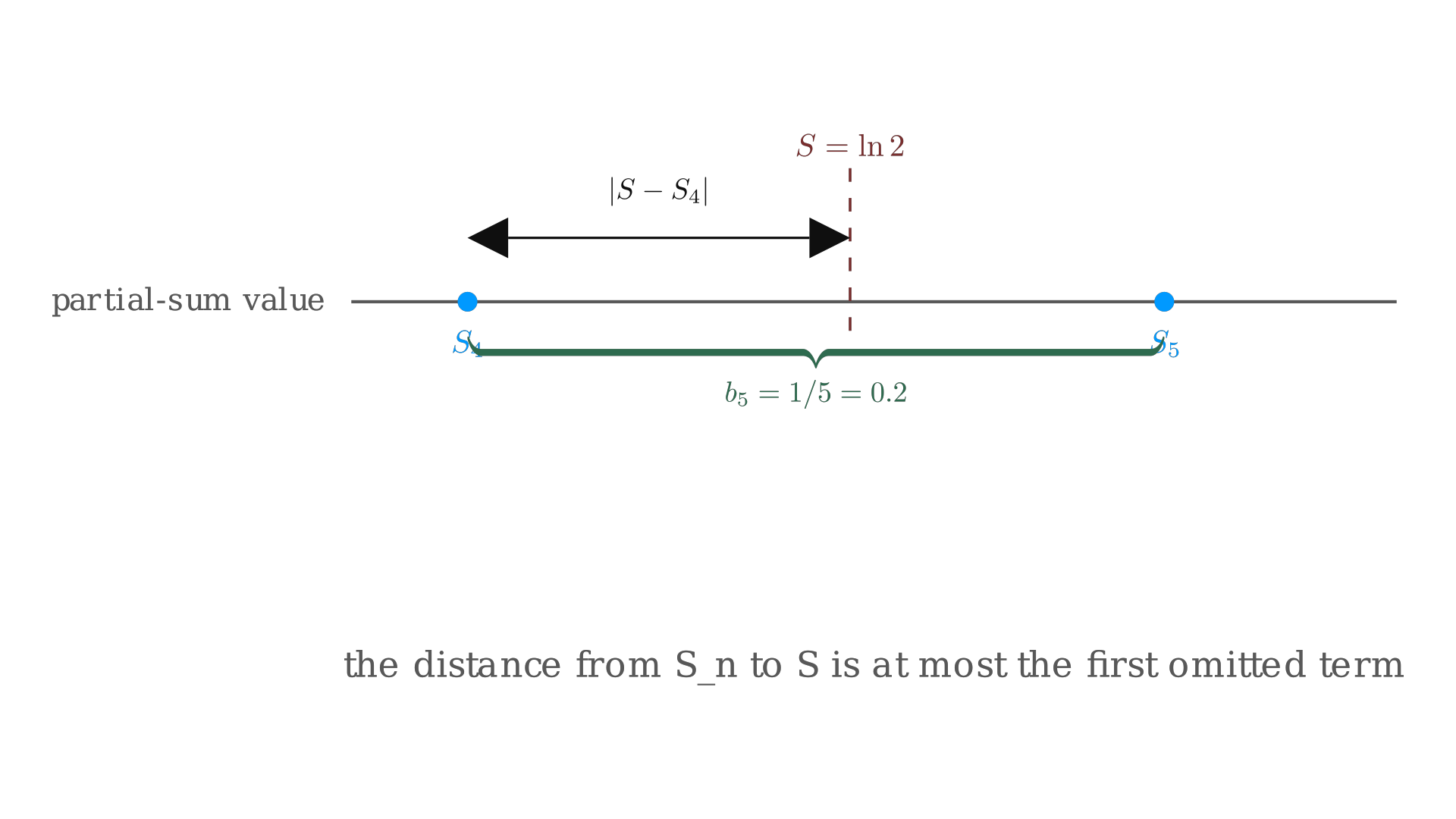
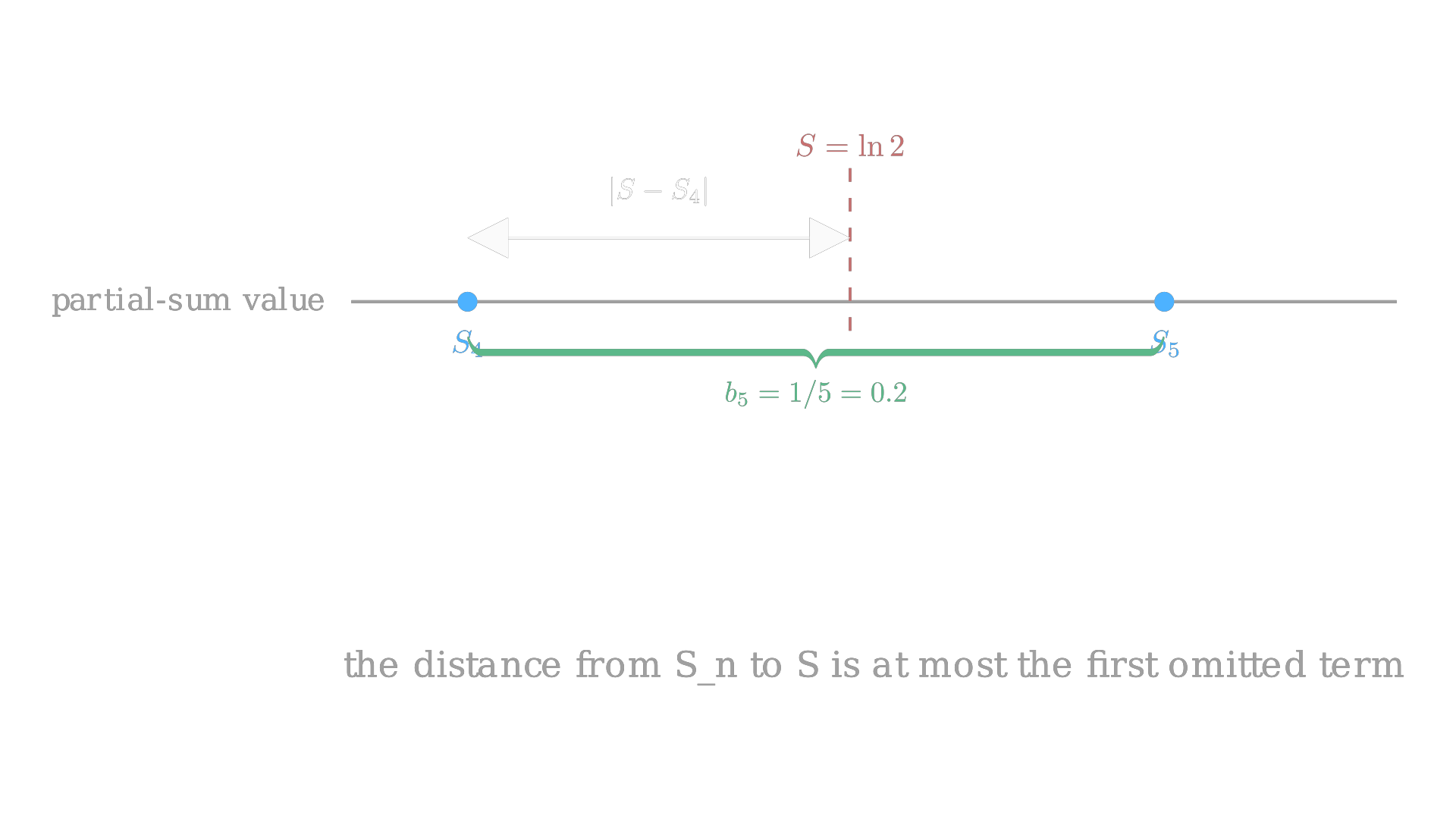
交错级数误差界
- State the alternating series error bound $|S - S_n| \le b_{n+1}$ and the conditions it needs.
- Calculate the number of terms needed for a given accuracy.
- Determine whether $S_n$ is an overestimate or an underestimate from the sign of the first omitted term.
- Explain why the true sum lies between consecutive partial sums.
- Identify series where the bound cannot be used.
- 表述交错级数误差界 $|S - S_n| \le b_{n+1}$ 及其所需条件。
- 计算达到给定精度所需的项数。
- 根据第一个被舍弃项的符号判断 $S_n$ 是高估还是低估。
- 解释为什么真实和位于相邻两个部分和之间。
- 识别不能使用该误差界的级数。
alternating series error bound)The error from using the $n$th partial sum is at most the absolute value of the first omitted term.
用第 $n$ 个部分和近似时的误差至多为第一个被舍弃项的绝对值。
Worked Example: Alternating Series Error Bound例题:交错级数误差界
Worked Example: Overestimate or Underestimate?例题:高估还是低估?
State that the alternating series test conditions hold before quoting the bound, then write it with the first omitted term, $|S - S_n| \le b_{n+1}$, and give its numerical value. For over or under, use the sign of that first omitted term: negative means $S_n$ is too large.
引用误差界之前先说明交错级数判别法的条件成立,再用第一个被舍弃项写出 $|S - S_n| \le b_{n+1}$ 并给出其数值。判断高估或低估时看第一个被舍弃项的符号:为负说明 $S_n$ 偏大。
How many terms of $\displaystyle\sum_{n=1}^{\infty}\frac{(-1)^{n+1}}{n}$ guarantee an error less than $0.001$?$\displaystyle\sum_{n=1}^{\infty}\frac{(-1)^{n+1}}{n}$ 取多少项能保证误差小于 $0.001$?
Need $b_{n+1} = \dfrac{1}{n+1} < 0.001$, so $n + 1 > 1000$. Taking $n = 1000$ terms gives error at most $\dfrac{1}{1001} < 0.001$.
需要 $b_{n+1} = \dfrac{1}{n+1} < 0.001$,即 $n + 1 > 1000$。取 $n = 1000$ 项,误差至多 $\dfrac{1}{1001} < 0.001$。
In the worked example above, $S_4 \approx 0.8964$ approximates $\displaystyle\sum_{n=1}^{\infty}\frac{(-1)^{n+1}}{n^3}$. Is $S_4$ an overestimate or an underestimate?在上面的例题中,$S_4 \approx 0.8964$ 近似 $\displaystyle\sum_{n=1}^{\infty}\frac{(-1)^{n+1}}{n^3}$。$S_4$ 是高估还是低估?
The first omitted term is $a_5 = +\dfrac{1}{125}$, which is positive, so $S - S_4 > 0$ and $S_4$ is an underestimate.
第一个被舍弃项为 $a_5 = +\dfrac{1}{125}$,为正,所以 $S - S_4 > 0$,$S_4$ 是低估值。
Why can the alternating series error bound not be used for $\displaystyle\sum_{n=1}^{\infty}\frac{(-1)^n n}{n+1}$?为什么不能对 $\displaystyle\sum_{n=1}^{\infty}\frac{(-1)^n n}{n+1}$ 使用交错级数误差界?
Its $b_n = \dfrac{n}{n+1} \to 1$, so the alternating series test conditions fail; in fact the series diverges by the $n$th term test, so there is no sum to approximate.
其 $b_n = \dfrac{n}{n+1} \to 1$,交错级数判别法的条件不成立;事实上由第 $n$ 项判别法该级数发散,根本没有可近似的和。
Finding Taylor Polynomial Approximations of Functions
求函数的泰勒多项式近似
- Write the Taylor polynomial $P_n(x)$ of $f$ about $x = a$ from derivative values.
- Explain why the coefficient of $(x-a)^k$ is $\dfrac{f^{(k)}(a)}{k!}$.
- Construct Maclaurin polynomials for $\sin x$, $\cos x$ and $e^x$.
- Calculate an approximation $f(x) \approx P_n(x)$ near the centre.
- Deduce a derivative value from a polynomial: $f^{(k)}(a) = k! \times$ coefficient of $(x-a)^k$.
- Interpret a graph: the approximation is best near the centre and improves with degree.
- 由各阶导数值写出 $f$ 关于 $x = a$ 的泰勒多项式 $P_n(x)$。
- 解释为什么 $(x-a)^k$ 的系数是 $\dfrac{f^{(k)}(a)}{k!}$。
- 构造 $\sin x$、$\cos x$ 与 $e^x$ 的麦克劳林多项式。
- 在中心附近计算近似值 $f(x) \approx P_n(x)$。
- 由多项式反推导数值:$f^{(k)}(a) = k! \times$ $(x-a)^k$ 的系数。
- 解读图像:中心附近近似最好,次数越高近似越好。
Taylor polynomial)使用函数在点 $x = a$ 处的各阶导数来近似该点附近的函数。所含项越多,近似越好;很多情况下,无穷泰勒级数(Taylor series)恰等于该函数本身。
nth-degree Taylor polynomial)Maclaurin series 的多项式版本)就是以 $x = 0$ 为中心(center of a power series)的泰勒多项式:
$$ P_n(x) = f(0) + f'(0)x + \frac{f''(0)}{2!}x^2 + \frac{f'''(0)}{3!}x^3 + \cdots $$
Worked Example: Taylor Polynomial for $e^x$ at $a = 0$例题:$e^x$ 在 $a = 0$ 处的泰勒多项式
Worked Example: A Taylor Polynomial from a Table例题:由数值表构造泰勒多项式
Keep the powers centred at $a$: write $(x-2)^k$, not $x^k$. When derivative values come from a table, show the substitution into $\dfrac{f^{(k)}(a)}{k!}$ for each coefficient before simplifying, and write approximations as $f(2.1) \approx P_3(2.1)$, not as an equality.
幂次要以 $a$ 为中心:写 $(x-2)^k$,而不是 $x^k$。导数值来自表格时,先把每个系数代入 $\dfrac{f^{(k)}(a)}{k!}$ 再化简;近似值写成 $f(2.1) \approx P_3(2.1)$,不要写成等号。
Use the second-degree Maclaurin polynomial for $\cos x$ to approximate $\cos(0.2)$.用 $\cos x$ 的二次麦克劳林多项式近似 $\cos(0.2)$。
$P_2(x) = 1 - \dfrac{x^2}{2}$, so $\cos(0.2) \approx 1 - \dfrac{0.04}{2} = 0.98$. (A calculator gives $0.98007$.)
$P_2(x) = 1 - \dfrac{x^2}{2}$,所以 $\cos(0.2) \approx 1 - \dfrac{0.04}{2} = 0.98$。(计算器给出 $0.98007$。)
The third-degree Taylor polynomial of $f$ about $x = 1$ is $P_3(x) = 4 + 2(x-1) - 3(x-1)^2 + (x-1)^3$. Find $f''(1)$ and $f'''(1)$.$f$ 关于 $x = 1$ 的三次泰勒多项式为 $P_3(x) = 4 + 2(x-1) - 3(x-1)^2 + (x-1)^3$。求 $f''(1)$ 与 $f'''(1)$。
$f''(1) = 2! \times (-3) = -6$ and $f'''(1) = 3! \times 1 = 6$.
$f''(1) = 2! \times (-3) = -6$,$f'''(1) = 3! \times 1 = 6$。
Find the second-degree Taylor polynomial for $\ln x$ about $x = 1$ and use it to approximate $\ln(1.1)$.求 $\ln x$ 关于 $x = 1$ 的二次泰勒多项式,并用它近似 $\ln(1.1)$。
$f(1) = 0$, $f'(x) = 1/x$ gives $f'(1) = 1$, and $f''(x) = -1/x^2$ gives $f''(1) = -1$. So $P_2(x) = (x-1) - \dfrac{(x-1)^2}{2}$ and $\ln(1.1) \approx 0.1 - 0.005 = 0.095$. (A calculator gives $0.09531$.)
$f(1) = 0$;$f'(x) = 1/x$ 得 $f'(1) = 1$;$f''(x) = -1/x^2$ 得 $f''(1) = -1$。所以 $P_2(x) = (x-1) - \dfrac{(x-1)^2}{2}$,$\ln(1.1) \approx 0.1 - 0.005 = 0.095$。(计算器给出 $0.09531$。)
Lagrange Error Bound
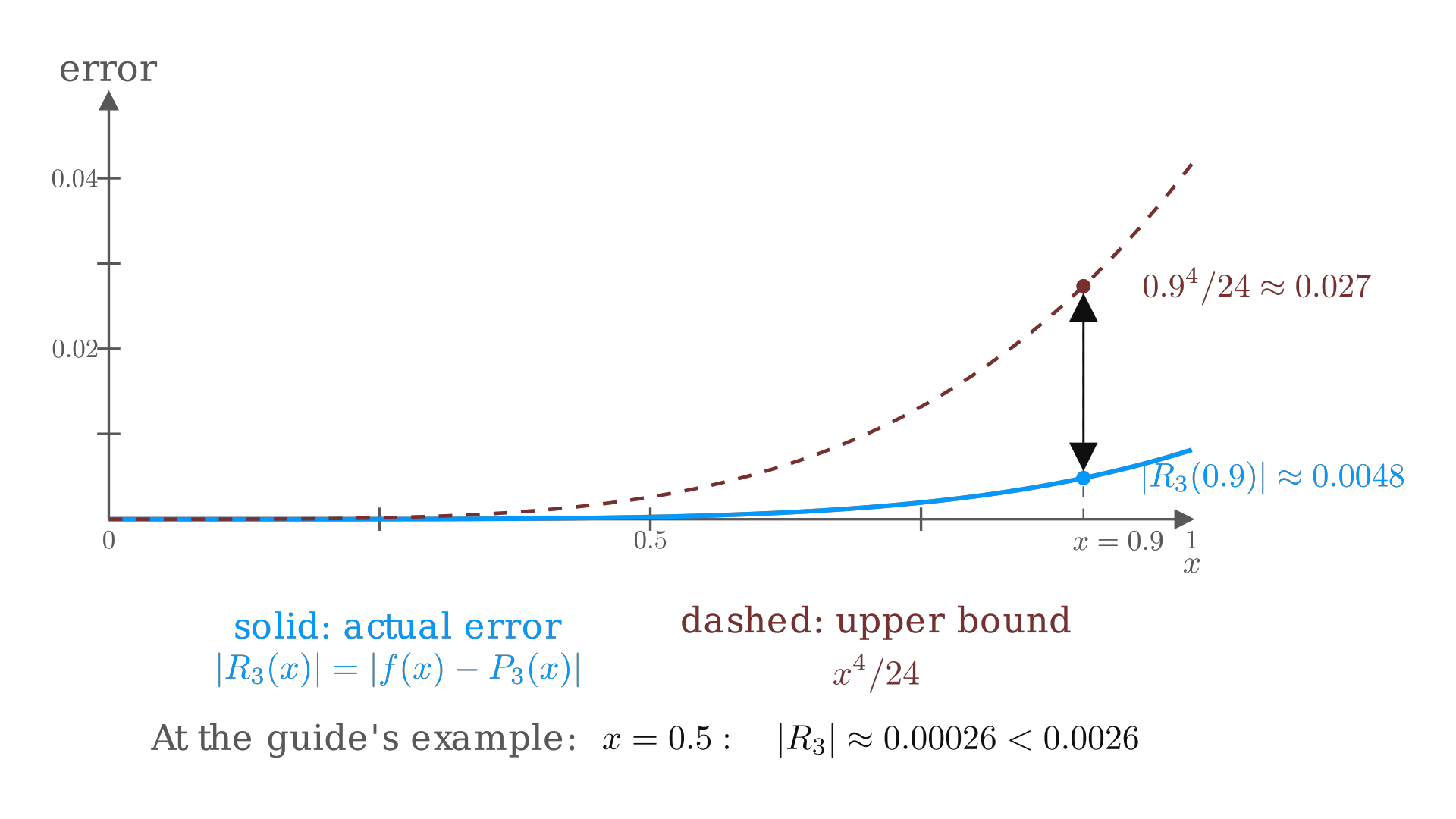
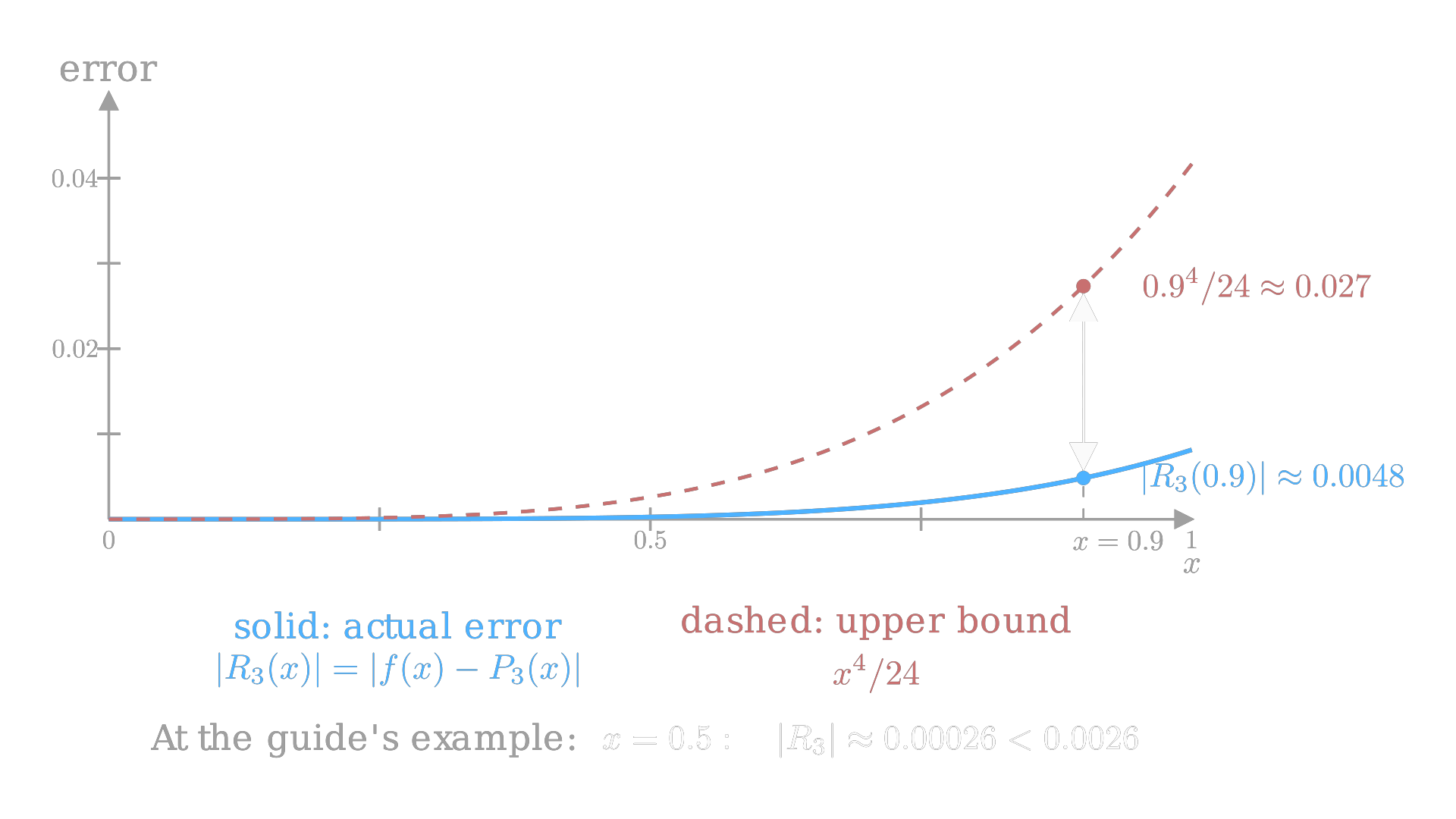
拉格朗日误差界
- State the Lagrange error bound $|f(x) - P_n(x)| \le \dfrac{M}{(n+1)!}|x-a|^{n+1}$.
- Identify $M$ as an upper bound for $|f^{(n+1)}|$ on the interval between $a$ and $x$.
- Calculate the bound with numbers substituted.
- Explain why any valid upper bound for $|f^{(n+1)}|$ works, not only the smallest.
- Choose between the Lagrange bound and the alternating series bound.
- 表述拉格朗日误差界 $|f(x) - P_n(x)| \le \dfrac{M}{(n+1)!}|x-a|^{n+1}$。
- 明确 $M$ 是 $|f^{(n+1)}|$ 在 $a$ 与 $x$ 之间区间上的一个上界。
- 代入数值计算误差界。
- 解释为何 $|f^{(n+1)}|$ 的任何有效上界都可以用,而不必是最小的。
- 在拉格朗日误差界与交错级数误差界之间作出选择。
Lagrange error bound,泰勒余项(remainder term))where $M = \max |f^{(n+1)}(c)|$ for $c$ between $a$ and $x$
其中 $M = \max |f^{(n+1)}(c)|$,$c$ 在 $a$ 与 $x$ 之间
Worked Example: Lagrange Error Bound例题:拉格朗日误差界
Worked Example: Bounding the Error for $e^{0.2}$例题:估计 $e^{0.2}$ 的误差界
Show the bound with numbers substituted, $\dfrac{M}{(n+1)!}|x-a|^{n+1}$, and say where $M$ comes from: the largest value of $|f^{(n+1)}|$ between $a$ and $x$, or the bound the question gives. Use the $(n+1)$th derivative, not the $n$th, and raise $|x-a|$ to the $(n+1)$th power.
代入数值写出 $\dfrac{M}{(n+1)!}|x-a|^{n+1}$,并说明 $M$ 的来源:$|f^{(n+1)}|$ 在 $a$ 与 $x$ 之间的最大值,或题目给出的界。要用 $(n+1)$ 阶导数而不是 $n$ 阶,并把 $|x-a|$ 取 $(n+1)$ 次幂。
$|f^{(4)}(x)| \le 6$ for $1 \le x \le 1.5$. Bound the error when the third-degree Taylor polynomial about $x = 1$ approximates $f(1.5)$.当 $1 \le x \le 1.5$ 时 $|f^{(4)}(x)| \le 6$。用关于 $x = 1$ 的三次泰勒多项式近似 $f(1.5)$,给出误差界。
$|R_3(1.5)| \le \dfrac{6\,(0.5)^4}{4!} = \dfrac{6(0.0625)}{24} = 0.015625$.
$|R_3(1.5)| \le \dfrac{6\,(0.5)^4}{4!} = \dfrac{6(0.0625)}{24} = 0.015625$。
Bound the error when the Maclaurin polynomial $P_4$ for $\cos x$ approximates $\cos(0.5)$, using $n = 4$.用 $n = 4$,估计 $\cos x$ 的麦克劳林多项式 $P_4$ 近似 $\cos(0.5)$ 时的误差界。
$f^{(5)}(x) = -\sin x$, so $|f^{(5)}| \le 1$ and $M = 1$. The bound is $\dfrac{(0.5)^5}{5!} = \dfrac{0.03125}{120} \approx 0.00026$.
$f^{(5)}(x) = -\sin x$,所以 $|f^{(5)}| \le 1$,取 $M = 1$。误差界为 $\dfrac{(0.5)^5}{5!} = \dfrac{0.03125}{120} \approx 0.00026$。
A student takes $M = |f^{(n+1)}(a)|$, the value at the centre only. Why is that not a valid choice in general?某学生只取中心处的值 $M = |f^{(n+1)}(a)|$。为什么这一般不是有效的选择?
$M$ must bound $|f^{(n+1)}(c)|$ for every $c$ between $a$ and $x$, because the theorem only says the error equals $\dfrac{f^{(n+1)}(c)}{(n+1)!}(x-a)^{n+1}$ for some unknown $c$ there. The value at $a$ can be smaller than the values further along.
$M$ 必须对 $a$ 与 $x$ 之间的每个 $c$ 都是 $|f^{(n+1)}(c)|$ 的上界,因为定理只说明误差等于 $\dfrac{f^{(n+1)}(c)}{(n+1)!}(x-a)^{n+1}$,其中 $c$ 是该区间内某个未知的点。$a$ 处的值可能小于区间其他位置的值。
Radius and Interval of Convergence of Power Series
![The interval of convergence [1, 5) with a closed dot at x = 1 (included, endpoint converges) and an open circle at x = 5 (excluded, endpoint diverges). / 收敛区间 [1, 5):x = 1 处为实心点(该端点收敛,取等号),x = 5 处为空心圈(该端点发散,不取等号)。](../../out/figures/Unit_10_Sequences_and_Series/calc10-interval-endpoints_light.png)
![The interval of convergence [1, 5) with a closed dot at x = 1 (included, endpoint converges) and an open circle at x = 5 (excluded, endpoint diverges). / 收敛区间 [1, 5):x = 1 处为实心点(该端点收敛,取等号),x = 5 处为空心圈(该端点发散,不取等号)。](../../out/figures/Unit_10_Sequences_and_Series/calc10-interval-endpoints_dark.png)
幂级数的收敛半径与收敛区间
- Apply the ratio test to a power series to find its radius of convergence $R$.
- Write the open interval $(c - R, c + R)$.
- Test each endpoint separately, naming the test used.
- State the interval of convergence with brackets that match the endpoint results.
- Identify the cases $R = 0$ and $R = \infty$.
- 对幂级数使用比值判别法求收敛半径 $R$。
- 写出开区间 $(c - R, c + R)$。
- 分别检验每个端点,并写出所用判别法。
- 用与端点结果一致的括号写出收敛区间。
- 识别 $R = 0$ 与 $R = \infty$ 的情形。
power series)
A power series centered at $x = c$ has the form $\displaystyle\sum_{n=0}^{\infty} a_n(x - c)^n$. It converges for some values of $x$ and diverges for others.
以 $x = c$ 为中心的幂级数形如 $\displaystyle\sum_{n=0}^{\infty} a_n(x - c)^n$。它对某些 $x$ 收敛,对其他 $x$ 发散。
radius of convergence)The series converges when $|x - c| < R$ and diverges when $|x - c| > R$. The shortcut formula needs every coefficient nonzero and the limit to exist; for a series with only even or odd powers, such as $\sum x^{2n}/4^n$, apply the ratio test to the whole term instead.
当 $|x - c| < R$ 时级数收敛,当 $|x - c| > R$ 时发散。该简便公式要求每个系数都不为零且极限存在;对只含偶次或奇次幂的级数(如 $\sum x^{2n}/4^n$),应对整个通项使用比值判别法。
interval of convergence)Step 1: Use the ratio test to find $R$ (the radius of convergence).
步骤 1:使用比值判别法求 $R$(收敛半径)。
Step 2: Write the open interval $(c - R, c + R)$.
步骤 2:写出开区间 $(c - R, c + R)$。
Step 3: Test the endpoints $x = c - R$ and $x = c + R$ individually by plugging them back into the original series.
步骤 3:分别将端点 $x = c - R$ 和 $x = c + R$ 代回原级数检验。
Step 4: Include or exclude each endpoint based on whether the resulting series converges.
步骤 4:根据各端点处所得级数是否收敛,决定端点的取舍。
Worked Example: Interval of Convergence例题:收敛区间
Worked Example: Both Endpoints Included例题:两个端点都包含
After the ratio test, state $R$ and the open interval, then test both endpoints and name the test used at each (for example $p$-series, alternating series test). The final interval can be open, closed or half-open; its brackets must match your endpoint results.
用完比值判别法后,写出 $R$ 与开区间,再检验两个端点并写出各自所用的判别法(例如 $p$ 级数、交错级数判别法)。最终区间可以是开区间、闭区间或半开区间;括号必须与端点结果一致。
Find the radius of convergence of $\displaystyle\sum_{n=0}^{\infty}\frac{x^n}{n!}$.求 $\displaystyle\sum_{n=0}^{\infty}\frac{x^n}{n!}$ 的收敛半径。
$\left|\dfrac{a_{n+1}}{a_n}\right| = \dfrac{|x|}{n+1} \to 0 < 1$ for every $x$, so $R = \infty$ and the series converges for all real $x$.
对每个 $x$,$\left|\dfrac{a_{n+1}}{a_n}\right| = \dfrac{|x|}{n+1} \to 0 < 1$,所以 $R = \infty$,级数对所有实数 $x$ 收敛。
For which $x$ does $\displaystyle\sum_{n=0}^{\infty} n!\,x^n$ converge?$\displaystyle\sum_{n=0}^{\infty} n!\,x^n$ 对哪些 $x$ 收敛?
For $x \ne 0$, $\left|\dfrac{a_{n+1}}{a_n}\right| = (n+1)|x| \to \infty$, so the series diverges. It converges only at $x = 0$, so $R = 0$.
当 $x \ne 0$ 时,$\left|\dfrac{a_{n+1}}{a_n}\right| = (n+1)|x| \to \infty$,级数发散。它只在 $x = 0$ 处收敛,所以 $R = 0$。
Find the interval of convergence of $\displaystyle\sum_{n=1}^{\infty}\frac{(x-5)^n}{\sqrt n\,2^n}$.求 $\displaystyle\sum_{n=1}^{\infty}\frac{(x-5)^n}{\sqrt n\,2^n}$ 的收敛区间。
The ratio tends to $\dfrac{|x-5|}{2}$, so $R = 2$ and the open interval is $(3, 7)$. At $x = 7$: $\sum 1/\sqrt n$, a $p$-series with $p = \tfrac12 \le 1$, diverges. At $x = 3$: $\sum (-1)^n/\sqrt n$ converges by the alternating series test. Interval: $[3, 7)$.
比值趋于 $\dfrac{|x-5|}{2}$,所以 $R = 2$,开区间为 $(3, 7)$。$x = 7$ 时:$\sum 1/\sqrt n$ 是 $p = \tfrac12 \le 1$ 的 $p$ 级数,发散。$x = 3$ 时:$\sum (-1)^n/\sqrt n$ 由交错级数判别法收敛。区间为 $[3, 7)$。
Finding Taylor or Maclaurin Series for a Function
求函数的泰勒或麦克劳林级数
- Write the general term $\dfrac{f^{(n)}(a)}{n!}(x-a)^n$ of a Taylor series.
- Recall the Maclaurin series for $e^x$, $\sin x$, $\cos x$ and $\dfrac{1}{1-x}$ with their intervals.
- Construct new series by substitution or multiplication by a power of $x$.
- Deduce a derivative value from a series coefficient.
- Write a series both as its first few nonzero terms and in sigma notation.
- 写出泰勒级数的通项 $\dfrac{f^{(n)}(a)}{n!}(x-a)^n$。
- 记住 $e^x$、$\sin x$、$\cos x$ 与 $\dfrac{1}{1-x}$ 的麦克劳林级数及其收敛区间。
- 通过代换或乘以 $x$ 的幂构造新级数。
- 由级数的系数反推导数值。
- 既写出前几个非零项,也用求和符号写出级数。
These four Maclaurin series are the building blocks for almost every other series in this unit. Memorize them.
这四条常见的麦克劳林级数(common Maclaurin series)是本单元几乎所有其他级数的基本砖块。请熟记。
| Function函数 | Maclaurin Series麦克劳林级数 | Converges for收敛域 |
|---|---|---|
| $e^x$ | $\displaystyle\sum_{n=0}^{\infty} \frac{x^n}{n!} = 1 + x + \frac{x^2}{2!} + \frac{x^3}{3!} + \cdots$ | all $x$所有 $x$ |
| $\sin x$ | $\displaystyle\sum_{n=0}^{\infty} \frac{(-1)^n x^{2n+1}}{(2n+1)!} = x - \frac{x^3}{3!} + \frac{x^5}{5!} - \cdots$ | all $x$所有 $x$ |
| $\cos x$ | $\displaystyle\sum_{n=0}^{\infty} \frac{(-1)^n x^{2n}}{(2n)!} = 1 - \frac{x^2}{2!} + \frac{x^4}{4!} - \cdots$ | all $x$所有 $x$ |
| $\dfrac{1}{1-x}$ | $\displaystyle\sum_{n=0}^{\infty} x^n = 1 + x + x^2 + x^3 + \cdots$ | $|x| < 1$ |
Worked Example: Constructing from a Known Series例题:从已知级数构造
Worked Example: A High Derivative from a Series例题:由级数求高阶导数
Give the first few nonzero terms and the general term when asked for a series, and check that the general term reproduces those first terms. When a question asks for a derivative value at the centre, read it off: $f^{(k)}(a) = k! \times$ the coefficient of $(x-a)^k$.
题目要求写级数时,写出前几个非零项和通项,并检查通项能否给出这些项。若要求中心处的导数值,直接读取:$f^{(k)}(a) = k! \times$ $(x-a)^k$ 的系数。
Write the first three nonzero terms of the Maclaurin series for $\cos(2x)$.写出 $\cos(2x)$ 的麦克劳林级数的前三个非零项。
Substitute $2x$ into $\cos u = 1 - \dfrac{u^2}{2!} + \dfrac{u^4}{4!} - \cdots$: $1 - \dfrac{4x^2}{2} + \dfrac{16x^4}{24} = 1 - 2x^2 + \dfrac23 x^4$.
把 $2x$ 代入 $\cos u = 1 - \dfrac{u^2}{2!} + \dfrac{u^4}{4!} - \cdots$:$1 - \dfrac{4x^2}{2} + \dfrac{16x^4}{24} = 1 - 2x^2 + \dfrac23 x^4$。
Write the Taylor series for $e^x$ about $x = 1$ in sigma notation.用求和符号写出 $e^x$ 关于 $x = 1$ 的泰勒级数。
Every derivative of $e^x$ at $x = 1$ equals $e$, so $e^x = \displaystyle\sum_{n=0}^{\infty}\frac{e\,(x-1)^n}{n!}$, valid for all $x$.
$e^x$ 在 $x = 1$ 处的各阶导数都等于 $e$,所以 $e^x = \displaystyle\sum_{n=0}^{\infty}\frac{e\,(x-1)^n}{n!}$,对所有 $x$ 成立。
For $g(x) = x\sin x$, find $g^{(4)}(0)$.对 $g(x) = x\sin x$,求 $g^{(4)}(0)$。
$x\sin x = x\left(x - \dfrac{x^3}{6} + \cdots\right) = x^2 - \dfrac{x^4}{6} + \cdots$. The coefficient of $x^4$ is $-\dfrac16$, so $g^{(4)}(0) = 4! \cdot \left(-\dfrac16\right) = -4$.
$x\sin x = x\left(x - \dfrac{x^3}{6} + \cdots\right) = x^2 - \dfrac{x^4}{6} + \cdots$。$x^4$ 的系数为 $-\dfrac16$,所以 $g^{(4)}(0) = 4! \cdot \left(-\dfrac16\right) = -4$。
Representing Functions as Power Series
将函数表示为幂级数
- Construct power series by substituting into $\dfrac{1}{1-x}$, $e^x$, $\sin x$ and $\cos x$.
- Differentiate and integrate power series term by term.
- Determine the constant of integration by evaluating at the centre.
- State that the radius of convergence is unchanged by these operations, while endpoints must be rechecked.
- Use a series to evaluate a limit.
- 通过代入 $\dfrac{1}{1-x}$、$e^x$、$\sin x$ 与 $\cos x$ 构造幂级数。
- 对幂级数逐项求导与逐项积分。
- 在中心处取值以确定积分常数。
- 说明这些运算不改变收敛半径,但端点需重新检验。
- 用级数求极限。
Worked Example: Substitution例题:代换
Worked Example: Term-by-Term Integration例题:逐项积分
Carry the interval with every substitution: replacing $x$ by $-x^2$ in $\dfrac{1}{1-x}$ needs $|-x^2| < 1$. After integrating term by term, evaluate both sides at the centre to find $C$. The radius stays the same after differentiating or integrating, but recheck each endpoint.
每次代换都要带上收敛区间:在 $\dfrac{1}{1-x}$ 中以 $-x^2$ 代 $x$ 需要 $|-x^2| < 1$。逐项积分后,在中心处计算两边以确定 $C$。求导或积分后半径不变,但每个端点都要重新检验。
Find a power series for $\dfrac{1}{(1-x)^2}$ by differentiating a known series.通过对已知级数求导,求 $\dfrac{1}{(1-x)^2}$ 的幂级数。
$\dfrac{d}{dx}\dfrac{1}{1-x} = \dfrac{1}{(1-x)^2}$, so differentiate $\sum_{n=0}^{\infty} x^n$ term by term: $\dfrac{1}{(1-x)^2} = \sum_{n=1}^{\infty} n x^{n-1} = 1 + 2x + 3x^2 + \cdots$ for $|x| < 1$.
$\dfrac{d}{dx}\dfrac{1}{1-x} = \dfrac{1}{(1-x)^2}$,所以对 $\sum_{n=0}^{\infty} x^n$ 逐项求导:$\dfrac{1}{(1-x)^2} = \sum_{n=1}^{\infty} n x^{n-1} = 1 + 2x + 3x^2 + \cdots$,$|x| < 1$。
Find the Maclaurin series for $\ln(1+x)$ and its interval of convergence.求 $\ln(1+x)$ 的麦克劳林级数及其收敛区间。
$\dfrac{1}{1+x} = \sum_{n=0}^{\infty}(-1)^n x^n$ for $|x| < 1$. Integrating term by term, $\ln(1+x) = \sum_{n=0}^{\infty}\dfrac{(-1)^n x^{n+1}}{n+1} + C$, and $\ln 1 = 0$ gives $C = 0$: $x - \dfrac{x^2}{2} + \dfrac{x^3}{3} - \cdots$. At $x = 1$ it is the alternating harmonic series (converges); at $x = -1$ it is minus the harmonic series (diverges). Interval: $(-1, 1]$.
当 $|x| < 1$ 时 $\dfrac{1}{1+x} = \sum_{n=0}^{\infty}(-1)^n x^n$。逐项积分得 $\ln(1+x) = \sum_{n=0}^{\infty}\dfrac{(-1)^n x^{n+1}}{n+1} + C$,由 $\ln 1 = 0$ 得 $C = 0$:$x - \dfrac{x^2}{2} + \dfrac{x^3}{3} - \cdots$。$x = 1$ 时为交错调和级数(收敛);$x = -1$ 时为调和级数的相反数(发散)。区间为 $(-1, 1]$。
Use the Maclaurin series for $\sin x$ to find $\displaystyle\lim_{x\to 0}\frac{\sin x - x}{x^3}$.用 $\sin x$ 的麦克劳林级数求 $\displaystyle\lim_{x\to 0}\frac{\sin x - x}{x^3}$。
$\sin x - x = -\dfrac{x^3}{6} + \dfrac{x^5}{120} - \cdots$, so $\dfrac{\sin x - x}{x^3} = -\dfrac16 + \dfrac{x^2}{120} - \cdots \to -\dfrac16$.
$\sin x - x = -\dfrac{x^3}{6} + \dfrac{x^5}{120} - \cdots$,所以 $\dfrac{\sin x - x}{x^3} = -\dfrac16 + \dfrac{x^2}{120} - \cdots \to -\dfrac16$。
Which Convergence Test Should I Use?
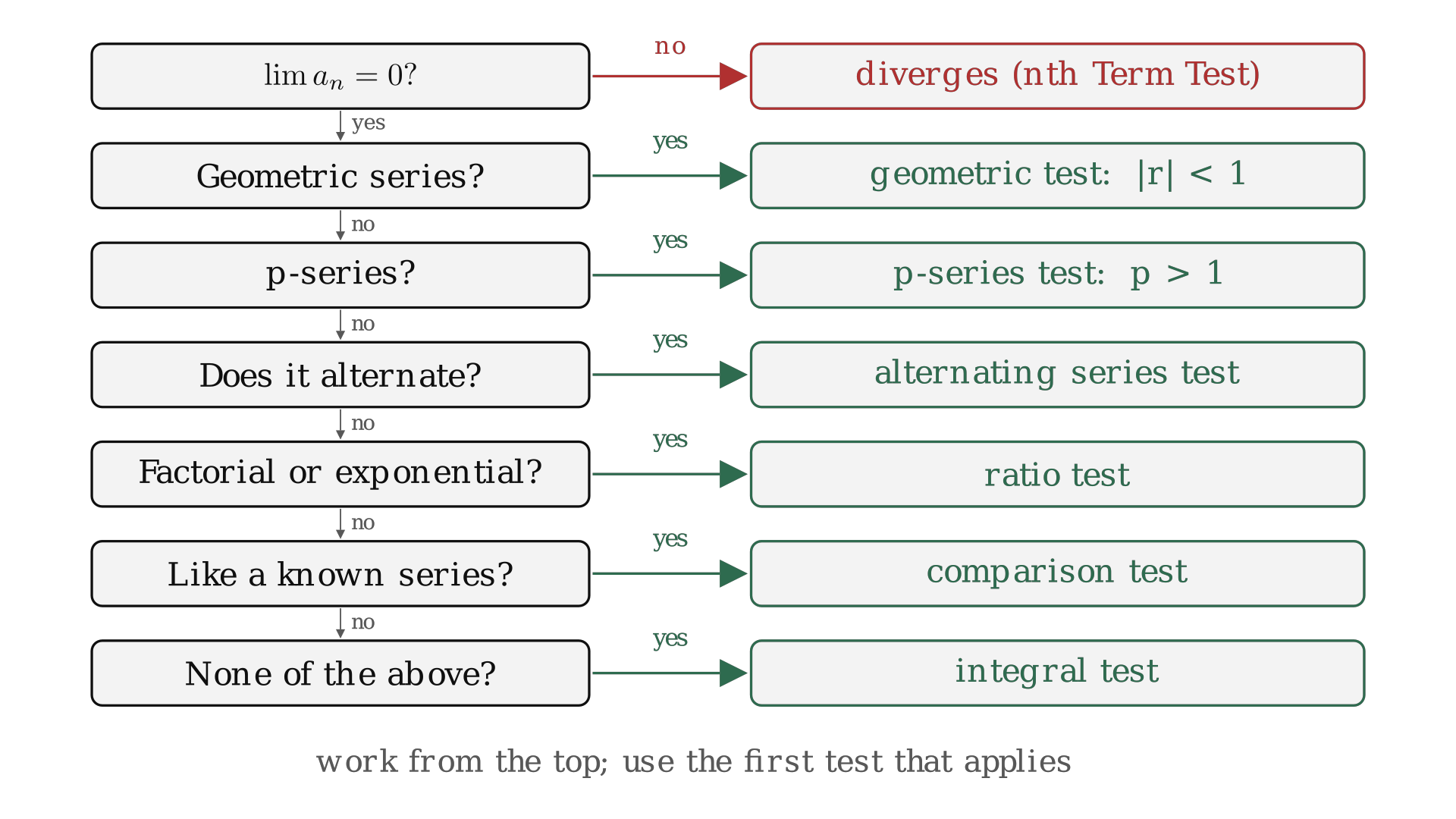
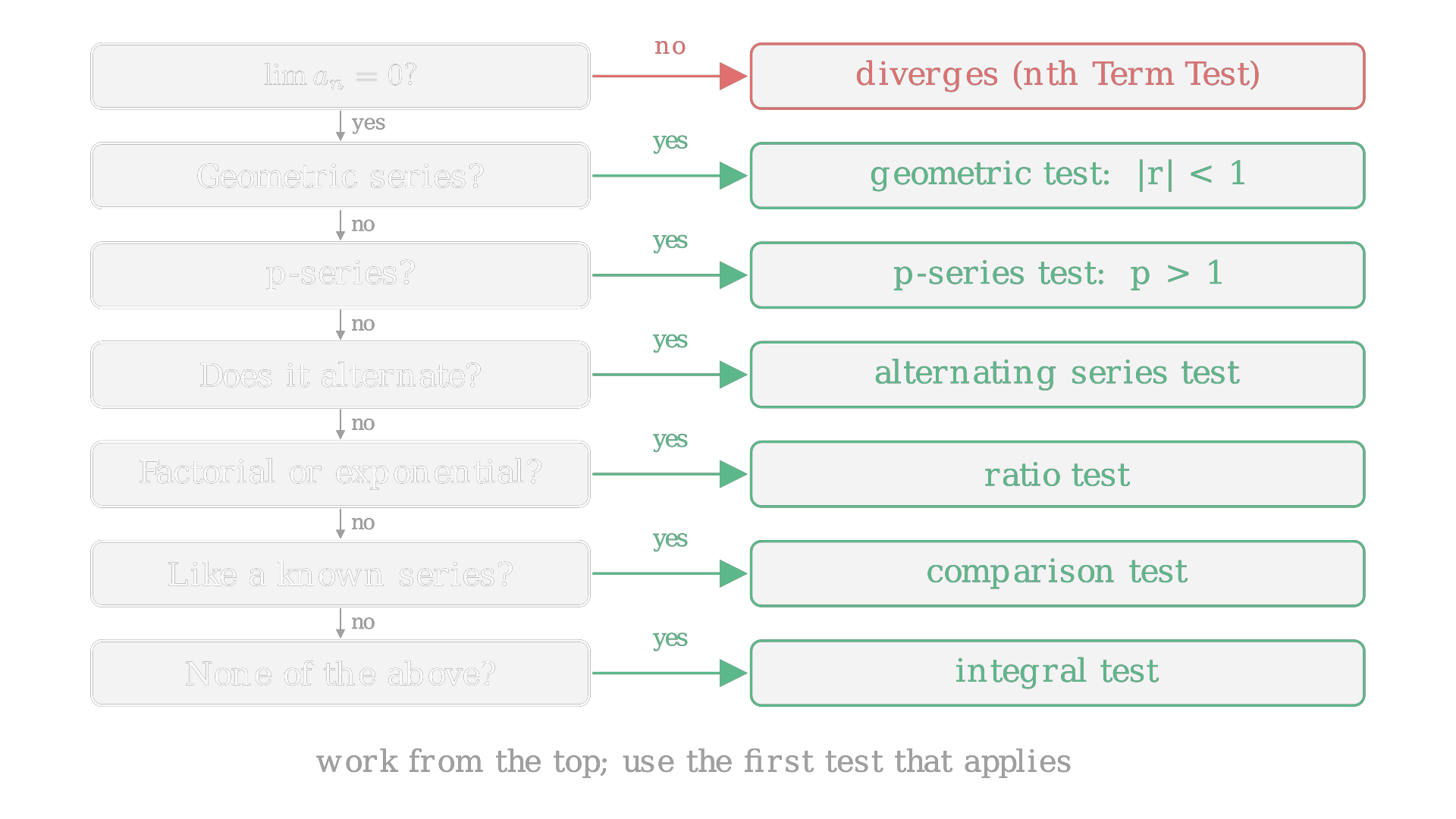
应该使用哪个收敛判别法?
Step 0 (always start here): Does $\lim a_n = 0$? If NO → diverges (nth Term Test). If YES → continue.
步骤 0(永远先做):$\lim a_n = 0$ 吗?若否 → 发散(第 n 项判别法)。若是 → 继续。
Step 1: Is it geometric? $\sum ar^n$ → converges if $|r| < 1$, diverges if $|r| \geq 1$.
步骤 1:是等比级数吗?$\sum ar^n$ → $|r| < 1$ 时收敛,$|r| \geq 1$ 时发散。
Step 2: Is it a $p$-series? $\sum 1/n^p$ → converges if $p > 1$, diverges if $p \leq 1$.
步骤 2:是 $p$ 级数吗?$\sum 1/n^p$ → $p > 1$ 时收敛,$p \leq 1$ 时发散。
Step 3: Does it alternate? Try the Alternating Series Test.
步骤 3:是否交错?尝试交错级数判别法。
Step 4: Factorials or exponentials? Try the Ratio Test.
步骤 4:含阶乘或指数?尝试比值判别法。
Step 5: Looks like a known series? Try Direct or Limit Comparison.
步骤 5:与已知级数相似?尝试比较判别法或极限比较判别法。
Step 6: None of the above? Try the Integral Test.
步骤 6:以上都不是?尝试积分判别法。
| Test判别法 | Applies To适用对象 | Conclusion结论 |
|---|---|---|
| nth Term第 n 项 | All series所有级数 | Diverges if $\lim a_n \neq 0$ (only proves divergence)$\lim a_n \neq 0$ 时发散(只能判发散) |
| Geometric等比 | $\sum ar^n$ | Converges to $a/(1-r)$ if $|r| < 1$$|r| < 1$ 时收敛到 $a/(1-r)$ |
| $p$-Series$p$ 级数 | $\sum 1/n^p$ | Converges if $p > 1$$p > 1$ 时收敛 |
| Integral积分 | Positive, continuous, decreasing $f(n)$正、连续、单调递减的 $f(n)$ | Same as $\int_1^{\infty} f(x)\,dx$与 $\int_1^{\infty} f(x)\,dx$ 同性质 |
| Direct Comparison比较 | Positive series正项级数 | Bounded by convergent → converges被收敛级数控制 → 收敛 |
| Limit Comparison极限比较 | Positive series正项级数 | Limit is finite & positive → same behavior极限有限且为正 → 同收敛或同发散 |
| Alternating Series交错级数 | $\sum (-1)^n b_n$ | Converges if $b_n > 0$ is decreasing and $b_n \to 0$$b_n > 0$ 单调递减且 $b_n \to 0$ 时收敛 |
| Ratio比值 | All series所有级数 | $L < 1$ converges; $L > 1$ diverges; $L = 1$ inconclusive$L < 1$ 收敛;$L > 1$ 发散;$L = 1$ 不能判断 |
Exam Strategy for Unit 10
单元 10 考试策略
Determine convergence/divergence of a given series using the appropriate test.
判断收敛/发散:对给定级数使用合适的判别法。
Find the sum of a geometric or telescoping series.
求和:等比级数或裂项相消级数的和。
Find the interval of convergence of a power series using the ratio test + endpoint checks.
求幂级数的收敛区间:使用比值判别法并检验端点。
Identify the Taylor or Maclaurin series for a function, or match a series to its function.
识别:函数的泰勒或麦克劳林级数,或将级数与对应函数匹配。
Compute Taylor polynomial coefficients from given derivative values.
由给定导数值计算泰勒多项式系数。
Taylor polynomial chain: build a Taylor polynomial from a table of derivative values, use it to approximate a value, and bound the error.
泰勒多项式链式任务:由导数值表构造泰勒多项式,用它近似某值,并估计误差界。
Deriving a new series from a known one via substitution, differentiation, or integration.
由已知级数推导新级数:通过代换、求导或积分。
Finding the interval of convergence with complete endpoint analysis.
求收敛区间:含完整的端点分析。
Using the Lagrange error bound or alternating series error bound to justify that an approximation is within a given tolerance.
使用拉格朗日误差界或交错级数误差界,论证近似值在给定容差内。
Flashcards: Click to Flip
闪卡:点击翻面
$\displaystyle\sum_{n=0}^{\infty} ar^n = \;?$等比级数和
$\displaystyle\sum_{n=0}^{\infty} ar^n = \;?$
$$ \frac{a}{1-r}, \quad |r| < 1 $$
If $\lim a_n \neq 0$, then…?第 n 项判别法:
若 $\lim a_n \neq 0$,则……?
$$\lim a_n \neq 0 \;\Rightarrow\; \sum a_n \text{ diverges}$$
converse fails逆命题不成立
$\sum 1/n^p$ converges when…?$p$ 级数:
$\sum 1/n^p$ 何时收敛?
$$\sum \frac{1}{n^p} \text{ converges} \iff p > 1$$
$L = \lim |a_{n+1}/a_n|$
What do the outcomes mean?比值判别法:
$L = \lim |a_{n+1}/a_n|$
各结果的含义?
$L < 1$: converges absolutely
$L > 1$: diverges
$L = 1$: inconclusive$L < 1$:绝对收敛
$L > 1$:发散
$L = 1$:不能判断
$$ \sum_{n=0}^{\infty} \frac{x^n}{n!} $$
Converges for all $x$.对所有 $x$ 收敛。
$$ \sum_{n=0}^{\infty} \frac{(-1)^n x^{2n+1}}{(2n+1)!} $$
Odd powers only, alternating signs.只含奇次幂,正负交替。
$|S - S_n| \leq |a_{n+1}|$
Error ≤ the first omitted term.误差 ≤ 第一个被舍弃项。
$|R_n(x)| \leq \dfrac{M}{(n+1)!}|x-a|^{n+1}$
where $M = \max|f^{(n+1)}(c)|$其中 $M = \max|f^{(n+1)}(c)|$
Unit 10 Practice Quiz
单元 10 练习小测
Readiness Checklist
备考清单
Click each item you've mastered. Aim for 100% before exam day.
点击勾选已掌握的项目,争取在考试前达到 100%。
- Define convergence/divergence using partial sums用部分和定义收敛/发散
- Recognize and evaluate geometric series ($|r| < 1$)识别并求等比级数的值($|r| < 1$)
- Apply the nth Term Test for Divergence应用第 n 项发散判别法
- Apply the Integral Test (with conditions)应用积分判别法(含条件检验)
- Classify p-series convergence ($p > 1$ vs $p \leq 1$)判断 p 级数的收敛性($p > 1$ vs $p \leq 1$)
- Use Direct and Limit Comparison Tests使用比较判别法与极限比较判别法
- Apply the Alternating Series Test (all 3 conditions)应用交错级数判别法(三条件齐验)
- Apply the Ratio Test for absolute convergence用比值判别法判定绝对收敛
- Distinguish absolute vs. conditional convergence区分绝对收敛与条件收敛
- Use the Alternating Series Error Bound使用交错级数误差界
- Construct Taylor/Maclaurin polynomials from derivatives由导数值构造泰勒/麦克劳林多项式
- Apply the Lagrange Error Bound应用拉格朗日误差界
- Find the radius and interval of convergence (including endpoints)求收敛半径与收敛区间(含端点)
- Write the 4 essential Maclaurin series from memory默写 4 条常见的麦克劳林级数
- Derive new series via substitution, differentiation, integration通过代换、求导、积分推导新级数