Unit 8: Applications of Integration
单元 8:积分的应用
This unit turns the definite integral into a problem-solving tool: average values, net change, geometric area, volume from cross sections, solids of revolution, and arc length (BC). The unifying idea is simple: an integral accumulates many tiny pieces into one total quantity.
本单元把定积分(definite integral)当作解题工具:平均值、净变化、几何面积、由横截面(cross-section)得到的体积、旋转体(solid of revolution)以及弧长(BC)。统一思想很简单:积分把无数微小片段累加成一个整体量。
Finding the Average Value of a Function on an Interval
在区间上求函数的平均值
- Calculate the average value of a continuous function on $[a,b]$ with $f_{\text{avg}}=\frac{1}{b-a}\int_a^b f(x)\,dx$.
- Explain average value as the height of the rectangle whose area equals the signed area under the curve.
- Distinguish average value from average rate of change and choose the right one from the wording.
- Interpret an average value in context, with the units of $f$.
- Determine a value $c$ with $f(c)=f_{\text{avg}}$ (Mean Value Theorem for integrals).
- 用 $f_{\text{avg}}=\frac{1}{b-a}\int_a^b f(x)\,dx$ 计算(
calculate)连续函数在 $[a,b]$ 上的平均值。 - 解释(
explain)平均值:它是面积等于曲线下带号面积的矩形的高。 - 区分平均值与平均变化率,并根据题目措辞选用正确的一个。
- 结合情境解释平均值,其单位与 $f$ 的单位相同。
- 求出满足 $f(c)=f_{\text{avg}}$ 的 $c$(积分中值定理,
Mean Value Theorem for integrals)。
The average value of a continuous function is the constant height that gives the same area as the original curve over the same interval. It is a “one-number summary” of a varying function.
连续函数的平均值(average value of a function)是这样一个常数高度:它在同一区间上所围矩形面积与原曲线下的面积相等。它是一个变化函数(function)的“单值概括”。
Geometrically, this is the height of a rectangle with width b − a whose area matches the signed area under the graph of f on [a,b].
几何上,这就是一个宽度为 b − a 的矩形高度,使其面积等于 f 在 [a,b] 上图形下方的带号面积。
Average value is not average rate of change. Average value measures a typical output level; average rate of change measures how much the output changes per unit input.
函数的平均值不是平均变化率(average rate of change)。平均值衡量典型的输出水平;平均变化率衡量每单位输入对应输出的变化量。
Worked Example: Average Value of $x^2+1$ on $[0,2]$例题:$x^2+1$ 在 $[0,2]$ 上的平均值
Find the average value of $f(x)=x^2+1$ on $[0,2]$.
求 $f(x)=x^2+1$ 在 $[0,2]$ 上的平均值。
- Write the average-value formula:写出平均值公式: $$f_{\text{avg}}=\frac{1}{2-0}\int_0^2 (x^2+1)\,dx$$
- Evaluate the integral:计算积分(
integral): $$\int_0^2 (x^2+1)\,dx=\left[\frac{x^3}{3}+x\right]_0^2=\frac{8}{3}+2=\frac{14}{3}$$ - Divide by the interval length:除以区间长度: $$f_{\text{avg}}=\frac{1}{2}\cdot\frac{14}{3}=\frac{7}{3}$$
The curve’s average height on [0,2] is $\frac73$. A rectangle of width 2 and height $\frac73$ has the same area as the region under $y=x^2+1$ from 0 to 2.
曲线在 [0,2] 上的平均高度为 $\frac73$。宽 2、高 $\frac73$ 的矩形与 $y=x^2+1$ 在 0 到 2 之间的区域面积相同。
Interactive Example: Average Value as an Equal-Area Rectangle
交互示例:把函数平均值看作等面积矩形
Controls
控制项
Worked Example: Average Temperature in a Greenhouse例题:温室的平均温度
The temperature in a greenhouse is $T(t)=50+6t-t^2$ degrees Fahrenheit, $t$ hours after 6 a.m., for $0\le t\le 6$. (a) Find the average temperature on $[0,6]$. (b) Find every time $c$ in $[0,6]$ at which $T(c)$ equals that average.
温室温度为 $T(t)=50+6t-t^2$(华氏度,°F),$t$ 为早上 6 点后的小时数,$0\le t\le 6$。(a) 求 $[0,6]$ 上的平均温度。(b) 求 $[0,6]$ 内所有满足 $T(c)$ 等于该平均值的时刻 $c$。
- Set up. $T_{\text{avg}}=\frac{1}{6-0}\int_0^6 (50+6t-t^2)\,dt$.
- 建立式子。 $T_{\text{avg}}=\frac{1}{6-0}\int_0^6 (50+6t-t^2)\,dt$。
- Integrate. $\int_0^6 (50+6t-t^2)\,dt=\left[50t+3t^2-\frac{t^3}{3}\right]_0^6=300+108-72=336$.
- 积分。 $\int_0^6 (50+6t-t^2)\,dt=\left[50t+3t^2-\frac{t^3}{3}\right]_0^6=300+108-72=336$。
- (a) Divide by the length. $T_{\text{avg}}=\frac{336}{6}=56$ °F.
- (a) 除以区间长度。 $T_{\text{avg}}=\frac{336}{6}=56$ °F。
- (b) Solve $T(c)=56$. $50+6c-c^2=56$ gives $c^2-6c+6=0$, so $c=3\pm\sqrt3$: $c\approx1.27$ h and $c\approx4.73$ h. Both lie in $[0,6]$.
- (b) 解 $T(c)=56$。 由 $50+6c-c^2=56$ 得 $c^2-6c+6=0$,所以 $c=3\pm\sqrt3$:$c\approx1.27$ 小时与 $c\approx4.73$ 小时,两者都在 $[0,6]$ 内。
$T$ is continuous, so the Mean Value Theorem for integrals guarantees at least one time when the temperature equals its average. Here there are two: one while the temperature rises (before $t=3$) and one while it falls.
$T$ 连续,所以积分中值定理保证至少有一个时刻温度等于其平均值。这里有两个:一个在升温阶段($t=3$ 之前),一个在降温阶段。
Read the wording. "Average value of $f$" means $\frac{1}{b-a}\int_a^b f(x)\,dx$; "average rate of change of $f$" means $\frac{f(b)-f(a)}{b-a}$. If a table or graph gives a rate $r(t)$ and the question asks for its average over an interval, that is the average value of $r$: integrate $r$ and divide by the length. The answer carries the units of the function being averaged.
看清措辞。“$f$ 的平均值”(average value)指 $\frac{1}{b-a}\int_a^b f(x)\,dx$;“$f$ 的平均变化率”(average rate of change)指 $\frac{f(b)-f(a)}{b-a}$。若表格或图像给出变化率 $r(t)$,并问它在某区间上的平均值,那就是 $r$ 的平均值:对 $r$ 积分再除以区间长度。答案的单位与被平均的函数相同。
Calculate the average value of $f(x)=2x$ on $[1,3]$.计算 $f(x)=2x$ 在 $[1,3]$ 上的平均值。
$\frac{1}{3-1}\int_1^3 2x\,dx=\frac12\left[x^2\right]_1^3=\frac12(9-1)=4$. Check: $f$ is linear, so its average equals its value at the midpoint, $f(2)=4$.
$\frac{1}{3-1}\int_1^3 2x\,dx=\frac12\left[x^2\right]_1^3=\frac12(9-1)=4$。验证:$f$ 是线性函数,其平均值等于中点处的值 $f(2)=4$。
$f$ is continuous on $[0,4]$ and $\int_0^4 f(x)\,dx=-8$. State the average value and explain whether $f$ must take that value.$f$ 在 $[0,4]$ 上连续,且 $\int_0^4 f(x)\,dx=-8$。写出平均值,并说明 $f$ 是否一定取到该值。
$f_{\text{avg}}=\frac{-8}{4}=-2$. Yes: $f$ is continuous, so by the Mean Value Theorem for integrals there is a $c$ in $[0,4]$ with $f(c)=-2$. An average value can be negative because it comes from signed area.
$f_{\text{avg}}=\frac{-8}{4}=-2$。一定:$f$ 连续,由积分中值定理,$[0,4]$ 内存在 $c$ 使 $f(c)=-2$。平均值可以为负,因为它来自带号面积。
For $f(x)=\sin x$ on $[0,\pi]$, calculate the average value and the average rate of change, and explain why they differ.对 $f(x)=\sin x$ 在 $[0,\pi]$ 上,计算平均值与平均变化率,并解释二者为何不同。
Average value: $\frac{1}{\pi}\int_0^\pi \sin x\,dx=\frac{1}{\pi}\left[-\cos x\right]_0^\pi=\frac{2}{\pi}\approx0.637$. Average rate of change: $\frac{\sin\pi-\sin0}{\pi-0}=0$. The first is a typical height of the graph; the second is the slope of the secant line, which is flat because the endpoints have equal heights.
平均值:$\frac{1}{\pi}\int_0^\pi \sin x\,dx=\frac{1}{\pi}\left[-\cos x\right]_0^\pi=\frac{2}{\pi}\approx0.637$。平均变化率:$\frac{\sin\pi-\sin0}{\pi-0}=0$。前者是图像的典型高度;后者是割线斜率,两端点等高,所以割线水平。
Connecting Position, Velocity, and Acceleration Using Integrals
用积分串联位置、速度与加速度
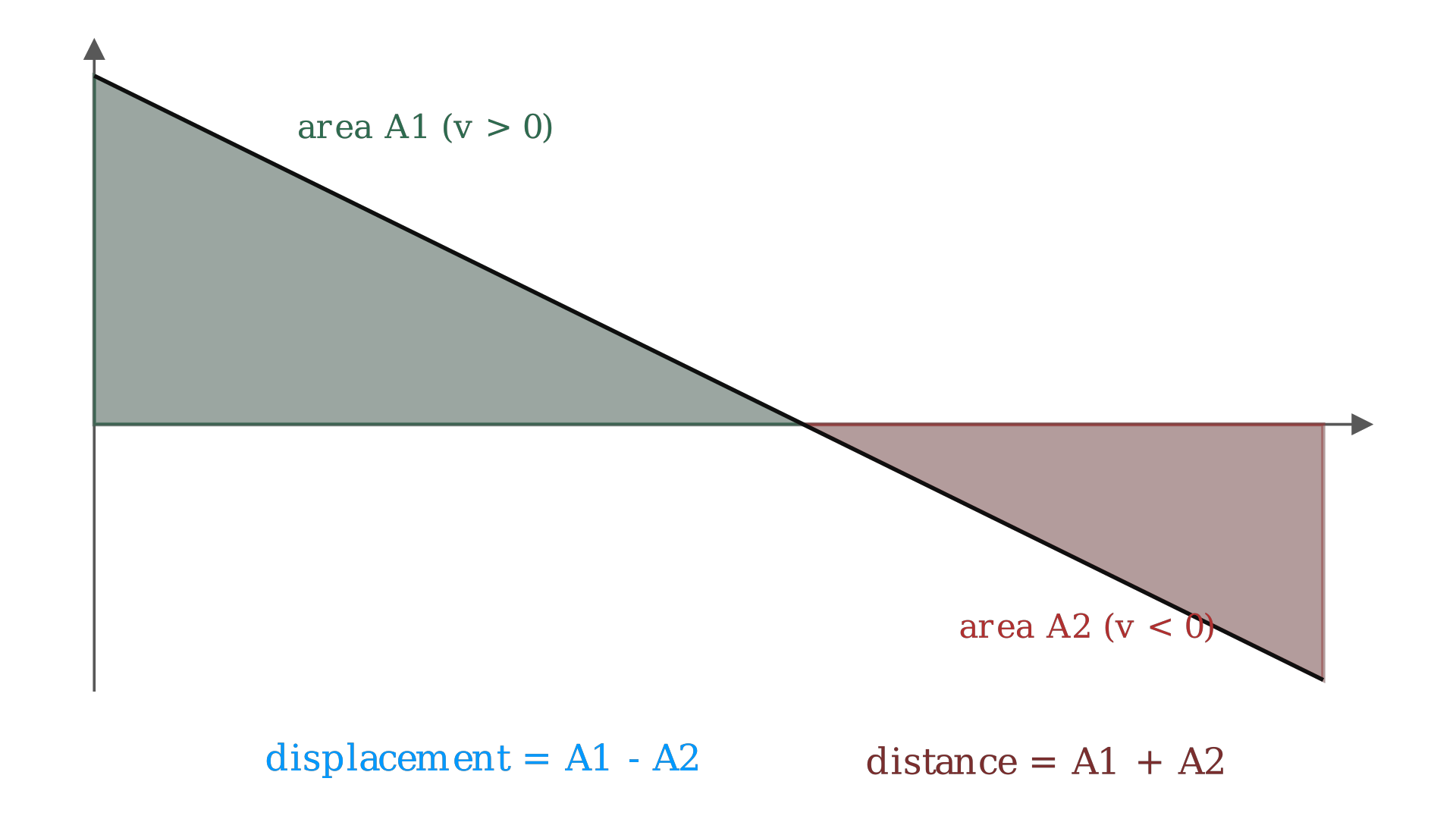
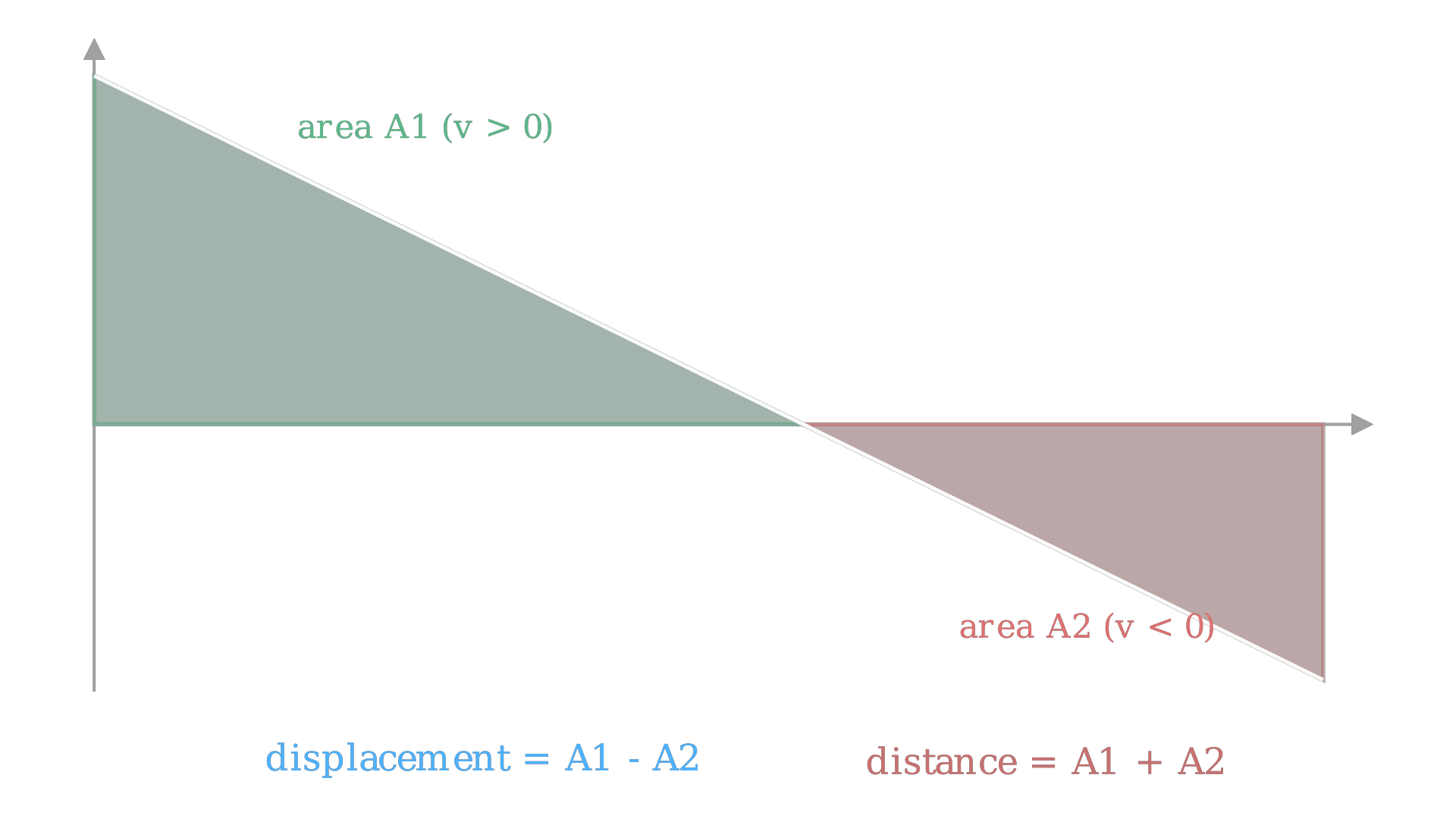
- Calculate displacement on $[a,b]$ as $\int_a^b v(t)\,dt$.
- Calculate total distance as $\int_a^b |v(t)|\,dt$, splitting at every sign change of $v$.
- Determine position from an initial condition: $s(b)=s(a)+\int_a^b v(t)\,dt$.
- Determine velocity from acceleration and an initial velocity.
- Interpret each result with units and the direction of motion.
- 把 $[a,b]$ 上的位移计算为 $\int_a^b v(t)\,dt$。
- 把总路程计算为 $\int_a^b |v(t)|\,dt$,并在 $v$ 每次变号处分段。
- 由初始条件确定(
determine)位置:$s(b)=s(a)+\int_a^b v(t)\,dt$。 - 由加速度与初速度确定速度。
- 结合单位与运动方向解释每个结果。
If velocity is the rate of change of position, then integrating velocity accumulates displacement. If acceleration is the rate of change of velocity, then integrating acceleration accumulates the change in velocity.
若速度是位置的变化率(rate of change),则对速度积分就累积出位移。若加速度是速度的变化率,则对加速度积分就累积出速度的变化量。
Displacement keeps track of direction. Distance ignores direction and is always nonnegative. If velocity changes sign, you must account for that before computing distance.
位移(displacement)会保留方向信息。路程(distance)忽略方向,且恒为非负。如果速度变号,在计算路程前必须先处理这一点。
Worked Example: Velocity Changes Sign例题:速度变号
A particle moves along the $x$-axis with velocity $v(t) = t^{2} - 4t + 3$ for $0 \le t \le 4$ (in m/s). Find (a) the displacement and (b) the total distance traveled on $[0, 4]$.
一质点沿 $x$ 轴运动,速度为 $v(t) = t^{2} - 4t + 3$,其中 $0 \le t \le 4$(单位 m/s)。求 (a) 位移;(b) 在 $[0, 4]$ 上的总路程。
- Find where $v(t)$ changes sign. Factor: $v(t) = (t-1)(t-3)$, so $v(t) = 0$ at $t = 1$ and $t = 3$. Sign chart on $[0, 4]$: $v(0.5) = 1.25 > 0$, $v(2) = -1 < 0$, $v(3.5) = 1.25 > 0$. So $v > 0$ on $(0, 1)$ and $(3, 4)$, and $v < 0$ on $(1, 3)$.
- 找出 $v(t)$ 的变号点。 因式分解:$v(t) = (t-1)(t-3)$,所以 $v(t) = 0$ 在 $t = 1$ 与 $t = 3$。在 $[0, 4]$ 上的符号表:$v(0.5) = 1.25 > 0$,$v(2) = -1 < 0$,$v(3.5) = 1.25 > 0$。所以 $v > 0$ 在 $(0, 1)$ 和 $(3, 4)$ 上,$v < 0$ 在 $(1, 3)$ 上。
- (a) Displacement keeps direction (the sign of $v$), so integrate $v$ straight through: $$\int_0^{4}(t^{2} - 4t + 3)\,dt \;=\; \Bigl[\tfrac{t^{3}}{3} - 2t^{2} + 3t\Bigr]_0^{4} \;=\; \tfrac{64}{3} - 32 + 12 \;=\; \tfrac{4}{3}\text{ m}.$$
- (a) 位移保留方向(即 $v$ 的正负),所以直接对 $v$ 在整个区间积分: $$\int_0^{4}(t^{2} - 4t + 3)\,dt \;=\; \Bigl[\tfrac{t^{3}}{3} - 2t^{2} + 3t\Bigr]_0^{4} \;=\; \tfrac{64}{3} - 32 + 12 \;=\; \tfrac{4}{3}\text{ m}.$$
- (b) Total distance uses $|v(t)|$. Split at each sign change so absolute value resolves into a definite sign:
$$\int_0^{4}|v(t)|\,dt \;=\; \int_0^{1}\!v\,dt \;+\; \int_1^{3}\!(-v)\,dt \;+\; \int_3^{4}\!v\,dt.$$
Each piece evaluates separately. Using the same antiderivative $\tfrac{t^{3}}{3} - 2t^{2} + 3t$:
- $\int_0^{1} v \,dt = \tfrac{1}{3} - 2 + 3 = \tfrac{4}{3}$.
- $\int_1^{3} v \,dt = (9 - 18 + 9) - (\tfrac{1}{3} - 2 + 3) = 0 - \tfrac{4}{3} = -\tfrac{4}{3}$. Take absolute value: $\tfrac{4}{3}$.
- $\int_3^{4} v \,dt = \tfrac{4}{3} - 0 = \tfrac{4}{3}$.
- (b) 总路程使用 $|v(t)|$。在每个变号点处分段,让绝对值落到确定的符号:
$$\int_0^{4}|v(t)|\,dt \;=\; \int_0^{1}\!v\,dt \;+\; \int_1^{3}\!(-v)\,dt \;+\; \int_3^{4}\!v\,dt.$$
每段分别计算。使用同一个原函数(
antiderivative) $\tfrac{t^{3}}{3} - 2t^{2} + 3t$:- $\int_0^{1} v \,dt = \tfrac{1}{3} - 2 + 3 = \tfrac{4}{3}$。
- $\int_1^{3} v \,dt = (9 - 18 + 9) - (\tfrac{1}{3} - 2 + 3) = 0 - \tfrac{4}{3} = -\tfrac{4}{3}$。 取绝对值:$\tfrac{4}{3}$。
- $\int_3^{4} v \,dt = \tfrac{4}{3} - 0 = \tfrac{4}{3}$。
Computing $\int_0^4 v\,dt$ and reporting that as the total distance. That gives the displacement $\tfrac{4}{3}$ m: the cancellation across the sign change has thrown away $\tfrac{8}{3}$ m of "back-and-forth" motion. Always split at sign changes before computing distance.
把 $\int_0^4 v\,dt$ 当成总路程。这只算出位移 $\tfrac{4}{3}$ m:变号处的正负相消已经抹掉了 $\tfrac{8}{3}$ m 的“来回”运动。计算路程前务必在变号点处分段。
Worked Example: From Acceleration to Position例题:由加速度到位置
A particle moves along a line with acceleration $a(t)=6t-4$ (in $\mathrm{m/s^2}$), initial velocity $v(0)=2$ m/s and initial position $x(0)=1$ m. Find (a) $v(t)$ and $v(2)$, (b) $x(2)$, and (c) the total distance traveled on $[0,2]$.
一质点沿直线运动,加速度 $a(t)=6t-4$(单位 $\mathrm{m/s^2}$),初速度 $v(0)=2$ m/s,初始位置 $x(0)=1$ m。求 (a) $v(t)$ 与 $v(2)$;(b) $x(2)$;(c) $[0,2]$ 上的总路程。
- (a) Velocity. $v(t)=v(0)+\int_0^t (6u-4)\,du=2+3t^2-4t$, so $v(2)=2+12-8=6$ m/s.
- (a) 速度。 $v(t)=v(0)+\int_0^t (6u-4)\,du=2+3t^2-4t$,所以 $v(2)=2+12-8=6$ m/s。
- (b) Position. $x(2)=x(0)+\int_0^2 (3t^2-4t+2)\,dt=1+\left[t^3-2t^2+2t\right]_0^2=1+(8-8+4)=5$ m.
- (b) 位置。 $x(2)=x(0)+\int_0^2 (3t^2-4t+2)\,dt=1+\left[t^3-2t^2+2t\right]_0^2=1+(8-8+4)=5$ m。
- (c) Distance. $3t^2-4t+2$ has discriminant $16-24=-8<0$ and a positive leading coefficient, so $v(t)>0$ for every $t$. The particle never turns around, so the distance equals the displacement: $4$ m.
- (c) 路程。 $3t^2-4t+2$ 的判别式为 $16-24=-8<0$,且首项系数为正,所以对所有 $t$ 有 $v(t)>0$。质点从不掉头,路程等于位移:$4$ m。
Each integral of a rate gives a change, and adding the initial value turns that change into a value. Distance equals displacement only because $v$ never changes sign here.
对变化率的每个积分都给出一个变化量,加上初始值就把变化量变成了数值。这里路程等于位移,只是因为 $v$ 从不变号。
When asked for position at time $b$, write $x(b)=x(a)+\int_a^b v(t)\,dt$ with the given starting position; the integral alone is only the change in position. For total distance on a calculator-active part, you can enter $\int_a^b |v(t)|\,dt$ directly; without a calculator, find the zeros of $v$ and split there. Give units (m, m/s) with each answer.
求时刻 $b$ 的位置时,写出 $x(b)=x(a)+\int_a^b v(t)\,dt$ 并代入已知的初始位置;单独的积分只是位置的变化量。在允许计算器的部分求总路程,可以直接输入 $\int_a^b |v(t)|\,dt$;不用计算器时,先求 $v$ 的零点再分段。每个答案都写上单位(m、m/s)。
$v(t)=3-t$ m/s on $[0,5]$. Calculate the displacement and the total distance.在 $[0,5]$ 上 $v(t)=3-t$ m/s。计算位移与总路程。
Displacement: $\int_0^5(3-t)\,dt=15-12.5=2.5$ m. $v$ changes sign at $t=3$, so distance $=\int_0^3(3-t)\,dt+\int_3^5(t-3)\,dt=4.5+2=6.5$ m.
位移:$\int_0^5(3-t)\,dt=15-12.5=2.5$ m。$v$ 在 $t=3$ 处变号,所以路程 $=\int_0^3(3-t)\,dt+\int_3^5(t-3)\,dt=4.5+2=6.5$ m。
$x(0)=4$ and $\int_0^3 v(t)\,dt=-7$. Find $x(3)$.$x(0)=4$ 且 $\int_0^3 v(t)\,dt=-7$。求 $x(3)$。
$x(3)=4+(-7)=-3$. Over $[0,3]$ the net motion was 7 units in the negative direction.
$x(3)=4+(-7)=-3$。在 $[0,3]$ 上净运动为负方向 7 个单位。
Explain why $\int_a^b |v(t)|\,dt\ge\left|\int_a^b v(t)\,dt\right|$, and state when they are equal.解释为何 $\int_a^b |v(t)|\,dt\ge\left|\int_a^b v(t)\,dt\right|$,并说明何时二者相等。
In $\int v\,dt$, forward and backward motion cancel; in $\int|v|\,dt$ every piece counts as positive. They are equal exactly when $v$ does not change sign on $[a,b]$, so the particle never reverses.
在 $\int v\,dt$ 中,正向与反向运动相互抵消;在 $\int|v|\,dt$ 中每一段都按正数计入。当且仅当 $v$ 在 $[a,b]$ 上不变号(质点不掉头)时二者相等。
Using Accumulation Functions and Definite Integrals in Applied Contexts
在应用情境中使用累积函数与定积分
- Interpret $\int_a^b r(t)\,dt$ as the net change in a quantity whose rate is $r$, with units.
- Calculate an amount as a starting value plus the integral of the net rate (in minus out).
- Determine when an amount is greatest or least by setting the net rate to zero and comparing endpoints.
- Explain the units of an integral as rate units times input units.
- Evaluate and differentiate accumulation functions $F(x)=\int_a^x f(t)\,dt$.
- 把 $\int_a^b r(t)\,dt$ 解释为变化率为 $r$ 的量的净变化,并写出单位。
- 把某个量计算为初始值加上净变化率(流入减流出)的积分。
- 令净变化率为零并比较端点,确定某个量何时最大或最小。
- 解释积分的单位:变化率的单位乘以自变量的单位。
- 计算累积函数 $F(x)=\int_a^x f(t)\,dt$ 的值与导数。
An accumulation function records how much of a changing quantity has built up from a starting point to a variable endpoint. In AP Calculus, this usually appears in the form $F(x)=\int_a^x f(t)\,dt$.
累积函数(accumulation function)记录某个变化量从起点到可变终点之间累积了多少。在 AP 微积分中,它通常写成 $F(x)=\int_a^x f(t)\,dt$ 的形式。
In words: the integral of a rate gives net change in the underlying quantity. This is why words like accumulation, flows in, net increase, and amount added usually point to integration.
用文字描述:对一个变化率(rate)积分得到的是底层量的净变化(net change)。这就是为什么累积、流入、净增加、新增量这类词通常都指向积分。
If the problem gives a rate and asks for an amount, integrate. If the problem gives an amount and asks how fast it changes, differentiate.
若题目给出变化率而求总量,则积分。若题目给出总量而问其变化速率,则求导(derivative)。
Worked Example: Tank Filling with a Variable-Rate Inflow例题:变速率注水的水箱
Water flows into a tank at the rate $R(t) = 6 + 4t$ gal/min for $0 \le t \le 5$ min. The tank holds $W(0) = 20$ gal at $t = 0$.
水以速率 $R(t) = 6 + 4t$ gal/min 流入水箱,$0 \le t \le 5$ 分钟。$t = 0$ 时水箱中的水量为 $W(0) = 20$ gal。
(a) How much water enters the tank during the interval $[0, 5]$?
(a) 在 $[0, 5]$ 区间内有多少水流入水箱?
(b) How much water is in the tank at $t = 5$?
(b) $t = 5$ 时水箱里有多少水?
- Identify the integral. The amount that enters during $[0, 5]$ is the accumulation of the inflow rate: $$\text{Net inflow} \;=\; \int_0^{5} R(t)\,dt \;=\; \int_0^{5}(6 + 4t)\,dt.$$
- 识别积分。 在 $[0, 5]$ 区间内流入的水量(净流入量)就是流入速率的累积: $$\int_0^{5} R(t)\,dt \;=\; \int_0^{5}(6 + 4t)\,dt.$$
- Evaluate. $$\int_0^{5}(6 + 4t)\,dt \;=\; \bigl[\,6t + 2t^{2}\,\bigr]_0^{5} \;=\; 30 + 50 \;=\; 80\text{ gal}.$$
- 计算。 $$\int_0^{5}(6 + 4t)\,dt \;=\; \bigl[\,6t + 2t^{2}\,\bigr]_0^{5} \;=\; 30 + 50 \;=\; 80\text{ gal}.$$
- (b) Add to the initial amount. Net change formula: $W(5) = W(0) + \int_0^{5} R(t)\,dt = 20 + 80 = 100$ gal.
- (b) 加上初始量。 由净变化公式:$W(5) = W(0) + \int_0^{5} R(t)\,dt = 20 + 80 = 100$ gal。
The Net Change Theorem ($Q(b) - Q(a) = \int_a^b Q'(t)\,dt$) is the bridge between rates and amounts. We do not need an explicit formula for $W(t)$: the rate $R$ is $W'$, and integrating it directly gives the change.
净变化定理 ($Q(b) - Q(a) = \int_a^b Q'(t)\,dt$) 是连接变化率与总量的桥梁。我们无需 $W(t)$ 的显式表达:速率 $R$ 就是 $W'$,直接积分就得到变化量。
If water also drains at rate $D(t)$, the net rate of change of the tank is $W'(t) = R(t) - D(t)$, and the same formula applies: $W(b) = W(a) + \int_a^b\!\bigl[\,R(t) - D(t)\,\bigr]\,dt$. A problem that pairs an inflow rate with an outflow rate is solved the same way: integrate the net rate and add the starting amount.
若同时以速率 $D(t)$ 排水,则水箱的净变化率为 $W'(t) = R(t) - D(t)$,同一公式仍然适用:$W(b) = W(a) + \int_a^b\!\bigl[\,R(t) - D(t)\,\bigr]\,dt$。同时给出流入率与流出率的题目解法相同:对净变化率积分,再加上初始量。
Worked Example: Inflow, Outflow, and the Maximum Amount例题:流入、流出与最大水量
Water enters a tank at $E(t)=12$ L/min and drains at $D(t)=2t$ L/min for $0\le t\le 10$ min. At $t=0$ the tank holds $W(0)=30$ L. (a) Find $W(10)$. (b) When is the amount of water greatest, and how much is there then?
水以 $E(t)=12$ L/min 流入水箱,并以 $D(t)=2t$ L/min 排出,$0\le t\le 10$ 分钟。$t=0$ 时水箱有 $W(0)=30$ L。(a) 求 $W(10)$。(b) 何时水量最大?最大水量是多少?
- Net rate. $W'(t)=E(t)-D(t)=12-2t$.
- 净变化率。 $W'(t)=E(t)-D(t)=12-2t$。
- (a) $W(10)=30+\int_0^{10}(12-2t)\,dt=30+\left[12t-t^2\right]_0^{10}=30+(120-100)=50$ L.
- (a) $W(10)=30+\int_0^{10}(12-2t)\,dt=30+\left[12t-t^2\right]_0^{10}=30+(120-100)=50$ L。
- (b) Critical time. $W'(t)=0$ when $t=6$; $W'>0$ before and $W'<0$ after.
- (b) 临界时刻。 $t=6$ 时 $W'(t)=0$;之前 $W'>0$,之后 $W'<0$。
- Candidates test. $W(0)=30$, $W(6)=30+(72-36)=66$, $W(10)=50$. The maximum is $66$ L at $t=6$ min.
- 候选值检验。 $W(0)=30$,$W(6)=30+(72-36)=66$,$W(10)=50$。最大水量为 $66$ L,出现在 $t=6$ 分钟。
The amount rises while inflow exceeds outflow and falls once outflow is larger, so the maximum occurs where the two rates are equal (or at an endpoint, which the candidates test checks).
流入大于流出时水量上升,流出更大时水量下降,所以最大值出现在两速率相等处(或端点处,由候选值检验确认)。
Track units: if $R$ is in gallons per minute and $t$ in minutes, $\int R(t)\,dt$ is in gallons. An amount reported with a rate unit, or a rate reported with an amount unit, is an incorrect answer. For "when is the amount greatest", justify with the candidates test: list the endpoints and the times where the net rate is zero, then compare the amounts.
注意单位:若 $R$ 的单位是加仑每分钟、$t$ 的单位是分钟,则 $\int R(t)\,dt$ 的单位是加仑。用变化率的单位报告总量,或用总量的单位报告变化率,都是错误答案。对“何时总量最大”,用候选值检验(candidates test)说明理由:列出端点与净变化率为零的时刻,再比较对应的总量。
$r(t)$ is the rate, in people per hour, at which people enter a museum. State the units and meaning of $\int_2^5 r(t)\,dt$.$r(t)$ 是进入博物馆的人数速率(人/小时)。写出 $\int_2^5 r(t)\,dt$ 的单位与含义。
Units: people. It is the number of people who enter the museum between $t=2$ and $t=5$ hours.
单位:人。它表示在 $t=2$ 到 $t=5$ 小时之间进入博物馆的人数。
$F(x)=\int_1^x 3t^2\,dt$. Calculate $F(2)$ and $F'(2)$.$F(x)=\int_1^x 3t^2\,dt$。计算 $F(2)$ 与 $F'(2)$。
$F(2)=\left[t^3\right]_1^2=8-1=7$. By the Fundamental Theorem of Calculus, $F'(x)=3x^2$, so $F'(2)=12$.
$F(2)=\left[t^3\right]_1^2=8-1=7$。由微积分基本定理(Fundamental Theorem of Calculus),$F'(x)=3x^2$,所以 $F'(2)=12$。
Snow falls at $4$ cm/h for $0\le t\le 3$ h while melting removes it at $2t$ cm/h. The depth is $5$ cm at $t=0$. Find the depth at $t=3$ and the greatest depth.积雪以 $4$ cm/h 增加,$0\le t\le 3$ 小时,同时融化以 $2t$ cm/h 减少。$t=0$ 时深度为 $5$ cm。求 $t=3$ 时的深度与最大深度。
$D(3)=5+\int_0^3(4-2t)\,dt=5+(12-9)=8$ cm. The net rate $4-2t$ is zero at $t=2$, and $D(2)=5+(8-4)=9$ cm. Candidates: $D(0)=5$, $D(2)=9$, $D(3)=8$, so the greatest depth is $9$ cm at $t=2$ h.
$D(3)=5+\int_0^3(4-2t)\,dt=5+(12-9)=8$ cm。净变化率 $4-2t$ 在 $t=2$ 处为零,$D(2)=5+(8-4)=9$ cm。候选值:$D(0)=5$,$D(2)=9$,$D(3)=8$,所以最大深度为 $9$ cm,出现在 $t=2$ 小时。
Finding the Area Between Curves Expressed as Functions of x
求以 x 为自变量的两条曲线之间的面积
- Determine which curve is on top on an interval, using a test point or a sketch.
- Calculate the intersection $x$-values that serve as the limits of integration.
- Set up $A=\int_a^b [f(x)-g(x)]\,dx$ from a representative vertical strip.
- Calculate the enclosed area exactly, or with a calculator when the intersections are not exact.
- Explain why a correct setup always gives a positive area.
- 用试验点或草图确定区间上哪条曲线在上方。
- 计算作为积分上下限的交点 $x$ 值。
- 由代表性竖条建立 $A=\int_a^b [f(x)-g(x)]\,dx$。
- 精确计算所围面积;交点不是精确值时用计算器计算。
- 解释为什么正确的建立式总给出正的面积。
When curves are written as y = f(x) and y = g(x), the area between them is found by integrating the vertical distance between the top and bottom curves.
当曲线写成 y = f(x) 和 y = g(x) 时,两条曲线之间的面积(area between two curves)就是对上下两条曲线之间的垂直距离作积分。
Worked Example: Area Between $y=x$ and $y=x^2$例题:$y=x$ 与 $y=x^2$ 之间的面积
Find the area enclosed by $y=x$ and $y=x^2$ on $[0,1]$.
求 $y=x$ 与 $y=x^2$ 在 $[0,1]$ 上所围成的面积。
- Determine which graph is on top on [0,1]. Since $x \ge x^2$ there, the top curve is $y=x$ and the bottom curve is $y=x^2$.
- 先判断在 [0,1] 上哪条在上。因为该区间内 $x \ge x^2$,所以上曲线是 $y=x$,下曲线是 $y=x^2$。
- Set up the integral: $$A=\int_0^1 (x-x^2)\,dx$$
- 建立积分: $$A=\int_0^1 (x-x^2)\,dx$$
- Integrate: $$A=\left[\frac{x^2}{2}-\frac{x^3}{3}\right]_0^1=\frac12-\frac13=\frac16$$
- 积分: $$A=\left[\frac{x^2}{2}-\frac{x^3}{3}\right]_0^1=\frac12-\frac13=\frac16$$
Interactive Example: Area Between Two Curves
交互示例:两条曲线之间的面积
Controls
控制项
As the slope changes, the “top minus bottom” gap changes point-by-point, so the total area changes. This is exactly what the definite integral is measuring.
当斜率变化时,“上减下”的间距逐点变化,因此总面积也随之改变。这正是定积分所衡量的东西。
Worked Example: Area Between $y=4-x^2$ and $y=x+2$例题:$y=4-x^2$ 与 $y=x+2$ 之间的面积
Find the area of the region enclosed by $y=4-x^2$ and $y=x+2$ (Figure 8.1).
求 $y=4-x^2$ 与 $y=x+2$ 所围区域的面积(图 8.1)。
- Intersections. $4-x^2=x+2\Rightarrow x^2+x-2=0\Rightarrow (x+2)(x-1)=0$, so $x=-2$ and $x=1$.
- 交点。 $4-x^2=x+2\Rightarrow x^2+x-2=0\Rightarrow (x+2)(x-1)=0$,所以 $x=-2$ 与 $x=1$。
- Top curve. Test $x=0$: the parabola gives $4$ and the line gives $2$, so $y=4-x^2$ is on top.
- 上方曲线。 取 $x=0$ 试:抛物线给出 $4$,直线给出 $2$,所以 $y=4-x^2$ 在上。
- Set up. $A=\int_{-2}^{1}\left[(4-x^2)-(x+2)\right]dx=\int_{-2}^{1}(2-x-x^2)\,dx$.
- 建立积分。 $A=\int_{-2}^{1}\left[(4-x^2)-(x+2)\right]dx=\int_{-2}^{1}(2-x-x^2)\,dx$。
- Evaluate. $\left[2x-\frac{x^2}{2}-\frac{x^3}{3}\right]_{-2}^{1}=\left(2-\frac12-\frac13\right)-\left(-4-2+\frac83\right)=\frac76+\frac{10}{3}=\frac92$.
- 计算。 $\left[2x-\frac{x^2}{2}-\frac{x^3}{3}\right]_{-2}^{1}=\left(2-\frac12-\frac13\right)-\left(-4-2+\frac83\right)=\frac76+\frac{10}{3}=\frac92$。
Every strip has height top minus bottom, which is positive between the intersections, so the integral adds only positive pieces and equals the area.
每个竖条的高都是上减下,在两交点之间为正,所以积分只累加正的部分,结果就是面积。
Write the integrand as (top − bottom) and the intersection $x$-values as the limits before doing any arithmetic. On a calculator-active part, find the intersections with the calculator and store them rather than typing rounded limits; rounding the limits early can change the final decimals of the area.
在做任何计算之前,先把被积式写成(上 − 下),并把交点的 $x$ 值写成上下限。在允许计算器的部分,用计算器求交点并存储,而不是输入四舍五入后的上下限;过早舍入上下限会改变面积的最后几位小数。
Calculate the area enclosed by $y=x^2$ and $y=2x$.计算 $y=x^2$ 与 $y=2x$ 所围的面积。
Intersections: $x^2=2x\Rightarrow x=0,2$. On $(0,2)$, $2x\ge x^2$. $A=\int_0^2(2x-x^2)\,dx=4-\frac83=\frac43$.
交点:$x^2=2x\Rightarrow x=0,2$。在 $(0,2)$ 上 $2x\ge x^2$。$A=\int_0^2(2x-x^2)\,dx=4-\frac83=\frac43$。
A student writes $\int_0^1(x^2-x)\,dx$ for the region between $y=x$ and $y=x^2$ and gets $-\frac16$. Explain the error.某学生对 $y=x$ 与 $y=x^2$ 之间的区域写出 $\int_0^1(x^2-x)\,dx$,得到 $-\frac16$。解释错误所在。
The order is reversed: on $[0,1]$ the line is on top, so the integrand is $x-x^2$ and the area is $\frac16$. An area can never be negative.
顺序反了:在 $[0,1]$ 上直线在上,被积式应为 $x-x^2$,面积为 $\frac16$。面积不可能为负。
Calculate the area between $y=\cos x$ and $y=\sin x$ on $\left[0,\frac{\pi}{4}\right]$.计算 $y=\cos x$ 与 $y=\sin x$ 在 $\left[0,\frac{\pi}{4}\right]$ 上之间的面积。
On this interval $\cos x\ge\sin x$. $A=\int_0^{\pi/4}(\cos x-\sin x)\,dx=\left[\sin x+\cos x\right]_0^{\pi/4}=\sqrt2-1\approx0.414$.
在该区间上 $\cos x\ge\sin x$。$A=\int_0^{\pi/4}(\cos x-\sin x)\,dx=\left[\sin x+\cos x\right]_0^{\pi/4}=\sqrt2-1\approx0.414$。
Finding the Area Between Curves Expressed as Functions of y
求关于 y 轴的两曲线间面积
- Recognize regions whose boundaries are simpler to write as $x=g(y)$.
- Rewrite curves in the form $x=g(y)$ and find the intersections as $y$-values.
- Set up $A=\int_c^d [\text{right}-\text{left}]\,dy$ from a representative horizontal strip.
- Compare a $dy$ setup with the equivalent $dx$ setup and choose the one with fewer integrals.
- Calculate the area exactly.
- 识别边界更适合写成 $x=g(y)$ 的区域。
- 把曲线改写为 $x=g(y)$ 的形式,并以 $y$ 值求交点。
- 由代表性横条建立 $A=\int_c^d [\text{right}-\text{left}]\,dy$(右减左)。
- 比较 $dy$ 与等价的 $dx$ 建立式,选择积分个数更少的一种。
- 精确计算面积。
When the left and right boundaries are easier to describe than the top and bottom boundaries, integrate with respect to y.
若左右边界比上下边界更容易描述,则关于 y 积分(area between two curves with respect to y)。
Use vertical slices when the region is naturally “top minus bottom.” Use horizontal slices when the region is naturally “right minus left.” Choose the variable that produces one clean integral whenever possible.
当区域自然呈现“上减下”形式时,用垂直切片;当区域自然呈现“右减左”形式时,用水平切片。尽可能选择能写出一个干净积分的变量。
Worked Example: $x = y^2$ and $x = y + 2$例题:$x = y^2$ 与 $x = y + 2$
Find the area enclosed by $x = y^{2}$ and $x = y + 2$.
求 $x = y^{2}$ 与 $x = y + 2$ 所围成的面积。
- Find the intersections. $y^{2} = y + 2 \Rightarrow y^{2}-y-2=0 \Rightarrow (y-2)(y+1)=0 \Rightarrow y=-1,\,2$.
- 求交点。 $y^{2} = y + 2 \Rightarrow y^{2}-y-2=0 \Rightarrow (y-2)(y+1)=0 \Rightarrow y=-1,\,2$。
- Determine which is on the right. At $y=0$: the line gives $x=2$, the parabola gives $x=0$. So the line is to the right of the parabola on $[-1,2]$.
- 判断哪条在右。 取 $y=0$:直线给出 $x=2$,抛物线给出 $x=0$。所以在 $[-1,2]$ 上直线在抛物线右侧。
- Set up and integrate. $$A=\int_{-1}^{2}\bigl[(y+2)-y^{2}\bigr]\,dy=\left[\frac{y^2}{2}+2y-\frac{y^3}{3}\right]_{-1}^{2}$$
- 建立并积分。 $$A=\int_{-1}^{2}\bigl[(y+2)-y^{2}\bigr]\,dy=\left[\frac{y^2}{2}+2y-\frac{y^3}{3}\right]_{-1}^{2}$$
- Evaluate. At $y=2$: $2+4-\tfrac{8}{3}=\tfrac{10}{3}$. At $y=-1$: $\tfrac12-2+\tfrac13=-\tfrac{7}{6}$. Subtract: $\tfrac{10}{3}-\left(-\tfrac{7}{6}\right)=\tfrac{20}{6}+\tfrac{7}{6}=\tfrac{27}{6}=\tfrac{9}{2}$.
- 计算。 $y=2$ 时:$2+4-\tfrac{8}{3}=\tfrac{10}{3}$。$y=-1$ 时:$\tfrac12-2+\tfrac13=-\tfrac{7}{6}$。相减:$\tfrac{10}{3}-\left(-\tfrac{7}{6}\right)=\tfrac{20}{6}+\tfrac{7}{6}=\tfrac{27}{6}=\tfrac{9}{2}$。
Solving for $x$ in terms of $y$ gives two simple functions directly ($x=y^2$ and $x=y+2$). Solving for $y$ in terms of $x$ would require splitting the parabola into two branches ($y=\pm\sqrt{x}$), a strictly harder setup. When the curves are naturally "$x=$ something," integrate in $y$.
用 $y$ 表示 $x$ 直接给出两个简单函数($x=y^2$ 与 $x=y+2$)。反过来用 $x$ 表示 $y$ 则需把抛物线拆成两支($y=\pm\sqrt{x}$),明显更麻烦。当曲线天然写成"$x=$ 某式"时,就对 $y$ 积分。
Worked Example: Region Between $x=4-y^2$ and the $y$-Axis例题:$x=4-y^2$ 与 $y$ 轴之间的区域
Find the area of the region bounded by $x=4-y^2$ and the $y$-axis.
求 $x=4-y^2$ 与 $y$ 轴所围区域的面积。
- Intersections. The $y$-axis is $x=0$: $4-y^2=0\Rightarrow y=\pm2$.
- 交点。 $y$ 轴即 $x=0$:$4-y^2=0\Rightarrow y=\pm2$。
- Right and left. For $-2\le y\le2$ the right curve is $x=4-y^2$ and the left is $x=0$.
- 右与左。 当 $-2\le y\le2$ 时,右曲线为 $x=4-y^2$,左边界为 $x=0$。
- Integrate. $A=\int_{-2}^{2}(4-y^2)\,dy=\left[4y-\frac{y^3}{3}\right]_{-2}^{2}=\left(8-\frac83\right)-\left(-8+\frac83\right)=\frac{32}{3}$.
- 积分。 $A=\int_{-2}^{2}(4-y^2)\,dy=\left[4y-\frac{y^3}{3}\right]_{-2}^{2}=\left(8-\frac83\right)-\left(-8+\frac83\right)=\frac{32}{3}$。
- Check with $dx$. For $0\le x\le4$ a vertical strip runs from $y=-\sqrt{4-x}$ to $y=\sqrt{4-x}$, so $A=\int_0^4 2\sqrt{4-x}\,dx=\left[-\frac43(4-x)^{3/2}\right]_0^4=\frac43\cdot8=\frac{32}{3}$.
- 用 $dx$ 验证。 当 $0\le x\le4$ 时,竖条从 $y=-\sqrt{4-x}$ 到 $y=\sqrt{4-x}$,所以 $A=\int_0^4 2\sqrt{4-x}\,dx=\left[-\frac43(4-x)^{3/2}\right]_0^4=\frac43\cdot8=\frac{32}{3}$。
A horizontal strip has length right minus left. In $y$ the region is described by one pair of curves, so one polynomial integral suffices; the $dx$ check needs square roots.
横条的长度是右减左。用 $y$ 描述时区域只由一对曲线界定,一个多项式积分就够;用 $dx$ 验证则需要处理平方根。
If you integrate in $y$, every part of the integral must be in $y$: the limits are $y$-values, the integrand is right minus left written as functions of $y$, and the differential is $dy$. Mixing $x$-limits with a $dy$ integrand is a setup error that no later arithmetic can repair.
如果对 $y$ 积分,积分的每一部分都必须用 $y$ 表示:上下限是 $y$ 值,被积式是用 $y$ 表示的右减左,微分是 $dy$。把 $x$ 的上下限与 $dy$ 的被积式混用是建立式错误,后面的计算无法弥补。
Calculate the area enclosed by $x=y^2$ and $x=2y$.计算 $x=y^2$ 与 $x=2y$ 所围的面积。
$y^2=2y\Rightarrow y=0,2$. At $y=1$: $2y=2$ and $y^2=1$, so $x=2y$ is on the right. $A=\int_0^2(2y-y^2)\,dy=4-\frac83=\frac43$.
$y^2=2y\Rightarrow y=0,2$。取 $y=1$:$2y=2$,$y^2=1$,所以 $x=2y$ 在右。$A=\int_0^2(2y-y^2)\,dy=4-\frac83=\frac43$。
The region is bounded by $y=\sqrt{x}$, $y=x-2$ and the $x$-axis. Explain why $dy$ is the better choice, then find the area.区域由 $y=\sqrt{x}$、$y=x-2$ 与 $x$ 轴围成。解释为何选 $dy$ 更好,并求面积。
In $x$ the lower boundary changes at $x=2$ (from the $x$-axis to the line), so two integrals are needed. In $y$: left $x=y^2$, right $x=y+2$, for $0\le y\le2$. $A=\int_0^2(y+2-y^2)\,dy=2+4-\frac83=\frac{10}{3}$.
对 $x$ 积分时,下边界在 $x=2$ 处改变(从 $x$ 轴变为直线),需要两个积分。对 $y$ 积分:左 $x=y^2$,右 $x=y+2$,$0\le y\le2$。$A=\int_0^2(y+2-y^2)\,dy=2+4-\frac83=\frac{10}{3}$。
In $\int_c^d [\text{right}-\text{left}]\,dy$, where do $c$ and $d$ come from?在 $\int_c^d [\text{right}-\text{left}]\,dy$ 中,$c$ 与 $d$ 从何而来?
They are the lowest and highest $y$-values of the region, usually the $y$-coordinates of the intersection points.
它们是区域的最低与最高 $y$ 值,通常是交点的 $y$ 坐标。
Finding the Area Between Curves That Intersect at More Than Two Points
求多次相交的两曲线之间的面积
- Find every intersection of the two curves inside the interval.
- Determine which curve is on top on each subinterval with a test point.
- Set up one integral per subinterval, top minus bottom, and add them.
- Use $\int_a^b |f(x)-g(x)|\,dx$ on a calculator as a one-step check.
- Explain why the signed integral of $f-g$ can understate the area.
- 求出两曲线在区间内的所有交点。
- 用试验点确定每个子区间上哪条曲线在上。
- 每个子区间写一个“上减下”的积分,再相加。
- 用计算器计算 $\int_a^b |f(x)-g(x)|\,dx$ 作为一步验证。
- 解释为何 $f-g$ 的带号积分可能低估面积。
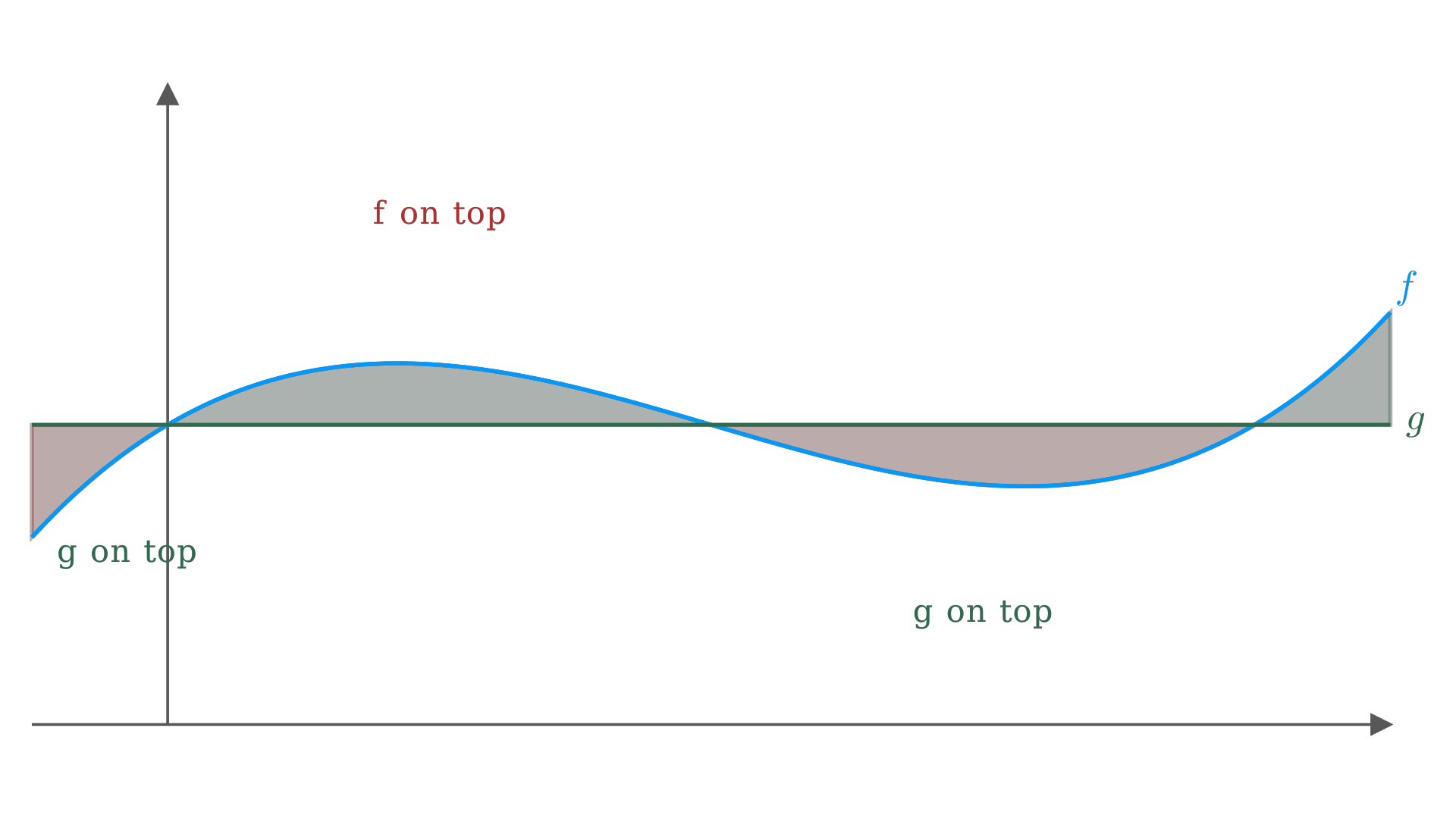
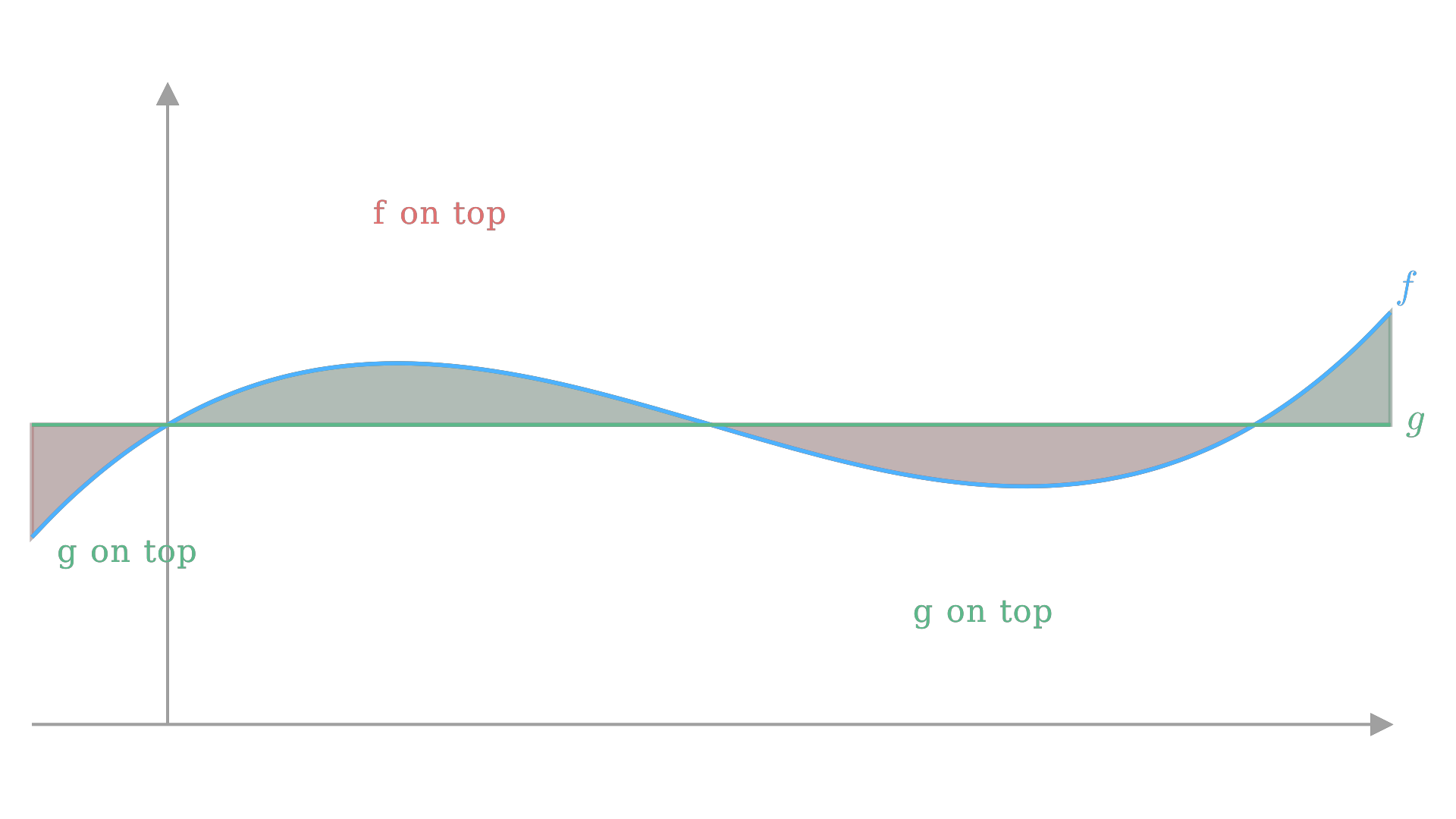
If the top and bottom curves switch positions, a single integral will no longer work unless you use absolute value. Usually the safest method is to split the interval at every intersection.
如果上下曲线发生位置互换,一个不带绝对值的积分就不能直接用了。最稳妥的做法通常是在每一个交点处把区间拆开。
Students often forget to split at an intersection where the graphs cross. That causes cancellation and gives signed area instead of actual area.
学生常常忘记在两条曲线相交处拆分区间,导致正负相消,得到的是带号面积而不是实际面积。
Worked Example: $\displaystyle\int_{-1}^{1} |x^{3} - x|\,dx$例题:$\displaystyle\int_{-1}^{1} |x^{3} - x|\,dx$
Find the area enclosed between $y = x^{3}$ and $y = x$ on $[-1, 1]$. The graphs cross at $x = -1, 0, 1$, so the "top minus bottom" identity flips at $x = 0$.
求 $y = x^{3}$ 与 $y = x$ 在 $[-1, 1]$ 上所围的面积。两图象在 $x = -1, 0, 1$ 处相交,所以“上减下”的关系在 $x = 0$ 处发生翻转。
- Locate the zeros of the difference. $x^{3} - x = x(x-1)(x+1) = 0$ at $x = -1, 0, 1$. These split $[-1, 1]$ into two subintervals.
- 找出差函数的零点。 $x^{3} - x = x(x-1)(x+1) = 0$,零点为 $x = -1, 0, 1$。它们把 $[-1, 1]$ 切成两段。
- Sign chart on each subinterval.
- On $(-1, 0)$, test $x = -\tfrac{1}{2}$: $(-\tfrac{1}{2})^{3} - (-\tfrac{1}{2}) = -\tfrac{1}{8} + \tfrac{1}{2} = \tfrac{3}{8} > 0$. So $x^{3} \ge x$: the cubic is on top.
- On $(0, 1)$, test $x = \tfrac{1}{2}$: $\tfrac{1}{8} - \tfrac{1}{2} = -\tfrac{3}{8} < 0$. So $x \ge x^{3}$: the line is on top.
- 对每段做符号表。
- 在 $(-1, 0)$ 上取 $x = -\tfrac{1}{2}$ 试: $(-\tfrac{1}{2})^{3} - (-\tfrac{1}{2}) = -\tfrac{1}{8} + \tfrac{1}{2} = \tfrac{3}{8} > 0$。所以 $x^{3} \ge x$:三次函数在上。
- 在 $(0, 1)$ 上取 $x = \tfrac{1}{2}$ 试: $\tfrac{1}{8} - \tfrac{1}{2} = -\tfrac{3}{8} < 0$。所以 $x \ge x^{3}$:直线在上。
- Split the absolute-value integral by sign. $$\int_{-1}^{1}|x^{3} - x|\,dx \;=\; \int_{-1}^{0}(x^{3} - x)\,dx \;+\; \int_{0}^{1}(x - x^{3})\,dx.$$
- 按符号拆分绝对值积分。 $$\int_{-1}^{1}|x^{3} - x|\,dx \;=\; \int_{-1}^{0}(x^{3} - x)\,dx \;+\; \int_{0}^{1}(x - x^{3})\,dx.$$
- Evaluate each piece. Use antiderivative $\tfrac{x^{4}}{4} - \tfrac{x^{2}}{2}$: $$\int_{-1}^{0}(x^{3} - x)\,dx \;=\; \Bigl[\tfrac{x^{4}}{4} - \tfrac{x^{2}}{2}\Bigr]_{-1}^{0} \;=\; 0 - \!\left(\tfrac{1}{4} - \tfrac{1}{2}\right) \;=\; \tfrac{1}{4}.$$ $$\int_{0}^{1}(x - x^{3})\,dx \;=\; \Bigl[\tfrac{x^{2}}{2} - \tfrac{x^{4}}{4}\Bigr]_{0}^{1} \;=\; \tfrac{1}{2} - \tfrac{1}{4} \;=\; \tfrac{1}{4}.$$
- 分别计算每一段。 使用原函数 $\tfrac{x^{4}}{4} - \tfrac{x^{2}}{2}$: $$\int_{-1}^{0}(x^{3} - x)\,dx \;=\; \Bigl[\tfrac{x^{4}}{4} - \tfrac{x^{2}}{2}\Bigr]_{-1}^{0} \;=\; 0 - \!\left(\tfrac{1}{4} - \tfrac{1}{2}\right) \;=\; \tfrac{1}{4}.$$ $$\int_{0}^{1}(x - x^{3})\,dx \;=\; \Bigl[\tfrac{x^{2}}{2} - \tfrac{x^{4}}{4}\Bigr]_{0}^{1} \;=\; \tfrac{1}{2} - \tfrac{1}{4} \;=\; \tfrac{1}{4}.$$
- Sum. Total area $= \tfrac{1}{4} + \tfrac{1}{4} = \tfrac{1}{2}$.
- 求和。 总面积 $= \tfrac{1}{4} + \tfrac{1}{4} = \tfrac{1}{2}$。
$|x^{3} - x|$ is an even function (the absolute value kills the odd-symmetry sign flip), so $\int_{-1}^{1}|x^{3} - x|\,dx = 2\!\int_0^1 |x^{3} - x|\,dx = 2 \cdot \tfrac{1}{4} = \tfrac{1}{2}$. Same answer.
$|x^{3} - x|$ 是偶函数(绝对值消去了奇函数的符号反转),所以 $\int_{-1}^{1}|x^{3} - x|\,dx = 2\!\int_0^1 |x^{3} - x|\,dx = 2 \cdot \tfrac{1}{4} = \tfrac{1}{2}$。答案相同。
Computing $\int_{-1}^{1}(x^{3} - x)\,dx$ without the absolute value gives $0$, because $x^{3} - x$ is odd and the contributions on $(-1,0)$ and $(0,1)$ cancel. That $0$ is signed area, definitely not the geometric area between the curves.
如果不加绝对值直接算 $\int_{-1}^{1}(x^{3} - x)\,dx$,结果为 $0$,因为 $x^{3} - x$ 是奇函数,$(-1,0)$ 和 $(0,1)$ 两段的贡献相互抵消。这个 $0$ 是带号面积,绝对不是两曲线之间的几何面积。
Worked Example: $y=\sin x$ and $y=\cos x$ on $[0,\pi]$例题:$[0,\pi]$ 上的 $y=\sin x$ 与 $y=\cos x$
Find the total area between $y=\sin x$ and $y=\cos x$ on $[0,\pi]$.
求 $y=\sin x$ 与 $y=\cos x$ 在 $[0,\pi]$ 上之间的总面积。
- Intersection. $\sin x=\cos x$ at $x=\frac{\pi}{4}$ on $[0,\pi]$.
- 交点。 在 $[0,\pi]$ 上 $\sin x=\cos x$ 于 $x=\frac{\pi}{4}$。
- Test points. At $x=0$: $\cos0=1>\sin0=0$, so cosine is on top on $\left[0,\frac{\pi}{4}\right]$. At $x=\frac{\pi}{2}$: $\sin\frac{\pi}{2}=1>\cos\frac{\pi}{2}=0$, so sine is on top on $\left[\frac{\pi}{4},\pi\right]$.
- 试验点。 在 $x=0$:$\cos0=1>\sin0=0$,所以在 $\left[0,\frac{\pi}{4}\right]$ 上余弦在上。在 $x=\frac{\pi}{2}$:$\sin\frac{\pi}{2}=1>\cos\frac{\pi}{2}=0$,所以在 $\left[\frac{\pi}{4},\pi\right]$ 上正弦在上。
- Split. $A=\int_0^{\pi/4}(\cos x-\sin x)\,dx+\int_{\pi/4}^{\pi}(\sin x-\cos x)\,dx$.
- 拆分。 $A=\int_0^{\pi/4}(\cos x-\sin x)\,dx+\int_{\pi/4}^{\pi}(\sin x-\cos x)\,dx$。
- Evaluate. First piece: $\left[\sin x+\cos x\right]_0^{\pi/4}=\sqrt2-1$. Second piece: $\left[-\cos x-\sin x\right]_{\pi/4}^{\pi}=1-(-\sqrt2)=1+\sqrt2$.
- 计算。 第一段:$\left[\sin x+\cos x\right]_0^{\pi/4}=\sqrt2-1$。第二段:$\left[-\cos x-\sin x\right]_{\pi/4}^{\pi}=1-(-\sqrt2)=1+\sqrt2$。
- Add. $A=(\sqrt2-1)+(1+\sqrt2)=2\sqrt2\approx2.828$.
- 相加。 $A=(\sqrt2-1)+(1+\sqrt2)=2\sqrt2\approx2.828$。
Splitting at the crossing makes each integrand nonnegative, so nothing cancels. Without splitting, $\int_0^\pi(\cos x-\sin x)\,dx=-2$, which is a signed total, not an area.
在交点处拆分使每段被积式非负,不会相互抵消。不拆分时 $\int_0^\pi(\cos x-\sin x)\,dx=-2$,这是带号总和,不是面积。
On a calculator-active part, $\int_a^b |f(x)-g(x)|\,dx$ gives the total area in one step. Without a calculator, list the intersections, test one point per subinterval, and write one integral per subinterval with the top curve first. Show the intersection values you use as limits.
在允许计算器的部分,$\int_a^b |f(x)-g(x)|\,dx$ 一步给出总面积。不用计算器时,列出交点,每个子区间取一个试验点,再按“上曲线在前”为每个子区间写一个积分。写出作为上下限的交点值。
Calculate the total area enclosed by $y=x^3$ and $y=4x$.计算 $y=x^3$ 与 $y=4x$ 所围的总面积。
$x^3=4x\Rightarrow x=-2,0,2$. On $(0,2)$, $4x\ge x^3$, and by symmetry the region on $(-2,0)$ has the same area. $A=2\int_0^2(4x-x^3)\,dx=2(8-4)=8$.
$x^3=4x\Rightarrow x=-2,0,2$。在 $(0,2)$ 上 $4x\ge x^3$,由对称性 $(-2,0)$ 上的区域面积相同。$A=2\int_0^2(4x-x^3)\,dx=2(8-4)=8$。
Two curves cross at three points and enclose two regions. How many integrals does a non-calculator setup need, and why?两曲线交于三点,围成两个区域。不用计算器的建立式需要几个积分?为什么?
Two, one per region, because the top curve changes at the middle crossing.
两个,每个区域一个,因为上方曲线在中间交点处改变。
Explain why $\int_{-1}^{1}(x^3-x)\,dx=0$ does not mean that $y=x^3$ and $y=x$ enclose zero area.解释为何 $\int_{-1}^{1}(x^3-x)\,dx=0$ 并不表示 $y=x^3$ 与 $y=x$ 所围面积为零。
The integrand is odd, so the positive part on $(-1,0)$ cancels the negative part on $(0,1)$. Splitting at $x=0$ gives the area $\frac12$.
被积函数是奇函数,$(-1,0)$ 上的正部分与 $(0,1)$ 上的负部分相互抵消。在 $x=0$ 处拆分,得面积 $\frac12$。
Volume Methods Roadmap
体积方法路线图
Every Unit 8 volume problem reduces to the same three moves:
- Pick a typical slice of the solid (perpendicular to one axis).
- Compute the area of that slice as a function of position.
- Integrate the area along the axis.
Topics 8.7 – 8.12 differ only in the shape of that slice. The 4-step decision tree below tells you which.
Unit 8 的每一道体积(volume)题都归结为同样的三步:
- 取实体的一个典型切片(垂直于某条轴)。
- 把该切片的面积表示为位置的函数。
- 沿该轴积分这个面积。
小节 8.7 – 8.12 之间的差别仅在切片的形状。下面的四步决策树告诉你该用哪种。
If the problem describes a solid built from specified cross-sectional shapes (squares, equilateral triangles, semicircles, …) sitting over a planar region, use the Cross-Section Method (Topics 8.7 – 8.8). Otherwise, if a planar region is revolved about a line, go to Step 2.
若题目描述的是由给定形状的横截面(cross-section)(正方形、等边三角形、半圆…)落在某平面区域上构成的实体,则使用已知横截面的体积法(volume by known cross-sections,小节 8.7 – 8.8)。否则,如果是把平面区域绕某条直线旋转得到旋转体,则进入第 2 步。
Sketch the region together with the axis of revolution and ask:
"Does the region share at least one boundary with the axis?"
- Yes: the region's edge sits ON the axis → Disc Method. Each cross-section is a solid disc (no hole). Topics 8.9 (axis is $x$- or $y$-axis) and 8.10 (axis is $y=k$ or $x=k$).
- No: there is a gap between the region and the axis → Washer Method. Each cross-section is annular (hole in the middle). Topics 8.11 (standard axis) and 8.12 (shifted axis).
把区域与旋转轴(axis of revolution)一起画出来,自问:
“区域是否至少有一条边界落在旋转轴上?”
- 是:区域边缘落在轴上 → 圆盘法(
disk method)。每个横截面都是无孔的实心圆盘。涉及小节 8.9(轴为 $x$ 或 $y$ 轴)和 8.10(轴为 $y=k$ 或 $x=k$)。 - 否:区域与旋转轴之间有间隙 → 圆环法(
washer method)。每个横截面都是环形(中间有孔)。涉及小节 8.11(标准轴)和 8.12(平移过的轴)。
Slices must be perpendicular to the axis of revolution.
- Axis is horizontal (the $x$-axis, or any $y=k$) → vertical slices → integrate dx.
- Axis is vertical (the $y$-axis, or any $x=k$) → horizontal slices → integrate dy. (You will likely need to rewrite curves as $x=g(y)$.)
切片必须垂直于旋转轴。
- 旋转轴水平($x$ 轴,或任意 $y=k$)→ 垂直切片 → 对 dx 积分。
- 旋转轴竖直($y$ 轴,或任意 $x=k$)→ 水平切片 → 对 dy 积分(这时通常需要把曲线改写为 $x=g(y)$)。
A radius is the perpendicular distance from a boundary point of the region to the axis of revolution, not automatically the function value.
Disc (region edge sits on the axis):
- Axis is the $x$-axis: $R = |f(x)|$. Squaring kills the sign, so writing $R = f(x)$ in the integrand is fine.
- Axis is $y = k$: $R = |f(x) - k|$, which simplifies to $k - f(x)$ when the axis lies above the curve and $f(x) - k$ when below.
Washer (gap between region and axis): a region bounded by two curves, both on the same side of the axis. The slice is an annulus.
- $R$ = outer radius = distance from the farther boundary curve to the axis.
- $r$ = inner radius = distance from the nearer boundary curve to the axis.
- Critical: "outer" and "inner" depend on the axis location, not on which curve is called "$f$" or "$g$". Move the axis and the labels can swap. Always re-identify outer/inner from your sketch.
半径是区域边界上的一点到旋转轴的垂直距离,不一定等于函数值本身。
圆盘(区域边缘落在轴上):
- 旋转轴为 $x$ 轴:$R = |f(x)|$。平方会消去符号,所以在被积式中写成 $R = f(x)$ 也可以。
- 旋转轴为 $y = k$:$R = |f(x) - k|$;轴在曲线上方时简化为 $k - f(x)$,轴在曲线下方时为 $f(x) - k$。
圆环(区域与轴之间有间隙):由两条曲线围成的区域,两条曲线都在轴的同侧。切片是一个环形。
- $R$ = 外半径 = 较远的边界曲线到旋转轴的距离。
- $r$ = 内半径 = 较近的边界曲线到旋转轴的距离。
- 关键:“外”和“内”取决于旋转轴的位置,与哪条曲线被命名为 “$f$” 或 “$g$” 无关。轴一移动,标签就可能互换。每次都要根据自己的草图重新判定外/内。
| Method | When | Integrand | Topic |
|---|---|---|---|
| Cross Section | Solid built from named cross-sectional shapes | $A(x)\,dx$ (or $A(y)\,dy$) | 8.7 – 8.8 |
| Disc, axis = $x$ or $y$ | Revolved; region's edge sits on axis | $\pi\,R^2\,dx$ (or $dy$) | 8.9 |
| Disc, axis = $y=k$ or $x=k$ | Revolved; region's edge sits on the line | $\pi\,[\,\text{dist}(f, \text{axis})\,]^{\,2}\,dx$ | 8.10 |
| Washer, axis = $x$ or $y$ | Revolved; gap between region and axis | $\pi\,(R^2 - r^2)\,dx$ | 8.11 |
| Washer, axis = $y=k$ or $x=k$ | Revolved; gap between region and the line | $\pi\,(R^2 - r^2)\,dx$ where $R, r$ = distances to the axis | 8.12 |
| 方法 | 何时使用 | 被积式 | 小节 |
|---|---|---|---|
| 横截面法 | 实体由命名的横截面形状构成 | $A(x)\,dx$ (或 $A(y)\,dy$) | 8.7 – 8.8 |
| 圆盘法,轴 = $x$ 或 $y$ | 旋转体;区域边缘在轴上 | $\pi\,R^2\,dx$ (或 $dy$) | 8.9 |
| 圆盘法,轴 = $y=k$ 或 $x=k$ | 旋转体;区域边缘落在该直线上 | $\pi\,[\,\text{dist}(f, \text{axis})\,]^{\,2}\,dx$ | 8.10 |
| 圆环法,轴 = $x$ 或 $y$ | 旋转体;区域与轴之间有间隙 | $\pi\,(R^2 - r^2)\,dx$ | 8.11 |
| 圆环法,轴 = $y=k$ 或 $x=k$ | 旋转体;区域与该直线之间有间隙 | $\pi\,(R^2 - r^2)\,dx$ 其中 $R, r$ 为到轴的距离 | 8.12 |
Numerical check: with $R = 3$ and $r = 1$, $R^2 - r^2 = 9 - 1 = 8$, but $(R - r)^2 = 2^2 = 4$. They are not equal, and the washer formula uses the first.
数值验证:取 $R = 3$,$r = 1$, $R^2 - r^2 = 9 - 1 = 8$, 但 $(R - r)^2 = 2^2 = 4$。两者不等,圆环公式用的是前者。
Same Region, Three Axes: How the Setup Changes
同一区域,三个旋转轴:设置如何变化
To see the decision tree in action, take one fixed region and revolve it about three different axes. The region: bounded by $y = \sqrt{x}$, $y = 0$, and $x = 4$. (A half-parabola sitting on the $x$-axis, with maximum height $\sqrt{4} = 2$.)
为了看决策树如何运行,取一个固定区域,把它绕三个不同的旋转轴旋转。该区域由 $y = \sqrt{x}$、 $y = 0$、 $x = 4$ 围成。(一段坐在 $x$ 轴上的半抛物线,最大高度 $\sqrt{4} = 2$。)
| Axis of revolution | Method & reasoning | Radii | Volume integral |
|---|---|---|---|
| $y = 0$ (the $x$-axis) | Disc. Region's lower boundary is the axis. | $R = \sqrt{x}$ | $\displaystyle V = \pi\!\int_0^4 (\sqrt{x})^{\,2}\,dx = \pi\!\int_0^4 x\,dx = 8\pi$ |
| $y = 3$ (line above region) | Washer. Region's max height is $2$, so axis sits $1$ unit above the top, leaving a gap. | $R = 3 - 0 = 3$ (axis to the lower edge $y=0$, the farther boundary) $r = 3 - \sqrt{x}$ (axis to upper curve, the nearer boundary) |
$\displaystyle V = \pi\!\int_0^4 \!\!\left[\,9 - (3 - \sqrt{x})^{\,2}\,\right]dx$ |
| $y = -1$ (line below region) | Washer. Region's bottom is at $y=0$; gap of $1$ unit below. | $R = \sqrt{x} - (-1) = \sqrt{x} + 1$ (axis to upper curve, the farther boundary) $r = 0 - (-1) = 1$ (axis to lower edge, the nearer boundary) |
$\displaystyle V = \pi\!\int_0^4 \!\!\left[\,(\sqrt{x}+1)^{\,2} - 1\,\right]dx$ |
| 旋转轴 | 方法与判断依据 | 半径 | 体积积分 |
|---|---|---|---|
| $y = 0$ ($x$ 轴) | 圆盘法。 区域的下边界就是旋转轴。 | $R = \sqrt{x}$ | $\displaystyle V = \pi\!\int_0^4 (\sqrt{x})^{\,2}\,dx = \pi\!\int_0^4 x\,dx = 8\pi$ |
| $y = 3$ (区域上方的直线) | 圆环法。 区域最大高度为 $2$,所以轴位于顶部上方 $1$ 个单位,有间隙。 | $R = 3 - 0 = 3$ (轴到下边界 $y=0$,更远的边界) $r = 3 - \sqrt{x}$ (轴到上曲线,更近的边界) |
$\displaystyle V = \pi\!\int_0^4 \!\!\left[\,9 - (3 - \sqrt{x})^{\,2}\,\right]dx$ |
| $y = -1$ (区域下方的直线) | 圆环法。 区域底部在 $y=0$;轴在其下方 $1$ 个单位,有间隙。 | $R = \sqrt{x} - (-1) = \sqrt{x} + 1$ (轴到上曲线,更远的边界) $r = 0 - (-1) = 1$ (轴到下边界,更近的边界) |
$\displaystyle V = \pi\!\int_0^4 \!\!\left[\,(\sqrt{x}+1)^{\,2} - 1\,\right]dx$ |
Same region every time. The axis moved, and that flipped which boundary is farther. With $y=3$ above, the lower edge $y=0$ is the outer curve. With $y=-1$ below, the upper curve $y=\sqrt{x}$ is the outer curve. Mechanical reuse of a previous problem's $R$ and $r$ assignments will give a wrong answer here. Always re-derive from a fresh sketch.
每次都是同一区域。轴的位置改变了,从而翻转了哪条边界更远。当 $y=3$ 在上方时,下边界 $y=0$ 是外曲线。当 $y=-1$ 在下方时,上曲线 $y=\sqrt{x}$ 是外曲线。直接照搬上一道题里的 $R$、$r$ 在这里会得出错误答案。每次都要根据新草图重新推导。
Before writing any integral: (1) draw the region; (2) draw the axis of revolution as a dashed line; (3) draw one representative slice perpendicular to that axis; (4) on the slice, mark the boundary points and label the perpendicular distance to the axis as $R$ (and $r$ if there's a hole). If your sketch is right, the integrand reads itself off the page.
写积分前先做:(1) 画出区域;(2) 把旋转轴画成虚线;(3) 在该轴的垂直方向上画一片代表性切片;(4) 在切片上标出边界点,并把它到轴的垂直距离标为 $R$(如果有孔,再标一个 $r$)。如果草图画对了,被积式就会自己从图上显现出来。
Volumes with Cross Sections: Squares and Rectangles
已知横截面的体积:正方形与矩形
- Identify the base region and the axis the slices are perpendicular to.
- Express the side of a cross-section as the distance across the base: top minus bottom.
- Write the cross-sectional area $A(x)$ for squares and for rectangles of a stated height.
- Set up and calculate $V=\int_a^b A(x)\,dx$.
- Sketch a representative cross-section standing on the base.
- 确定底面区域,以及切片垂直于哪条轴。
- 把横截面的边长表示为穿过底面的距离:上减下。
- 写出正方形及给定高度的矩形横截面的面积 $A(x)$。
- 建立并计算 $V=\int_a^b A(x)\,dx$。
- 画出(
sketch)立在底面上的代表性横截面。
For solids built from specified cross-sectional shapes (no rotation), the volume reduces to a single question: what is the area of a typical slice as a function of position? Integrate that area along the axis.
对于由给定横截面形状构成的实体(非旋转体),求体积归结为一个问题:典型切片的面积如何随位置变化?把该面积沿轴积分即可。
When cross-sections are squares with side equal to the vertical distance between two curves, $A(x)=[f(x)-g(x)]^2$. For rectangles, replace $A(x)$ with the correct length × width matching the problem statement.
当横截面是正方形(square cross-section),且边长等于两曲线之间的垂直距离时,$A(x)=[f(x)-g(x)]^2$。对于矩形,把 $A(x)$ 替换为题目所述的正确“长 × 宽”。
Worked Example: Square Cross-Sections例题:正方形横截面
The base of a solid is the region bounded by $y=\sqrt{x}$, $y=0$, and $x=4$. Cross-sections perpendicular to the $x$-axis are squares with one side in the base. Find the volume.
实体的底面是由 $y=\sqrt{x}$、 $y=0$、 $x=4$ 围成的区域。垂直于 $x$ 轴的横截面是正方形,且其一边位于底面上。求体积。
- Read the side length off the base. A vertical slice of the base at position $x$ runs from $y=0$ to $y=\sqrt{x}$, so the square's side is $s = \sqrt{x}$.
- 从底面读出边长。 在位置 $x$ 处,底面的垂直切片从 $y=0$ 到 $y=\sqrt{x}$,所以正方形的边长为 $s = \sqrt{x}$。
- Cross-sectional area. $A(x) = s^2 = (\sqrt{x})^2 = x$.
- 横截面面积。 $A(x) = s^2 = (\sqrt{x})^2 = x$。
- Integrate. $\displaystyle V = \int_0^4 x\,dx = \tfrac{x^2}{2}\Big|_0^4 = 8.$
- 积分。 $\displaystyle V = \int_0^4 x\,dx = \tfrac{x^2}{2}\Big|_0^4 = 8.$
Worked Example: Rectangles Three Times as Tall as the Base例题:高为底边 3 倍的矩形横截面
The base of a solid is the region between $y=x$ and $y=x^2$ for $0\le x\le1$. Cross-sections perpendicular to the $x$-axis are rectangles whose height is $3$ times the side that lies in the base. Find the volume.
实体的底面是 $0\le x\le1$ 时 $y=x$ 与 $y=x^2$ 之间的区域。垂直于 $x$ 轴的横截面是矩形,其高为底面上那条边的 $3$ 倍。求体积。
- Side in the base. $s=x-x^2$ (top minus bottom).
- 底面上的边。 $s=x-x^2$(上减下)。
- Area. $A(x)=s\cdot3s=3(x-x^2)^2$.
- 面积。 $A(x)=s\cdot3s=3(x-x^2)^2$。
- Integrate. $V=3\int_0^1(x^2-2x^3+x^4)\,dx=3\left(\frac13-\frac12+\frac15\right)=3\cdot\frac{1}{30}=\frac{1}{10}$.
- 积分。 $V=3\int_0^1(x^2-2x^3+x^4)\,dx=3\left(\frac13-\frac12+\frac15\right)=3\cdot\frac{1}{30}=\frac{1}{10}$。
The base supplies one length at each $x$; the shape rule (here height $=3s$) turns that length into an area, and integrating the area along $x$ stacks the slices.
底面在每个 $x$ 处提供一条长度;形状规则(这里高 $=3s$)把长度变成面积,再沿 $x$ 积分把切片叠起来。
The side that lies in the base is the distance across the region at $x$, top minus bottom. It equals the function value only when the bottom boundary is $y=0$. Write $A(x)$ on its own line before integrating so the shape rule is visible in your work.
位于底面上的那条边是区域在 $x$ 处的宽度,即上减下。只有当下边界是 $y=0$ 时它才等于函数值。积分前单独写一行 $A(x)$,让形状规则在解答中清楚可见。
The base is the triangle bounded by $y=2-x$ and the coordinate axes. Cross-sections perpendicular to the $x$-axis are squares. Find the volume.底面是由 $y=2-x$ 与两坐标轴围成的三角形。垂直于 $x$ 轴的横截面是正方形。求体积。
$s=2-x$ for $0\le x\le2$. $V=\int_0^2(2-x)^2\,dx=\left[-\frac{(2-x)^3}{3}\right]_0^2=\frac83$.
当 $0\le x\le2$ 时 $s=2-x$。$V=\int_0^2(2-x)^2\,dx=\left[-\frac{(2-x)^3}{3}\right]_0^2=\frac83$。
The base is the disc $x^2+y^2\le1$, and cross-sections perpendicular to the $x$-axis are squares. Find the volume.底面是圆盘 $x^2+y^2\le1$,垂直于 $x$ 轴的横截面是正方形。求体积。
The chord at $x$ runs from $-\sqrt{1-x^2}$ to $\sqrt{1-x^2}$, so $s=2\sqrt{1-x^2}$ and $A(x)=4(1-x^2)$. $V=\int_{-1}^{1}4(1-x^2)\,dx=4\left(2-\frac23\right)=\frac{16}{3}$.
$x$ 处的弦从 $-\sqrt{1-x^2}$ 到 $\sqrt{1-x^2}$,所以 $s=2\sqrt{1-x^2}$,$A(x)=4(1-x^2)$。$V=\int_{-1}^{1}4(1-x^2)\,dx=4\left(2-\frac23\right)=\frac{16}{3}$。
Why does a volume with square cross-sections usually contain no $\pi$?为什么正方形横截面的体积通常不含 $\pi$?
Nothing is revolved and $A(x)=s^2$ has no $\pi$. A $\pi$ appears only when the base or the slice shape involves circles.
没有旋转,且 $A(x)=s^2$ 不含 $\pi$。只有底面或切片形状涉及圆时才会出现 $\pi$。
Volumes with Cross Sections: Triangles and Semicircles
已知横截面的体积:三角形与半圆
- State the area of a square, equilateral triangle, isosceles right triangle and semicircle in terms of a side or diameter $s$.
- Distinguish a diameter from a radius when the base segment is the diameter.
- Write $A(x)$ for the stated shape and set up $V=\int_a^b A(x)\,dx$.
- Calculate the volume exactly and compare different shapes on the same base.
- 用边长或直径 $s$ 写出(
state)正方形、等边三角形、等腰直角三角形与半圆的面积。 - 当底面线段是直径时,区分直径与半径。
- 按给定形状写出 $A(x)$,并建立 $V=\int_a^b A(x)\,dx$。
- 精确计算体积,并比较同一底面上不同形状的结果。
These problems use the same structure as Topic 8.7, but the cross-sectional area now depends on a geometry formula.
这类问题与 8.7 结构相同,只是横截面面积现在要用几何公式计算。
| Cross Section | Area in terms of side / diameter s |
|---|---|
| Square | $A=s^2$ |
| Equilateral triangle | $A=\frac{\sqrt3}{4}s^2$ |
| Isosceles right triangle (leg = s) | $A=\frac12 s^2$ |
| Semicircle (diameter = s) | $A=\frac{\pi}{8}s^2$ |
| 横截面 | 用边长 / 直径 s 表示的面积 |
|---|---|
正方形(square cross-section) | $A=s^2$ |
等边三角形横截面(equilateral triangle cross-section) | $A=\frac{\sqrt3}{4}s^2$ |
| 等腰直角三角形(直角边 = s) | $A=\frac12 s^2$ |
半圆横截面(semicircle cross-section,直径 = s) | $A=\frac{\pi}{8}s^2$ |
If the region gives you the diameter, do not use it as the radius. Radius is half the diameter.
如果题目给出的是直径,不要把它当作半径用。半径等于直径的一半。
Worked Example: Semicircular Cross-Sections例题:半圆横截面
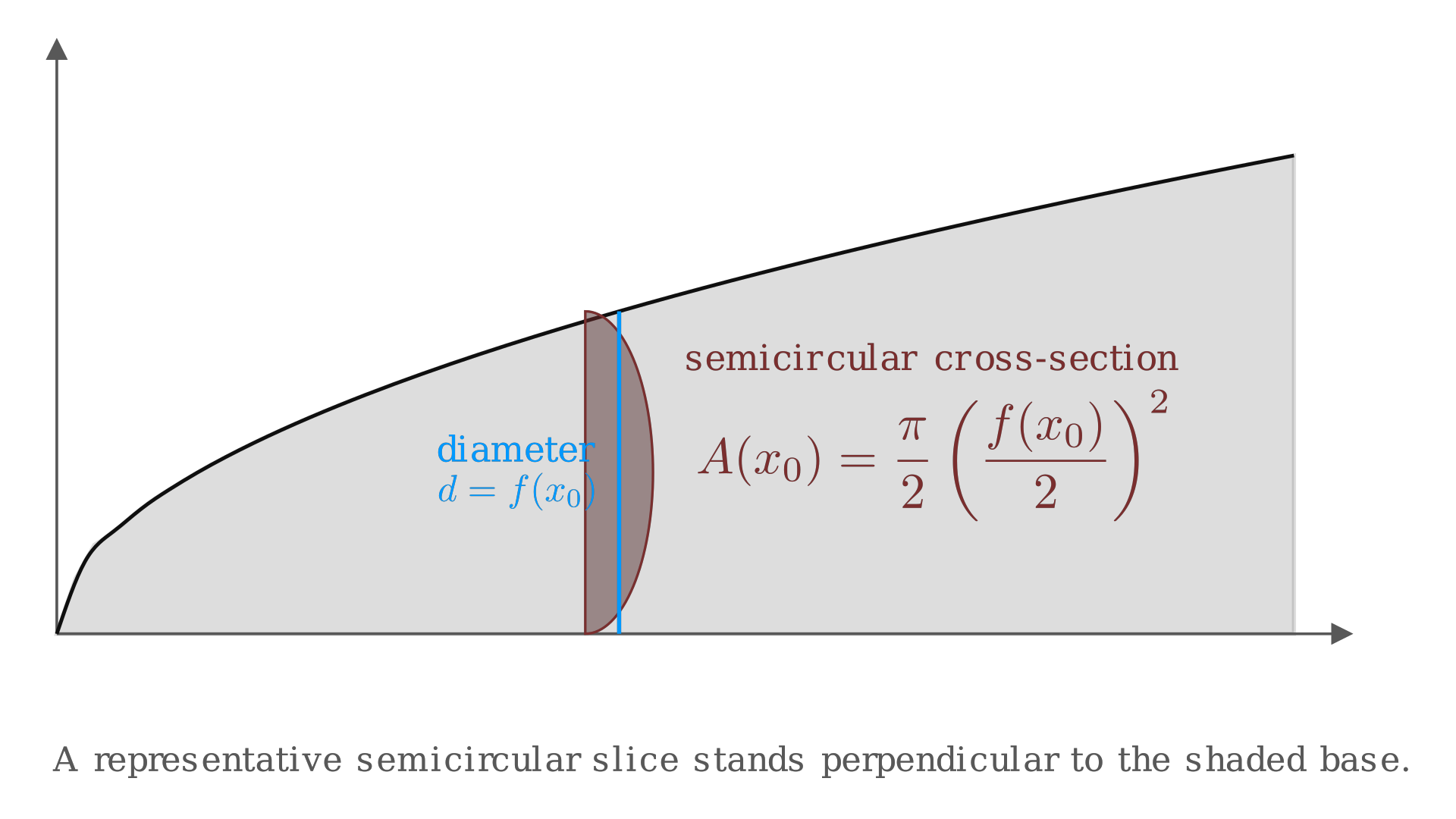
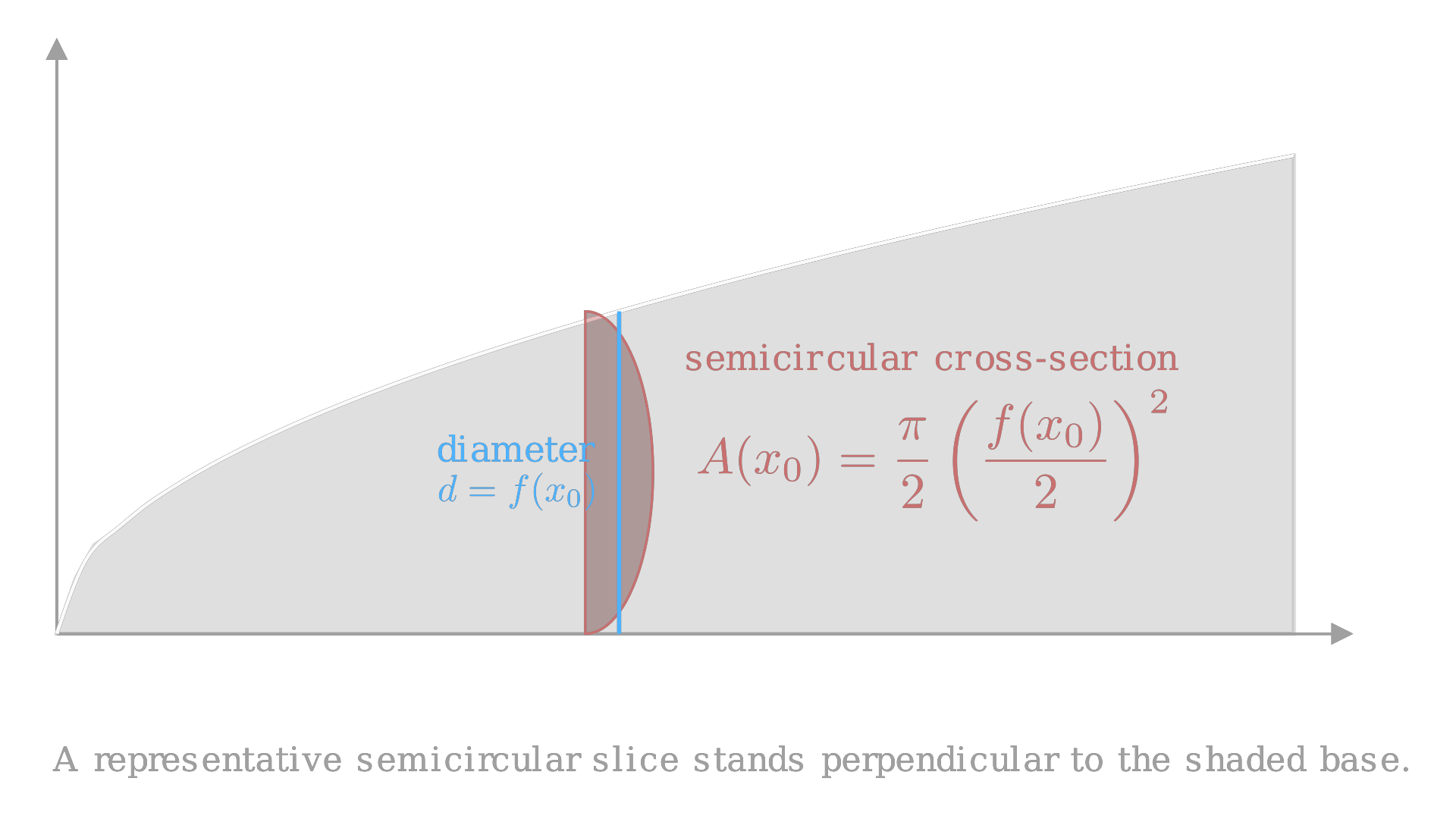
Same base as Topic 8.7: the region bounded by $y=\sqrt{x}$, $y=0$, and $x=4$. This time, cross-sections perpendicular to the $x$-axis are semicircles with diameter equal to the segment in the base. Find the volume.
与 8.7 同样的底面:由 $y=\sqrt{x}$、$y=0$、$x=4$ 围成的区域。这次垂直于 $x$ 轴的横截面是半圆,直径等于底面上的线段长度。求体积。
- Diameter from the base. As before, the vertical segment at position $x$ has length $s=\sqrt{x}$; this is now the diameter.
- 由底面读出直径。 与之前相同,位置 $x$ 处的垂直线段长度为 $s=\sqrt{x}$;这次它是直径。
- Cross-sectional area. $A(x)=\dfrac{\pi}{8}s^2=\dfrac{\pi}{8}x$.
- 横截面面积。 $A(x)=\dfrac{\pi}{8}s^2=\dfrac{\pi}{8}x$。
- Integrate. $\displaystyle V=\int_0^4 \frac{\pi}{8}x\,dx=\frac{\pi}{8}\cdot\frac{x^2}{2}\bigg|_0^4=\frac{\pi}{8}\cdot 8=\pi.$
- 积分。 $\displaystyle V=\int_0^4 \frac{\pi}{8}x\,dx=\frac{\pi}{8}\cdot\frac{x^2}{2}\bigg|_0^4=\frac{\pi}{8}\cdot 8=\pi.$
Topic 8.7's square cross-sections on this exact base gave $V=8$; semicircular cross-sections give $V=\pi\approx3.14$. Only the cross-sectional shape formula changed. This is a reminder that volume-by-slicing depends entirely on which area formula you plug in for $A(x)$.
8.7 中同一底面上的正方形横截面给出 $V=8$;半圆横截面给出 $V=\pi\approx3.14$。唯一改变的是横截面形状公式。这提醒我们切片法求体积完全取决于代入 $A(x)$ 的是哪个面积公式。
Worked Example: Equilateral Triangle Cross-Sections例题:等边三角形横截面
Same base as before: the region bounded by $y=\sqrt{x}$, $y=0$ and $x=4$. Cross-sections perpendicular to the $x$-axis are equilateral triangles with one side in the base. Find the volume.
与前面同一底面:由 $y=\sqrt{x}$、$y=0$、$x=4$ 围成的区域。垂直于 $x$ 轴的横截面是一边在底面上的等边三角形。求体积。
- Side. $s=\sqrt{x}$.
- 边长。 $s=\sqrt{x}$。
- Area. $A(x)=\frac{\sqrt3}{4}s^2=\frac{\sqrt3}{4}x$.
- 面积。 $A(x)=\frac{\sqrt3}{4}s^2=\frac{\sqrt3}{4}x$。
- Integrate. $V=\int_0^4\frac{\sqrt3}{4}x\,dx=\frac{\sqrt3}{4}\cdot8=2\sqrt3\approx3.46$.
- 积分。 $V=\int_0^4\frac{\sqrt3}{4}x\,dx=\frac{\sqrt3}{4}\cdot8=2\sqrt3\approx3.46$。
On one base every shape gives (shape constant) times $\int_0^4 s^2\,dx=8$: squares give $8$, equilateral triangles $2\sqrt3$, semicircles $\pi$. Only the constant changes.
在同一底面上,每种形状都给出(形状常数)乘以 $\int_0^4 s^2\,dx=8$:正方形得 $8$,等边三角形得 $2\sqrt3$,半圆得 $\pi$。改变的只是常数。
Write the area formula in terms of $s$ first, then substitute $s$ as a function of $x$. For a semicircle whose diameter lies in the base, $r=\frac{s}{2}$, so $A=\frac12\pi\left(\frac{s}{2}\right)^2=\frac{\pi}{8}s^2$. Using $s$ as the radius makes the answer four times too large.
先用 $s$ 写出面积公式,再把 $s$ 代换为 $x$ 的函数。若半圆的直径在底面上,则 $r=\frac{s}{2}$,所以 $A=\frac12\pi\left(\frac{s}{2}\right)^2=\frac{\pi}{8}s^2$。把 $s$ 当成半径会使答案大到 4 倍。
Same base, isosceles right triangles with one leg in the base. Find the volume.同一底面,横截面是一条直角边在底面上的等腰直角三角形。求体积。
$A(x)=\frac12 s^2=\frac{x}{2}$. $V=\int_0^4\frac{x}{2}\,dx=4$.
$A(x)=\frac12 s^2=\frac{x}{2}$。$V=\int_0^4\frac{x}{2}\,dx=4$。
Find the area of a semicircle with diameter $s=2$.求直径 $s=2$ 的半圆面积。
$A=\frac{\pi}{8}(2)^2=\frac{\pi}{2}$. Check with radius $1$: $\frac12\pi(1)^2=\frac{\pi}{2}$.
$A=\frac{\pi}{8}(2)^2=\frac{\pi}{2}$。用半径 $1$ 验证:$\frac12\pi(1)^2=\frac{\pi}{2}$。
The base is the disc $x^2+y^2\le4$, and cross-sections perpendicular to the $x$-axis are equilateral triangles. Find the volume.底面是圆盘 $x^2+y^2\le4$,垂直于 $x$ 轴的横截面是等边三角形。求体积。
$s=2\sqrt{4-x^2}$, so $A(x)=\frac{\sqrt3}{4}\cdot4(4-x^2)=\sqrt3(4-x^2)$. $V=\sqrt3\int_{-2}^{2}(4-x^2)\,dx=\sqrt3\left(16-\frac{16}{3}\right)=\frac{32\sqrt3}{3}\approx18.48$.
$s=2\sqrt{4-x^2}$,所以 $A(x)=\frac{\sqrt3}{4}\cdot4(4-x^2)=\sqrt3(4-x^2)$。$V=\sqrt3\int_{-2}^{2}(4-x^2)\,dx=\sqrt3\left(16-\frac{16}{3}\right)=\frac{32\sqrt3}{3}\approx18.48$。
Volume with Disc Method: Revolving Around the x- or y-Axis
圆盘法求体积:绕 x 轴或 y 轴旋转
- Decide that the disc method applies: the region's edge lies on the axis of revolution.
- Write the radius $R(x)$ or $R(y)$ as the distance from the curve to the axis.
- Set up $V=\pi\int_a^b [R(x)]^2\,dx$ with slices perpendicular to the axis.
- Revolve about the $y$-axis by rewriting the curve as $x=g(y)$ and integrating in $y$.
- Calculate the volume exactly in terms of $\pi$.
- 判断圆盘法适用:区域的边落在旋转轴上。
- 把半径 $R(x)$ 或 $R(y)$ 写成曲线到旋转轴的距离。
- 用垂直于旋转轴的切片建立 $V=\pi\int_a^b [R(x)]^2\,dx$。
- 绕 $y$ 轴旋转时,把曲线改写为 $x=g(y)$ 并对 $y$ 积分。
- 用 $\pi$ 表示,精确计算体积。
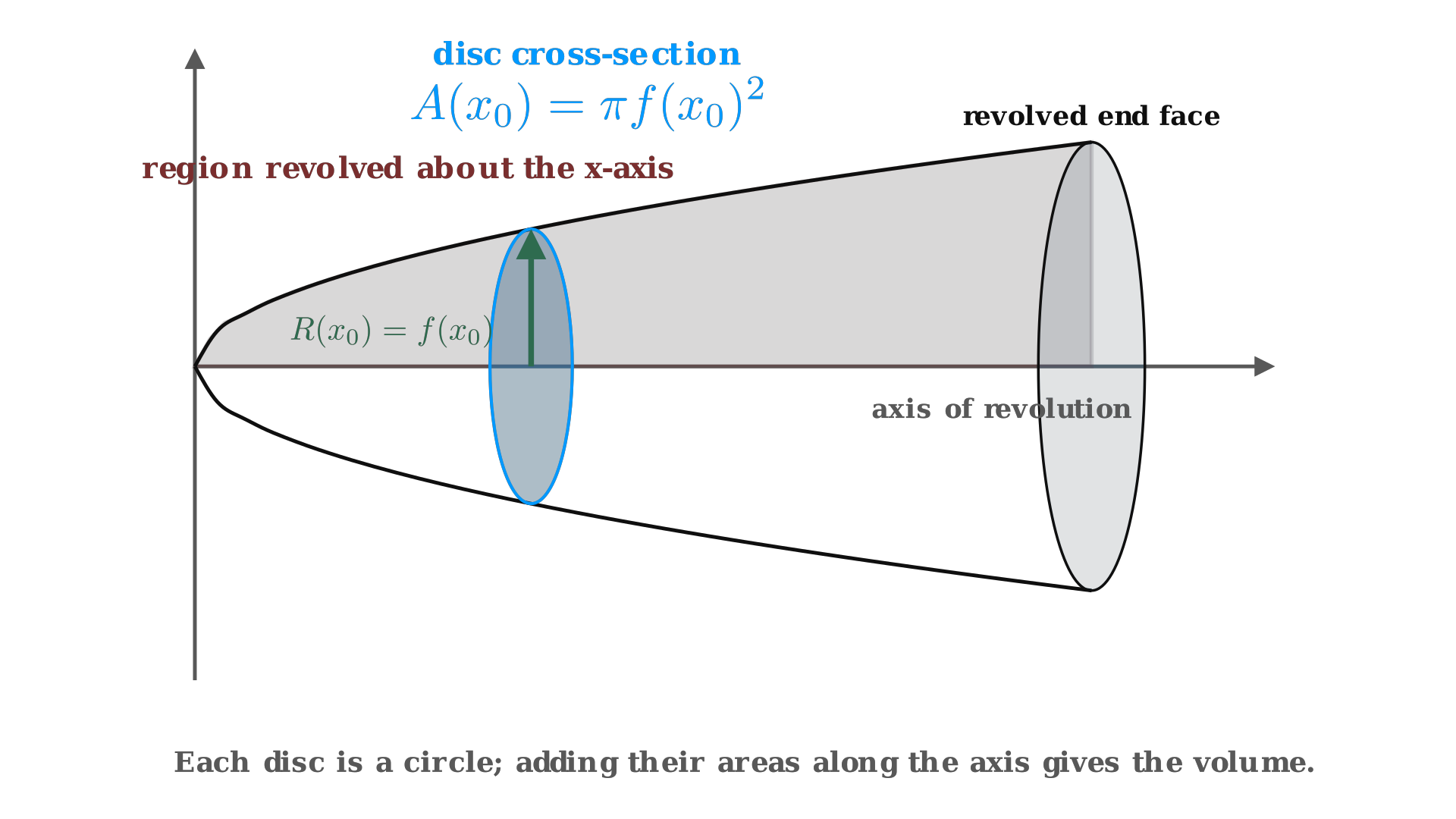
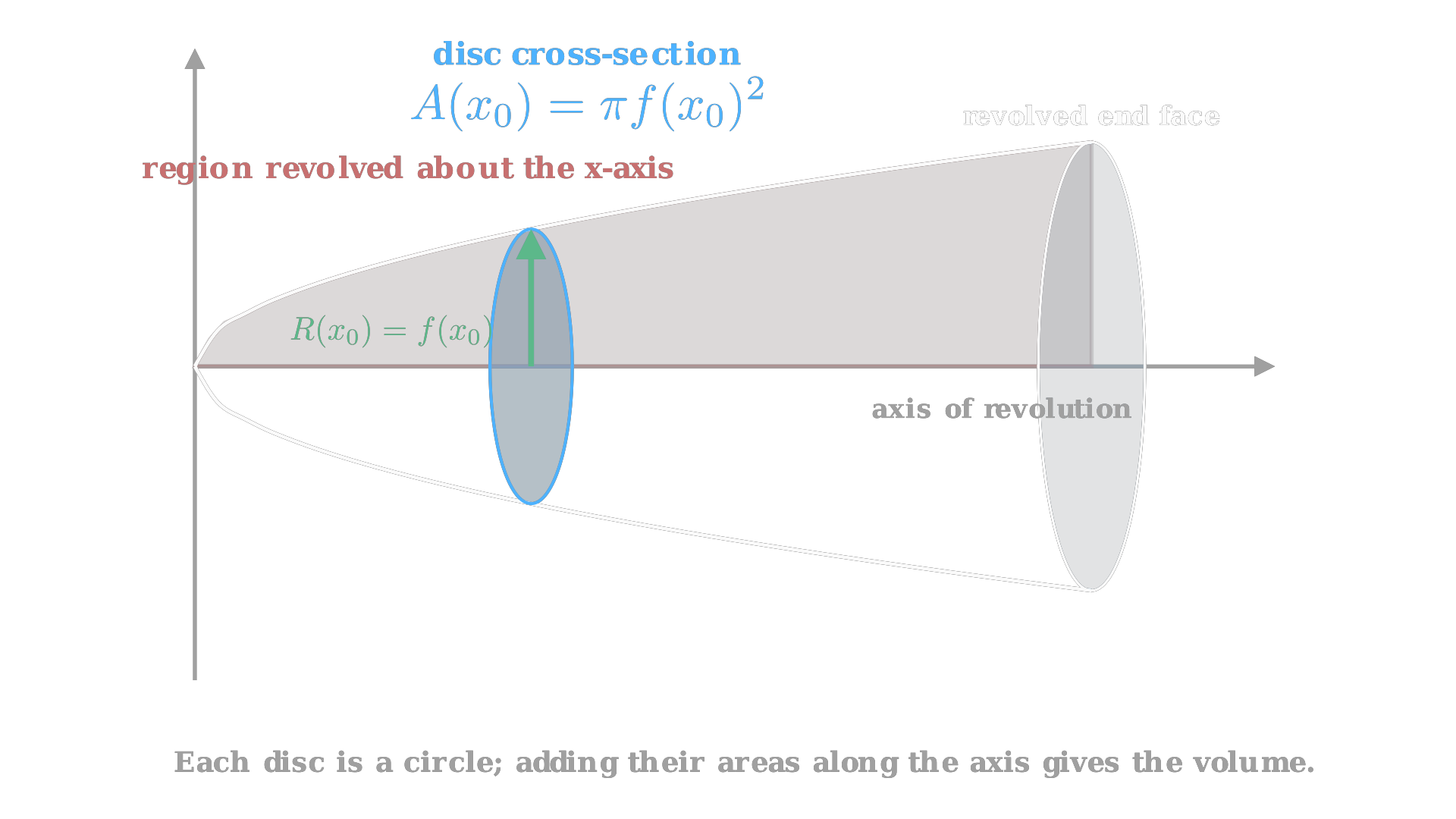
Use the disc method when the region's boundary sits on the axis of revolution: every cross-section is a solid disc with no hole. (See the Roadmap above for the disc-vs-washer decision.)
当区域边界落在旋转轴上时使用圆盘法(disk method):每个横截面都是无孔的实心圆盘。(圆盘 vs. 圆环的判别见上方路线图。)
$R$ is the perpendicular distance from the curve to the axis. About the $x$-axis: $R = f(x)$. About the $y$-axis (slicing in $y$): $R = g(y)$ where $x = g(y)$.
$R$ 是曲线到旋转轴的垂直距离。绕 $x$ 轴旋转(rotating about x-axis):$R = f(x)$。绕 $y$ 轴旋转(沿 $y$ 切片,rotating about y-axis):$R = g(y)$,其中 $x = g(y)$。
Worked Example: Revolve $y = x^2$ on $[0,1]$ about the $x$-axis例题:将 $y = x^2$ 在 $[0,1]$ 上绕 $x$ 轴旋转
- Region touches axis? Yes: the region under $y=x^2$ from $0$ to $1$ has its lower boundary on $y=0$. Disc applies.
- 区域是否与轴相接? 是:$y=x^2$ 在 $0$ 到 $1$ 之间下方的区域,下边界落在 $y=0$ 上。可用圆盘法。
- Slice direction. Axis is horizontal, so slice vertically and integrate $dx$.
- 切片方向。 轴水平,故作垂直切片,对 $dx$ 积分。
- Radius. $R(x) = x^2$ (distance from curve to $x$-axis).
- 半径。 $R(x) = x^2$(曲线到 $x$ 轴的距离)。
- Set up and evaluate. $$V = \pi\!\int_0^1 (x^2)^{\,2}\,dx = \pi\!\int_0^1 x^4\,dx = \pi \cdot \tfrac{1}{5} = \tfrac{\pi}{5}.$$
- 建立并计算。 $$V = \pi\!\int_0^1 (x^2)^{\,2}\,dx = \pi\!\int_0^1 x^4\,dx = \pi \cdot \tfrac{1}{5} = \tfrac{\pi}{5}.$$
Worked Example: Revolve About the $y$-Axis例题:绕 $y$ 轴旋转
The first-quadrant region bounded by $y=x^2$, $y=4$ and the $y$-axis is revolved about the $y$-axis. Find the volume.
由 $y=x^2$、$y=4$ 与 $y$ 轴在第一象限围成的区域绕 $y$ 轴旋转。求体积。
- Method and slices. The region's left edge lies on the $y$-axis, so discs apply. The axis is vertical, so slice horizontally and integrate in $y$ from $0$ to $4$.
- 方法与切片。 区域的左边落在 $y$ 轴上,可用圆盘法。旋转轴竖直,所以作水平切片,对 $y$ 从 $0$ 积到 $4$。
- Radius. Rewrite $y=x^2$ as $x=\sqrt{y}$, so $R(y)=\sqrt{y}$.
- 半径。 把 $y=x^2$ 改写为 $x=\sqrt{y}$,所以 $R(y)=\sqrt{y}$。
- Integrate. $V=\pi\int_0^4(\sqrt{y})^2\,dy=\pi\int_0^4 y\,dy=\pi\cdot8=8\pi$.
- 积分。 $V=\pi\int_0^4(\sqrt{y})^2\,dy=\pi\int_0^4 y\,dy=\pi\cdot8=8\pi$。
Each horizontal slice is a disc of radius $\sqrt{y}$ and thickness $dy$, with volume $\pi(\sqrt{y})^2\,dy$; the integral adds the discs from bottom to top.
每个水平切片是半径 $\sqrt{y}$、厚度 $dy$ 的圆盘,体积为 $\pi(\sqrt{y})^2\,dy$;积分把这些圆盘自下而上累加。
Slices are perpendicular to the axis. About the $y$-axis you need $x$ as a function of $y$ and limits in $y$. Leave a volume in terms of $\pi$ unless a decimal is requested; on a calculator part, keep the unrounded value until the final answer.
切片垂直于旋转轴。绕 $y$ 轴旋转时,需要把 $x$ 写成 $y$ 的函数,并使用 $y$ 的上下限。除非题目要求小数,体积用 $\pi$ 表示;在允许计算器的部分,保留未舍入的数值直到最终答案。
Revolve the region under $y=\sqrt{x}$, $0\le x\le9$, about the $x$-axis. Find the volume.把 $y=\sqrt{x}$($0\le x\le9$)下方的区域绕 $x$ 轴旋转。求体积。
$V=\pi\int_0^9 x\,dx=\frac{81\pi}{2}$.
$V=\pi\int_0^9 x\,dx=\frac{81\pi}{2}$。
Revolve the region under $y=\frac1x$, $1\le x\le3$, about the $x$-axis. Find the volume.把 $y=\frac1x$($1\le x\le3$)下方的区域绕 $x$ 轴旋转。求体积。
$V=\pi\int_1^3 x^{-2}\,dx=\pi\left[-\frac1x\right]_1^3=\pi\left(1-\frac13\right)=\frac{2\pi}{3}$.
$V=\pi\int_1^3 x^{-2}\,dx=\pi\left[-\frac1x\right]_1^3=\pi\left(1-\frac13\right)=\frac{2\pi}{3}$。
Explain why the radius is $f(x)$ when the region under $y=f(x)\ge0$ is revolved about the $x$-axis.解释:把 $y=f(x)\ge0$ 下方的区域绕 $x$ 轴旋转时,为何半径是 $f(x)$。
The radius is the perpendicular distance from the axis $y=0$ to the curve, which is $f(x)-0=f(x)$.
半径是旋转轴 $y=0$ 到曲线的垂直距离,即 $f(x)-0=f(x)$。
Volume with Disc Method: Revolving Around Other Axes
圆盘法求体积:绕其它轴旋转
- Determine the radius as the distance from the curve to the line $y=k$ or $x=k$.
- Decide whether the axis lies above or below the curve and write the radius as larger minus smaller.
- Set up $V=\pi\int_a^b [R(x)]^2\,dx$ for a horizontal axis and $V=\pi\int_c^d [R(y)]^2\,dy$ for a vertical one.
- Calculate the volume exactly and check it with a translation argument when possible.
- 把半径确定为曲线到直线 $y=k$ 或 $x=k$ 的距离。
- 判断旋转轴在曲线上方还是下方,把半径写成“大减小”。
- 水平轴用 $V=\pi\int_a^b [R(x)]^2\,dx$,竖直轴用 $V=\pi\int_c^d [R(y)]^2\,dy$。
- 精确计算体积,并在可能时用平移论证验证。
When the axis is $y=k$ or $x=k$, the formula is the same; only the radius changes. The radius is now the perpendicular distance from the curve to that line, not to the standard axis.
当旋转轴为 $y=k$ 或 $x=k$ 时,公式不变,只是半径变了。半径现在是曲线到该直线的垂直距离,而不是到标准坐标轴的距离。
If the axis lies above the curve, swap to $\,k - f(x)\,$. Either way, $|f(x)-k|$ is the perpendicular distance, and squaring it makes the sign moot.
如果轴在曲线上方,则改写为 $\,k - f(x)\,$。无论如何,$|f(x)-k|$ 才是垂直距离,平方后符号无关紧要。
Worked Example: Translation Invariance例题:平移不变性
Revolve $y = x + 3$ on $[0, 2]$ about the line $y = 3$. The region touches the axis at $x = 0$ (where $y = 3$).
将 $y = x + 3$ 在 $[0, 2]$ 上绕直线 $y = 3$ 旋转。区域在 $x = 0$ 处(此时 $y = 3$)与轴相接。
- Radius. $R(x) = (x + 3) - 3 = x$.
- 半径。 $R(x) = (x + 3) - 3 = x$。
- Volume. $$V = \pi\!\int_0^2 x^2\,dx = \pi\cdot \tfrac{8}{3} = \tfrac{8\pi}{3}.$$
- 体积。 $$V = \pi\!\int_0^2 x^2\,dx = \pi\cdot \tfrac{8}{3} = \tfrac{8\pi}{3}.$$
- Sanity check. The same line $y = x$ on $[0, 2]$ revolved about the $x$-axis gives $\pi\!\int_0^2 x^2\,dx = \tfrac{8\pi}{3}$. Translating the region and the axis together by the same amount does not change the volume, a useful self-check.
- 验证。 同一条直线 $y = x$ 在 $[0, 2]$ 上绕 $x$ 轴旋转得到 $\pi\!\int_0^2 x^2\,dx = \tfrac{8\pi}{3}$。把区域与旋转轴一起平移同样的距离不会改变体积,这是一个有用的自检手段。
Draw one representative disc on your sketch and label the radius on the picture. The picture catches "is the axis above or below the curve" before you write a single integral.
在草图上画一个代表性的圆盘,并在图上标出半径。图像在你写下一个积分之前就能告诉你“轴在曲线上方还是下方”。
Worked Example: Revolve About the Line $y=1$例题:绕直线 $y=1$ 旋转
The region between $y=x^2$ and $y=1$ is revolved about the line $y=1$. Find the volume.
$y=x^2$ 与 $y=1$ 之间的区域绕直线 $y=1$ 旋转。求体积。
- Limits and method. $x^2=1\Rightarrow x=\pm1$. The region's top edge lies on the axis, so discs apply.
- 上下限与方法。 $x^2=1\Rightarrow x=\pm1$。区域的上边落在旋转轴上,可用圆盘法。
- Radius. The axis is above the curve, so $R(x)=1-x^2$.
- 半径。 旋转轴在曲线上方,所以 $R(x)=1-x^2$。
- Integrate. $V=\pi\int_{-1}^{1}(1-x^2)^2\,dx=\pi\int_{-1}^{1}(1-2x^2+x^4)\,dx=\pi\left(2-\frac43+\frac25\right)=\frac{16\pi}{15}$.
- 积分。 $V=\pi\int_{-1}^{1}(1-x^2)^2\,dx=\pi\int_{-1}^{1}(1-2x^2+x^4)\,dx=\pi\left(2-\frac43+\frac25\right)=\frac{16\pi}{15}$。
The radius is a vertical distance from the line $y=1$ to the curve, larger $y$ minus smaller $y$, so it is never negative and each slice is a disc of area $\pi(1-x^2)^2$.
半径是直线 $y=1$ 到曲线的竖直距离,即较大的 $y$ 减较小的 $y$,不会为负;每个切片是面积为 $\pi(1-x^2)^2$ 的圆盘。
Write the radius as (larger coordinate) − (smaller coordinate) between the curve and the axis line, for example $1-x^2$ when $y=1$ lies above $y=x^2$. This form is never negative, so no sign repair is needed, and it shows the axis location in your setup.
把半径写成曲线与旋转轴之间的(较大坐标)−(较小坐标),例如当 $y=1$ 在 $y=x^2$ 上方时写 $1-x^2$。这种写法不会为负,无需事后修正符号,也让旋转轴位置在建立式中一目了然。
The region between $x=y^2$ and $x=4$ is revolved about the line $x=4$. Find the volume.$x=y^2$ 与 $x=4$ 之间的区域绕直线 $x=4$ 旋转。求体积。
Vertical axis, so integrate in $y$; $y^2=4$ gives $-2\le y\le2$. $R(y)=4-y^2$. $V=\pi\int_{-2}^{2}(16-8y^2+y^4)\,dy=\pi\left(64-\frac{128}{3}+\frac{64}{5}\right)=\frac{512\pi}{15}$.
旋转轴竖直,对 $y$ 积分;由 $y^2=4$ 得 $-2\le y\le2$。$R(y)=4-y^2$。$V=\pi\int_{-2}^{2}(16-8y^2+y^4)\,dy=\pi\left(64-\frac{128}{3}+\frac{64}{5}\right)=\frac{512\pi}{15}$。
The region between $y=x^2+1$ and $y=5$ is revolved about $y=5$. Write the radius.$y=x^2+1$ 与 $y=5$ 之间的区域绕 $y=5$ 旋转。写出半径。
$R(x)=5-(x^2+1)=4-x^2$.
$R(x)=5-(x^2+1)=4-x^2$。
The region between $y=2+\sin x$ and $y=2$ on $[0,\pi]$ is revolved about $y=2$. Explain why the volume equals that of the region under $y=\sin x$ on $[0,\pi]$ revolved about the $x$-axis, and find it.$[0,\pi]$ 上 $y=2+\sin x$ 与 $y=2$ 之间的区域绕 $y=2$ 旋转。解释为何其体积等于 $y=\sin x$ 在 $[0,\pi]$ 上下方区域绕 $x$ 轴旋转的体积,并求出它。
The radius is $(2+\sin x)-2=\sin x$, the same radius as for $y=\sin x$ about $y=0$, so the integrals are identical: $\pi\int_0^\pi\sin^2 x\,dx=\frac{\pi^2}{2}$.
半径为 $(2+\sin x)-2=\sin x$,与 $y=\sin x$ 绕 $y=0$ 旋转时的半径相同,所以积分完全一样:$\pi\int_0^\pi\sin^2 x\,dx=\frac{\pi^2}{2}$。
Volume with Washer Method: Revolving Around the x- or y-Axis
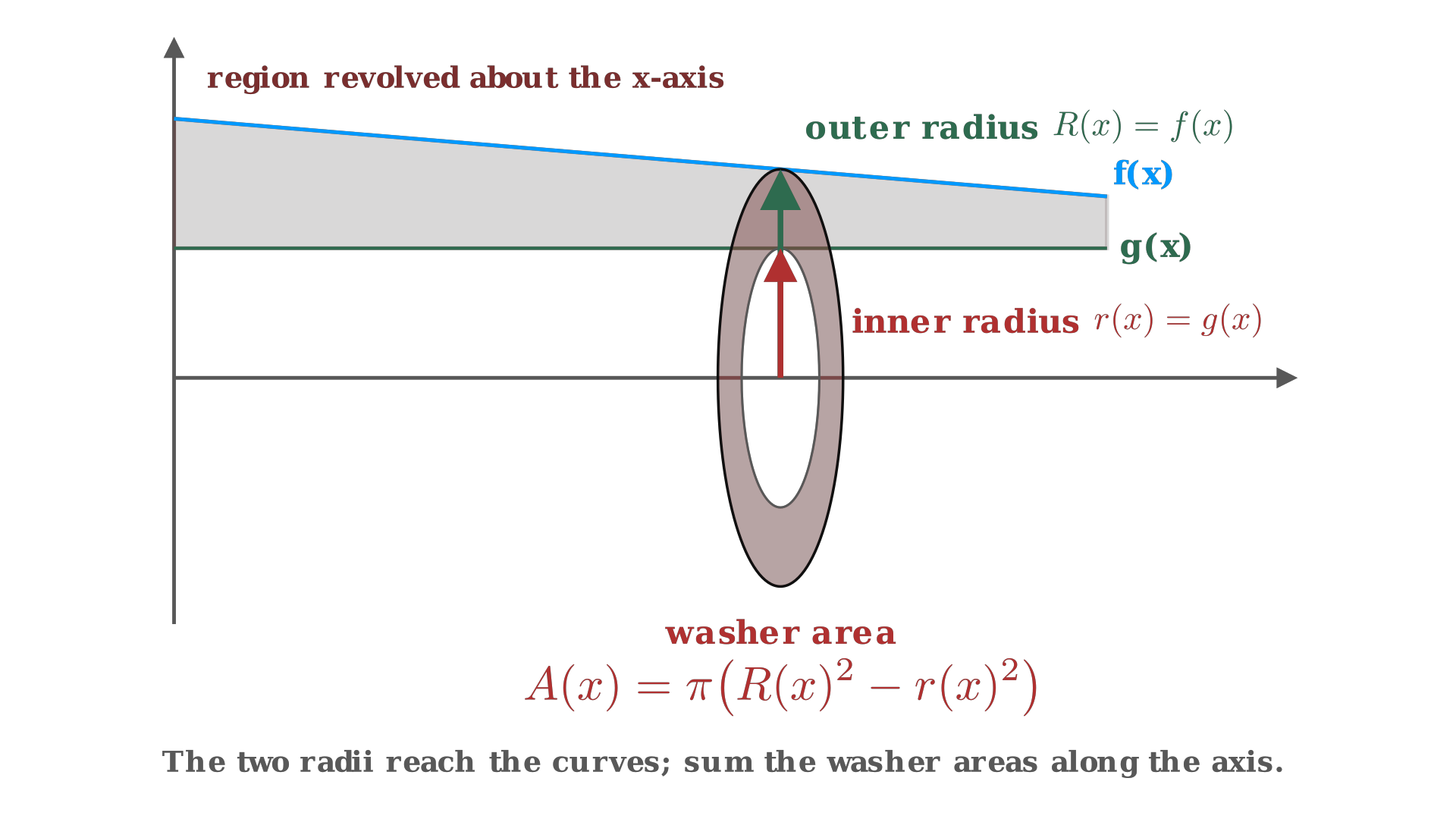
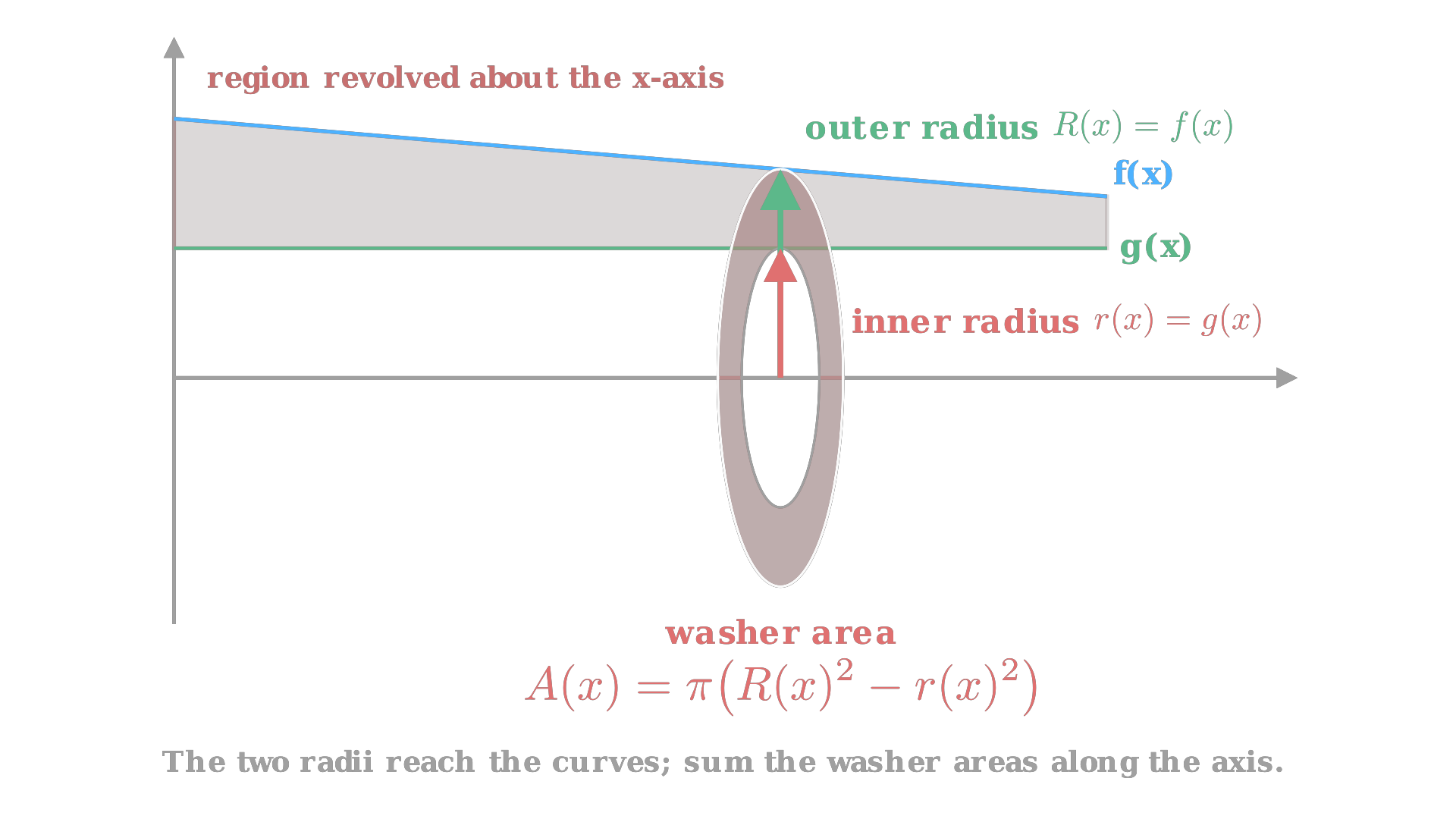
圆环法求体积:绕 x 轴或 y 轴旋转
- Recognize that a gap between the region and the axis produces a washer.
- Identify the outer radius $R$ (farther curve) and the inner radius $r$ (nearer curve).
- Set up $V=\pi\int_a^b (R^2-r^2)\,dx$, never with $(R-r)^2$.
- Apply the washer method about the $y$-axis by integrating in $y$.
- Calculate the volume exactly.
- 认识到区域与旋转轴之间有间隙时会产生圆环。
- 确定外半径 $R$(较远曲线)与内半径 $r$(较近曲线)。
- 建立 $V=\pi\int_a^b (R^2-r^2)\,dx$,绝不用 $(R-r)^2$。
- 绕 $y$ 轴时对 $y$ 积分,应用圆环法。
- 精确计算体积。
The washer method is used when rotating a region that leaves a hole in the middle. Each cross section is an outer disc with an inner disc removed.
当旋转一个会在中间留下孔的区域时使用圆环法(washer method)。每个横截面都是从外圆盘中扣掉一个内圆盘后的环。
Worked Example: Washer About the $x$-Axis例题:绕 $x$ 轴的圆环
Find the volume generated by revolving the region between $y=x$ and $y=x^2$ on $[0,1]$ around the x-axis.
求 $y=x$ 与 $y=x^2$ 在 $[0,1]$ 上之间的区域绕 $x$ 轴旋转所得的体积。
- On [0,1], the outer radius is $R(x)=x$ and the inner radius is $r(x)=x^2$.
- 在 [0,1] 上,外半径为 $R(x)=x$,内半径为 $r(x)=x^2$。
- Set up the washer integral: $$V=\pi\int_0^1 (x^2-x^4)\,dx$$
- 写出圆环积分: $$V=\pi\int_0^1 (x^2-x^4)\,dx$$
- Evaluate: $$V=\pi\left[\frac{x^3}{3}-\frac{x^5}{5}\right]_0^1=\pi\left(\frac13-\frac15\right)=\frac{2\pi}{15}$$
- 计算: $$V=\pi\left[\frac{x^3}{3}-\frac{x^5}{5}\right]_0^1=\pi\left(\frac13-\frac15\right)=\frac{2\pi}{15}$$
Compute R² − r², not (R − r)². Those are different expressions.
计算的是 R² − r²,不是 (R − r)²。两者不是同一个表达式。
Worked Example: Washer About the $y$-Axis例题:绕 $y$ 轴的圆环
The region between $y=2x$ and $y=x^2$ is revolved about the $y$-axis. Find the volume.
$y=2x$ 与 $y=x^2$ 之间的区域绕 $y$ 轴旋转。求体积。
- Intersections. $x^2=2x\Rightarrow x=0,2$, so the region spans $0\le y\le4$.
- 交点。 $x^2=2x\Rightarrow x=0,2$,所以区域覆盖 $0\le y\le4$。
- Rewrite in $y$. The axis is vertical, so integrate in $y$: the line is $x=\frac{y}{2}$ and the parabola is $x=\sqrt{y}$.
- 改写为 $y$ 的函数。 旋转轴竖直,对 $y$ 积分:直线为 $x=\frac{y}{2}$,抛物线为 $x=\sqrt{y}$。
- Outer and inner. At $y=1$: $\sqrt{1}=1>\frac12$, so the parabola is farther from the axis: $R=\sqrt{y}$, $r=\frac{y}{2}$.
- 外与内。 取 $y=1$:$\sqrt{1}=1>\frac12$,所以抛物线离旋转轴更远:$R=\sqrt{y}$,$r=\frac{y}{2}$。
- Integrate. $V=\pi\int_0^4\left(y-\frac{y^2}{4}\right)dy=\pi\left(8-\frac{16}{3}\right)=\frac{8\pi}{3}$.
- 积分。 $V=\pi\int_0^4\left(y-\frac{y^2}{4}\right)dy=\pi\left(8-\frac{16}{3}\right)=\frac{8\pi}{3}$。
The hole comes from the gap between the axis and the nearer curve; subtracting the inner disc $\pi r^2$ from the outer disc $\pi R^2$ leaves the washer's area.
孔来自旋转轴与较近曲线之间的间隙;从外圆盘 $\pi R^2$ 中减去内圆盘 $\pi r^2$,就得到圆环面积。
Write $\pi\int(R^2-r^2)$ with each radius squared on its own, and expand only after both squares are written. A constant radius, such as the distance to a horizontal boundary line, is still squared.
写 $\pi\int(R^2-r^2)$ 时,两个半径分别平方,写好两个平方后再展开。常数半径(如到水平边界线的距离)同样要平方。
Revolve the region between $y=\sqrt{x}$ and $y=x$ on $[0,1]$ about the $x$-axis. Find the volume.把 $[0,1]$ 上 $y=\sqrt{x}$ 与 $y=x$ 之间的区域绕 $x$ 轴旋转。求体积。
On $(0,1)$, $\sqrt{x}>x$, so $R=\sqrt{x}$ and $r=x$. $V=\pi\int_0^1(x-x^2)\,dx=\frac{\pi}{6}$.
在 $(0,1)$ 上 $\sqrt{x}>x$,所以 $R=\sqrt{x}$,$r=x$。$V=\pi\int_0^1(x-x^2)\,dx=\frac{\pi}{6}$。
With $R=5$ and $r=3$, compare $R^2-r^2$ with $(R-r)^2$.取 $R=5$,$r=3$,比较 $R^2-r^2$ 与 $(R-r)^2$。
$R^2-r^2=25-9=16$, but $(R-r)^2=4$. Only $R^2-r^2$ is the washer's area divided by $\pi$.
$R^2-r^2=25-9=16$,而 $(R-r)^2=4$。只有 $R^2-r^2$ 才是圆环面积除以 $\pi$。
Revolve the region between $y=x^2$ and $y=4$ about the $x$-axis. Find the volume.把 $y=x^2$ 与 $y=4$ 之间的区域绕 $x$ 轴旋转。求体积。
Limits $x=\pm2$; $R=4$ and $r=x^2$. $V=\pi\int_{-2}^{2}(16-x^4)\,dx=\pi\left(64-\frac{64}{5}\right)=\frac{256\pi}{5}$.
上下限 $x=\pm2$;$R=4$,$r=x^2$。$V=\pi\int_{-2}^{2}(16-x^4)\,dx=\pi\left(64-\frac{64}{5}\right)=\frac{256\pi}{5}$。
Volume with Washer Method: Revolving Around Other Axes
圆环法求体积:绕其它轴旋转
- Calculate each radius as a distance to the shifted axis $y=k$ or $x=k$.
- Identify which boundary is outer from the axis position, not from the names of the functions.
- Set up $V=\pi\int_a^b (R^2-r^2)\,dx$, or the $dy$ form for a vertical axis, and check $R\ge r$ on the interval.
- Calculate the volume exactly.
- 把每个半径计算为到平移后旋转轴 $y=k$ 或 $x=k$ 的距离。
- 根据旋转轴位置(而不是函数名称)确定哪条边界是外边界。
- 建立 $V=\pi\int_a^b (R^2-r^2)\,dx$(竖直轴用 $dy$ 形式),并检查区间上 $R\ge r$。
- 精确计算体积。
Same structure as Topic 8.11. The only change: $R$ and $r$ are now perpendicular distances to a shifted axis $y=k$ or $x=k$.
结构与 8.11 完全相同。唯一的变化:$R$ 与 $r$ 现在是到平移过的轴 $y=k$ 或 $x=k$ 的垂直距离。
where $R, r$ are distances from the farther and nearer boundary curves to the axis, respectively.
其中 $R$、$r$ 分别为较远和较近的边界曲线到旋转轴的距离。
"Outer" depends on the axis location, not on which boundary you happened to call $f$. With axis above the region, the lower boundary is farther (outer); with axis below the region, the upper boundary is farther. Re-identify on every problem from a fresh sketch.
“外”取决于旋转轴的位置,而不是你恰好把哪条边界叫作 $f$。轴在区域上方时,下边界更远(外);轴在区域下方时,上边界更远。每道题都要根据新草图重新判别。
Worked Example: Region $\{y=x, y=x^2\}$ on $[0,1]$ Revolved About $y = -1$例题:把 $\{y=x, y=x^2\}$ 在 $[0,1]$ 上的区域绕 $y = -1$ 旋转
- Region touches axis? No: the region sits above $y=0$, while the axis is at $y=-1$. Gap of at least 1 unit. Washer.
- 区域是否接轴? 否:区域位于 $y=0$ 上方,而轴在 $y=-1$。至少有 1 个单位的间隙。用圆环法。
- Identify outer and inner. Both boundaries are above the axis. The line $y=x$ is farther from $y=-1$ than the parabola $y=x^2$ is, so $y=x$ is outer.
- 判别外/内。 两条边界都在轴上方。直线 $y=x$ 到 $y=-1$ 的距离比抛物线 $y=x^2$ 大,所以 $y=x$ 是外曲线。
- Radii.
- $R = x - (-1) = x + 1$
- $r = x^2 - (-1) = x^2 + 1$
- 半径。
- $R = x - (-1) = x + 1$
- $r = x^2 - (-1) = x^2 + 1$
- Set up and evaluate. $$\begin{aligned} V &= \pi\!\int_0^1 \!\bigl[(x+1)^2 - (x^2+1)^2\bigr]\,dx \\[4pt] &= \pi\!\int_0^1 \!\bigl[(x^2 + 2x + 1) - (x^4 + 2x^2 + 1)\bigr]\,dx \\[4pt] &= \pi\!\int_0^1 \!\bigl(2x - x^2 - x^4\bigr)\,dx \\[4pt] &= \pi\Bigl[\,x^2 - \tfrac{x^3}{3} - \tfrac{x^5}{5}\,\Bigr]_0^1 \\[4pt] &= \pi\Bigl(1 - \tfrac{1}{3} - \tfrac{1}{5}\Bigr) = \tfrac{7\pi}{15}. \end{aligned}$$
- 建立并计算。 $$\begin{aligned} V &= \pi\!\int_0^1 \!\bigl[(x+1)^2 - (x^2+1)^2\bigr]\,dx \\[4pt] &= \pi\!\int_0^1 \!\bigl[(x^2 + 2x + 1) - (x^4 + 2x^2 + 1)\bigr]\,dx \\[4pt] &= \pi\!\int_0^1 \!\bigl(2x - x^2 - x^4\bigr)\,dx \\[4pt] &= \pi\Bigl[\,x^2 - \tfrac{x^3}{3} - \tfrac{x^5}{5}\,\Bigr]_0^1 \\[4pt] &= \pi\Bigl(1 - \tfrac{1}{3} - \tfrac{1}{5}\Bigr) = \tfrac{7\pi}{15}. \end{aligned}$$
- Compare to Topic 8.11. The same region revolved about the $x$-axis gives $\tfrac{2\pi}{15}$. Shifting the axis from $y=0$ down to $y=-1$ enlarged the volume to $\tfrac{7\pi}{15}$. Each radius grew by 1, but $R^2 - r^2$ changes in a non-trivial way, so always rewrite from scratch.
- 与 8.11 对比。 同一区域绕 $x$ 轴旋转得到 $\tfrac{2\pi}{15}$。把轴从 $y=0$ 向下移到 $y=-1$,体积扩大到 $\tfrac{7\pi}{15}$。每个半径都增加了 1,但 $R^2 - r^2$ 的变化并非线性,所以每次都要从头重新写。
Worked Example: The Roadmap Region About $y=3$例题:路线图区域绕 $y=3$ 旋转
Evaluate the middle row of the roadmap table: the region bounded by $y=\sqrt{x}$, $y=0$ and $x=4$ revolved about $y=3$.
计算路线图表格的中间一行:由 $y=\sqrt{x}$、$y=0$、$x=4$ 围成的区域绕 $y=3$ 旋转。
- Radii. The axis is above the region (whose top is $y=2$). The farther boundary is $y=0$, so $R=3-0=3$; the nearer is the curve, so $r=3-\sqrt{x}$.
- 半径。 旋转轴在区域上方(区域最高为 $y=2$)。较远边界是 $y=0$,所以 $R=3-0=3$;较近的是曲线,所以 $r=3-\sqrt{x}$。
- Simplify. $R^2-r^2=9-(9-6\sqrt{x}+x)=6\sqrt{x}-x$.
- 化简。 $R^2-r^2=9-(9-6\sqrt{x}+x)=6\sqrt{x}-x$。
- Integrate. $V=\pi\int_0^4(6\sqrt{x}-x)\,dx=\pi\left[4x^{3/2}-\frac{x^2}{2}\right]_0^4=\pi(32-8)=24\pi$.
- 积分。 $V=\pi\int_0^4(6\sqrt{x}-x)\,dx=\pi\left[4x^{3/2}-\frac{x^2}{2}\right]_0^4=\pi(32-8)=24\pi$。
Both radii are measured from the line $y=3$, so the farther boundary is the $x$-axis even though it is the lower curve; the washer is the disc of radius $3$ minus the hole of radius $3-\sqrt{x}$.
两个半径都从直线 $y=3$ 量起,所以虽然 $x$ 轴是下边界,它却是较远的边界;圆环就是半径 $3$ 的圆盘减去半径 $3-\sqrt{x}$ 的孔。
Draw the axis as a dashed line and measure every radius from it: axis above, radius $=k-y$; axis below, radius $=y-k$. Before integrating, check that $R\ge r$ at one interior point; if not, the outer and inner curves are swapped.
把旋转轴画成虚线,所有半径都从它量起:轴在上方时半径 $=k-y$;轴在下方时半径 $=y-k$。积分前在一个内部点检查 $R\ge r$;若不成立,说明外、内曲线弄反了。
Evaluate the roadmap's last row: the same region revolved about $y=-1$.计算路线图的最后一行:同一区域绕 $y=-1$ 旋转。
$R=\sqrt{x}+1$ and $r=1$, so $R^2-r^2=x+2\sqrt{x}$. $V=\pi\int_0^4(x+2\sqrt{x})\,dx=\pi\left(8+\frac{32}{3}\right)=\frac{56\pi}{3}$.
$R=\sqrt{x}+1$,$r=1$,所以 $R^2-r^2=x+2\sqrt{x}$。$V=\pi\int_0^4(x+2\sqrt{x})\,dx=\pi\left(8+\frac{32}{3}\right)=\frac{56\pi}{3}$。
The region between $y=x$ and $y=x^2$ on $[0,1]$ is revolved about $y=1$. Which curve is outer? Find the volume.$[0,1]$ 上 $y=x$ 与 $y=x^2$ 之间的区域绕 $y=1$ 旋转。哪条曲线是外曲线?求体积。
The axis is above the region, so the lower curve $y=x^2$ is farther: $R=1-x^2$, $r=1-x$. $V=\pi\int_0^1\left[(1-x^2)^2-(1-x)^2\right]dx=\pi\int_0^1(2x-3x^2+x^4)\,dx=\pi\left(1-1+\frac15\right)=\frac{\pi}{5}$.
旋转轴在区域上方,所以下曲线 $y=x^2$ 更远:$R=1-x^2$,$r=1-x$。$V=\pi\int_0^1\left[(1-x^2)^2-(1-x)^2\right]dx=\pi\int_0^1(2x-3x^2+x^4)\,dx=\pi\left(1-1+\frac15\right)=\frac{\pi}{5}$。
For revolution about $x=-2$, write the radius to a curve $x=g(y)$ with $g(y)\ge-2$.绕 $x=-2$ 旋转时,写出到曲线 $x=g(y)$($g(y)\ge-2$)的半径。
$g(y)-(-2)=g(y)+2$.
$g(y)-(-2)=g(y)+2$。
The Arc Length of a Smooth, Planar Curve and Distance Traveled (BC)
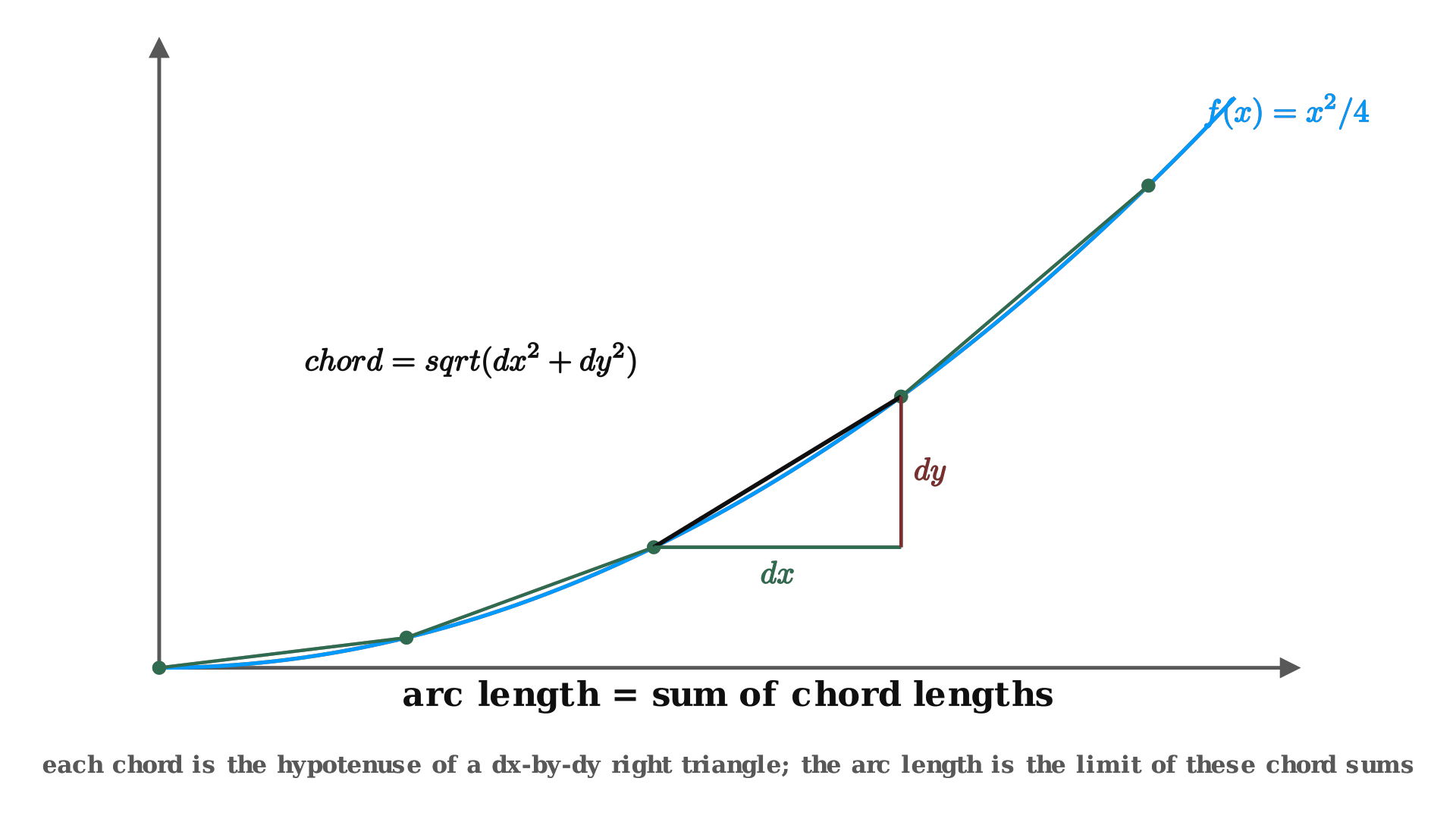
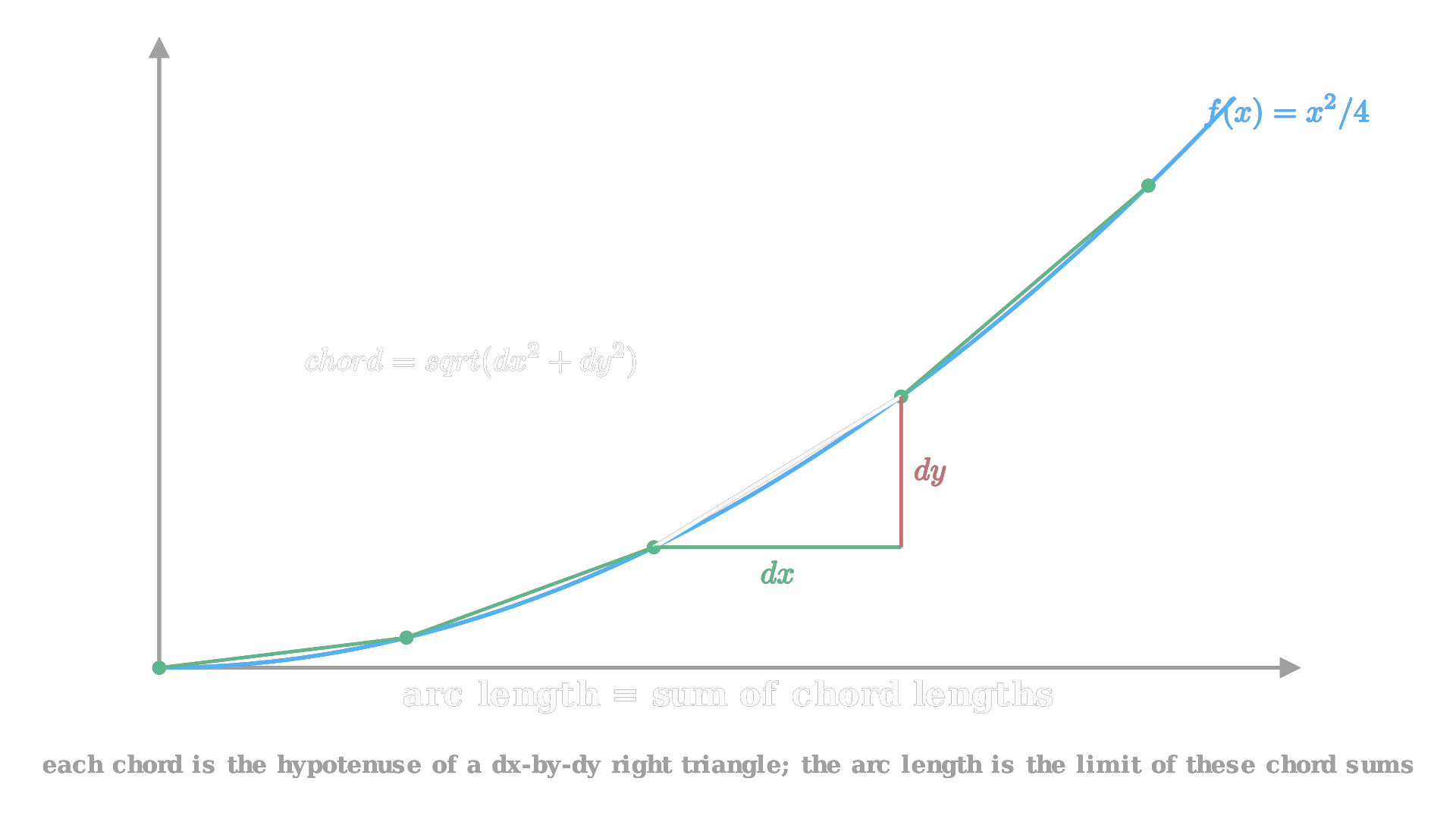
光滑平面曲线的弧长与路程(BC)
- State the arc length formula $L=\int_a^b\sqrt{1+[f'(x)]^2}\,dx$ for a smooth curve $y=f(x)$.
- Explain the formula as the limit of sums of chord lengths.
- Calculate an exact arc length when $1+[f'(x)]^2$ simplifies, and a numerical one with a calculator otherwise.
- Calculate the distance traveled along a parametric path with $\int_{t_1}^{t_2}\sqrt{[x'(t)]^2+[y'(t)]^2}\,dt$.
- 写出光滑曲线 $y=f(x)$ 的弧长公式 $L=\int_a^b\sqrt{1+[f'(x)]^2}\,dx$。
- 把该公式解释为弦长之和的极限。
- 当 $1+[f'(x)]^2$ 可化简时精确计算弧长,否则用计算器求数值。
- 用 $\int_{t_1}^{t_2}\sqrt{[x'(t)]^2+[y'(t)]^2}\,dt$ 计算沿参数路径的路程。
Arc length measures the accumulated length of tiny tangent-like segments along a curve.
弧长(arc length)衡量沿曲线累积起来的、近似切向的小段长度之和。
For parametric motion in the plane, the total distance traveled is:
对于平面参数运动,总路程为:
Derivation Sketch: From Polygonal Approximation to the Integral推导提纲:从折线近似到积分
The idea: approximate a smooth curve by a chain of straight segments, sum their lengths, then refine.
思路:用一串直线段去逼近光滑曲线,把它们的长度加起来,再不断加密。
- Partition. Split $[a,b]$ into $n$ equal subintervals of width $\Delta x$, with sample points $x_0,x_1,\ldots,x_n$. The curve passes through $\bigl(x_i,\,f(x_i)\bigr)$.
- 分划。 把 $[a,b]$ 等分成 $n$ 个宽度为 $\Delta x$ 的子区间,分点为 $x_0,x_1,\ldots,x_n$。曲线经过 $\bigl(x_i,\,f(x_i)\bigr)$。
- Approximate each piece by a line segment. The straight segment from $\bigl(x_{i-1},f(x_{i-1})\bigr)$ to $\bigl(x_i,f(x_i)\bigr)$ has length, by the distance formula, $$ \Delta L_i \;=\; \sqrt{(\Delta x)^2 + (\Delta y_i)^2}, \quad \text{where } \Delta y_i = f(x_i)-f(x_{i-1}). $$
- 用线段近似每一小段。 由距离公式,从 $\bigl(x_{i-1},f(x_{i-1})\bigr)$ 到 $\bigl(x_i,f(x_i)\bigr)$ 的线段长度为 $$ \Delta L_i \;=\; \sqrt{(\Delta x)^2 + (\Delta y_i)^2}, \quad \Delta y_i = f(x_i)-f(x_{i-1}). $$
- Factor out $\Delta x$. $$ \Delta L_i \;=\; \sqrt{1 + \!\left(\dfrac{\Delta y_i}{\Delta x}\right)^{\!2}}\;\Delta x. $$
- 提出 $\Delta x$。 $$ \Delta L_i \;=\; \sqrt{1 + \!\left(\dfrac{\Delta y_i}{\Delta x}\right)^{\!2}}\;\Delta x. $$
- Mean Value Theorem. Since $f$ is differentiable, MVT guarantees a point $x_i^{*}\in(x_{i-1},x_i)$ with $\dfrac{\Delta y_i}{\Delta x}=f'(x_i^{*})$. Substitute: $$ \Delta L_i \;=\; \sqrt{1 + [f'(x_i^{*})]^2}\;\Delta x. $$
- 中值定理(MVT)。 因为 $f$ 可微,MVT 保证存在一点 $x_i^{*}\in(x_{i-1},x_i)$,使 $\dfrac{\Delta y_i}{\Delta x}=f'(x_i^{*})$。代入: $$ \Delta L_i \;=\; \sqrt{1 + [f'(x_i^{*})]^2}\;\Delta x. $$
- Sum and take the limit. The total polygonal length is $\displaystyle\sum_{i=1}^{n}\sqrt{1+[f'(x_i^{*})]^2}\,\Delta x$, a Riemann sum. As $n\to\infty$ (so $\Delta x\to 0$), $$ L \;=\; \lim_{n\to\infty}\sum_{i=1}^{n}\sqrt{1+[f'(x_i^{*})]^2}\,\Delta x \;=\; \int_a^b \sqrt{1+[f'(x)]^2}\,dx. $$
- 求和并取极限。 折线总长度为 $\displaystyle\sum_{i=1}^{n}\sqrt{1+[f'(x_i^{*})]^2}\,\Delta x$,这是一个黎曼和(
Riemann sum)。当 $n\to\infty$($\Delta x\to 0$)时, $$ L \;=\; \lim_{n\to\infty}\sum_{i=1}^{n}\sqrt{1+[f'(x_i^{*})]^2}\,\Delta x \;=\; \int_a^b \sqrt{1+[f'(x)]^2}\,dx. $$
Geometrically: if you walk a horizontal step of length $1$ along a curve, you also rise by $\tfrac{dy}{dx}$ vertically, so the actual arc distance is the hypotenuse $\sqrt{1+(dy/dx)^2}$. The integral just accumulates this "speed-along-the-curve" over $[a,b]$.
几何上:沿曲线水平方向走 $1$ 单位,竖直方向同时上升 $\tfrac{dy}{dx}$ 单位,因此真正的弧线距离是斜边 $\sqrt{1+(dy/dx)^2}$。积分就是把这个“沿曲线的速度”在 $[a,b]$ 上累加。
Repeat the derivation with the segment from $\bigl(x(t_{i-1}),y(t_{i-1})\bigr)$ to $\bigl(x(t_i),y(t_i)\bigr)$. Its length is $\sqrt{(\Delta x)^2+(\Delta y)^2}=\sqrt{(\Delta x/\Delta t)^2+(\Delta y/\Delta t)^2}\,\Delta t$. MVT on each component yields the parametric arc-length integral.
把推导应用到从 $\bigl(x(t_{i-1}),y(t_{i-1})\bigr)$ 到 $\bigl(x(t_i),y(t_i)\bigr)$ 的线段上。其长度为 $\sqrt{(\Delta x)^2+(\Delta y)^2}=\sqrt{(\Delta x/\Delta t)^2+(\Delta y/\Delta t)^2}\,\Delta t$。对每个分量分别用 MVT,就得到参数形式的弧长积分。
The formula uses $[f'(x)]^2$, not $|f'(x)|$ or $f'(x)$. Because of the square, the sign of $f'$ doesn't matter, but you must square before integrating, never after. A common student error is writing $\int f'(x)\sqrt{\cdots}\,dx$.
公式使用的是 $[f'(x)]^2$,不是 $|f'(x)|$,也不是 $f'(x)$。由于平方,$f'$ 的符号无所谓,但必须在积分前就平方,绝不能积分后再平方。常见学生错误是写成 $\int f'(x)\sqrt{\cdots}\,dx$。
Worked Example: Arc Length of $y=\frac23x^{3/2}$ on $[0,3]$例题:$y=\frac23x^{3/2}$ 在 $[0,3]$ 上的弧长
Find the length of the curve $y=\frac23x^{3/2}$ from $x=0$ to $x=3$.
求曲线 $y=\frac23x^{3/2}$ 从 $x=0$ 到 $x=3$ 的长度。
- Derivative. $f'(x)=x^{1/2}$, so $1+[f'(x)]^2=1+x$.
- 求导。 $f'(x)=x^{1/2}$,所以 $1+[f'(x)]^2=1+x$。
- Integrate. $L=\int_0^3\sqrt{1+x}\,dx=\left[\frac23(1+x)^{3/2}\right]_0^3=\frac23(8-1)=\frac{14}{3}\approx4.67$.
- 积分。 $L=\int_0^3\sqrt{1+x}\,dx=\left[\frac23(1+x)^{3/2}\right]_0^3=\frac23(8-1)=\frac{14}{3}\approx4.67$。
- Sanity check. The chord from $(0,0)$ to $(3,2\sqrt3)$ has length $\sqrt{9+12}=\sqrt{21}\approx4.58$, slightly less than $L$, as it must be.
- 合理性检查。 从 $(0,0)$ 到 $(3,2\sqrt3)$ 的弦长为 $\sqrt{9+12}=\sqrt{21}\approx4.58$,略小于 $L$,符合预期。
Squaring $f'$ removes the square root inside $f'$, so $\sqrt{1+x}$ has an elementary antiderivative. A straight chord is the shortest path, so it must be shorter than the curve.
把 $f'$ 平方消去了 $f'$ 中的根号,所以 $\sqrt{1+x}$ 有初等原函数。直线弦是最短路径,所以必然比曲线短。
Worked Example: Distance Along a Parametric Path例题:沿参数路径的路程
A particle moves with $x(t)=t^2$ and $y(t)=\frac23t^3$ for $0\le t\le1$. Find the distance it travels.
质点按 $x(t)=t^2$、$y(t)=\frac23t^3$ 运动,$0\le t\le1$。求它走过的路程。
- Speed. $x'(t)=2t$ and $y'(t)=2t^2$, so the speed is $\sqrt{4t^2+4t^4}=2t\sqrt{1+t^2}$ for $t\ge0$.
- 速率。 $x'(t)=2t$,$y'(t)=2t^2$,所以当 $t\ge0$ 时速率为 $\sqrt{4t^2+4t^4}=2t\sqrt{1+t^2}$。
- Substitute. In $\int_0^1 2t\sqrt{1+t^2}\,dt$ let $u=1+t^2$, $du=2t\,dt$: $\int_1^2\sqrt{u}\,du=\frac23\left(2^{3/2}-1\right)$.
- 换元。 在 $\int_0^1 2t\sqrt{1+t^2}\,dt$ 中令 $u=1+t^2$,$du=2t\,dt$:$\int_1^2\sqrt{u}\,du=\frac23\left(2^{3/2}-1\right)$。
- Value. $\frac23(2\sqrt2-1)\approx1.219$.
- 数值。 $\frac23(2\sqrt2-1)\approx1.219$。
Speed is the rate at which arc length accumulates, so integrating speed over the time interval gives the distance traveled; the limits are $t$-values.
速率是弧长累积的速率,所以在时间区间上对速率积分就得到路程;上下限是 $t$ 值。
Write the complete integral, square root and limits included, before using a calculator. For a parametric path the limits are $t$-values, not $x$-values. Many arc length integrals have no elementary antiderivative; then a numerical value from the calculator is the answer.
使用计算器之前,先写出完整积分,包括根号与上下限。参数路径的上下限是 $t$ 值,不是 $x$ 值。许多弧长积分没有初等原函数,这时计算器给出的数值就是答案。
Find the length of $y=2x+1$ on $[0,3]$ two ways.用两种方法求 $y=2x+1$ 在 $[0,3]$ 上的长度。
With $f'=2$: $L=\int_0^3\sqrt5\,dx=3\sqrt5$. Distance formula from $(0,1)$ to $(3,7)$: $\sqrt{9+36}=\sqrt{45}=3\sqrt5$.
由 $f'=2$:$L=\int_0^3\sqrt5\,dx=3\sqrt5$。用距离公式,从 $(0,1)$ 到 $(3,7)$:$\sqrt{9+36}=\sqrt{45}=3\sqrt5$。
Set up the arc length of $y=x^2$ on $[0,1]$ and evaluate it with a calculator.写出 $y=x^2$ 在 $[0,1]$ 上的弧长积分,并用计算器求值。
$L=\int_0^1\sqrt{1+4x^2}\,dx\approx1.479$.
$L=\int_0^1\sqrt{1+4x^2}\,dx\approx1.479$。
Explain why the arc length of $y=f(x)$ on $[a,b]$ is always at least $b-a$.解释为何 $y=f(x)$ 在 $[a,b]$ 上的弧长总不小于 $b-a$。
$\sqrt{1+[f'(x)]^2}\ge1$ for every $x$, so $L\ge\int_a^b 1\,dx=b-a$, with equality only for a horizontal line.
对每个 $x$ 都有 $\sqrt{1+[f'(x)]^2}\ge1$,所以 $L\ge\int_a^b 1\,dx=b-a$,只有水平线时取等号。
Exam Strategy
考试策略
Identify the quantity
Area, volume, net change, average value, and arc length all use different integrands even though they share the same accumulation idea.
先识别所求量
面积、体积、净变化、平均值与弧长虽然都源自同一“累积”思想,但被积式各不相同。
Match slice direction
Vertical slices lead to dx. Horizontal slices lead to dy. For disc and washer problems, slices must be perpendicular to the axis of revolution.
切片方向要对
垂直切片对 dx 积分。水平切片对 dy 积分。圆盘和圆环问题中,切片必须垂直于旋转轴。
State the setup first
Write the integral with its limits and integrand before evaluating. A complete setup shows your reasoning and makes an arithmetic slip easy to find.
先写出建立式
先写出完整积分(含上下限与被积式)再计算。完整的建立式能展示推理过程,也便于发现计算失误。
Common Mistakes
常见错误
One uses an integral divided by interval length. The other divides the difference of the endpoint outputs by the difference of the endpoint inputs.
一个是积分除以区间长度,另一个是端点输出之差除以端点输入之差。
$\int v(t)\,dt$ is displacement. For total distance, use $\int |v(t)|\,dt$.
$\int v(t)\,dt$ 是位移。求总路程要用 $\int |v(t)|\,dt$。
Radius is distance to the axis, not automatically the function itself.
半径是到旋转轴的距离,并不一定就是函数本身。
When graphs cross, one “top minus bottom” rule will not work over the full interval.
两图象相交时,单一的“上减下”规则不能贯穿整个区间。
Washer method is $R^2-r^2$, not $(R-r)^2$.
圆环法是 $R^2-r^2$,不是 $(R-r)^2$。
Flashcards
闪卡
Click a card to reveal the answer.
点击卡片查看答案。
Unit Quiz
单元小测
Select an answer for each question.
为每题选择一个答案。
Readiness Checklist
备考清单
Click each item you've mastered. Aim for 100% before exam day.
点击你已经掌握的每一项。考前争取 100%。
- Compute the average value of a function on a closed interval在闭区间上计算函数的平均值
- Relate position, velocity, and acceleration via integration通过积分把位置、速度、加速度联系起来
- Distinguish displacement from total distance traveled区分位移与总路程
- Set up accumulation / net-change integrals from a rate function由变化率函数建立累积 / 净变化积分
- Find area between curves integrating with respect to $x$对 $x$ 积分求两曲线之间的面积
- Find area between curves integrating with respect to $y$对 $y$ 积分求两曲线之间的面积
- Split the integral when curves cross or intersect multiple times在曲线相交或多次相交时拆分积分区间
- Compute volume by known cross sections (squares, triangles, semicircles)用已知横截面(正方形、三角形、半圆)计算体积
- Apply the Disc Method about the $x$- or $y$-axis用圆盘法绕 $x$ 或 $y$ 轴旋转
- Apply the Disc Method about a horizontal or vertical line用圆盘法绕水平或竖直直线旋转
- Apply the Washer Method for volumes of revolution用圆环法求旋转体体积
- Choose outer/inner radii correctly for non-axis axes of rotation在非标准旋转轴情形下正确选择外/内半径
- Compute arc length with $\int \sqrt{1 + (f'(x))^2}\,dx$ (BC)用 $\int \sqrt{1 + (f'(x))^2}\,dx$ 计算弧长(BC)
- Sketch the region and axis of rotation before setting up the integral写积分前先画出区域和旋转轴
- Select the appropriate method (disc, washer, cross-section) per problem针对每道题选择合适方法(圆盘、圆环、横截面)
- Use proper notation and units in contextual applications在情境应用题中使用正确的记号与单位
AP-Style Practice Problems
AP 风格练习题
Exam-level practice for this unit: multiple-choice plus extended-response items in the AP style. Go here after you've worked through the notes and the in-page quizzes above.
本单元考试级别的练习:AP 风格的选择题与扩展回答题。请在完成上方讲解与页内小测后再到此练习。